Writing Complex Redox Equations (VCE SSCE Chemistry): Revision Notes
📚Revision Notes
Writing Complex Redox Equations
Introduction to complex redox equations
Not all redox reactions involve simple ions and their elements. Many interesting reactions, such as the iodine clock reaction, involve reactants and products that contain oxygen and hydrogen in their formulas. These are called complex redox equations, and they require a systematic approach to balance properly.
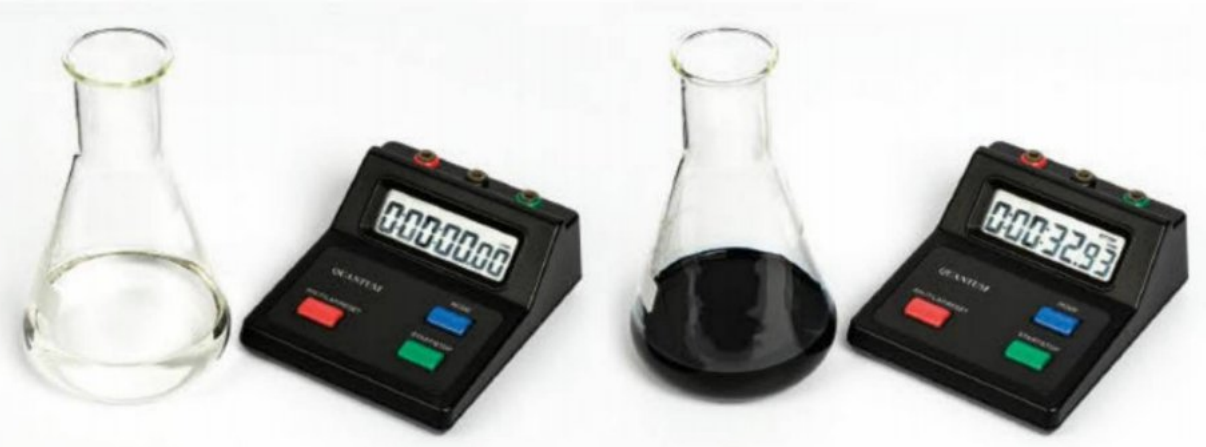
The key challenge with complex redox equations is balancing the oxygen and hydrogen atoms while also ensuring the charges are equal on both sides. Fortunately, there are straightforward methods for handling these equations in both acidic and basic solutions.
Important
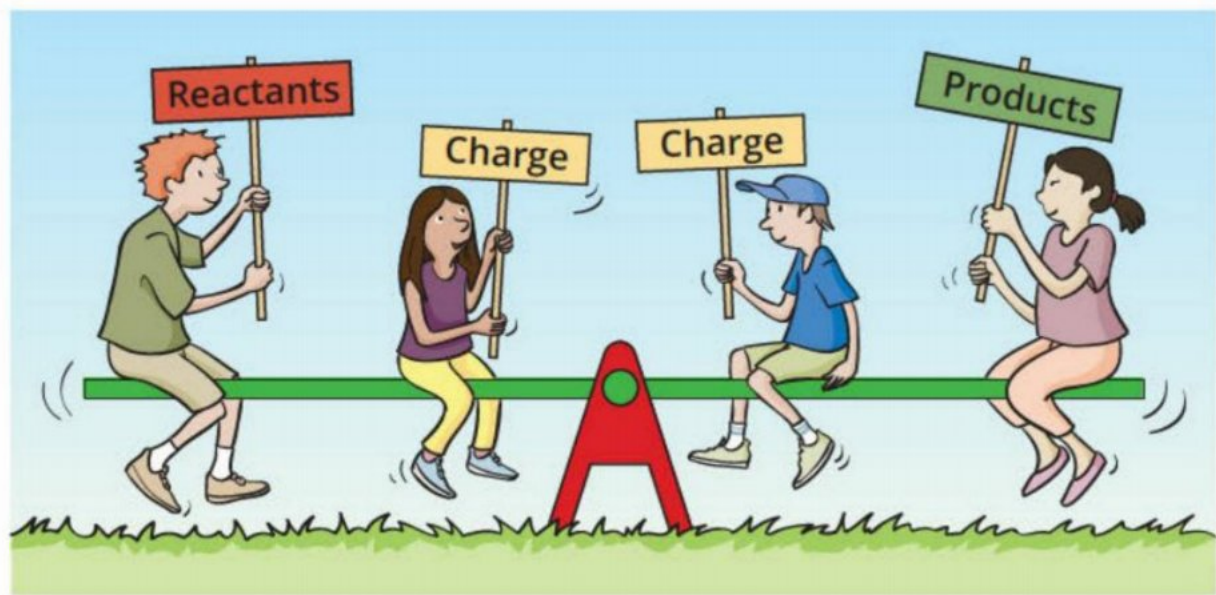
When balancing any half-equation or overall equation, remember two essential rules:
- The number of atoms of each element must be equal on both sides
- The total charge must be equal on both sides (but doesn't have to be zero)
Balancing half-equations in acidic solutions
Acidic solutions contain ions provided by acids. These ions can be used to help balance half-equations. Let's look at the systematic approach.
The five-step method
Follow these steps in order when balancing half-equations in acidic conditions:
Step 1: Balance all elements except hydrogen and oxygen
Start by making sure elements other than H and O have equal numbers on both sides of the equation.
Step 2: Balance oxygen atoms by adding water molecules
Add to whichever side needs more oxygen atoms.
Step 3: Balance hydrogen atoms by adding H⁺ ions
Since you're working in acidic conditions, ions are available. Add them to balance the hydrogen.
Step 4: Balance the charge by adding electrons
Calculate the total charge on each side and add electrons () to make them equal.
Step 5: Add state symbols
Complete the equation by adding appropriate state symbols: (aq), (s), (l), or (g).
Example
Worked Example: Reducing Dichromate Ions
Let's see how this works for the reduction of dichromate ions () to chromium(III) ions () in an acidic solution.
Starting equation:
Step 1: Balance chromium atoms. There are 2 Cr atoms on the left, so we need 2 on the right:
Step 2: Balance oxygen. There are 7 oxygen atoms on the left, so add 7 water molecules to the right:
Step 3: Balance hydrogen. There are now 14 H atoms on the right, so add 14 ions to the left:
Step 4: Balance charge. The left side has a total charge of . The right side has . Add 6 electrons to the left to make both sides :
Step 5: Add state symbols:
This half-equation shows the reduction process (electrons are gained). Notice that the final charge on each side is , which is perfectly acceptable - charges don't have to be zero, just equal.
Note
Key Points for Acidic Solutions:
- Always follow the steps in the correct sequence for the method to work properly
- When you add a coefficient in front of a charged species, it multiplies both the atoms and the charge
- The ions come from the acidic solution
Overall redox equations under acidic conditions
To write a complete redox equation, you need to combine the oxidation half-equation with the reduction half-equation. The electrons released during oxidation must equal the electrons used in reduction.
Steps for combining half-equations
- Write balanced half-equations for both oxidation and reduction
- Multiply one or both equations to make the number of electrons equal
- Add the equations together
- Cancel out electrons (they should completely disappear)
- Cancel out any ions and molecules that appear on both sides
Example
Worked Example: Permanganate and Iodine Reaction
Let's combine half-equations for the reaction between permanganate ions () and iodine () to form and iodate ions ().
Reduction half-equation (given):
Oxidation half-equation (given):
Making electrons equal:
The lowest common multiple of 5 and 10 is 10. Multiply the reduction equation by 2:
Adding the equations:
When we add them, the 10 electrons cancel out. We also need to cancel and appearing on both sides:
- : 16 on left, 12 on right → leaves 4 on left
- : 8 on right, 6 on left → leaves 2 on right
Final overall equation:
Balancing half-equations in basic conditions
Basic or alkaline solutions contain hydroxide ions () rather than ions. There are two different methods for balancing equations in basic conditions, depending on the situation.
Method 1: When OH⁻ appears in a reactant or product
If hydroxide ions are already present in the formula of a reactant or product, you can add them directly to balance the equation.
Note
When to Use Method 1:
Use this method when already appears in the chemical formulas of your reactants or products (such as in iron(II) hydroxide or iron(III) hydroxide).
Steps:
- Balance all elements except hydrogen and oxygen
- Balance hydroxide ions by adding
- Balance the charge by adding electrons
- Add state symbols
Example
Worked Example: Oxidising Iron(II) Hydroxide
Write the half-equation for oxidation of iron(II) hydroxide to iron(III) hydroxide in a basic solution.
Starting equation:
Step 1: Iron is already balanced (1 Fe on each side).
Step 2: Balance hydroxide ions. There are 2 OH groups on the left and 3 on the right, so add 1 to the left:
Step 3: Balance charge. Left side: , Right side: . Add 1 electron to the right:
Step 4: Add state symbols:
Method 2: When OH⁻ is not present in reactants or products
When hydroxide ions don't appear in the chemical formulas, start by balancing as if it's an acidic solution, then neutralise the H⁺ ions with OH⁻.
Note
When to Use Method 2:
Use this method when does not appear in any of your reactant or product formulas. You'll temporarily use for balancing, then neutralise it.
Steps:
- Balance oxygen atoms by adding
- Balance hydrogen atoms by adding
- Balance charge by adding electrons
- Add enough to both sides to neutralise all ions
- Cancel water molecules (H⁺ + OH⁻ → H₂O)
- Add state symbols
Example
Worked Example: Reducing Hydrogen Peroxide
Write the half-equation for reduction of hydrogen peroxide () to hydroxide ions () in a basic solution.
Starting equation:
Steps 1-2: Balance O and then H as if acidic:
Step 3: Balance charge. Add 2 electrons to the left:
Step 4: Add to neutralise . Add 1 to each side:
Step 5: Neutralisation creates water. Cancel the water on the right:
Step 6: Add state symbols:
Overall redox equations under basic conditions
The process for combining half-equations in basic conditions is the same as for acidic conditions: multiply to equalise electrons, add the equations together, and cancel species appearing on both sides.
Important
When cancelling in basic conditions, remember to remove:
- All electrons
- Any appearing on both sides
- Any appearing on both sides
The final equation should only show and on one side each.
Real-world application: Detecting alcohol with redox chemistry
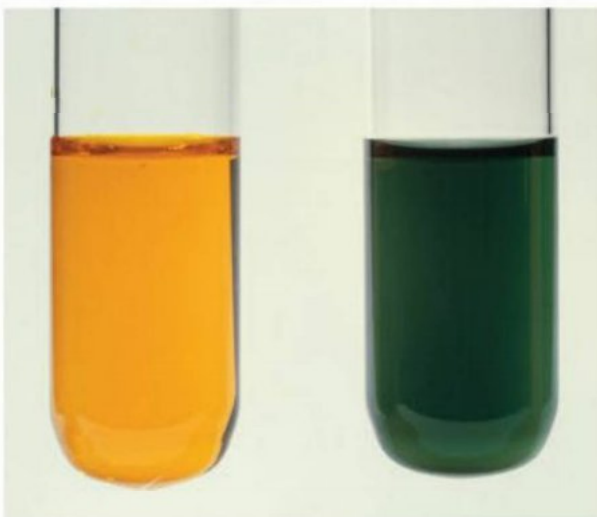
Some strong oxidising agents are highly coloured. The dichromate ion () is yellow-orange, while chromium(III) ions () are green. This colour change is used in early breathalyser designs to detect alcohol.
How breathalysers work

Early breathalysers detected the oxidation of ethanol to ethanoic acid using an acidified dichromate solution. The reaction produces a visible colour change from orange to green.
Oxidation half-equation (ethanol to ethanoic acid):
Reduction half-equation (dichromate to chromium(III)):
Note
These equations demonstrate the practical importance of understanding complex redox reactions in everyday applications like road safety testing. The colour change provides a clear visual indicator of alcohol presence, making it an effective screening tool.
Remember!
Summary
Key Points to Remember:
For Acidic Solutions:
- Balance using ions
- Follow the 5-step method: balance elements, add for oxygen, add for hydrogen, add electrons for charge, then state symbols
For Basic Solutions:
- Two methods exist depending on whether appears in formulas
- Method 1: Direct addition when hydroxide appears in formulas
- Method 2: Balance as acidic first, then neutralise with
For Combining Equations:
- Multiply to equalise electrons
- Add equations together
- Cancel species appearing on both sides
- Electrons must completely disappear
General Principles:
- The total charge must be equal on both sides, but doesn't have to be zero
- The steps must be completed in order for the method to work correctly
- Follow the systematic approach for reliable results every time