Evaluation and Conclusion (VCE SSCE Chemistry): Revision Notes
📚Revision Notes
Evaluation and Conclusion
Introduction
After conducting an experiment, it's essential to evaluate the method used and draw evidence-based conclusions. This process involves critically examining your experimental procedure, identifying strengths and weaknesses, and relating your findings back to your original hypothesis and research question. When evaluating your method, focus on comparing your results to accepted or literature values, as this helps identify areas for improvement.
Note
The evaluation and conclusion phases are where scientific learning truly occurs. By critically examining what worked and what didn't, you develop the analytical skills essential for scientific inquiry and improvement.
Evaluating the method
Purpose of evaluation
The method used in your controlled experiment should be thoroughly evaluated to determine whether it was appropriate and effective. Even well-designed methods may produce unexpected results, making evaluation crucial for scientific learning and improvement.
Key considerations when evaluating
When evaluating your experimental method, consider these important questions:
- What were the sources of systematic errors?
- What were the sources of random errors?
- Was the method valid (did it measure what it aimed to measure)?
- Was the experiment repeated to ensure reliability?
- Was the data precise (were repeated measurements consistent)?
- Would a larger sample or more variations in the independent variable strengthen your conclusion?
- What improvements could be made for future experiments?
Example
Worked Example: Evaluating Two Methods for Measuring Gas Volume
Consider an experiment measuring the volume of carbon dioxide gas produced when calcium carbonate reacts with hydrochloric acid. Two different methods could be used:
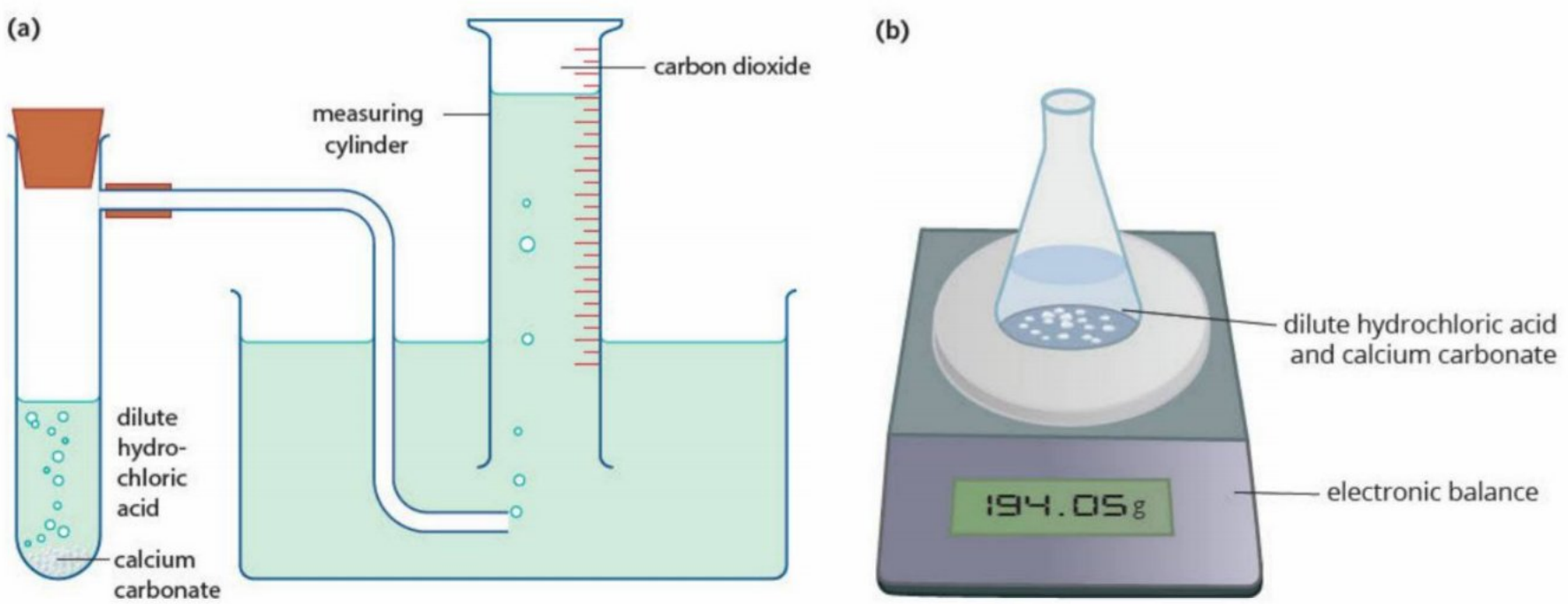
Method a - Water displacement method: In the water displacement method, the gas is collected in an inverted measuring cylinder filled with water. Whilst this method is valid (it aims to measure the volume of gas produced), it is not accurate. Carbon dioxide is slightly soluble in water, meaning some gas will dissolve rather than being collected. This causes the measured volume to be consistently lower than the true value, creating a systematic error.
Method b - Electronic balance method: The electronic balance method provides an improvement. By measuring the mass loss from the reaction vessel, you directly measure the mass of carbon dioxide that escapes. This method is generally more accurate because it avoids the problem of gas dissolution.
Identifying errors
Understanding different types of errors
Most practical investigations contain errors, which can be classified into two main categories:
Systematic errors:
- Caused by problems with part of the method or equipment
- Produce results that are consistently higher or lower than the accepted value
- Identified when your results consistently don't match expected values
- Often method-related rather than technique-related
Random errors:
- Affect the precision of results
- May be due to lack of experience with equipment
- Cause results to vary unpredictably between trials
- Become evident when insufficient trials are conducted
Important
Mistakes are different from errors. Mistakes are blunders that produce outliers and should not be included as valid results. Always distinguish between genuine errors (which affect all measurements systematically or randomly) and one-off mistakes that should be excluded from your data analysis.
What to do about errors
Minimising random errors:
- Repeat trials multiple times
- Calculate the average of your results
- Gain more experience with the equipment
- Use more precise measuring instruments
Minimising systematic errors:
- Take care when using equipment
- Calibrate instruments properly
- Consider alternative methods if necessary
- Address design flaws in the experimental setup
Using qualitative observations
Your qualitative observations often provide important clues about systematic errors. For example, if you observe a yellow, sooty flame whilst burning a hydrocarbon, this indicates incomplete combustion is occurring. Such observations help you identify and explain methodological issues.
Note
Don't overlook qualitative data during your evaluation. Observations about color changes, unusual smells, unexpected physical states, or other sensory information can provide valuable insights into what went wrong (or right) in your experiment.
Acknowledging contradictions
When analysing data, acknowledge any contradictions or unexpected results. Rather than ignoring results that don't fit your hypothesis, investigate the reasons why they occurred by carefully examining your method. Sometimes, unexpected findings lead to new research questions and hypotheses, which can extend your investigation further.
Improving the method
For every methodological weakness you identify, suggest a specific improvement. The following table shows examples from an experiment investigating how carbon chain length affects the heat of combustion of alcohols:
| Methodological weakness | How this may have influenced the results | Suggestion for improvement |
|---|---|---|
| The simple calorimeter was not insulated and did not have a lid | Once the water was heated above room temperature, heat may have been lost to the surroundings through the metal can and from the water surface. This would cause the calculated heat of combustion to be smaller than the true value (systematic error) | Make a lid for the can using one or more layers of aluminium foil. Loosely cover the sides of the can with foil to provide non-flammable insulation |
| The alcohol continued to evaporate from the wick after the flame was extinguished | The mass loss of alcohol would be greater than correct, decreasing the calculated heat of combustion | Snuff the flame using a metallic snuffer/cap rather than blowing it out. Remember to weigh the spirit burner with the snuffer before and after each trial |
| The three spirit burners had wicks of different lengths | Longer wicks produce larger flames that may transfer heat with different efficiencies. More efficient heat transfer means less heat loss as the experiment finishes more quickly. Different wick lengths introduce random uncertainty | Measure and record the wick length before starting to burn the alcohol in each trial. Try to match that length for subsequent trials |
Drawing evidence-based conclusions
Purpose of a conclusion
A conclusion is a summary of your investigation that allows readers to understand what you did, what results you obtained, and how valid those results were. A good conclusion links your collected evidence to your aim and hypothesis, using your results as evidence to provide a justified response to your research question.
Components of a conclusion
Your conclusion should include four key components:
1. Restatement of the aim
Transform your aim from future tense to past tense to introduce your conclusion. Instead of "To measure...", write "Three different alcohols were measured..."
2. Statement of your results
Present the mean values from multiple trials and include results from all parts of the experiment. Keep this section concise whilst being comprehensive.
Example
Example Statement of Results:
"The heat of combustion of the three alcohols was calculated from the average of three trials for each alcohol and was found to be for methanol, for ethanol and for propan-1-ol."
3. Comparison to accepted values or hypothesis
Compare your results quantitatively to accepted values. Calculate percentage differences to show how close your results were to literature values.
Example
Example Comparison to Literature Values:
"These three values were considerably lower than the literature values of for methanol, for ethanol (VCE Chemistry Data Book) and for propan-1-ol (NIST Chemistry webbook). The percentage differences for these values were , and respectively."
4. Brief explanation of discrepancies
Suggest what may have caused your results to differ from expected values.
Example
Example Explanation of Discrepancies:
"It is likely that these experimental values are low because heat energy was lost to the surroundings during the experiment due to lack of insulation on the simple calorimeter and the lack of a lid."
Language requirements for conclusions
Past tense and third person:
Write conclusions in the past tense and third person, as though someone else conducted the work.
Important
Incorrect: "I found that the heat of combustion of ethanol was less than it should be"
Correct: "The heat of combustion of ethanol was less than was expected"
The conclusion can be easily introduced by converting the aim into the past tense and writing it in the third person.
Complete conclusion example
The table below shows how to construct a complete conclusion for an alcohol combustion experiment:
| Part of the report | Example of what might be written |
|---|---|
| Aim | To measure and compare the heat of combustion of three different alcohols, methanol, ethanol and propan-1-ol, using a spirit burner and a simple calorimeter |
| Conclusion: Restatement of the aim | Three different alcohols, methanol, ethanol and propan-1-ol, were burnt in a spirit burner and the thermal energy released was calculated using the change in temperature of the water in the calorimeter. These values were then used to calculate the heat of combustion |
| Statement of your results | The heat of combustion of the three alcohols was calculated from the average of three trials for each alcohol and was found to be for methanol, for ethanol and for propan-1-ol |
| Comparison to accepted values | These three values were considerably lower than the literature values of for methanol, for ethanol (VCE Chemistry Data Book) and for propan-1-ol (NIST Chemistry webbook). The percentage differences for these values were , and respectively |
| Brief explanation of discrepancies | It is likely that these experimental values are low because heat energy was lost to the surroundings during the experiment due to lack of insulation on the simple calorimeter and the lack of a lid |
Summary
Key Points to Remember:
- Evaluate your method by considering validity, precision, accuracy, and reproducibility. Identify both systematic and random errors.
- Systematic errors cause consistent bias in results (too high or too low), whilst random errors reduce precision and cause inconsistent variation.
- For every weakness identified, suggest a specific, practical improvement to the method.
- Structure your conclusion by restating the aim, presenting results, comparing to accepted values, and explaining discrepancies.
- Write conclusions in past tense and third person to maintain scientific objectivity and proper academic style.