Planning Investigations (VCE SSCE Chemistry): Revision Notes
📚Revision Notes
Planning Investigations
Introduction
Planning and designing an investigation carefully before you begin helps you maintain a clear and focused approach throughout your work. This involves several key steps: choosing a topic, developing your research question and variables, ensuring safety, applying ethical principles, and evaluating your sources of information.
Choosing a topic
When selecting a topic for your investigation, consider the following questions:
- Personal interest: Do you find the research topic interesting? Your engagement with the topic will help sustain your motivation throughout the investigation.
- Background information: Is there background information on your topic that relates to your VCE Chemistry course? This helps ensure your investigation is relevant and allows you to build on existing knowledge.
- Available resources: Does your school laboratory have the resources needed to perform the investigation? Consider equipment, chemicals, time, and access to facilities.
- Measurable data: Can you collect clear, measurable data? Your investigation should produce quantitative results that can be analyzed.
Note
Selecting the right topic is crucial for the success of your investigation. A well-chosen topic balances your personal interests with practical considerations like available resources and the ability to collect meaningful data.
Potential research areas
Several practical research areas are suitable for VCE Chemistry investigations:
| Production of energy | Production of chemicals |
|---|---|
| Efficiency of galvanic cells | Changes that can be made to electrolytic cells |
| Factors affecting the operation of fuel cells | Factors affecting the oxidation of ethanol to make ethanoic acid |
Developing and refining your investigation
Conducting a literature search
Once you have chosen a topic, the first step is to conduct a search of the relevant literature. This means reading scientific reports and articles on the topic to find out:
- What is already known about the topic
- What is not known or not yet agreed upon
- Ideas for experimental methods
This background research provides important information for your report's introduction and helps you develop potential research questions.
Determining your research question
Your research question must be focused on ideas that are within your abilities to investigate, considering the resources and equipment you have available.
When developing your research question, consider:
- Equipment access: Do you have access to appropriate equipment such as waterbaths or data loggers?
- Time allocation: Do you have time to conduct the experiments? How many classes have been allocated?
- Location: Where will you conduct your research (e.g. in the school chemistry lab)?
- Variables: Can you identify the independent, dependent, and controlled variables?
- Hypothesis: Can you construct a hypothesis from your research question?
- Personal interest: Does the question interest you?
- Question format: Does the question end in a question mark? If it doesn't, it is not a question!
Note
Checklist for research questions:
- Relevance: Make sure your question is related to your chosen topic
- Clarity and measurability: Make sure your prediction can be framed as a clear hypothesis that can be measured
- Knowledge and skills: Make sure you have the knowledge and laboratory skills that will allow you to explore the question. Keep the question simple and achievable
- Advice: Seek advice from your teacher on your question. Their experience may help you consider aspects you haven't thought about
Format for controlled experiments:
In a controlled experiment, the research question should refer to the relationship between the independent variable and dependent variable. A useful format is:
"How does [the independent variable] affect [the dependent variable]?"
Example
Worked Example: Formulating a Research Question
Research Question: How does the distance between the electrodes affect the mass of copper deposited at the cathode during the electrolysis of copper(II) sulfate?
This question clearly identifies:
- Independent variable: Distance between the electrodes
- Dependent variable: Mass of copper deposited at the cathode
- Context: Electrolysis of copper(II) sulfate
Defining your variables
Variables are the factors that change during your experiment. An experiment determines the relationship between variables.
There are three categories of variable:
- Independent variable: The variable that is controlled by the researcher. This is what you deliberately change in your experiment.
- Dependent variable: The variable that may change in response to a change in the independent variable. This is what you measure or observe.
- Controlled variables: All the variables that must be kept constant during the investigation. These ensure that any change in the dependent variable is due only to the change in the independent variable.
Important
A valid experiment should have only one independent variable. If it had more than one, you could not be sure which independent variable was responsible for the changes observed in the dependent variable.
Examples of research questions and variables
| Research question | Independent variable | Dependent variable |
|---|---|---|
| How does the surface area of the electrodes affect the current transferred through a galvanic cell made up of a and a half-cell? | Surface area of the electrodes—this could be varied by keeping a constant length and changing the width of the electrodes or keeping the size of the electrode constant and dipping a larger depth of the electrode into the half-cells for each variation | Current going through a simple circuit made up of the galvanic cell and an ammeter |
| How does the number of carbon atoms in alcohol affect the enthalpy of combustion of the alcohol? | Number of carbon atoms in the alcohol that is combusted | Enthalpy of combustion as determined using simple calorimetry |
| How does the vegetable oil from which biodiesel is synthesised affect the enthalpy of combustion of the biodiesel? | The type of vegetable oil (such as peanut oil, sunflower oil, sesame oil, etc.) used in the synthesis of biodiesel samples | Enthalpy of combustion as determined using simple calorimetry |
Determining the aim
The aim is a statement describing in detail what will be investigated. It should be specific and clearly state the purpose of your investigation.
Example
Worked Example: Writing an Aim
Aim: To determine how the distance between the electrodes affects the mass of copper deposited at the cathode during the electrolysis of copper(II) sulfate.
Note that the aim is written as a statement (not a question) and includes both the independent and dependent variables.
Making predictions and constructing a hypothesis
A hypothesis is a prediction based on scientific reasoning that can be tested experimentally. It defines a proposed relationship between two variables and takes the form of cause and effect.
Structure of a hypothesis:
A good hypothesis typically follows this format:
"If [change in independent variable], then [predicted change in dependent variable] because [scientific reasoning]."
Example
Worked Example: Constructing a Hypothesis
Hypothesis: If the distance between the electrodes decreases, then the mass of copper deposited on the cathode will increase because a smaller distance will result in a lower resistance within the solution and a greater current will flow through the circuit. Faraday's first law of electrolysis relates current to charge according to the equation , so if current increases, then the charge will increase, the amount of electrons moving through the circuit will increase, and the mass of copper deposited will increase.
This hypothesis follows the required structure:
- If (change in independent variable): distance decreases
- Then (predicted outcome): mass of copper increases
- Because (scientific reasoning): lower resistance → greater current → more electrons → more copper deposited
Testing hypotheses:
Carefully designed experiments are conducted to determine whether the predictions made in a hypothesis are accurate:
- If the results of an experiment do not fall within an acceptable range, the hypothesis is rejected
- If the predictions are found to be accurate, the hypothesis is supported
- If, after many different experiments, one hypothesis is supported by all the results obtained so far and is considered verified using the scientific method, then this explanation can be given the status of a theory or principle
Selecting an appropriate methodology and method
When planning a scientific investigation, you need to think about the best way to address the research question. The scientific investigation methodology and the method (also known as procedure) selected will depend on the aim of the investigation and the research question.
Factors to consider:
- Do you have access to a laboratory, materials and chemicals (for a controlled experiment or product/process/system development)?
- Do you have access to a school or public library (for a literature review or case study)?
- Do you have computer access (e.g. international databases for classification and identification or for access to simulations)?
The method is the set of specific steps that are taken to collect data during the investigation.
Linking the planning parts together
Your research question, hypothesis, aim and variables should all link together coherently. Here is a complete example:
| Component | Details |
|---|---|
| Research question | How does the number of carbon atoms in an alcohol affect the enthalpy of combustion of the alcohol? |
| Independent variable | The number of carbon atoms in the alcohol that is combusted |
| Dependent variable | The enthalpy of combustion as determined using simple calorimetry |
| Controlled variables | The spirit burner used to burn the hydrocarbon, the distance between the flame and the calorimetry can, the calorimetry can used to hold the water that is heated, the initial mass of alcohol in the spirit burner (affects how well the wick is soaked), the initial temperature of the water in the calorimetry can |
| Potential hypothesis | As the number of carbon atoms increases, the enthalpy of combustion will increase because there are more carbon-carbon bonds to break and more products ( and ) are formed, so will increase. |
| Aim | To determine how the number of carbon atoms in an alcohol affects the enthalpy of combustion of the alcohol. |
Modifying an existing investigation
When designing a research question for a controlled experiment, it is often easiest to modify an investigation that you have already conducted in class. You could use an existing method and choose a different independent variable (which might change the dependent variable).
Note
Tip: Often a controlled variable from one investigation can become the independent variable for a new investigation. For example, in many rates investigations, the possible independent variables include concentration, temperature and sometimes the use of a catalyst. If you have already carried out an experiment where you changed concentration, you could make concentration one of the controlled variables and choose temperature as your new independent variable.
Examples of modifications
| Existing practical investigation | Potential student experiment |
|---|---|
| Synthesis of biodiesel | How does the vegetable oil from which biodiesel is synthesised affect the enthalpy of combustion of the biodiesel? |
| Half-cells and the electrochemical series | How does the concentration of the solutions in the half-cells affect the voltage of the electrochemical cell? |
| Preparing artificial fragrances and flavours | How does the number of carbon atoms in an ester molecule affect the boiling point of the ester? |
Complying with safety guidelines
Everything we do involves some risk. A risk assessment is performed for a controlled experiment to identify, assess and control hazards. Always identify the risks and control them to keep everyone safe.
Important
Ethical and safety considerations must be the highest priority at all times during a practical investigation.
Identifying risks
To identify risks, think about:
- The activity you will be carrying out
- The equipment or chemicals you will be using or producing
Example
Worked Example: Risk Identification
When hydrochloric acid reacts with sodium thiosulfate, the toxic gas sulfur dioxide () is produced, so this reaction must be conducted in a fume cupboard.
Risk identified: Production of toxic gas
Control measure: Use fume cupboard
Occupational health and safety
Occupational health and safety refers to all the measures that employers need to provide to ensure their employees are safe at work. Schools must also ensure that equipment and processes used in school laboratories are safe for all students, teachers and technical staff.
Chemical codes
The chemicals at school or at the hardware store have warning symbols on their labels. These symbols are a chemical code indicating the nature of the contents. From 1 January 2017, the Globally Harmonised System of Classification and Labelling of Chemicals (GHS) pictograms were introduced into Australia.
GHS pictograms and their meanings:
| Pictogram | Use |
|---|---|
| Flame | Flammable liquids, solids and gases; including self-heating and self-igniting substances |
| Flame over circle | Oxidising liquids, solids and gases, may cause or intensify fire |
| Exploding bomb | Explosion, blast or projection hazard |
| Corrosion | Corrosive chemicals; may cause severe skin and eye damage and may be corrosive to metals |
| Gas cylinder | Gases under pressure |
| Skull and crossbones | Fatal or toxic if swallowed, inhaled or in contact with skin |
| Exclamation mark | Low level toxicity; this includes respiratory, skin and eye irritation, skin sensitisers and chemicals harmful if swallowed, inhaled or in contact with skin |
| Environment | Hazardous to aquatic life and the environment |
| Health hazard | Chronic health hazards; this includes aspiratory and respiratory hazards, carcinogenicity, mutagenicity and reproductive toxicity |
Safety data sheets (SDS)
Each chemical substance has an accompanying document called a safety data sheet (SDS). An SDS contains important safety and first aid information about each chemical you commonly use in the laboratory.
Key information in an SDS:
- Product identification
- Hazard classification
- First aid measures
- Handling and storage
- Exposure controls and personal protection
- Physical and chemical properties
- Disposal considerations
Important
If the products of a reaction are toxic to the environment, you must pour your waste into a special container (not down the sink). This is something to discuss with your teacher or the laboratory technician.
Protective equipment
Everyone who works in a laboratory should wear items that help keep them safe. This is called personal protective equipment (PPE) and includes:
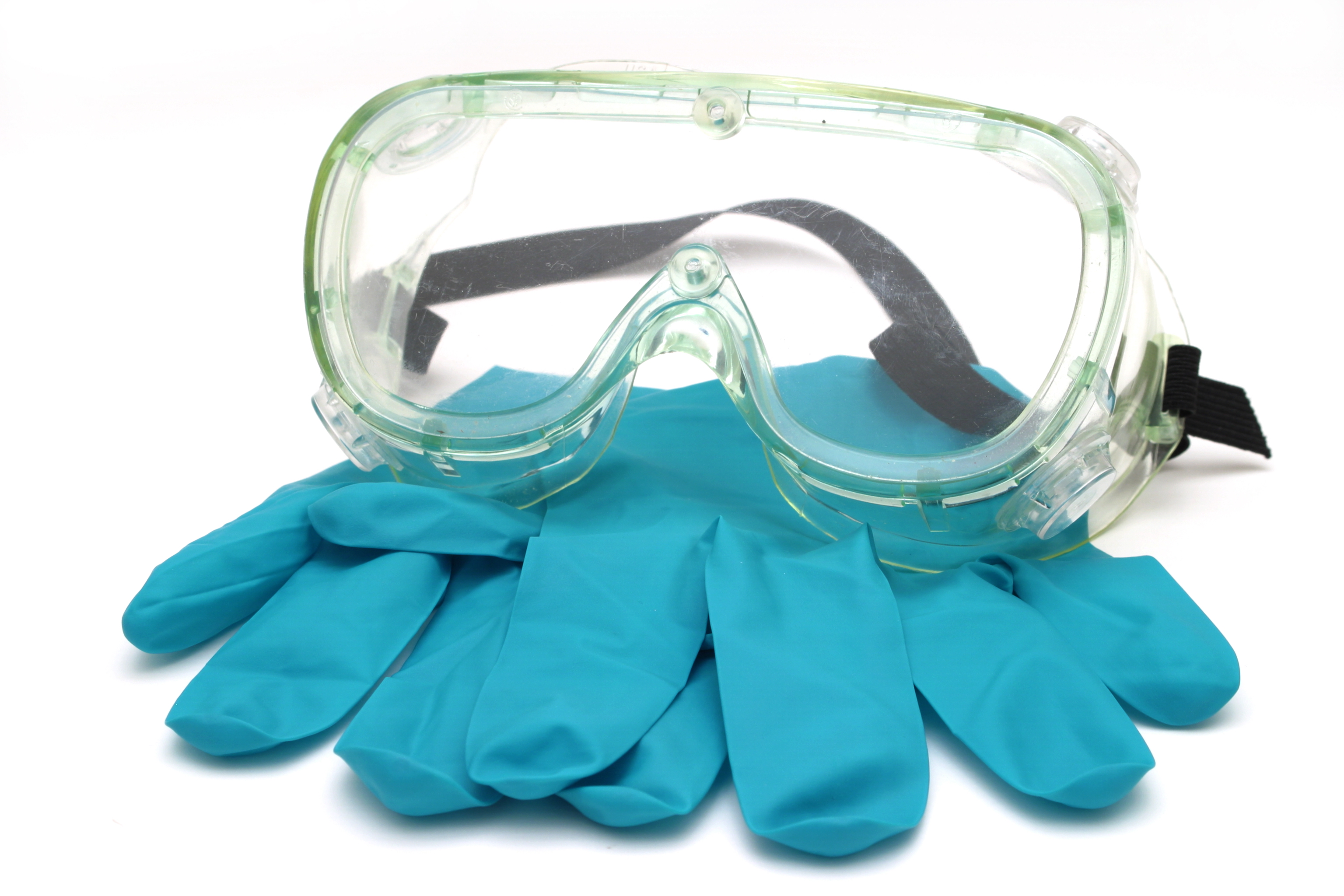
- Safety glasses
- Closed-toed shoes
- Disposable gloves for handling chemicals
- An apron or a lab coat if there is risk of damage to clothes
- A fume cupboard that should be used when toxic or corrosive gases are being handled or produced
Applying ethical principles
Ethics are a set of moral principles by which your actions can be judged as right or wrong. Every society or group of people has its own principles or rules of conduct.
Applying ethical principles in chemistry means:
- Using integrity and honesty when recording and reporting the outcomes of your investigation and when using other people's data (such as in a literature review)
- Recognising the importance of social, economic and political values when forming conclusions using scientific understanding
- Acknowledging the work of others by including in-text citations and details in a list of references
Important
Best practices for ethical data handling:
- Always record your data in a bound logbook, rather than scraps of paper
- Use the correct number of significant figures/decimal places for the reported values
- NEVER make up raw or processed data
- Record all data that you gathered in the investigation, even if it is not used in later calculations
Green chemistry
Green chemistry is an approach to chemistry that aims to design products and processes that efficiently use renewable raw materials, and minimise hazardous effects on human health and the environment.
The 12 principles of green chemistry (most relevant to VCE Chemistry):
| Principle | Description |
|---|---|
| Waste prevention | It is better to prevent waste than to treat it or clean it up after it has been produced. |
| Atom economy | Chemical processes should be designed to maximise incorporation of all reactant materials used in the process into the final product. |
| Less hazardous chemical syntheses | Wherever practicable, synthetic methods should be designed to use and generate substances that possess little or no toxicity to human health and the environment. |
| Designing safer chemicals | Chemical products should be designed to achieve their intended function while minimising toxicity. |
| Design for energy efficiency | Chemical processes should be designed for maximum energy efficiency and with minimal negative environmental and economic impacts. |
| Use of renewable feedstocks | Raw materials or feedstocks should be made from renewable (mainly plant-based) materials, rather than from fossil fuels whenever practicable. |
| Catalysis | Catalysts should be selected to generate the same desired product(s) with less waste and using less energy and reagents in chemical reactions. |
| Design for degradation | Chemical products should be designed so that at the end of their use they break down into harmless degradation products and do not persist in the environment. |
Note
Application in school laboratories:
In the school laboratory, we can apply the principles of green chemistry by using minimum quantities of chemicals in experiments, thus reducing the quantity of product that must be disposed of after the experiment is finished.
Sourcing information
When you are sourcing information during your search of the literature, such as when researching experimental methods or investigating a broader issue, consider whether that information is from primary or secondary sources.
Primary and secondary sources
Primary sources of information are created by a person directly involved in an investigation.
Secondary sources of information include textbooks, newspaper articles and websites that present a synthesis, review or interpretation of primary sources.
All sources of information may have a bias (a focus on only one part or one direction of the data or evidence) so you need to determine if they are reliable sources of information.
| Characteristics | Examples | |
|---|---|---|
| Primary sources | - First-hand records of events or experiences - Written at the time the event happened - Original documents | - Results of experiments - Scientific journal or magazine articles - Reports of scientific discoveries - Photographs, specimens, maps and artefacts - Interviews with experts - Websites (if they meet the criteria above) |
| Secondary sources | - Interpretations of primary sources - Written by people who did not see or experience the event - Use information from original documents but rework it | - Textbooks - Biographies - Newspaper articles - Magazine articles - Radio and television documentaries - Websites that interpret the scientific work of others - Podcasts |
Using books and the internet
Peer-reviewed scientific journals are the best sources of information, but you are unlikely to have access to many of these, and much of the information is difficult to interpret if you are not an expert in the field.
Books and internet searches will most likely be your most commonly used resources for information.
Comparison of book and internet resources:
| Book resources | Internet resources | |
|---|---|---|
| Advantages | - Written by experts - Authoritative information - Reviewed to ensure information is accurate - Logical, organised layout - Content is relevant to the topic - Contain a table of contents and index to help you find relevant information | - Quick and easy to access - Allow access to hard-to-find information - Allow access to a vast amount of information from around the world - Up-to-date information - May be interactive and use animations to enhance understanding |
| Disadvantages | - May not have been published recently - Usable by only a finite number of people at a time | - Time-consuming looking for relevant information - Search engines may not display the most useful sites - Cannot always tell how up-to-date information is - Difficult to tell if information is accurate - Hard to tell who has responsibility for authorship and if they are biased - Information may not be well ordered - Only a small proportion of sites are educational |
Critically evaluating information
Not all sources of information are credible. Critical thinking involves asking questions when evaluating the content and its origin, including:
- Who created this message? What are the qualifications, expertise, reputation, and affiliation (who they work for or are associated with) of the author/s?
- Why was the information written?
- Where was the information published?
- When was the information published?
- How often has the information been referred to by other researchers?
- Are the conclusions supported by data or evidence?
- What is implied?
- What has been omitted?
Peer review
Peer review is a process in which other researchers who work in the same field review your work and provide feedback about your methodology and whether your conclusions are justified. Scientists are expected to publish their findings in peer-reviewed journals.
Examples of peer-reviewed chemistry journals include:
- Australian Journal of Chemistry
- Journal of the American Chemical Society
- Nature Chemistry
- Chemical Reviews
- Green Chemistry
Note
Because scientific journals are peer-reviewed, this gives them more credibility than other sources.
Evaluating books and journals
Your textbook is an excellent starting point for reliable information. Information that you find elsewhere should be consistent with the information in your textbook.
Articles published in newspapers and magazines often present findings of new research, which may or may not be confirmed later, so be careful not to treat such sources of information as established fact. Peer-reviewed journal articles are likely to be up to date and reliable.
Evaluating websites
Remember that anyone can publish anything on the internet, so it is important to evaluate the credibility, currency and content of online information.
Website evaluation checklist:
- Credibility: Consider who the author is, their qualifications and expertise. Check for their contact information and for a trusted abbreviation in the web address, such as .gov or .edu. Websites using .com may have a bias towards selling a product (although this product could be a reputable science magazine or journal), and .org sites might have a bias towards one point of view (although these sites can be a good starting point for general information).
- Currency: Check the date the information you are using was last revised.
- Content: Consider whether the information presented is fact or opinion. Check for properly referenced sources, and compare information to other reputable sources, including books and science journals.
Recognising evidence compared to opinion and anecdote
An important aspect of the scientific method is to make conclusions based on data and evidence.
Data that is authoritative has been published by a credible source—for example, VCAA's VCE Chemistry Data Book.
Data should be objective (free of personal bias) and may be used as evidence, whereas opinion and anecdote are subjective (influenced by personal views). An anecdote is a story that might not be typical or representative of a pattern.
| Data and evidence | Opinion and anecdote |
|---|---|
| Objective | Subjective |
| Measured, unbiased, replicable, systematic, representative | Personal, individual story, non-systematic, not necessarily representative or part of a pattern |
| Example: Scientific consensus among the majority of experts is that greenhouse gases are contributing to climate change. | Example: Today is a cold day, therefore global warming is not true. |
Identifying information that is not scientifically valid
Beware of publications or sources of information that are presented as science but that are not scientifically valid. Non-scientific ideas and writing can be identified by:
- A lack of data or evidence
- Bias—only part of the data or evidence is considered (usually the data supporting the claim)
- Poorly collected data or evidence; for example, basing data or evidence on a group that is too small or not representative of the whole
- Invalid conclusions (that is, not supported by evidence)
- Lack of objectivity—appealing to emotion rather than presenting facts and evidence impartially
Summary
Key Points to Remember:
- A valid experiment should have only one independent variable to ensure clear cause-and-effect relationships.
- Your research question, hypothesis, aim, and variables should all link together coherently.
- Safety must be the highest priority at all times—always conduct a risk assessment, consult safety data sheets, and wear appropriate personal protective equipment.
- Apply ethical principles by recording data honestly in a bound logbook and never making up data.
- Primary sources (created by people directly involved in the investigation) are generally more reliable than secondary sources (interpretations of primary sources).
- When evaluating information, check the three C's: Credibility, Currency, and Content.
- Distinguish between data and evidence (objective, measured, systematic) and opinion and anecdote (subjective, individual stories).