Reporting Investigations (VCE SSCE Chemistry): Revision Notes
📚Revision Notes
Reporting Investigations
Introduction to scientific reporting
After completing your research, developing a hypothesis, conducting experiments, and collecting data, the final stage of any scientific investigation involves presenting your findings clearly and objectively to your audience.
Research findings can be communicated through various formats, including:
- Written peer-reviewed journal articles
- Web-based publications
- Oral presentations
- Scientific posters at conferences

Note
Regardless of the format chosen, all scientific reports follow the same fundamental structure and include the same essential components. This consistency helps readers navigate scientific literature efficiently.
Structure of a scientific report
Every scientific report, whether presented as a poster, written document, or oral presentation, must include seven key elements in a specific sequence:
Important
The Seven Essential Elements: All scientific reports must include these components in order: Title, Introduction, Methodology and Methods, Results, Discussion, Conclusion, and References and Acknowledgements. Missing any element or presenting them out of sequence can compromise the clarity and credibility of your report.
Title
Your title should be brief and focused, incorporating the key terms from your investigation. A well-crafted title immediately communicates what your research investigated.
Introduction
The introduction establishes the context for your investigation. It should include:
- Relevant background information about the topic
- What is already known about the issue being investigated
- The aim of your investigation
- The specific research question being addressed
Methodology and methods
This section explains your experimental approach and should contain:
- Your hypothesis
- A list of all variables (independent, dependent, and controlled)
- A brief description of your methodology, explaining the rationale behind your investigative approach
- A complete list of materials used
- Step-by-step experimental methods
- Optional diagrams or flow charts to illustrate procedures
Note
Including visual aids like diagrams or flow charts in your methodology section can make complex procedures much easier for readers to understand and follow.
Results
The results section presents your findings without interpretation. Include:
- Descriptive or observational text
- Data tables showing measurements and observations
- Images such as photographs or diagrams
- No analysis or conclusions in this section
Important
The results section is strictly for presenting data, not analyzing it. Keep all interpretation and analysis for the discussion section. This separation ensures clarity and allows readers to form their own initial impressions of your data.
Discussion
This is where you analyse and evaluate your results. The discussion should feature:
- Analysis of your findings
- Graphs that clearly show trends in your data
- Evaluation of the investigation's strengths and limitations
- Summary diagrams or charts where appropriate
Conclusion
Your conclusion provides a final summary and should:
- State whether the results support or reject your hypothesis
- Suggest improvements to the investigation methodology
- Avoid introducing any new information not already discussed
References and acknowledgements
This final section must:
- List all sources consulted or cited in alphabetical order
- Acknowledge everyone who assisted with the investigation
Scientific posters versus written reports
Scientific posters follow the same structural elements as written reports but require a more concise and direct approach. Posters must be accessible to both technical and non-technical audiences.
When creating a poster, carefully select which information to present. For example, instead of including large tables of raw data, you might choose to show only a summary results table and a graph that clearly illustrates trends in your data. The goal is to communicate the impact of your investigation effectively and efficiently.
Visual support in scientific reports
Visual elements such as diagrams, graphs, and flow charts can effectively convey complex scientific concepts and processes whilst significantly reducing word count.
Ways to incorporate visual support
You can make your report more accessible and concise by:
- Including annotated diagrams of experimental equipment and setup
- Using flow charts to summarise key procedural steps
- Presenting data in tables, graphs, and schematic diagrams
Schematic diagrams are particularly useful as they represent complex processes in a simplified way, often using standardised symbols.
Requirements for visual elements
Important
Essential Requirements for All Visual Elements:
Every visual element you include must have:
- A descriptive title that explains what is being shown
- Appropriate labels, captions, or descriptions
- Sequential numbering (e.g., Figure 1, Figure 2, or Table 1, Table 2)
- A citation indicating the source if the work is not your own or has been adapted from another source
Missing any of these elements can result in lost marks and may constitute plagiarism if sources are not properly cited.
Scientific writing style
Scientific reports require an objective and unbiased writing style, which differs significantly from other types of writing you may be familiar with.
Objective language
Scientific writing avoids subjective techniques such as rhetoric or persuasion. Your focus should be on presenting facts and evidence rather than opinions or emotional appeals.
Be cautious when using absolute terms such as:
- Always
- Never
- Shall
- Will
- Proven
Note
Qualifying Your Claims:
These absolute words can make claims that are too strong or inaccurate. Instead, consider using qualifying words that acknowledge uncertainty or limitations:
- May
- Might
- Possible
- Probably
- Likely
- Suggests
Using qualifying language demonstrates scientific rigor and acknowledges that scientific understanding continues to evolve.
Concise writing
Scientific reports should be written clearly and concisely to maintain your audience's interest and attention. Use shorter sentences and avoid unnecessarily wordy expressions. Every sentence should serve a clear purpose in communicating your findings.
First person versus third person narrative
Scientific writing can be composed in either first-person or third-person narrative, though historically only third person was considered appropriate.
Example
Narrative Perspective Examples:
First-person narrative uses personal pronouns such as "I" and "we":
- "I added of to the beaker and started timing."
- "After I observed the reaction, I found that..."
Third-person narrative avoids personal pronouns and often uses passive voice:
- "First, of was added and then timing was commenced."
- "After the reaction was completed, the results showed..."
Exam tip: Check with your teacher which narrative style is preferred before writing an assessed investigation report. Whichever style you choose, maintain consistency throughout your entire report.
Avoiding plagiarism
Plagiarism means using other people's work without acknowledging them as the author or creator. This is a serious academic offence that must be avoided at all costs.
How to avoid plagiarism
Always write using your own words, even when the original author's phrasing seems ideal. To properly acknowledge sources:
- Include a reference every time you report the work of others
- Place citations at the end of sentences or immediately following diagrams
- If using a direct quotation, enclose it in quotation marks
- Ensure every source is listed in your reference list
Important
Plagiarism Prevention:
These practices give proper credit to original authors and enable readers to locate the original sources. Even unintentional plagiarism can have serious academic consequences, including:
- Failed assignments or courses
- Disciplinary action
- Damage to your academic reputation
Always err on the side of caution - if you're unsure whether to cite something, cite it.
References versus bibliography
Understanding the difference between these two lists is important:
Bibliography: A list of all resources you consulted during your research, whether you specifically cited them or not.
Reference list: A detailed list of only those sources you have directly cited in your work.
Both lists include complete details about each resource and appear at the end of your report in alphabetical order (by author's last name or organisation name). The information provided should enable readers to easily locate the original sources.
Note
Study tip: Begin compiling your references in your logbook as you gather resources. This saves time later and ensures you don't lose track of important sources.
APA referencing style
APA (American Psychological Association) style is a commonly used academic referencing format. Understanding this system will help you properly credit sources and maintain academic integrity.
Basic APA format
The standard structure for a reference follows this pattern:
Author (year of publication). Title (edition). Publisher.
In APA style, no distinction is made between books, journal articles, or internet documents in terms of basic format, except where electronic documents lack page numbers.
Reference formats for different resource types
Print books
For a print book, include:
- Author's surname and initials
- Date of publication
- Title of the book
- Edition number
- Page number (if citing a specific page)
- Publisher's name
Example
Book Reference Format:
Chan, D., Commons, C., Commons, P., Derry, L., Freer, E., Huddart, E., Lennard, L., MacEoin, M., Moylan, M., O'Shea, P., Ross, B., Vanderkruk, K., & Waldron, P. (2023). Heinemann Chemistry 2 (6th ed., p. 426). Pearson Australia.
Note: Book titles are italicized, and multiple authors are separated by commas with an ampersand (&) before the final author.
Journal articles
For a journal article, include:
- Author's surname and initials
- Date of publication
- Title of the article
- Journal or magazine title
- Volume and issue numbers
- Page numbers
Example
Journal Article Reference Format:
Kizil, N., Soylak, M., & Tüzen, M. (2017). Spectrophotometric detection of rhodamine B in tap water, lipstick, rouge, and nail polish samples after supramolecular solvent microextraction. Turkish Journal of Chemistry, 41, 987-994.
Note: The journal title is italicized, followed by volume number, then page range.
Internet sources
For internet sources, include:
- Author's surname and initials, or organisation name, or title if no author is available
- Year the website was written or last revised (use "n.d." if no date is found)
- Website title in italics, or description
- Complete website address (URL)
Example
Internet Source Reference Format:
University of Canterbury. (n.d.). Determination of vitamin C concentration by titration. https://www.canterbury.ac.nz/media/documents/science-outreach/vitaminc\_iodine.pdf
Note: "n.d." stands for "no date" and is used when the publication or revision date cannot be determined.
In-text citations
Every time you reference the findings of other researchers or organisations in your work, you must provide an in-text citation and include full details in your reference list.
Format for in-text citations
In APA style, in-text citations include:
- The first author's surname
- The year of publication
- A page, chapter, or section number if you need to be specific
These elements are placed in brackets: (author, year, pages)
Examples of in-text citations
Example
In-Text Citation Examples:
-
An earlier study (Kizil et al., 2017) reported a method for determining the concentration of rhodamine B by UV-visible spectroscopy.
-
The procedure for determining the concentration of vitamin C in lemon juice was adapted from the University of Canterbury method (University of Canterbury, n.d.).
Note: "et al." is used when there are three or more authors, listing only the first author's surname followed by "et al." (meaning "and others").
Linking in-text citations to bibliography entries
In-text citations are designed to be concise for easy inclusion in your work whilst linking directly to complete information in your bibliography.
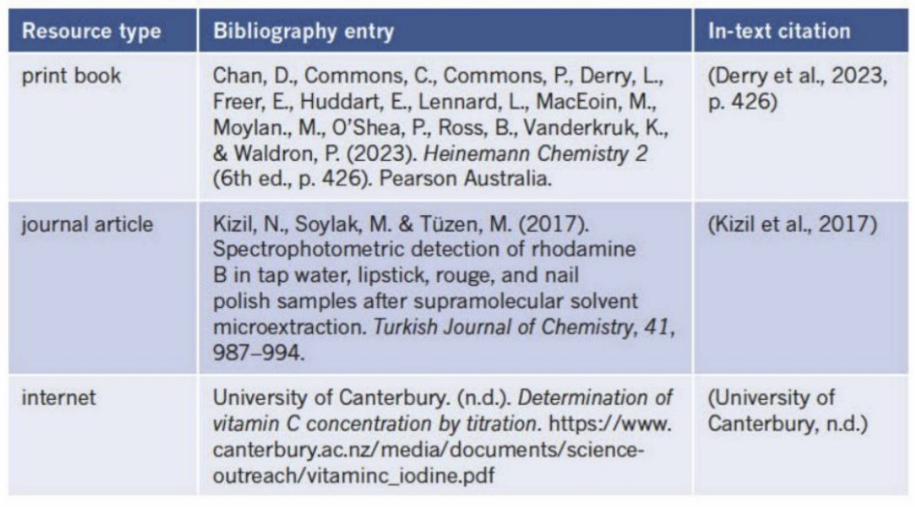
The table above demonstrates how bibliography entries correspond to their shortened in-text citation forms. This system allows readers to quickly identify sources in your text and then find complete publication details in your reference list.
Acknowledgements
Acknowledging the contributions of others demonstrates professionalism and gratitude. This section recognises everyone who supported your investigation but may not be listed as authors.
Who to acknowledge
Consider acknowledging:
- Your teacher or supervisor
- Laboratory technicians who prepared materials or chemicals
- Staff who provided facilities or resources
- Anyone who offered guidance or support
Writing acknowledgements
Keep acknowledgement statements brief and specific. Examples include:
Example
Sample Acknowledgements:
-
"This research was supported by the staff of the Science Faculty at Northern Secondary College, Melbourne."
-
"Special thanks to Mrs Smith for preparing stock solutions."
-
"I would like to thank the laboratory technicians, Karen and Tanneale, for their help in preparing the solutions for this investigation."
Summary
Key Points to Remember:
-
All scientific reports follow the same seven-part structure: Title, Introduction, Methodology and methods, Results, Discussion, Conclusion, and References and acknowledgements.
-
Use visual elements (diagrams, graphs, flow charts) to communicate information efficiently and reduce word count. Always include titles, labels, and citations for visual elements.
-
Scientific writing must be objective, concise, and use appropriate qualifying language rather than absolute terms.
-
Plagiarism is a serious academic offence. Always write in your own words and provide proper citations for all sources.
-
Use APA referencing style consistently, including complete bibliography entries and brief in-text citations that link to your reference list.
-
Maintain consistency in narrative perspective - choose either first person or third person and stick with it throughout your report.