How Substances Dissolve (VCE SSCE Chemistry): Revision Notes
📚Revision Notes
How Substances Dissolve
Introduction
Water is an excellent solvent, making it essential for biological and industrial processes. When a substance dissolves in water, its particles become free to move throughout the solution. This can be observed when potassium permanganate is added to water - the deep purple colour spreads through the water as the solid dissolves, eventually creating a uniformly coloured solution.
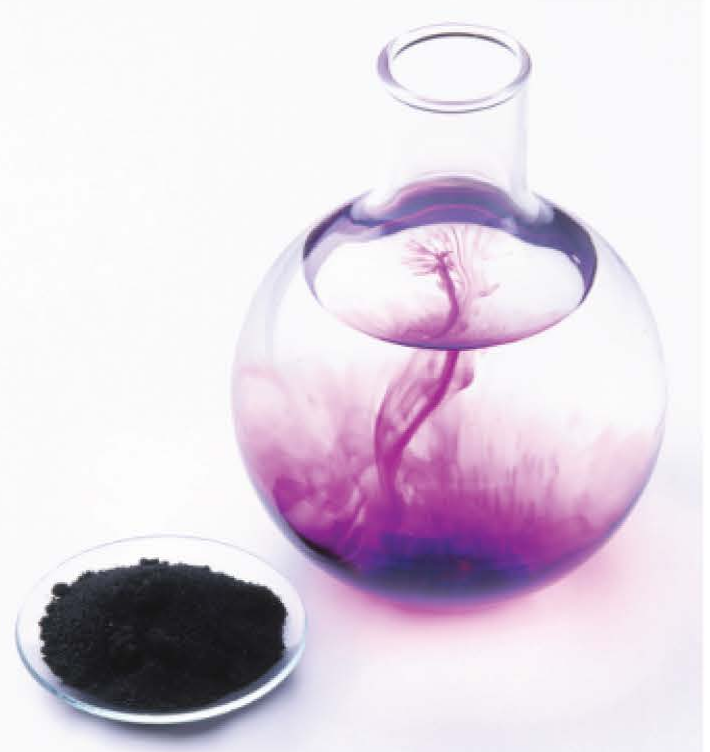
Understanding how substances dissolve requires examining the forces between particles and how these forces change during the dissolution process.
Characteristics of a solution
A solution is formed when a solid, liquid or gas is dissolved in a liquid. The substance being dissolved is called the solute, and the liquid in which it dissolves is the solvent.
When water is the solvent, the solution is called an aqueous solution. The solute can vary (such as salt or sugar), but the solvent remains water.
| Solution | solute(s) | Solvent |
|---|---|---|
| Saline solution (for contact lenses) | Sodium chloride | Water |
| Soft drink | Carbon dioxide, sugar, flavour, colour | Water |
| Coffee | Coffee, sugar, milk | Water |
Note
All solutions share these key characteristics:
- The solution is homogeneous - the solute and solvent cannot be distinguished from each other visually, and every part of the solution is identical to any other part
- The dissolved particles are too small to see
- The amount of dissolved solute can vary from one solution to another
The process of dissolving
The process of a substance dissolving in another substance is called dissolution. During dissolution, several things happen:
- Solute particles are attracted to some solvent particles
- The particles of the solute separate from one another
- Some solvent particles separate from one another to allow the solute particles to disperse throughout the liquid
- Solvent particles not attached to solute particles remain attracted to other solvent particles
For a solution to form successfully, the solute particles must interact with the solvent molecules. The solute particles become surrounded by solvent molecules and are carried throughout the solution.
Forces involved in dissolving
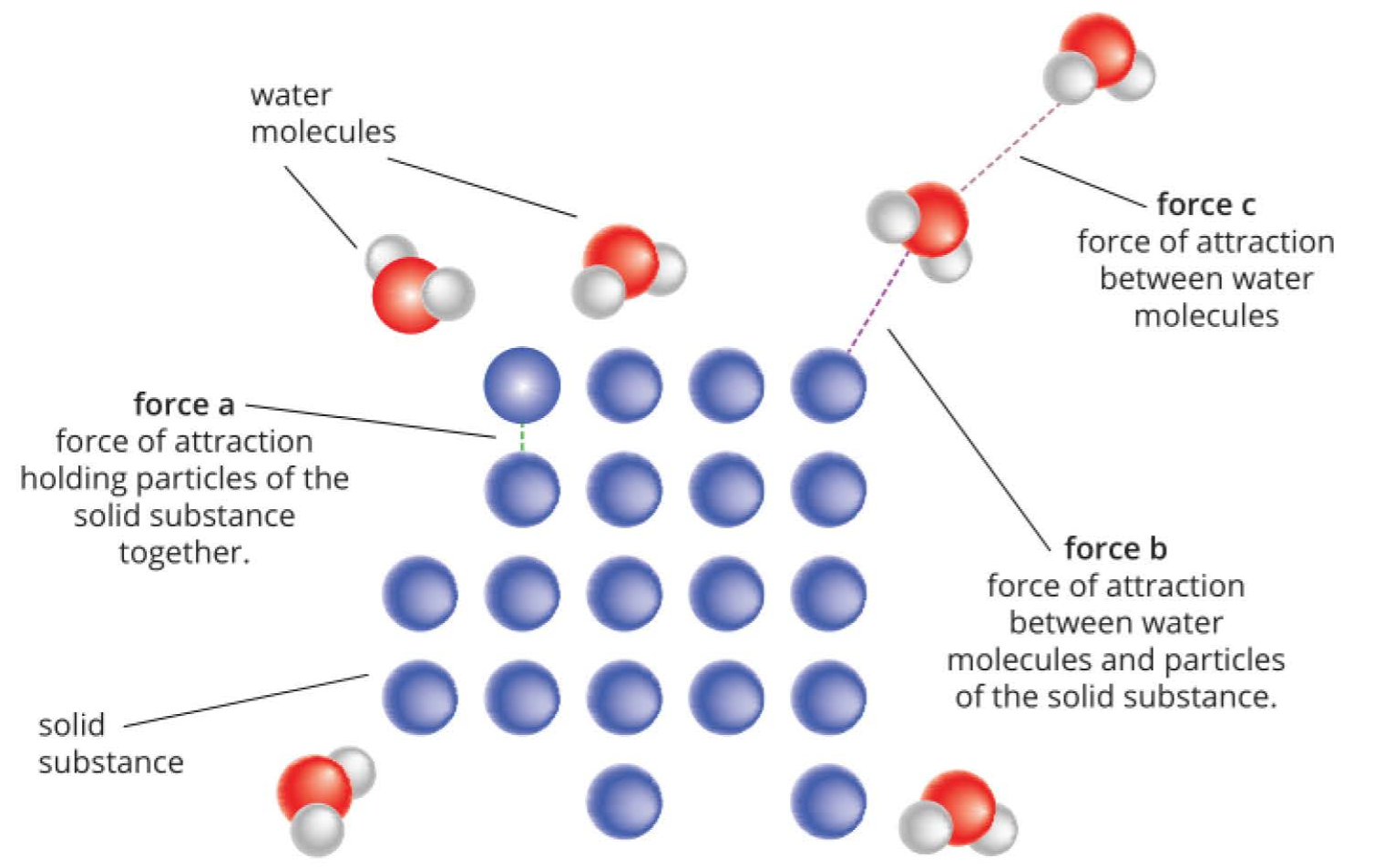
To understand whether a substance will dissolve, you need to consider three different forces of attraction:
Important
Three Key Forces in Dissolution:
Force A: The forces holding the solute particles together before the substance is added to the solvent
Force B: The forces holding the solvent molecules together (in water, these are hydrogen bonds and dispersion forces)
Force C: The forces that can form between the solute particles and the solvent molecules
For a substance to dissolve, the attractive forces between solute and solvent particles (Force C) must be similar to, or greater than, the forces within the solute (Force A) and the forces within the solvent (Force B).
The diagram below shows how particles rearrange during dissolution:
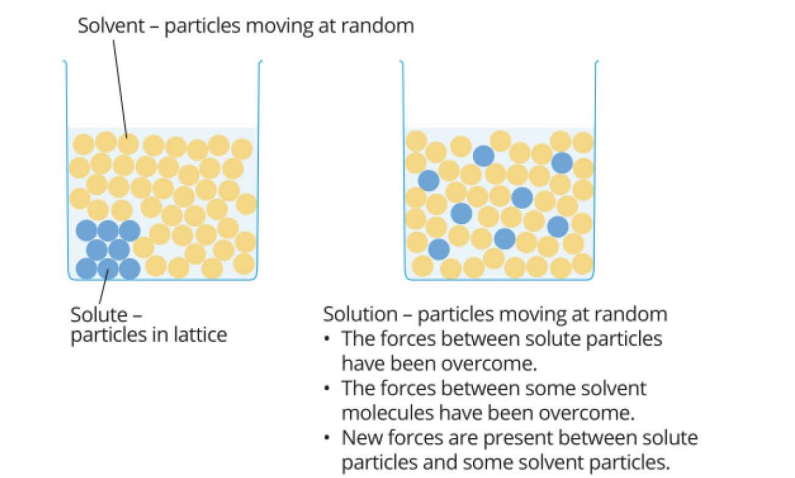
As the solute dissolves, three key changes occur:
- Forces between solute particles are overcome
- Forces between some solvent molecules are overcome
- New forces form between solute particles and solvent particles
The solute particles separate and become evenly distributed throughout the solvent. If the attraction between solute and solvent particles is not strong enough, the substance will not readily dissolve.
Like dissolves like
Important
The Golden Rule of Solubility: "Like dissolves like"
This means:
- Polar solvents will generally dissolve substances consisting of polar molecules or ions, but will not dissolve solutes made up of non-polar molecules
- Non-polar solvents can dissolve substances consisting of non-polar molecules, but will not dissolve substances with polar molecules or ions
Why don't non-polar substances dissolve in water?
Wax and other non-polar molecular substances do not dissolve well in water because:
- The only intermolecular forces in non-polar substances are weak dispersion forces
- Water molecules are held together by strong hydrogen bonds
- The dispersion forces that could form between wax and water molecules are much weaker than the hydrogen bonds between water molecules
- The attraction between water molecules cannot be overcome, so water molecules do not separate to form a solution with wax molecules
Miscible and immiscible liquids
When both the solute and solvent are liquids, we describe them as miscible if they dissolve in each other, or immiscible if they do not.
Ethanol and water (both polar):
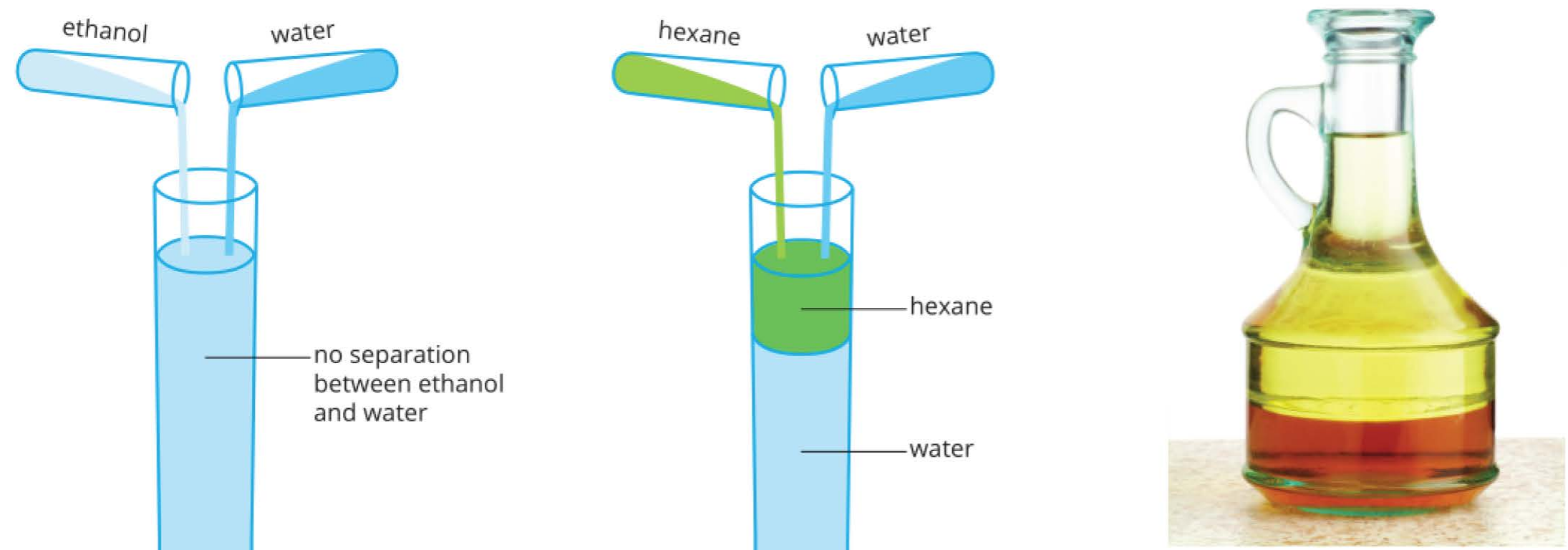
Ethanol is a polar molecule, so it readily dissolves in water (also polar). When mixed, they form a homogeneous solution with no separation between the liquids.
Hexane and water (non-polar and polar):
Hexane is composed of non-polar molecules that will not interact with polar water molecules. When mixed, two layers form, with the less dense hexane sitting on top of the water.
Note
An everyday example of immiscible liquids is home-made salad dressing. The dressing contains vinegar (an aqueous solution) and olive oil. Since olive oil is non-polar, it is immiscible with the polar vinegar and forms a separate layer on top.
Hexane and olive oil (both non-polar):
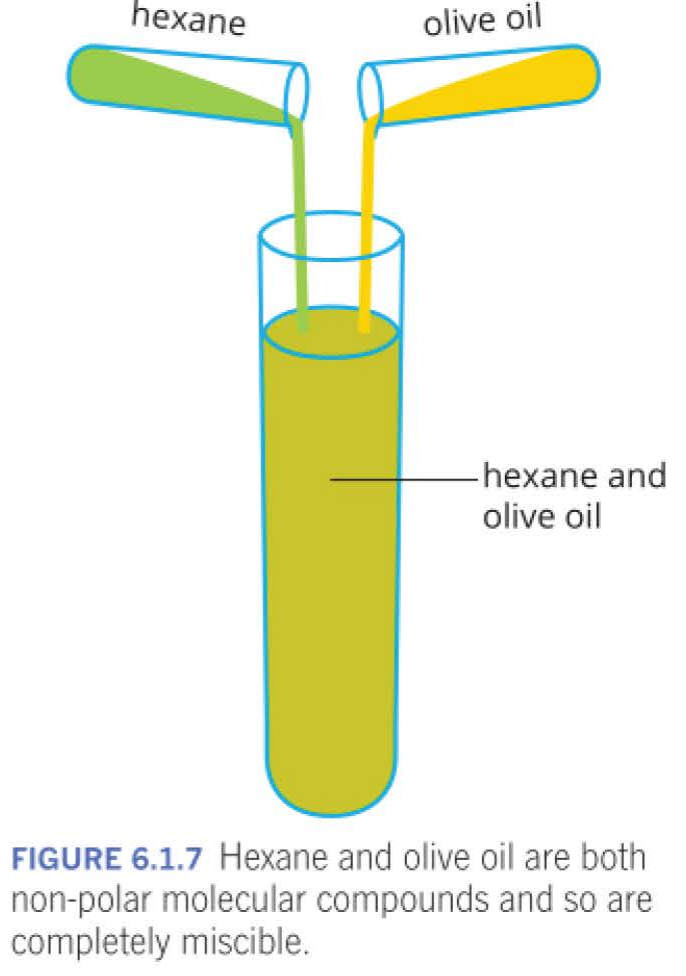
Both hexane and olive oil are composed of non-polar molecules. Following the 'like dissolves like' rule, these two non-polar liquids readily mix to form a homogeneous solution.
Different ways compounds dissolve in water
The way a compound dissolves depends on the bonding present in the substance. There are three main ways compounds dissolve in water:
- Some molecular compounds dissolve by forming hydrogen bonds with water
- Other molecular compounds dissolve in a process that involves the formation of ions
- Ionic compounds dissolve in a process called dissociation
Molecular compounds that form hydrogen bonds with water
Some molecular compounds dissolve in water by forming hydrogen bonds with water molecules. These compounds must have the ability to form hydrogen bonds themselves.
Example
Worked Example: Ethanol Dissolving in Water
Ethanol () is a good example. Ethanol molecules contain the polar group, with lone pairs of electrons on the oxygen atom. The hydrogen atom bonded to the electronegative oxygen atom allows ethanol molecules to form hydrogen bonds.
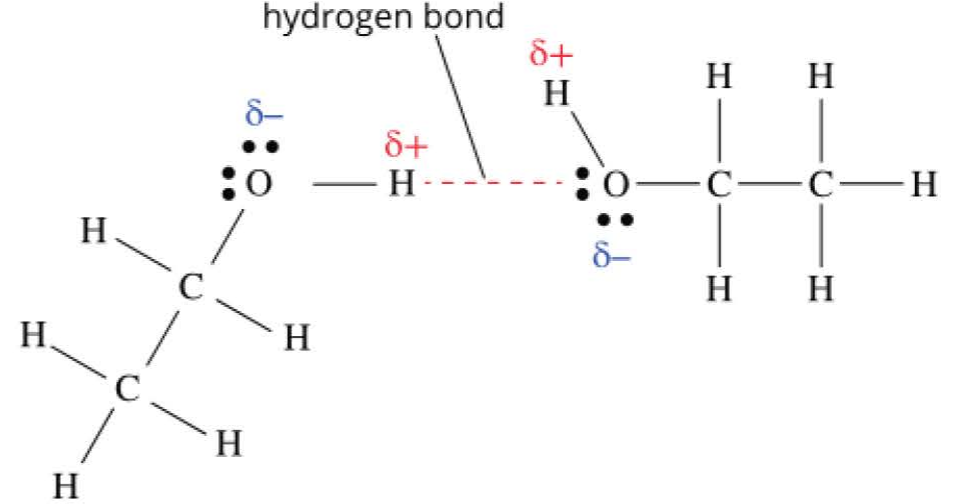
In pure ethanol, hydrogen bonds form between ethanol molecules. When ethanol is added to water, the two liquids are miscible because hydrogen bonds can form between ethanol and water molecules.
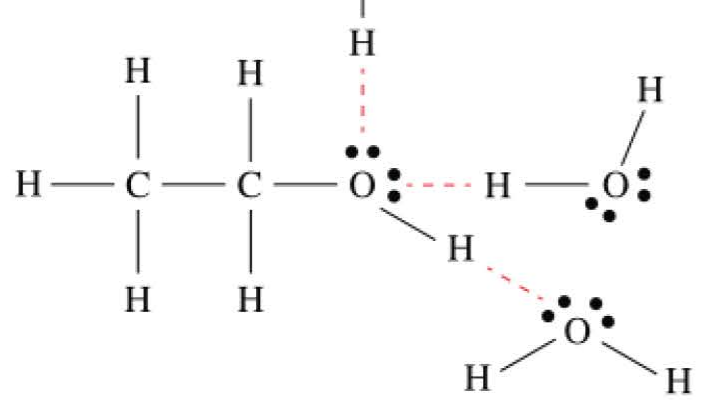
Because the strength of the intermolecular forces in ethanol is similar to those in water, the two substances can readily interact. Water and ethanol molecules mix freely, held together by hydrogen bonds.
What happens when ethanol dissolves:
- Hydrogen bonds between water molecules break
- Hydrogen bonds between ethanol molecules break
- Hydrogen bonds form between ethanol molecules and water molecules
The dissolution equation is:
Note that water sits above the arrow because there is no direct chemical reaction. The substances simply mix together. Only the state symbol changes from (l) to (aq), indicating the ethanol is now dissolved in water.
Sugars like glucose and sucrose also contain polar groups and can therefore dissolve in water by forming hydrogen bonds.
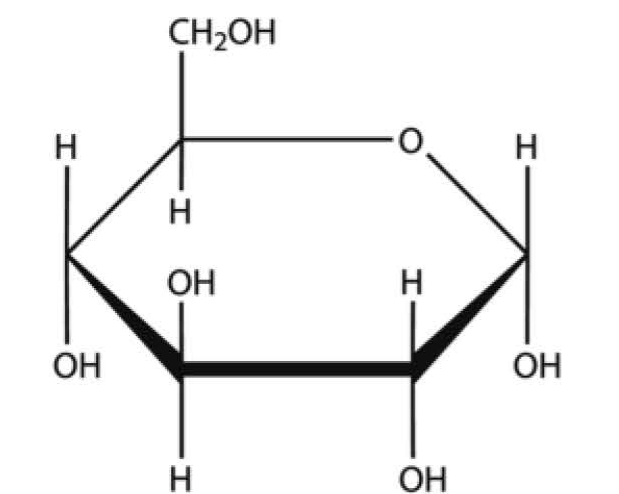
Each group in a glucose molecule can form hydrogen bonds with water molecules. Because each molecule has many groups, glucose is very soluble in water.
Note
Important points about polarity and solubility:
- The more polar the molecules of a compound, the more likely it is to dissolve in water
- Some molecules have both polar and non-polar sections
- In general, the larger the non-polar section of a molecule, the less soluble it is in water
- Non-polar molecular substances have no significant attraction to water molecules, only weak dispersion forces, which are not strong enough to overcome hydrogen bonding between water molecules
Molecular compounds that ionise in water
Some compounds have molecules with covalent bonds that are so polar they break when the compound is placed in water. Hydrogen chloride (HCl) is such a compound.
Hydrogen chloride is a gas at room temperature. Chlorine is much more electronegative than hydrogen, so the covalent bond is highly polar, creating a dipole.

When hydrogen chloride is added to water, the hydrogen atom in forms such a strong attraction to the oxygen atom in a water molecule that the covalent bond breaks. The two electrons that made up the bond remain with the more electronegative chlorine atom, and the newly formed hydrogen ion () joins the water molecule.
When the hydrogen ion bonds to the water molecule, it forms a new ion called the hydronium ion (). Since the chlorine atom has gained an electron, it becomes a negatively charged chloride ion ().
The is said to have become ionised - it has produced ions. This process is called ionisation. Since the molecule has broken apart, it can also be described as having undergone dissociation.
The two ions produced ( and ) become hydrated - they are surrounded by water molecules:
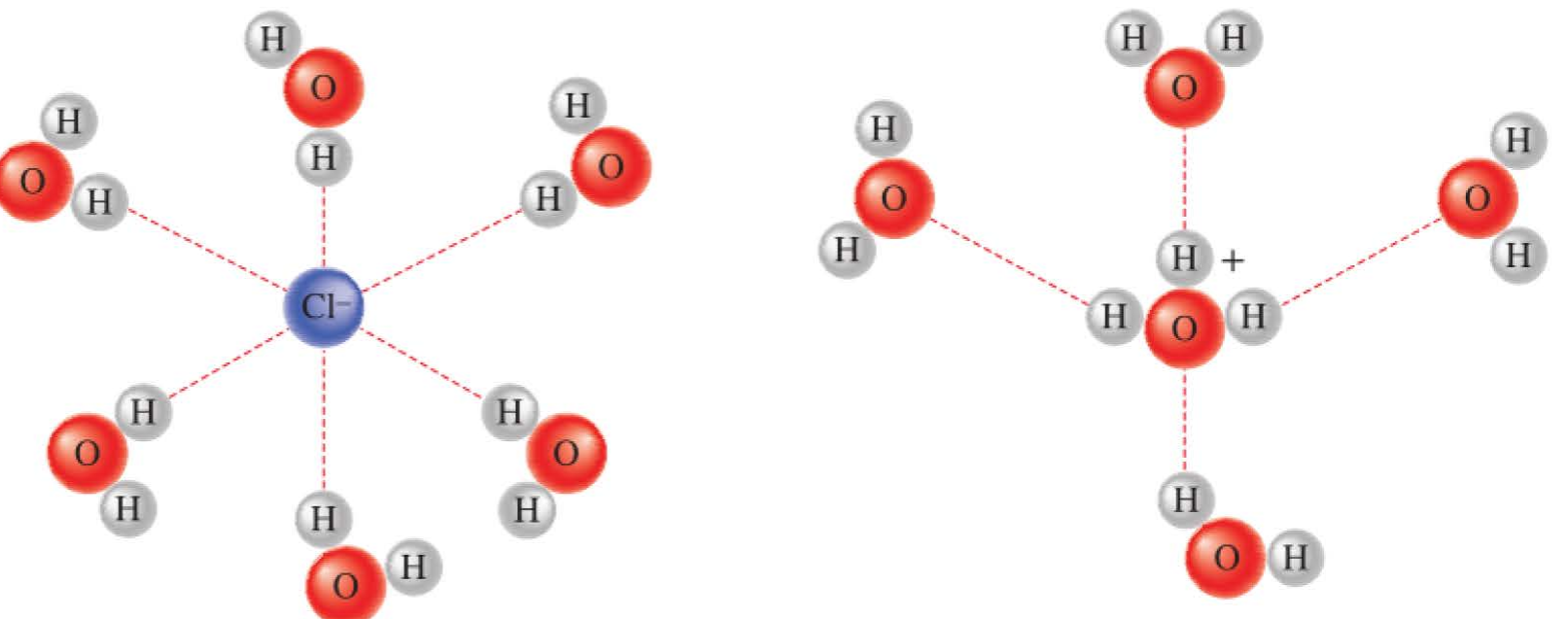
Around chloride ions, the charges on hydrogen atoms of water molecules are attracted to the negative charge of the chloride ion, forming ion-dipole attractions.
Around hydronium ions, the charges on oxygen atoms of water molecules are attracted to the positive charge, forming hydrogen bonds.
Example
Worked Example: Hydrogen Chloride Ionising in Water
Summary of the process:
- Polar covalent bonds within molecules break, producing and ions
- A covalent bond forms between each and an molecule, forming ions
- Ion-dipole attractions form between polar water molecules and ions
- Hydrogen bonds form between polar water molecules and ions
The equation for this process is:
Important points about this equation:
- Water is included as a reactant (not above the arrow) because atoms have been rearranged to form new substances
- The aqueous state of the ions indicates they are hydrated in solution
Note
Other compounds that dissolve by ionising include hydrobromic acid (), nitric acid (), and sulfuric acid ().
Dissociation of soluble ionic compounds in water
Many ionic compounds dissolve readily in water. Sodium chloride () is a typical example. It exists as a solid at room temperature with sodium cations () and chloride anions () arranged in a three-dimensional ionic lattice.
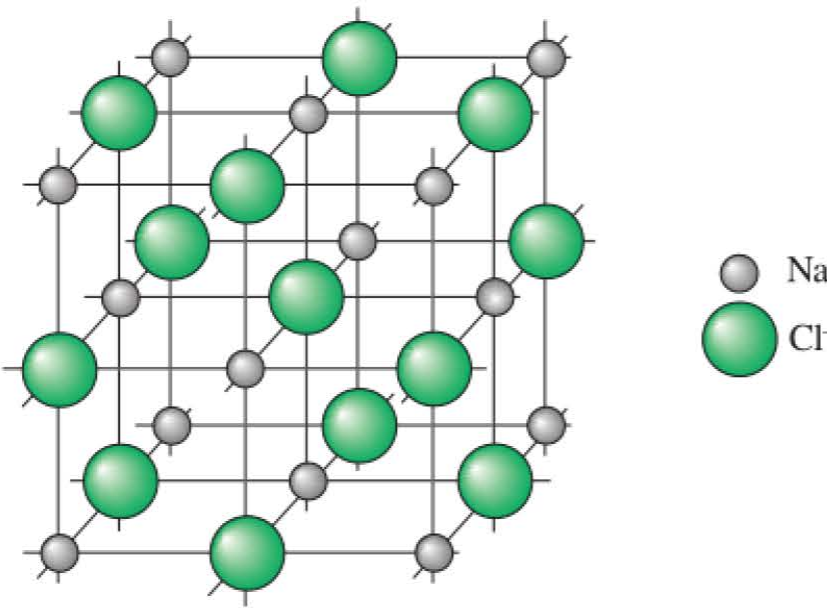
The ions are held together by strong electrostatic forces between the positive and negative charges - these are ionic bonds.
When sodium chloride is added to water, the positive ends of water molecules are attracted to negatively charged chloride ions, and the negative ends of water molecules are attracted to positively charged sodium ions.
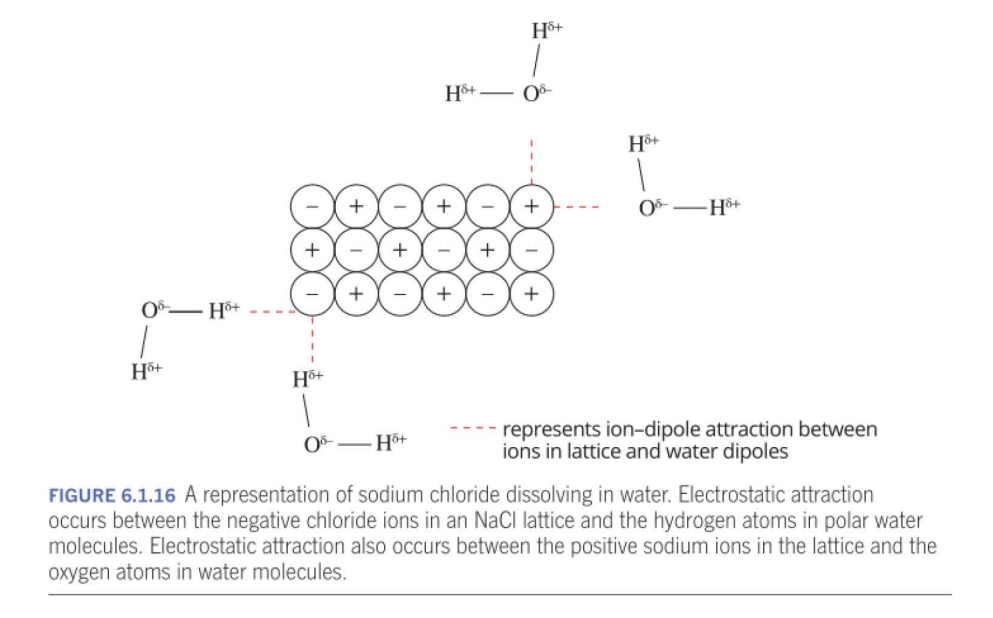
The attraction between an ion and a polar molecule like water is called an ion-dipole attraction.
Water molecules are in continuous random motion. If the ion-dipole attractions between ions and water molecules are strong enough, the water molecules can pull the sodium and chloride ions from the outer part of the crystal into the surrounding solution.
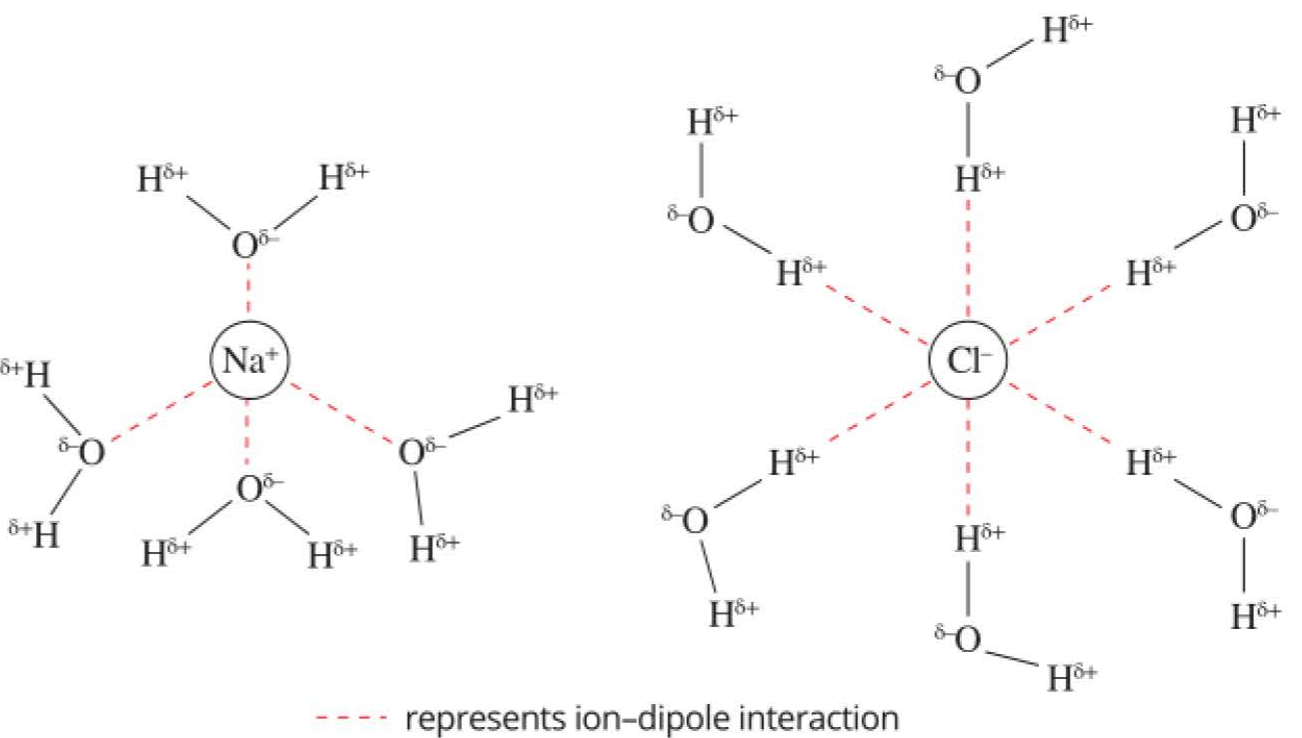
Ions pulled out of the lattice become surrounded by water molecules - they become hydrated. Note the different arrangements of water molecules around positive and negative ions:
- Around negative chloride ions, the more positive hydrogen atoms of water molecules are oriented towards the ion
- Around positive sodium ions, the more negative oxygen atoms of water molecules are oriented towards the ion
The process of separating positive and negative ions from a solid ionic compound to form hydrated ions is called dissociation.
Example
Worked Example: Sodium Chloride Dissolving in Water
Summary of the process:
- Ionic bonds within the sodium chloride lattice are broken
- Hydrogen bonds between water molecules are broken
- Ion-dipole attractions between ions and polar water molecules are formed
The equation for this dissociation process is:
Water sits above the arrow because there is no direct reaction between water and sodium chloride. The ions are simply separated and given the state symbol (aq) to indicate they are now dissolved in water.
Important
Critical Distinction: Ionisation vs Dissociation
Dissociation of ionic compounds is simply freeing ions from the lattice so they can move freely throughout the solution. The ions already existed in the solid.
Ionisation of molecular compounds involves new ions being formed by the reaction of the molecule with water. The ions did not exist before dissolving.
Insoluble ionic compounds
Not all ionic compounds are soluble in water. For example, limestone () is relatively insoluble in water.
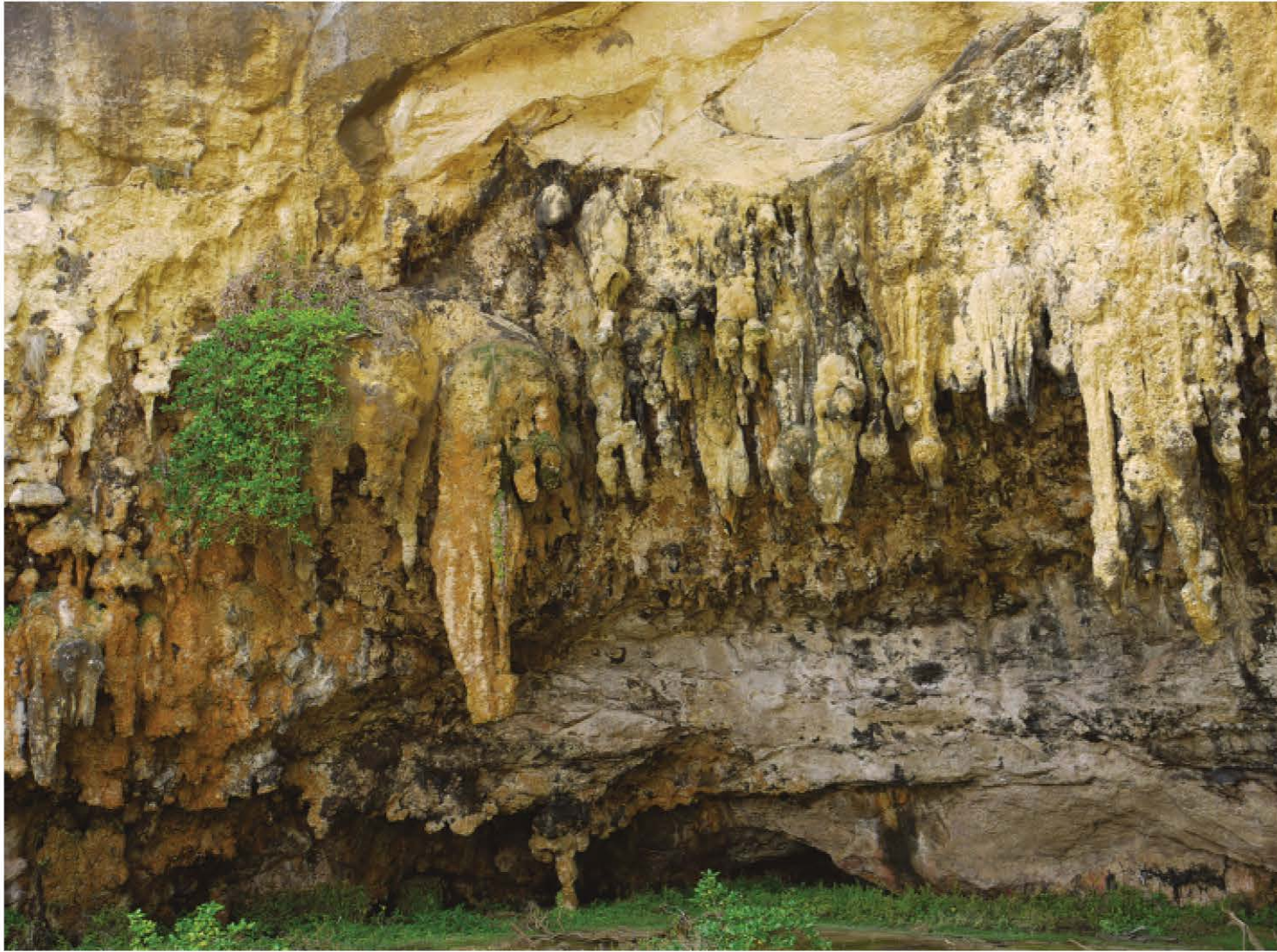
Limestone caves are formed over long periods as calcium carbonate slowly dissolves and is re-deposited. Other insoluble ionic compounds include , which gives strength to bones and teeth.
Insoluble ionic compounds do not dissolve in water because the forces of attraction between ions in the lattice (ionic bonds) are much stronger than the forces of attraction between water molecules and the ions (ion-dipole attractions).
Note
Although substances are often described as 'soluble' or 'insoluble', this is a generalisation. Substances described as 'insoluble' tend to dissolve very slightly, while those described as 'soluble' dissolve to varying extents. Solubility exists on a spectrum from highly soluble to almost insoluble.
Exam tips
Note
Key Points for Exam Success:
- When writing dissolution equations, pay attention to whether water goes above the arrow (simple mixing) or as a reactant (chemical change occurs)
- Remember the difference between ionisation (new ions formed) and dissociation (existing ions separated)
- Use the 'like dissolves like' rule to predict solubility, but remember that polarity is key
- For ionic compounds, check whether ion-dipole attractions are strong enough to overcome ionic bonds in the lattice
Remember!
Summary
Key Takeaways:
-
Solutions form when solute particles interact with solvent molecules. The solute becomes surrounded by solvent and dispersed throughout the solution.
-
Three forces determine solubility: forces within the solute, forces within the solvent, and forces between solute and solvent. For dissolution to occur, solute-solvent forces must be similar to or greater than the other two forces.
-
Like dissolves like: polar solvents dissolve polar or ionic solutes; non-polar solvents dissolve non-polar solutes. This rule helps predict whether substances will be miscible.
-
Molecular compounds can dissolve in two ways: by forming hydrogen bonds with water (like ethanol and sugars), or by ionising to form new ions (like forming and ).
-
Ionic compounds dissolve by dissociation: existing ions separate from the lattice and become hydrated by water molecules through ion-dipole attractions. This is different from ionisation, where new ions are created.