Essential Water (VCE SSCE Chemistry): Revision Notes
📚Revision Notes
Essential Water
Introduction
Water possesses unique chemical characteristics that make it essential for life on Earth. It regulates our weather patterns, shapes landscapes, and supports all living organisms. Water is the most abundant liquid on our planet, covering over 70% of Earth's surface. The total water supply on Earth exceeds 1.3 billion cubic kilometres and continuously cycles between land, oceans, rivers, and the atmosphere.
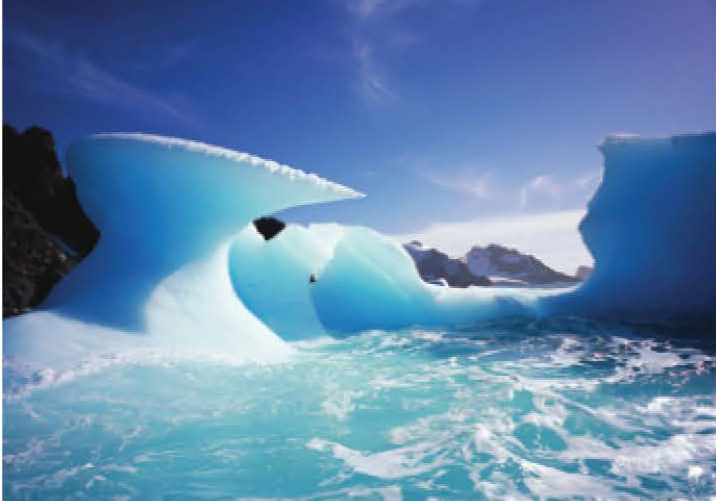
The availability of drinking water
In Australia, we have reliable access to clean drinking water through taps in our homes, schools, and workplaces. However, approximately 780 million people worldwide lack access to basic drinking water. Although Earth contains vast quantities of water, the ability of water to dissolve many substances means that many natural water sources do not provide fresh, drinkable water.
Note
The challenge isn't the total amount of water on Earth, but rather the availability of clean, drinkable water. Water's excellent solvent properties mean that many natural sources contain dissolved substances that make them unsuitable for direct consumption.
Water sources on Earth
Water exists naturally on Earth in three states of matter: solid (ice), liquid (water), and gas (water vapour).
The distribution of water across different locations on Earth is shown below:
| Location of water | State of matter | Volume (km³) | Percentage of total water (%) |
|---|---|---|---|
| Oceans | Liquid | 1,300,000,000 | 96.54 |
| Ice caps and glaciers | Solid | 24,000,000 | 1.74 |
| Groundwater | Liquid | 23,000,000 | 1.69 |
| Ground ice and permafrost | Solid | 300,000 | 0.022 |
| Lakes | Liquid | 180,000 | 0.013 |
| Soil moisture | Liquid | 17,000 | 0.001 |
| Atmosphere as water vapour | Gas | 13,000 | 0.001 |
| Rivers | Liquid | 2,100 | 0.0002 |
Despite these large quantities of water, there is a limited supply of fresh water on our planet. Only 2.5% of Earth's water is fresh and therefore potentially drinkable. Most of this fresh water is not accessible because it is locked up in ice caps, glaciers, or soil.
Important
Critical Water Scarcity: Of the 2.5% fresh water on Earth, only 0.5% is accessible for human use. This means that of all water on Earth, less than 0.02% is readily available as drinking water.
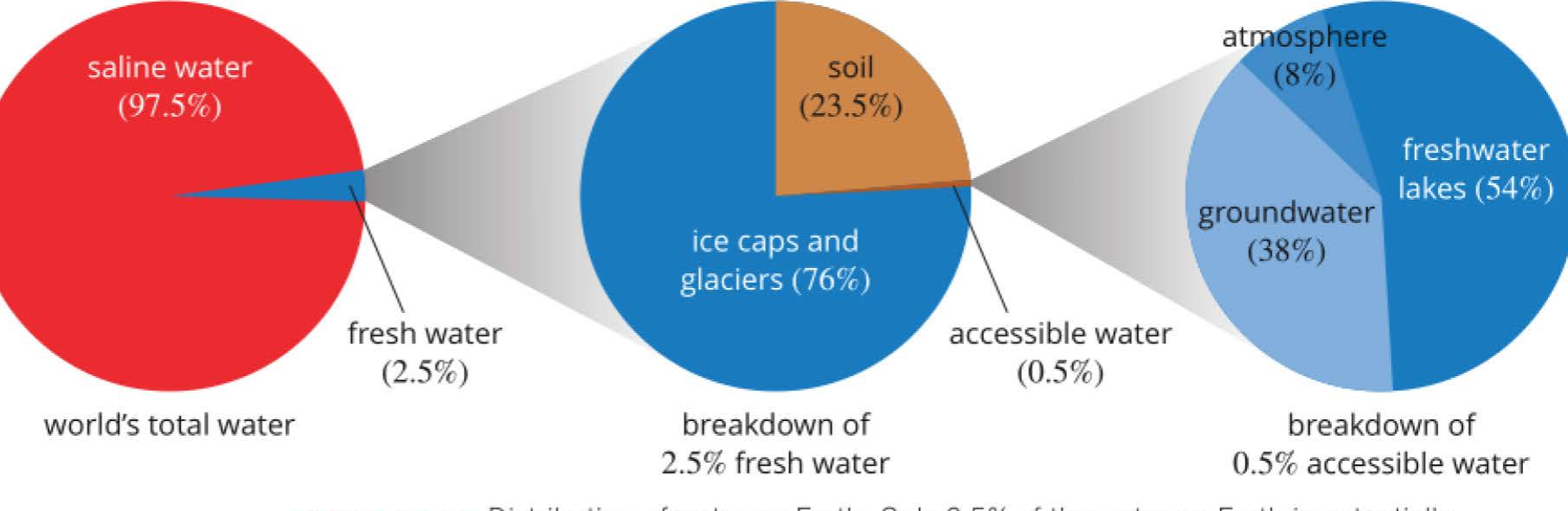
Key point: Of the 2.5% fresh water on Earth, only 0.5% is accessible. Within this accessible water, freshwater lakes contain 54%, groundwater contains 38%, and the atmosphere contains 8%.
Obtaining clean drinking water in Australia
Potable water is clean drinking water that has been treated to make it safe for human consumption. Obtaining potable water requires significant infrastructure to supply towns and cities with high-quality drinking water from naturally occurring water sources.
Major sources of drinking water
Drinking water in Australia comes from various sources:
- Reservoirs filled by run-off from rivers and streams
- Water obtained directly from rivers and lakes
- Groundwater (often called bore water in Australia)
- Recycled water
- Desalinated seawater
In most Australian major cities, water comes from reservoirs built on rivers in protected areas. These reservoirs are surrounded by protected land, often located in national parks and forests with limited access to ensure water quality remains very high. Water from such sources remains clean and requires only minor treatment before consumption.
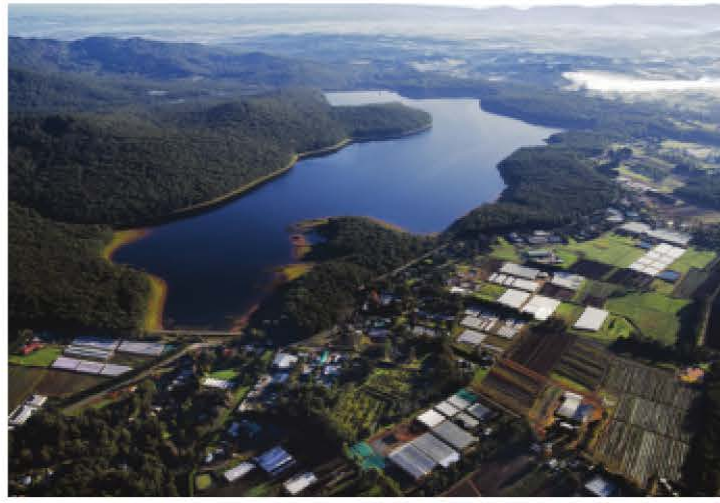
In some inland parts of Australia and other Asia-Pacific countries, water comes from sources other than protected catchments. These may include rivers and lakes subject to contamination from agricultural and urban run-off, or groundwater sources that may require more complex purification processes.
Note
Australian Water Sources Examples
Different regions rely on different water sources based on geographical and environmental factors:
| City or town | Main water source |
|---|---|
| Alice Springs, NT | Groundwater |
| Adelaide, SA | Torrens and Murray rivers |
| Bourke, NSW | Darling River |
| Broome, WA | Groundwater |
| Melbourne, VIC | Reservoirs |
| Mildura, VIC | Murray River |
| Birdsville, QLD | Groundwater |
| Hobart, TAS | Derwent River |
Drinking water in Victoria
Most Victorians obtain drinking water from a mains water supply - water piped from a reservoir and controlled by a local water authority. Where piped water supply is unavailable, drinking water may come from:
- Rainwater tanks
- Bores
- Dams
- Rivers and creeks
The Great Artesian Basin
The Great Artesian Basin is the world's largest underground water supply (artesian basin), lying beneath one-fifth of the Australian landmass. It provides a reliable water source for irrigation, livestock, and domestic use across a large part of inland Australia.
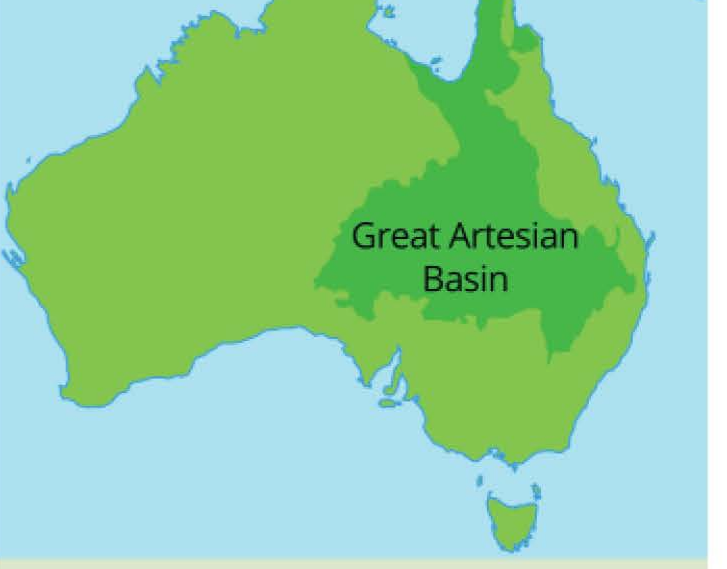
Key features:
- Covers over 1,700,000 km², underlying nearly one-fifth of Australia
- In some places, the basin extends up to 3,000 m deep
- Water temperatures range from 30°C to 100°C
- Traditionally accessed through bore holes, now managed by government initiatives to maintain water stores
Water contamination risks
Different water sources present different levels of contamination risk. The hierarchy from lowest to highest risk is:
Note
Contamination Risk Hierarchy:
- Lowest risk: Mains water (rigorously tested)
- Rainwater
- Deep groundwater
- Shallow groundwater
- Highest risk: Surface water (rivers and lakes)
Mains water undergoes rigorous testing and poses the lowest contamination risk, while surface water carries the highest risk of contamination.
Special properties of water
Water possesses several special properties that allow it to support life. Space scientists search for water throughout the universe as an indicator of potential life beyond Earth. These special properties can be explained by understanding the structure of water molecules and the hydrogen bonding between them.
Structure and bonding of water
Water has the chemical formula , meaning each water molecule contains one oxygen atom covalently bonded to two hydrogen atoms.
Important
The covalent bonds in a water molecule are polar because oxygen has higher electronegativity than hydrogen. This means the shared electron pairs in the O–H covalent bonds are more strongly attracted to the oxygen atom than to the hydrogen atoms. The entire molecule is polar overall.
Hydrogen bonding
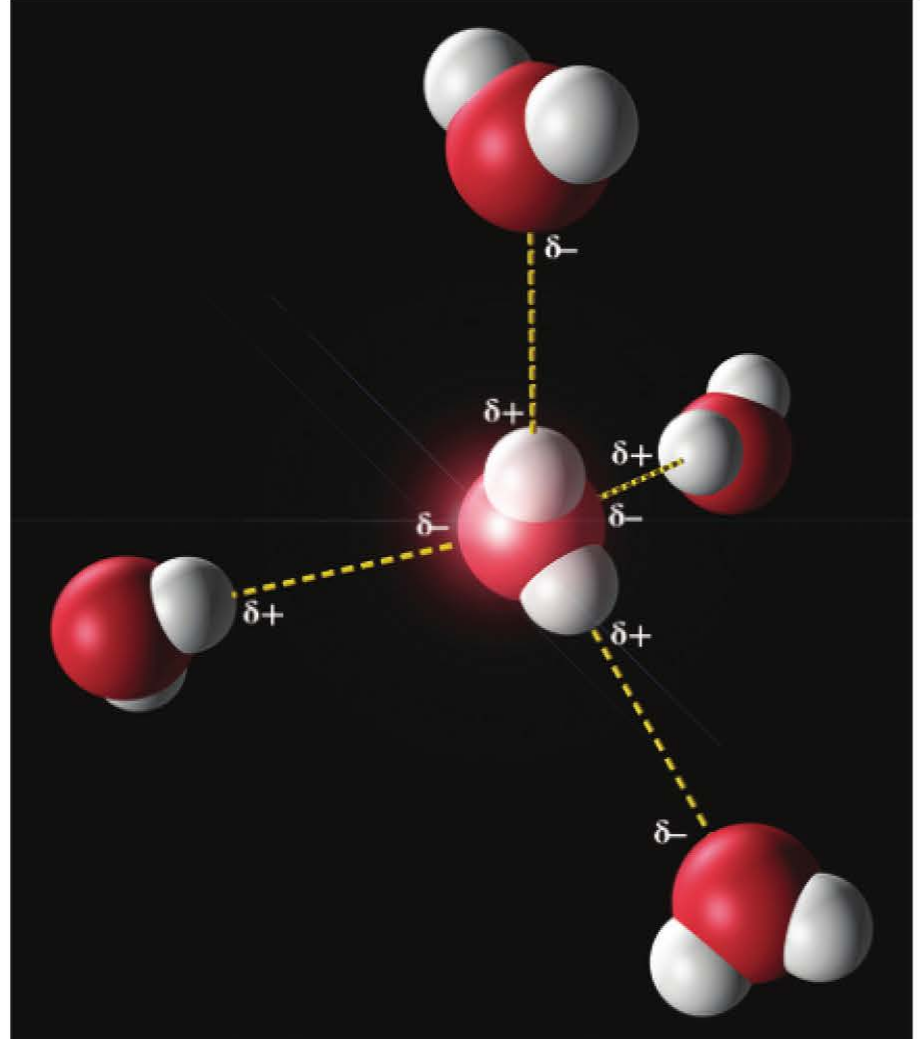
The main type of intermolecular force between water molecules is the hydrogen bond. Hydrogen bonds form through electrostatic attraction between the partial positive charge on a hydrogen atom of one water molecule and a non-bonding pair (lone pair) of electrons on the oxygen atom of a neighbouring water molecule.
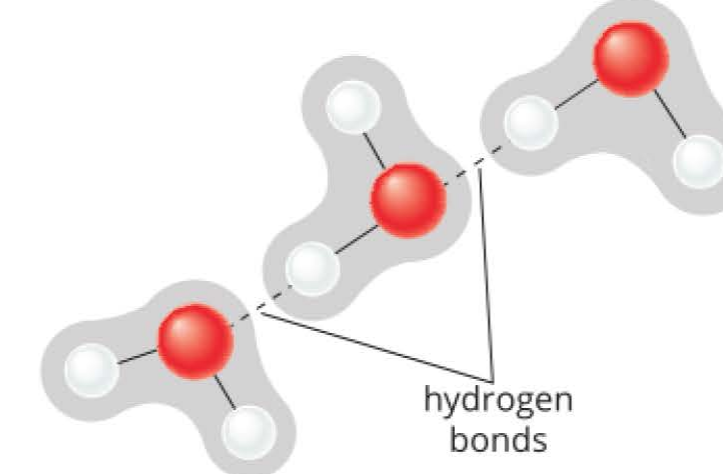
The large electronegativity difference between oxygen and hydrogen atoms creates relatively large partial charges on the atoms in a water molecule. This makes the electrostatic attraction between opposite partial charges strong, resulting in relatively strong hydrogen bonds between water molecules.
Important
Four Hydrogen Bonds Per Molecule
Each water molecule can form up to four hydrogen bonds with surrounding water molecules. There are two partially charged hydrogen atoms and two lone pairs of electrons on the oxygen atom in each molecule, so all hydrogen atoms and lone pairs can participate in hydrogen bonding.
This maximum of four hydrogen bonds per molecule is a key feature that explains many of water's unique properties.
Relatively high melting and boiling points
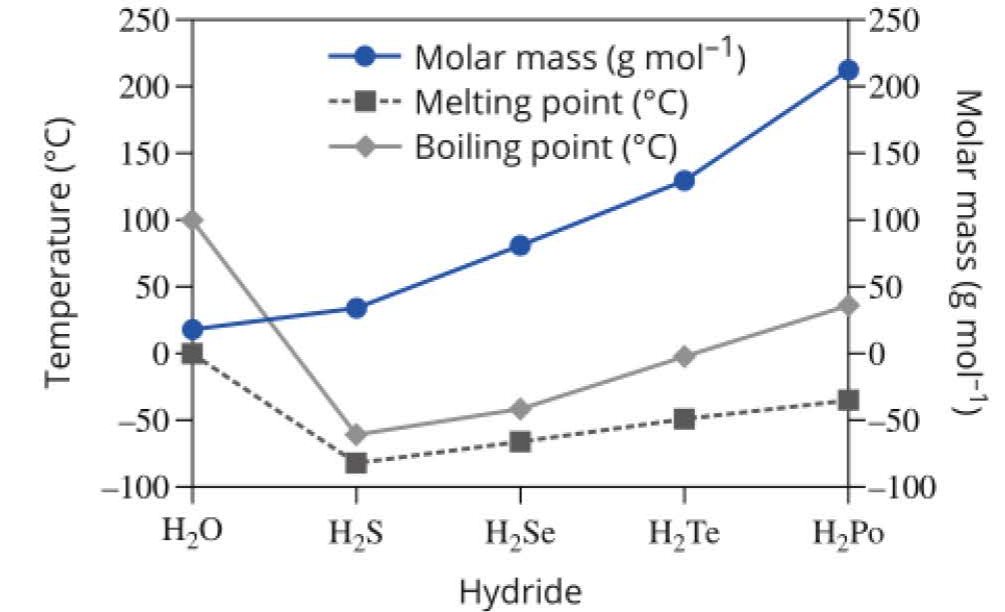
Compared to other molecules of similar size, water has exceptionally high boiling and melting points. This is most clearly demonstrated by comparing water with other group 16 hydrides.
Group 16 elements include oxygen (O), sulfur (S), selenium (Se), tellurium (Te), and polonium (Po). Each can bond with hydrogen to form a hydride compound. Water can be classified as a group 16 hydride (it could also be called hydrogen oxide).
| Group 16 element | Name of hydride | Formula of hydride |
|---|---|---|
| O | Water | |
| S | Hydrogen sulfide | |
| Se | Hydrogen selenide | |
| Te | Hydrogen telluride | |
| Po | Hydrogen polonide |
The group 16 hydrides are all molecular compounds. Their melting and boiling points reflect the strength of intermolecular forces between molecules. Higher melting and boiling points indicate stronger intermolecular forces, as more energy is required to overcome these forces and allow molecules to move apart during melting or evaporation.
Physical properties of group 16 hydrides:
| Hydride | Molar mass (g mol⁻¹) | Melting point (°C) | Boiling point (°C) |
|---|---|---|---|
| 18.0 | 0 | 100 | |
| 34.1 | -82 | -60.7 | |
| 81.0 | -66 | -41.5 | |
| 129.6 | -49 | -2.2 | |
| 212.0 | -35 | 36.1 |
Example
Comparing Group 16 Hydrides: The Water Anomaly
When examining the data for group 16 hydrides:
Expected pattern: As we move down the group from to , both melting and boiling points increase with molecular mass. This is because larger molecules have stronger dispersion forces.
Water's exception: has the smallest molar mass (18.0 g mol⁻¹) but the highest melting point (0°C) and highest boiling point (100°C).
Explanation: While other group 16 hydrides rely mainly on dispersion forces, water molecules are held together by much stronger hydrogen bonds, requiring significantly more energy to break during phase changes.
Apart from water, both melting and boiling points increase down the group of elements. The intermolecular forces strengthen down the group as the atom bonding with hydrogen increases in mass. For example, has greater mass than , , and , giving it stronger dispersion forces and higher melting and boiling points. However, , which has the smallest mass, has the highest melting and boiling points.
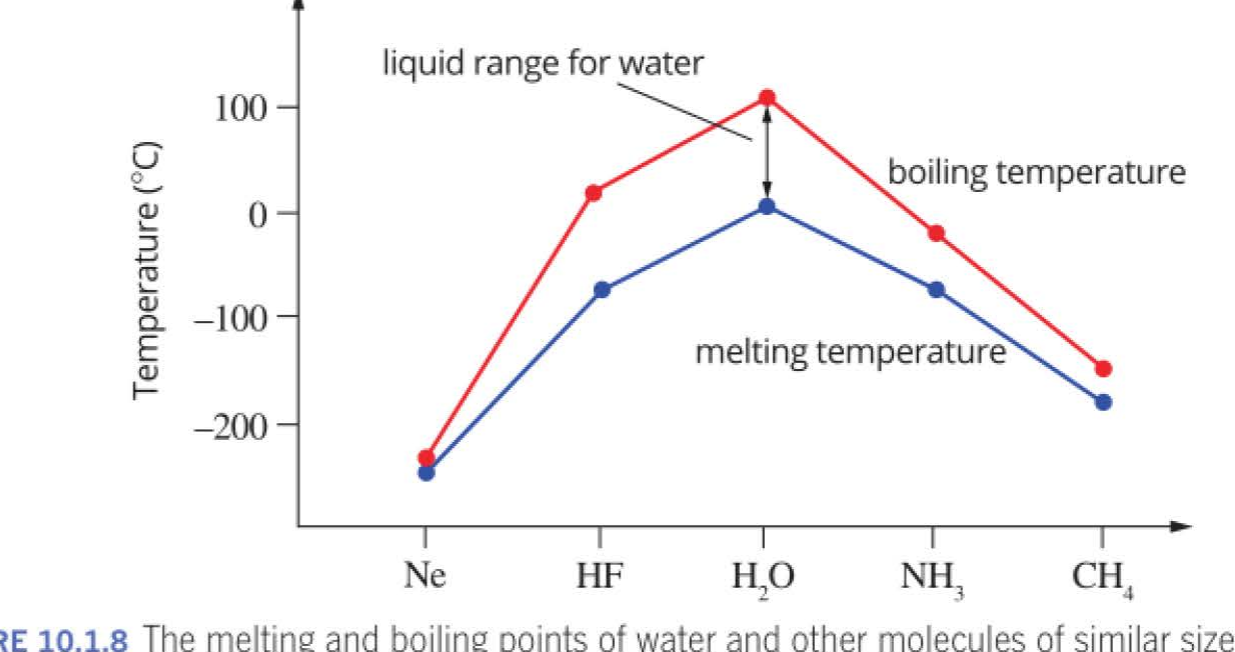
Water also has significantly higher melting and boiling points than other molecular substances of similar size, including neon (Ne), hydrogen fluoride (HF), ammonia (), and methane ().
Important
Why Water's Melting and Boiling Points Are So High
The strong hydrogen bonds between water molecules give water its relatively high melting and boiling points. Of all the group 16 hydrides, only water has hydrogen bonding as the strongest intermolecular force. Significant energy is needed to disrupt these hydrogen bonds, resulting in the higher melting and boiling points observed for water.
Exam tip: When explaining water's high melting/boiling points, always reference the strong hydrogen bonds between molecules and the energy required to overcome them.
Density of liquid water and solid ice
Another unusual property of water is that solid ice floats in liquid water because solid ice has lower density. For most other substances, the solid state is denser than the liquid, causing the solid to sink in the liquid.
Density is a measurement of the mass of a unit volume of a substance, calculated using:
In solid ice, there is less mass present in the same volume compared to liquid water. Water molecules are arranged in ice in a more spread-out pattern than in the liquid state. Solid ice has a density of 0.917 g mL⁻³, whereas liquid water has a density of 0.997 g mL⁻³ at 25°C.
Expansion of water on freezing
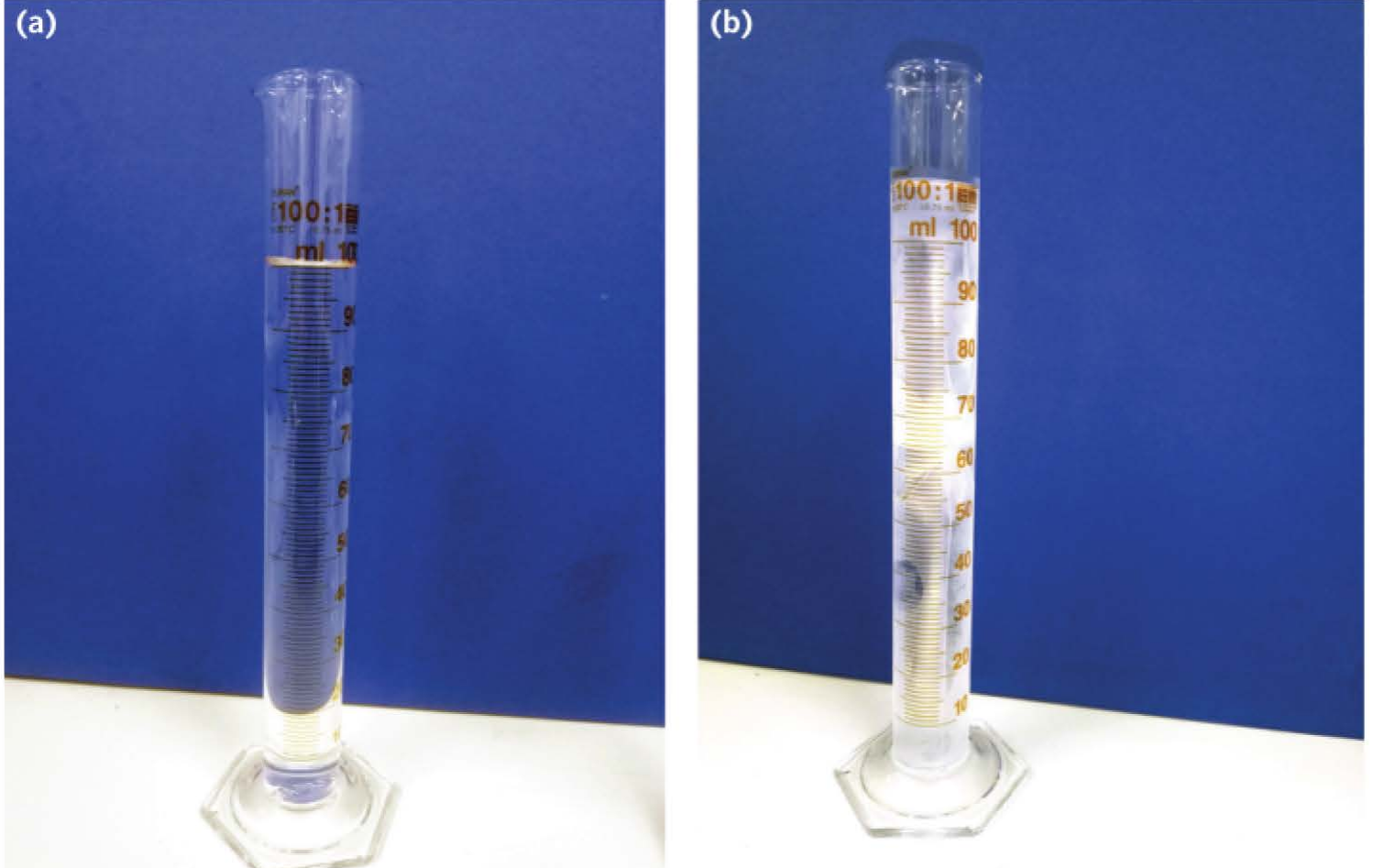
When water freezes, it expands. A sample of liquid water occupying 100 mL in a measuring cylinder expands to approximately 110 mL when frozen. This expansion can even crack containers if they are not designed to accommodate it.
Note
Why Does Water Expand When It Freezes?
As liquid water cools, water molecules move more slowly. When approaching the freezing temperature, molecules arrange so that each water molecule forms four hydrogen bonds with four neighbouring water molecules. This creates a very open arrangement of molecules, meaning water molecules are more widely spaced in ice than in liquid water. Therefore, ice is less dense than liquid water and floats. When ice melts, water molecules move more freely and become closer together.
Molecular explanation: As liquid water cools, water molecules move more slowly. When approaching the freezing temperature, molecules arrange so that each water molecule forms four hydrogen bonds with four neighbouring water molecules. This creates a very open arrangement of molecules, meaning water molecules are more widely spaced in ice than in liquid water. Therefore, ice is less dense than liquid water and floats. When ice melts, water molecules move more freely and become closer together.
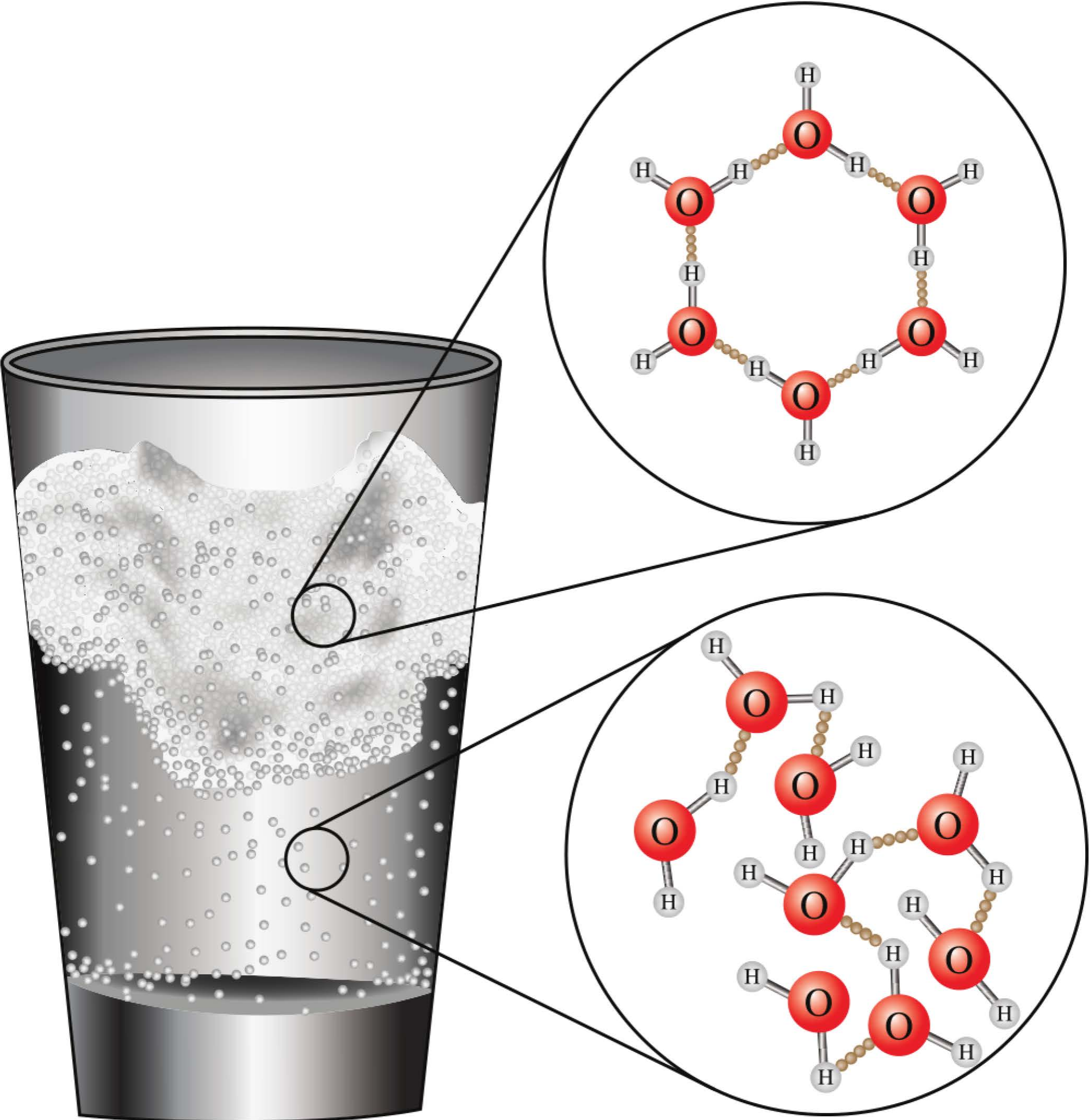
The crystal lattice structure of ice shows how each water molecule connects to four others through hydrogen bonds, creating a rigid framework with significant empty space between molecules. This open structure explains why ice is less dense than liquid water.
The importance of floating ice
The fact that ice floats has critical ecological importance. In countries with cold winters (such as parts of North America, the United Kingdom, and Europe), lakes and rivers completely freeze over. While this can be inconvenient for navigation, requiring icebreaker ships to break through surface ice, the low density of ice is essential for the survival of aquatic organisms.
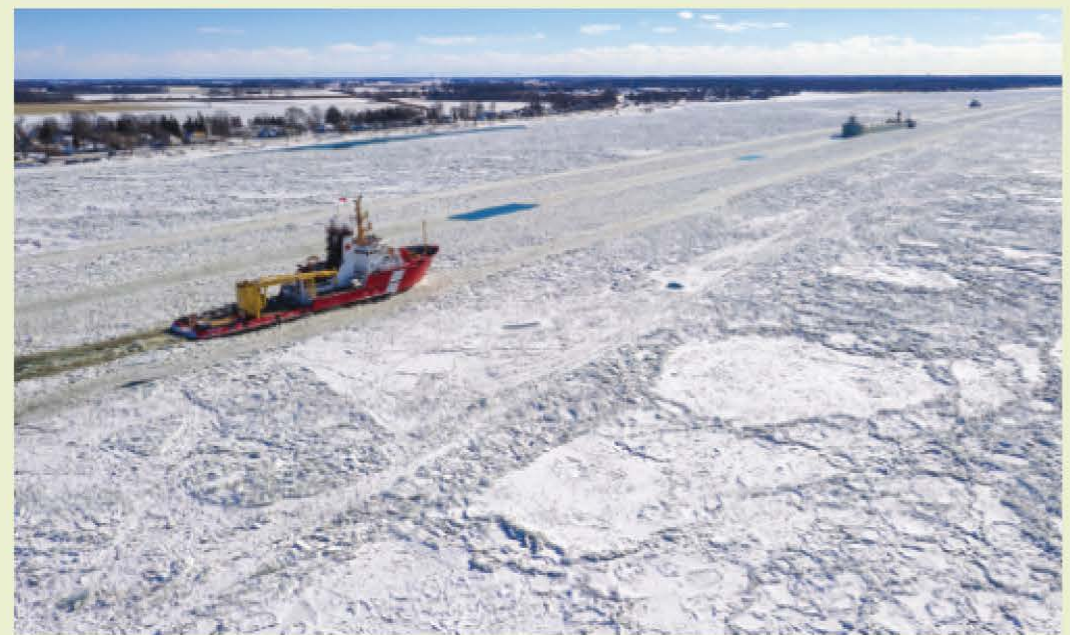
A layer of ice on the surface of water bodies forms an insulating barrier that separates warmer water below from cold air temperatures above. If ice were denser than water and sank to the bottom, new surface water would become exposed to cold air, also freeze, and sink. Eventually, the entire lake or river could freeze solid from bottom to top, and living organisms would not survive. Water below ice layers maintains a temperature of approximately 4°C, which is cold but above freezing, allowing aquatic life to survive.
Note
Ice as a Life-Saving Insulator
The floating ice layer acts as a protective blanket for aquatic ecosystems:
- Ice at the surface insulates the water below
- Water beneath maintains temperatures around 4°C
- This temperature is cold but still liquid, allowing fish and other organisms to survive
- Without this property, entire water bodies could freeze solid, making survival impossible
The density of liquid water varies slightly with temperature:
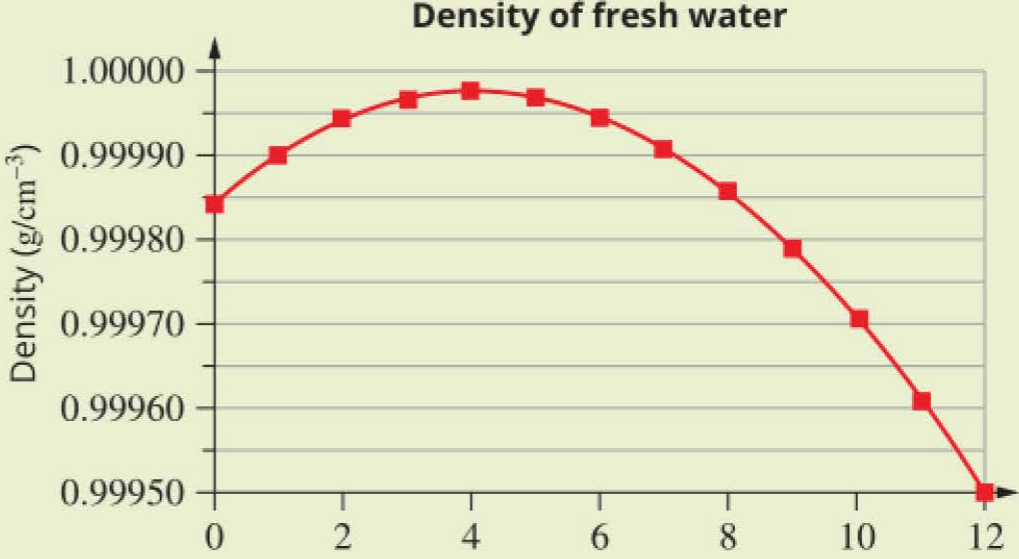
Key observation: Liquid water reaches its maximum density at approximately 4°C. At temperatures both above and below 4°C, water is slightly less dense. This property is crucial for aquatic ecosystems, as the densest water sinks to the bottom while ice forms at the surface.
Summary
Key Points to Remember
Water Distribution:
- Only 2.5% of Earth's water is fresh water
- Only 0.5% of that fresh water is accessible for human use
- The majority (96.54%) is saline ocean water
Hydrogen Bonding:
- Each water molecule can form up to four hydrogen bonds with neighbouring molecules
- Two hydrogen atoms and two lone pairs on oxygen enable this
- These hydrogen bonds are relatively strong due to the large electronegativity difference between oxygen and hydrogen
Exceptional Melting and Boiling Points:
- Water's melting point: 0°C
- Water's boiling point: 100°C
- These are exceptionally high compared to similar-sized molecules and other group 16 hydrides
- Caused by strong hydrogen bonds requiring significant energy to break
Ice Floats:
- Solid ice is less dense (0.917 g mL⁻³) than liquid water (0.997 g mL⁻³)
- Water molecules arrange in an open crystal lattice structure when frozen
- Each molecule forms four hydrogen bonds, creating more space between molecules than in liquid water
Ecological Importance:
- Ice floating creates an insulating layer protecting aquatic life below
- Water beneath ice maintains temperatures around 4°C even in freezing conditions
- This property is essential for the survival of aquatic ecosystems in cold climates