Bearings and Navigation (VCE SSCE General Mathematics): Revision Notes
📚Revision Notes
Bearings and Navigation
Introduction to three-figure bearings
When navigating or surveying land, we need a clear way to describe directions. This is where bearings come in handy.
A true bearing is an angle that tells you which direction to face. You measure this angle by starting at north and turning clockwise until you point in the direction you want. True bearings are also called three-figure bearings because we always write them using exactly three digits. For example, the direction we call "east" has a bearing of (that's clockwise from north).
Note
Key points about three-figure bearings:
- Always start measuring from north
- Always turn clockwise
- Always use three digits (add zeros at the start if needed)
- Each cardinal direction is separated by
How to determine three-figure bearings
Let's work through a method for calculating three-figure bearings from a diagram. The key is to count up all the angles you sweep through when turning clockwise from north to your target direction.
Example
Worked Example: Calculating a Three-Figure Bearing
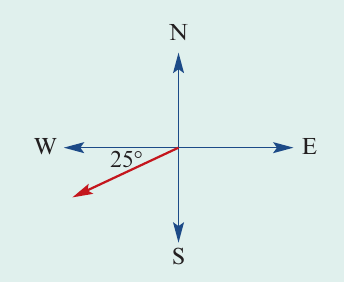
Find the three-figure bearing for the direction shown in the diagram below.
Solution:
To solve this, we need to work out the total angle swept clockwise from north.
Remember that there's a angle between each pair of cardinal compass points (N to E, E to S, S to W, W to N).
Looking at the diagram, we can see the direction arrow points southwest. Starting from north and moving clockwise:
- From N to E:
- From E to S:
- From S to the arrow: we need to calculate this
The arrow makes a angle with the east-west line. This means the angle from S to the arrow is .
Adding all these angles together:
Alternatively, we could calculate this as:
Therefore, the three-figure bearing is 245°.
Navigation problems using bearings
Navigation problems combine bearings (direction) with distances travelled. To solve these problems, we often need to use trigonometry with right-angled triangles.
Example
Worked Example: Bushwalker Navigation Problem
A group of bushwalkers leave point , which is on a road that runs north-south. They walk km on a bearing of to reach point .
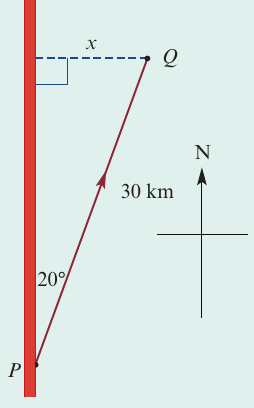
Part a: What is the shortest distance, , from back to the road (to one decimal place)?
Solution:
First, we need to identify the right-angled triangle that will help us solve this problem.
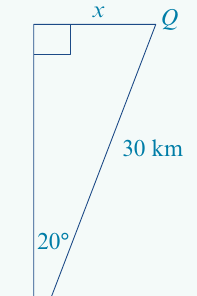
The shortest distance from Q to the road will be perpendicular to the road. This creates a right-angled triangle where:
- The hypotenuse is km (the distance walked)
- The angle at is
- We need to find (the opposite side)
Since we have the opposite side and the hypotenuse, we use the sine ratio:
Substituting our known values:
Multiply both sides by :
Using a calculator:
Therefore, the shortest distance to the road is 10.3 km.
Example
Part b: Looking from point , what would be the three-figure bearing of their starting point?
Solution:
To find the bearing from back to , we need to draw the compass points at Q and use alternate angles.
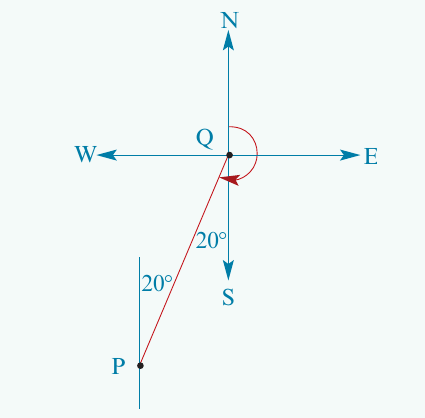
When we draw the compass at , we can see that the angle at (looking towards ) is also (alternate angles on parallel lines - both north-south lines are parallel).
Standing at and facing north, we need to turn clockwise to face :
- From N to S:
- From S towards :
Adding these together:
Therefore, the three-figure bearing from to is 200°.
Important
Common Mistakes to Avoid:
- Forgetting to use alternate angles when finding reverse bearings
- Measuring angles anti-clockwise instead of clockwise
- Writing bearings with only one or two digits (always use three!)
- Confusing which trigonometric ratio to use - check what sides you have
Exam tips
Note
Exam Strategy:
- Always draw a clear diagram showing all compass directions
- Mark all known angles and distances on your diagram
- Look for right-angled triangles in navigation problems
- Remember to use alternate angles when finding reverse bearings
- Check that your bearing is between and
- Use three digits even for small angles (write not )
Remember!
Summary
Key Points to Remember:
- A three-figure bearing is measured clockwise from north and written with three digits
- There is between each cardinal compass point (N, E, S, W)
- Navigation problems combine bearings with distances and often require trigonometry
- To find the reverse bearing, draw compass points at the new location and use alternate angles
- The trigonometric ratio you use depends on which sides of the triangle you know or need: use , , or