Finding an Angle in a Right-Angled Triangle (VCE SSCE General Mathematics): Revision Notes
📚Revision Notes
Finding an Angle in a Right-Angled Triangle
Introduction to inverse trigonometric functions
When working with right-angled triangles, you sometimes need to work backwards from a trigonometric ratio to find the angle that produced it. This process uses inverse trigonometric functions.
Think of it this way: if someone tells you that , and challenges you to discover what angle was used, you need a way to reverse or "undo" the sine operation.
The reverse operation for sine is called the inverse of sine, written as . The superscript is not a power or exponent. It simply indicates that we are undoing or reversing the sine function.
Note
The inverse notation can be confusing because the superscript looks like an exponent. However, it has nothing to do with powers or reciprocals. It specifically means "the inverse function" - the operation that reverses or undoes the sine function.
Understanding the cycle
The relationship between a trigonometric function and its inverse can be visualised as a cycle:
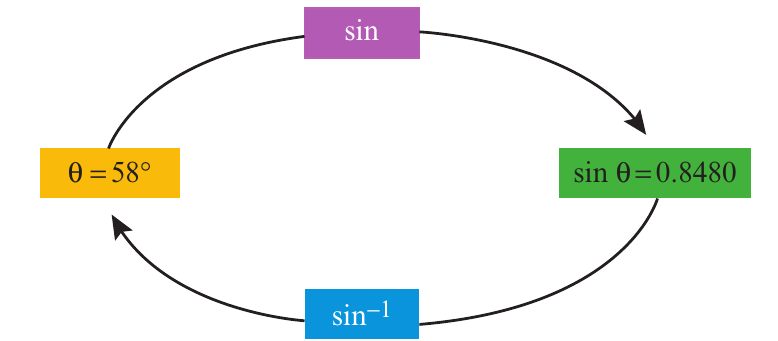
The cycle shows how sine and its inverse work together:
- The forward arrow shows: given an angle , use sine to find
- The backward arrow shows: given , use to find the angle
For example:
- Forward:
- Backward:
The three inverse functions
Just as there are three main trigonometric functions, there are three inverse functions:
- (inverse sine): used to find an angle when you know the sine ratio
- (inverse cosine): used to find an angle when you know the cosine ratio
- (inverse tangent): used to find an angle when you know the tangent ratio
Finding an angle from a trigonometric ratio value
When you know the value of a trigonometric ratio and need to find the corresponding angle, you use your calculator's inverse function keys.
Using your calculator
On a CAS calculator, you'll find the inverse function keys labelled as , , and . The general process is straightforward: access the appropriate inverse function, enter the ratio value, and calculate.
Example
Worked Example: Using Inverse Functions
Part a) For sine: To find when
- Access the function on your calculator
- Enter the value:
- Press enter to calculate
- Result: (to one decimal place)
Part b) For cosine: To find when
- Access the function
- Enter:
- Press enter
- Result:
Part c) For tangent: To find when
- Access the function
- Enter:
- Press enter
- Result: (to one decimal place)
Understanding the language
The terminology used with inverse trigonometric functions can be confusing at first. Here's how to read and interpret the notation:
| When you see: | Think: |
|---|---|
| "The sine of the angle 58° equals 0.8480" | |
| "The angle whose sine is 0.8480 equals 58°" | |
| "The cosine of the angle 60° equals 0.5" | |
| "The angle whose cosine is 0.5 equals 60°" | |
| "The tangent of the angle 59.1° equals 1.67" | |
| "The angle whose tangent is 1.67 equals 59.1°" |
Note
The key phrase to remember is "the angle whose [function] is [value]" when reading inverse notation. This helps you understand that you're finding an angle, not calculating a ratio.
Finding an angle when given two sides
When you know two sides of a right-angled triangle and need to find an unknown angle, you combine your knowledge of trigonometric ratios with inverse functions.
Step-by-step method
Step 1: Identify which two sides you know (opposite, adjacent, or hypotenuse relative to the angle you're finding)
Step 2: Choose the appropriate trigonometric ratio:
- If you know the opposite and hypotenuse: use
- If you know the adjacent and hypotenuse: use
- If you know the opposite and adjacent: use
Step 3: Substitute the known side lengths into the ratio formula
Step 4: Use the appropriate inverse function to find the angle
Important
The most critical step is correctly identifying which sides you have relative to the angle you're finding. Always label your triangle clearly with "opposite", "adjacent", and "hypotenuse" before starting your calculation. Choosing the wrong ratio is a common mistake that leads to incorrect answers.
Worked example
Example
Worked Example: Finding an Angle from Two Sides
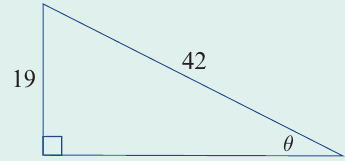
Question: Find the angle in this right-angled triangle to one decimal place.
Solution:
First, identify the sides relative to angle :
- The side of length 19 is opposite to
- The side of length 42 is the hypotenuse
Since we have the opposite and hypotenuse, we use the sine ratio:
Substitute the known values:
To find , use the inverse sine function:
Using a calculator:
Therefore, to one decimal place:
Finding the other acute angle
Remember that the three angles in any triangle sum to . In a right-angled triangle, one angle is , so the other two acute angles must sum to .
Once you've found one acute angle, you can find the other by subtracting from .
In the example above, the other acute angle would be:
Method summary
Summary
To find an angle in a right-angled triangle when given two sides:
-
Draw and label the triangle clearly, marking the unknown angle as
-
Identify the two known sides relative to the angle you're finding
-
Select the appropriate trigonometric ratio:
- Opposite and hypotenuse → use sine
- Adjacent and hypotenuse → use cosine
- Opposite and adjacent → use tangent
-
Divide the side lengths to calculate the value of the trigonometric ratio
-
Use the corresponding inverse function (, , or ) on your calculator to find the angle
-
Round your answer to the required number of decimal places
Exam tips
Important
Critical Calculator and Technique Tips:
- Always check your calculator is in degree mode, not radian mode
- Label your triangle clearly before starting calculations
- Show your working by writing out the trigonometric ratio before substituting values
- Remember that , , and are functions, not powers
- Use brackets when entering fractions into your calculator: not
Remember!
Summary
Key Points to Remember:
- Inverse trigonometric functions (, , ) are used to find angles from trigonometric ratio values
- The notation means "the angle whose sine is 0.8480 equals 58°"
- To find an angle in a right-angled triangle: identify the two known sides, choose the correct ratio, then use the inverse function
- The two acute angles in a right-angled triangle always sum to
- Always show your working and use brackets correctly when entering calculations into your calculator