Finding an Unknown Side in a Right-Angled Triangle (VCE SSCE General Mathematics): Revision Notes
📚Revision Notes
Finding an Unknown Side in a Right-Angled Triangle
Introduction
When you know one angle and the length of one side in a right-angled triangle, you can calculate the length of another side using trigonometric ratios. This is a powerful technique that works for any right-angled triangle, regardless of its size or orientation.
The key is choosing the correct trigonometric ratio based on which sides are involved in your problem.
The three trigonometric ratios
There are three main trigonometric ratios you need to know: sine, cosine, and tangent. Each ratio relates two sides of a right-angled triangle to an angle.
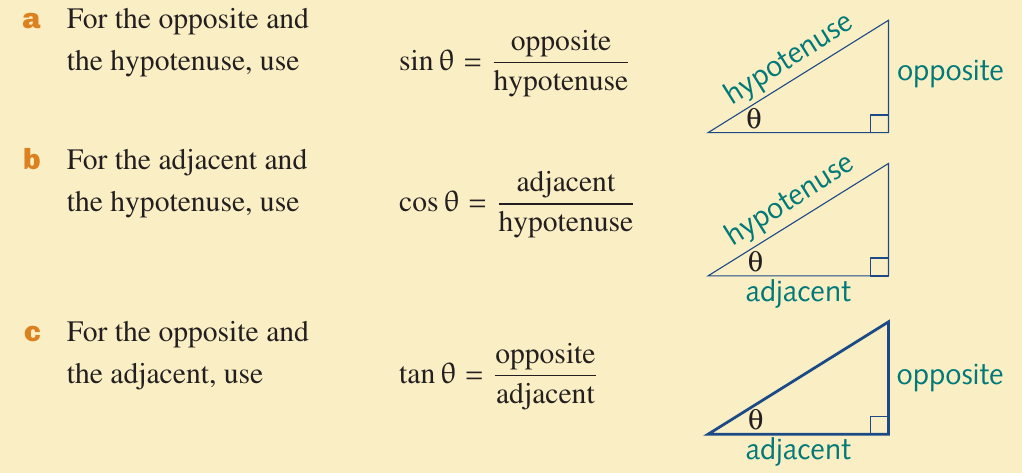
Sine (sin)
Use sine when you're working with the opposite side and the hypotenuse.
Cosine (cos)
Use cosine when you're working with the adjacent side and the hypotenuse.
Tangent (tan)
Use tangent when you're working with the opposite side and the adjacent side.
Remembering the ratios: SOH-CAH-TOA
Note
The SOH-CAH-TOA Mnemonic
A helpful way to remember these ratios is the mnemonic SOH-CAH-TOA:
- Sine = Opposite / Hypotenuse
- Cosine = Adjacent / Hypotenuse
- Tangent = Opposite / Adjacent
This mnemonic is one of the most useful memory aids in trigonometry!
Identifying the sides
Before using any trigonometric ratio, you need to identify the sides of your triangle:
- Hypotenuse: Always the longest side, opposite the right angle
- Opposite: The side across from the angle you're working with
- Adjacent: The side next to the angle you're working with (but not the hypotenuse)
Important
Critical Point About Side Labels
Remember that the "opposite" and "adjacent" labels depend on which angle you're considering. They can change if you work with a different angle in the same triangle. Always identify these sides relative to the angle you're using, not the right angle.
Finding an unknown side in the numerator
When the unknown side appears in the top (numerator) of your trigonometric ratio, the solution method is straightforward.
Example
Worked Example: Finding the Opposite Side
Find the length of the unknown side, , in the triangle shown to two decimal places.
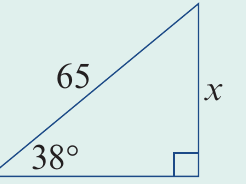
Step 1: Identify which sides are involved
Looking from the 38° angle:
- The side we're finding () is the opposite side
- The side we know (65) is the hypotenuse
Step 2: Choose the appropriate trigonometric ratio
Since we're using the opposite and the hypotenuse, we use sine:
Step 3: Substitute the known values
Step 4: Rearrange to solve for
Multiply both sides by 65:
Step 5: Calculate using a calculator
Step 6: Round to two decimal places
Method summary for numerator cases
Note
Standard Method When Unknown is in the Numerator:
- Identify the positions of the known and unknown sides relative to the given angle
- Select the trigonometric ratio that uses both these sides
- Substitute the known values into the ratio
- Multiply both sides by the denominator to isolate
- Use your calculator to evaluate the expression
- Round your answer to the required number of decimal places
Finding an unknown side in the denominator
When the unknown side appears in the bottom (denominator) of your trigonometric ratio, you need an extra step in your working.
Example
Worked Example: Finding the Hypotenuse
Find the value of in the triangle shown to two decimal places.
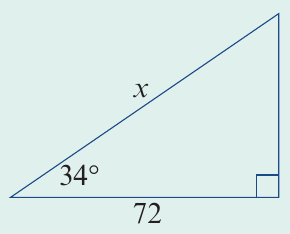
Step 1: Identify which sides are involved
Looking from the 34° angle:
- The side we know (72) is the adjacent side
- The side we're finding () is the hypotenuse
Step 2: Choose the appropriate trigonometric ratio
Since we're using the adjacent and the hypotenuse, we use cosine:
Step 3: Substitute the known values
Step 4: Multiply both sides by
Step 5: Divide both sides by
Step 6: Calculate using a calculator
Step 7: Round to two decimal places
Method summary for denominator cases
Note
Modified Method When Unknown is in the Denominator:
- Identify the positions of the known and unknown sides relative to the given angle
- Select the trigonometric ratio that uses both these sides
- Substitute the known values into the ratio
- Multiply both sides by to remove it from the denominator
- Divide both sides by the trigonometric function to isolate
- Use your calculator to evaluate the expression
- Round your answer to the required number of decimal places
Important
Why the Extra Step?
When is in the denominator, you can't simply multiply both sides by the denominator because the denominator itself contains the unknown. Instead, you must first multiply by to move it to the numerator, then divide by the trigonometric value to isolate completely.
Complete method for finding unknown sides
Here's a systematic approach that works for any problem:
-
Sketch and label: Draw the triangle clearly and mark the given angle and known side length. Label the unknown side as
-
Identify positions: Determine the position names (opposite, adjacent, hypotenuse) for both the known side and the unknown side, relative to the given angle
-
Choose the ratio: Select the trigonometric ratio that includes both the known and unknown sides:
- Use for opposite and hypotenuse
- Use for adjacent and hypotenuse
- Use for opposite and adjacent
-
Write the equation: Substitute the known values into your chosen ratio
-
Rearrange: Solve the equation to make the subject:
- If is in the numerator, multiply both sides by the denominator
- If is in the denominator, first multiply both sides by , then divide both sides by the trigonometric value
-
Calculate: Use your calculator to find the numerical value
-
Round: Express your answer to the required number of decimal places
Calculator tips
Note
Using Your Calculator Effectively:
- Make sure your calculator is in degree mode (not radians)
- For expressions like , enter: 65 × sin(38) =
- For expressions like , enter: 72 ÷ cos(34) =
- Always write down more decimal places than required before rounding your final answer
Common mistakes to avoid
Important
Watch Out for These Common Errors:
- Mixing up opposite and adjacent: Always identify these sides relative to the angle you're using, not the right angle
- Forgetting to multiply by : When is in the denominator, remember you need to multiply both sides by before you can divide
- Rounding too early: Keep extra decimal places during your calculation and only round at the final step
- Wrong calculator mode: Ensure your calculator is set to degrees, not radians
Summary
Key Points to Remember:
-
The three trigonometric ratios are: , , (remember SOH-CAH-TOA!)
-
Always identify the position names (opposite, adjacent, hypotenuse) of the sides relative to the given angle before choosing your trigonometric ratio
-
When the unknown side is in the numerator, multiply both sides by the denominator to isolate it
-
When the unknown side is in the denominator, multiply both sides by the unknown first, then divide by the trigonometric value
-
Always check your calculator is in degree mode and round only your final answer to the required number of decimal places