The Cosine Rule (VCE SSCE General Mathematics): Revision Notes
📚Revision Notes
The Cosine Rule
Introduction
The cosine rule is a powerful tool for working with non-right-angled triangles. You can use it in two main situations:
- When you know two sides and the angle between them (called the included angle), you can find the third side
- When you know all three sides, you can find any angle
This makes the cosine rule essential for solving triangles that don't have a right angle, especially in navigation and surveying problems.
Note
The cosine rule extends your ability to solve triangles beyond right-angled triangles. While Pythagoras' theorem and basic trigonometry only work with right angles, the cosine rule works with any triangle.
Deriving the cosine rule
To understand where the cosine rule comes from, let's work through the derivation step by step.
Consider triangle . We can draw a perpendicular line from vertex down to the base , creating a height . This line meets the base at point .
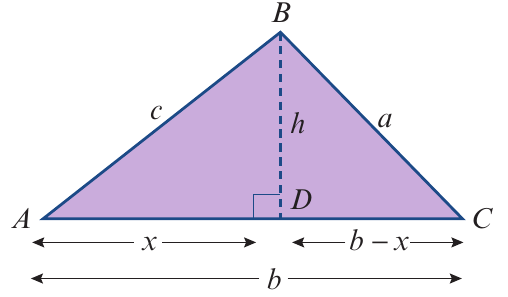
Let , which means (since the whole base ).
Now we can use trigonometry and Pythagoras' theorem:
In triangle , using the definition of cosine:
Multiplying both sides by :
Applying Pythagoras' theorem to triangle :
Now applying Pythagoras' theorem to triangle :
Expanding the squared bracket:
Using equation 1 to replace with :
Using equation 2 to replace with :
Rearranging gives us the cosine rule:
If we repeat this process using different sides as the base, we get the other forms of the cosine rule.
Important
The derivation shows that the cosine rule is built on fundamental principles you already know: Pythagoras' theorem and basic trigonometry. Understanding this derivation helps you see why the formula works, not just how to use it.
The cosine rule formulas
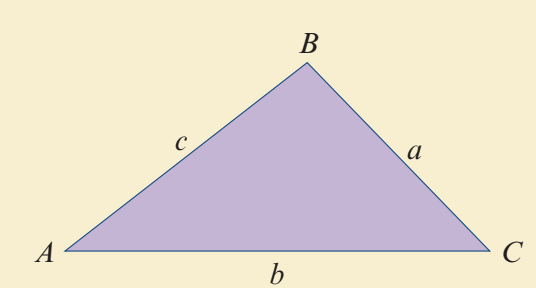
When you know two sides and the included angle:
You can find the third side using one of these formulas:
When you know all three sides:
You can find any angle using one of these rearranged formulas:
Understanding the pattern:
There's a helpful way to remember the cosine rule: "The square of one side equals the sum of the squares of the other sides, minus twice their product, times the cosine of the angle between them."
The pattern works for triangles using any letters. For example, in triangle :
Note
Connection to Pythagoras:
Notice that if the angle is , then , and the cosine rule becomes Pythagoras' theorem. This shows that Pythagoras' theorem is actually a special case of the cosine rule!
Using the cosine rule to find an unknown side
When you're given two sides and the angle between them (SAS configuration), use the cosine rule to find the third side.
Example
Worked Example: Finding an Unknown Side
Find side , to two decimal places, in the triangle shown.
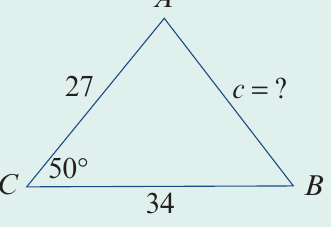
Step 1: Write down the given values and the required unknown value.
Step 2: We have two sides and the angle between them. To find side , use:
Step 3: Substitute the given values:
Step 4: Take the square root of both sides:
Step 5: Use your calculator to evaluate:
Step 6: Round to two decimal places:
The length of side is 26.55 units.
Using the cosine rule to find an angle
When you're given all three sides (SSS configuration), use the rearranged form of the cosine rule to find any angle.
Example
Worked Example: Finding an Unknown Angle
Find the largest angle, to one decimal place, in the triangle shown.
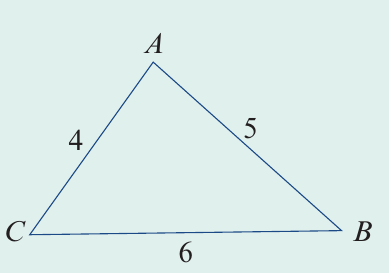
Step 1: Write down the given values.
Step 2: The largest angle is always opposite the largest side. Since side is the longest, we need to find angle .
Step 3: We have three sides. To find angle , use:
Step 4: Substitute the given values:
Step 5: To find angle , use the inverse cosine function:
Step 6: Use your calculator to evaluate. Make sure your calculator is in DEGREE mode.
Calculator tip: Put brackets around all the terms in the numerator (top), and also around all the terms in the denominator (bottom).
Step 7: Round to one decimal place:
The largest angle is 82.8°.
Important
Understanding negative cosine values:
If you calculate and get a negative value, this tells you that angle is obtuse (between and ). This is perfectly normal for triangles with obtuse angles.
When finding an angle such as , a negative value for indicates that:
Applications involving bearings
The cosine rule is particularly useful in navigation problems involving bearings. Remember that bearings are always measured clockwise from North.
Note
When working with bearings, always:
- Measure angles clockwise from North
- Write bearings as three-figure numbers (e.g., not )
- Draw a clear diagram showing North directions
Example
Worked Example: Finding an Angle and a Bearing
A yacht left point and sailed km east to point . Another yacht also started at point and sailed km to point , as shown in the diagram. The distance between points and is km.
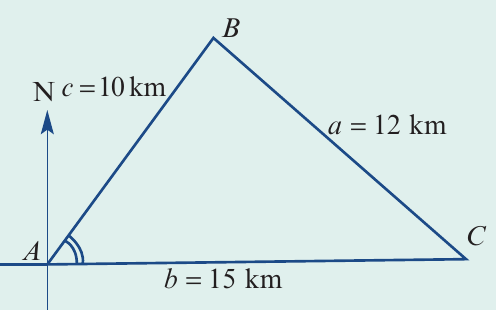
Part a: What was the angle between their directions as they left point ? Give the angle to two decimal places.
Step 1: Write the given values.
Step 2: Write the form of the cosine rule for the required angle :
Step 3: Substitute the given values:
Step 4: Find angle :
Step 5: Use your calculator:
Step 6: Give the answer to two decimal places:
The angle was 52.89°.
Part b: Find the bearing of point from the starting point , to the nearest degree.
Step 1: The bearing of point from starting point is measured clockwise from north.
Step 2: Consider the angles in the right angle at point :
Step 3: Find the value of :
Step 4: Write your answer as a three-figure bearing:
The bearing of point from point is 037°.
Example
Worked Example: Bushwalker Problem
A bushwalker left his base camp and walked km in the direction . His friend also left the base camp but walked km in the direction .
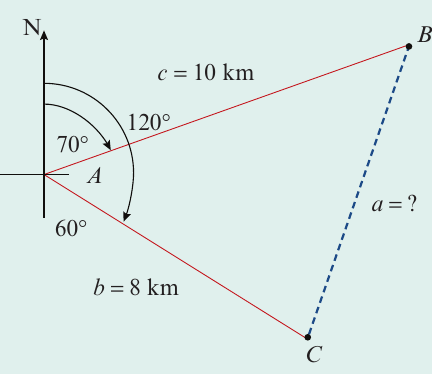
Part a: Find the angle between their paths.
Step 1: Angles lying on a straight line add to :
Step 2: The angle between their paths was 50°.
Part b: How far apart were they when they stopped walking? Give your answer to two decimal places.
Step 1: Write down the known values and the required unknown value.
Step 2: We have two sides and the angle between them. To find side , use:
Step 3: Substitute in the known values:
Step 4: Take the square root of both sides:
Step 5: Use a calculator:
Step 6: Round to two decimal places:
Distance between them was 7.82 km.
Exam tips
Note
Tips for Success:
- Always identify whether you have SAS (two sides and included angle) or SSS (three sides) before choosing your formula
- The largest angle is always opposite the longest side
- The smallest angle is always opposite the shortest side
- When finding angles, make sure your calculator is in DEGREE mode
- Use brackets carefully when entering formulas into your calculator
- For bearings, always measure clockwise from North
- Write bearings as three-figure numbers (e.g., not )
Summary
Key Points to Remember:
- The cosine rule works for any triangle, not just right-angled ones
- Use the form when you know two sides and the included angle (SAS)
- Use the form when you know all three sides (SSS)
- The cosine rule becomes Pythagoras' theorem when the angle is
- A negative value for means angle is obtuse (between and )
- In bearing problems, always measure angles clockwise from North