The Sine Rule (VCE SSCE General Mathematics): Revision Notes
📚Revision Notes
The Sine Rule
What is the sine rule?
The sine rule is a mathematical formula that helps us find missing sides and angles in triangles that do not have a right angle. While right-angled triangles can be solved using SOH CAH TOA, non-right-angled triangles require different methods. The sine rule is one of these methods.
The sine rule works when you know:
- Two sides and an angle opposite one of those sides, or
- Two angles and one side
Standard triangle notation
Before we learn the sine rule, we need to understand how mathematicians label triangles. This standard notation makes it easier to write formulas and solve problems.
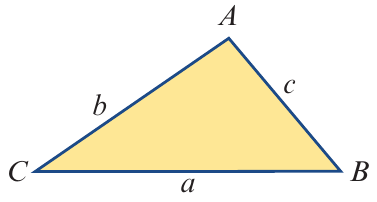
In a triangle:
- Angles are labelled with uppercase (capital) letters: , , and
- Sides are labelled with lowercase (small) letters: , , and
- Each side is named with the letter that matches the angle opposite to it
For example:
- Side is opposite angle
- Side is opposite angle
- Side is opposite angle
Note
This notation is used for both the sine rule and the cosine rule. Understanding this matching system between sides and opposite angles is essential for applying these formulas correctly.
Deriving the sine rule
To understand where the sine rule comes from, let's look at how it can be derived. Consider a triangle where we draw a perpendicular line from vertex down to point on the base. This perpendicular line represents the height of the triangle.
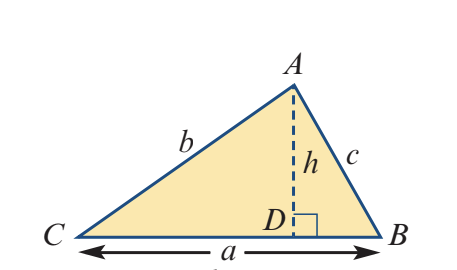
Now we can use right-angled triangle trigonometry in the two smaller triangles that are created:
In triangle :
Rearranging gives:
In triangle :
Rearranging gives:
Since both expressions equal , we can set them equal to each other:
Dividing both sides by :
Dividing both sides by :
If we redrew the triangle with a different side as the base and followed similar steps, we would also get:
Combining these relationships gives us the complete sine rule.
The sine rule formula
In any triangle :
This formula can be written as three separate equations:
Each equation contains two sides and their opposite angles. If you know three of these four parts, you can find the fourth.
The sine rule can also be flipped:
This form is sometimes more convenient when finding angles.
Important
When to use the sine rule:
- When you have two sides and an angle opposite one of the given sides
- When you have two angles and one side
Note: If you know two angles but neither is opposite the given side, first find the third angle using .
Using the sine rule to find an angle
When you know two sides and an angle opposite one of them, you can use the sine rule to find another angle.
Example
Example: Finding an Angle Using the Sine Rule
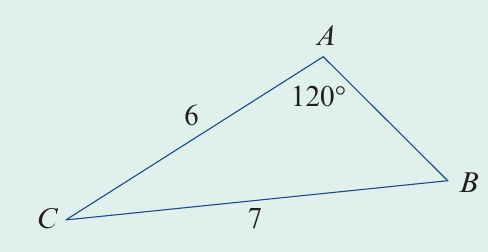
Find angle in the triangle shown, where angle , side and side . Give your answer to one decimal place.
Solution:
We have the angle-side pairs: with , and with
Using the sine rule:
Substituting the known values:
Cross-multiplying:
Dividing both sides by :
Finding angle :
Using a calculator:
Therefore, angle (to one decimal place).
Note
Alternative approach: You can flip both sides of the sine rule first to make the working easier when finding an angle:
Then multiply both sides by to find , and solve as before.
Using the sine rule to find a side
When you know two angles and one side, you can use the sine rule to find another side.
Example
Example: Finding a Side Using the Sine Rule
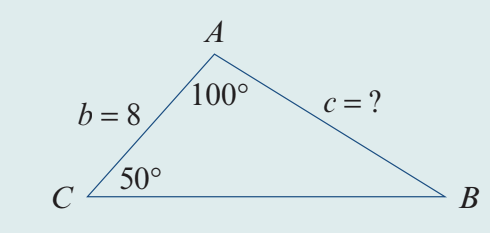
Find side in a triangle where angle , angle , and side . Give your answer to one decimal place.
Solution:
First, find angle using the angle sum property:
Now we have the angle-side pairs: with , and with
Using the sine rule:
Substituting the known values:
Multiplying both sides by :
Using a calculator:
Therefore, side units (to one decimal place).
The ambiguous case
Sometimes, when you are given two sides and an angle that is not between those two sides, two different triangles can be drawn that fit the given information. This is called the ambiguous case.
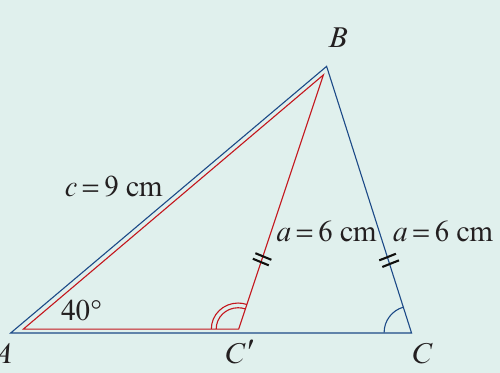
This happens because when constructing the triangle, one side can meet the base in two different positions.
Important
Understanding the Ambiguous Case
The ambiguous case occurs when you have:
- Two sides and an angle that is not between those two sides
When constructing the triangle, one side can cross the base in two possible places, creating two valid triangles with the same given measurements. Always check whether both solutions are geometrically possible in the context of the problem.
Example
Example: Solving the Ambiguous Case
In triangle , angle , side cm, and side cm.
When we draw side from vertex at to the base, and then measure out side cm from vertex , this side can cross the base in two possible places, which we call and .
This creates two possible triangles: triangle (shown in blue) and triangle (shown in red).
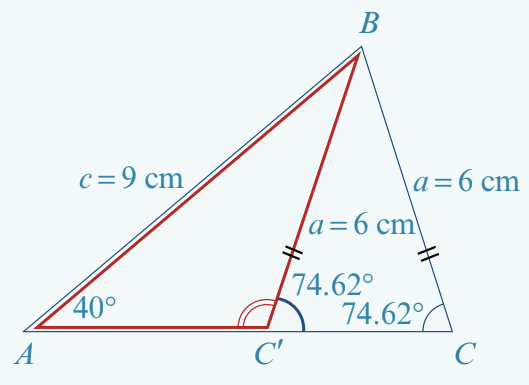
To find both possible values for angle :
Step 1: Use the sine rule to find one value of angle :
Step 2: Identify which angle this represents. Since is clearly greater than , this must be .
Step 3: Triangle is isosceles (both marked sides equal cm), so the base angles are equal:
Step 4: Angles on a straight line sum to :
Therefore, the two possible values for angle are 74.62° and 105.38°.
Applying the sine rule to real problems
The sine rule is particularly useful for solving real-world navigation and surveying problems.
Example
Example: Navigation Problem
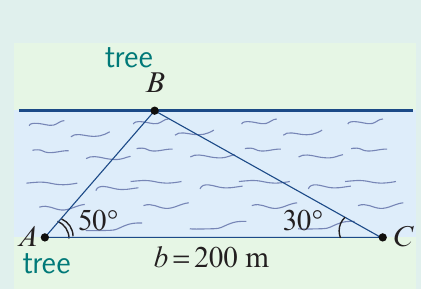
Leo wants to tie a rope from a tree at point to a tree at point on the other side of a river. When he stood at , he saw tree at an angle of with the riverbank. After walking metres east to point , the tree was at an angle of with the riverbank.
Find the length of rope required to reach from to to two decimal places.
Solution:
The unknown is the length of rope, which is side . We know angle and side m.
We need to find angle first. Using the angle sum:
Now we have: m with , and with
Using the sine rule:
Multiplying both sides by :
Therefore, the rope must be 101.54 m long (to two decimal places).
Tips for solving trigonometry problems
When working with the sine rule and other trigonometry problems, these tips will help you achieve accurate and reliable solutions:
Note
Always sketch the problem. Draw a rough diagram as you read the problem. You may need to adjust it as you read more information, but having a visual representation helps enormously.
Note
Check the longest and shortest sides. In any triangle, the longest side is opposite the largest angle, and the shortest side is opposite the smallest angle. Use this to check if your answer makes sense.
Note
Label carefully. When labelling sides and angles, ensure that each side is opposite the angle with the same letter. For example, side must be opposite angle .
Note
Verify your answer. After finding a solution, re-read the question and check that your answer fits logically with the given information and your diagram.
Important
Be careful with rounding. Round your final answers to the required number of decimal places. However, if you need to use intermediate results in further calculations, keep extra decimal places to avoid accumulating rounding errors.
Summary
Key Points to Remember:
- The sine rule is for any triangle
- Each equation consists of two sides and their opposite angles. If you know three parts, you can find the fourth
- Use the sine rule when you have: two sides and an opposite angle, or two angles and one side
- In the ambiguous case, two different triangles can be constructed from the same information. This occurs when you have two sides and an angle not between them
- Always check that your answer makes sense by comparing it with the given information and your diagram