Economic Characteristics of Different Countries (VCE SSCE Health and Human Development): Revision Notes
📚Revision Notes
Economic Characteristics of Different Countries
Introduction to country classification
Grouping countries based on shared characteristics serves an important purpose. When countries with similar features are classified together, policymakers can design targeted interventions to improve health and wellbeing. Successful strategies used in one country can be adapted and applied to others in the same group, helping to promote trade, increase incomes, and enhance overall quality of life.
How countries are classified
Historical approach
For many years, countries were categorised as either developed or developing. This system focused primarily on economic factors:
Developed countries typically showed:
- Strong economic performance across multiple sectors
- Diverse industries beyond just farming and mining
- Active participation in global trade
- Higher average incomes
Developing countries typically showed:
- Lower levels of economic development
- Heavy reliance on primary production (farming and mining)
- Dependence on subsistence farming
Note
Primary production refers to the process of producing natural products for human use, such as plants and animals.
Subsistence farming is self-sufficient farming carried out by individuals to provide food for themselves and their family.
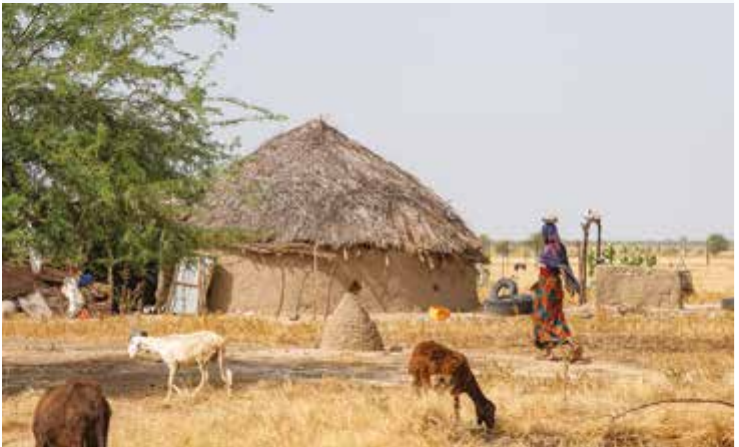
However, this developed/developing system had significant limitations. It was quite subjective, and experts couldn't agree on specific criteria for classification. This led to the development of a more objective system.
Modern World Bank classification
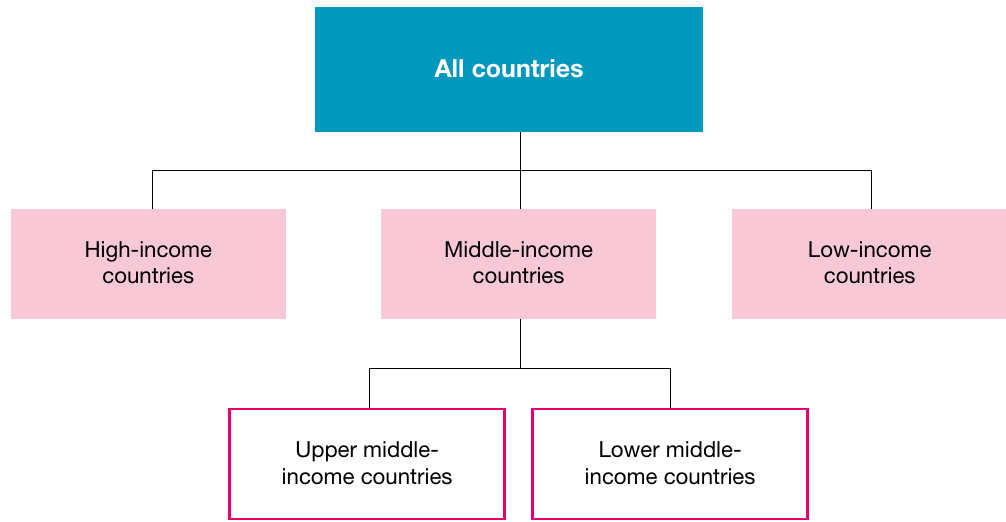
The World Bank developed a more reliable classification system based on Gross National Income (GNI) per capita, which measures a country's average income. This system groups countries into three main categories:
- High-income countries
- Middle-income countries
- Low-income countries
Middle-income countries are further divided into:
- Upper middle-income countries
- Lower middle-income countries
Note
Gross National Income (GNI) is the total value of goods and services a country's citizens produce, including income earned by citizens who may be working in overseas countries.
Income thresholds
The World Bank updates income thresholds on 1 July each year to reflect changes in global economic conditions. Countries can move between categories as their economies change. The thresholds are set according to World Bank criteria rather than dividing countries into equal groups, which means some categories contain more countries than others.
The 2020-21 income thresholds were:
| Income category | GNI per capita range | Example countries | Number of countries |
|---|---|---|---|
| High income | $12,536 or more | Australia, Canada, Chile, Greece, Ireland, Japan, USA, United Kingdom | 84 |
| Upper middle income | $4,046–$12,535 | China, Cuba, Fiji, Indonesia, Mexico, South Africa, Turkey, Russian Federation | 52 |
| Lower middle income | $1,036–$4,045 | Cambodia, India, Nepal, Pakistan, Papua New Guinea | 50 |
| Low income | $1,035 or less | Chad, Zimbabwe, Uganda, Rwanda, South Sudan | 32 |
Important considerations
Important
This classification system uses average incomes. This means it doesn't capture the variations that exist within individual countries or between countries in the same group.
Example
Understanding Income Variation: The Case of China
China is classified as upper middle-income, but income levels vary dramatically across different regions. Some areas would be classified as low-income if they were independent countries.
Similarly, both China and Fiji are upper middle-income countries, but they differ significantly in terms of:
- Industry composition and diversity
- Population size and distribution
- Cultural practices and social structures
This example shows why we must be careful not to assume all countries in the same income category are similar in every way.
Despite these variations, there are identifiable patterns in the characteristics common to each income group.
Three categories of characteristics
Countries can be compared using three types of characteristics that often influence each other:
- Economic characteristics: factors relating to the financial state of a country
- Social characteristics: factors relating to people and communities
- Environmental characteristics: factors relating to physical surroundings and infrastructure
These characteristics are interconnected. For instance, a country with good infrastructure (environmental) is better positioned to trade globally, which can lead to higher average incomes (economic). Higher incomes mean governments and individuals have more resources to invest in education (social).
Note
Understanding these relationships helps identify the full range of characteristics common to each income group. No single characteristic exists in isolation—they all work together to shape a country's overall development.
Economic characteristics
Economic characteristics relate to the financial state of a country and significantly influence the opportunities and resources available to citizens. The term poverty describes a lack of access to resources, usually resulting from insufficient income.
Low-income countries, and to a lesser extent middle-income countries, often have a larger proportion of their population living in poverty compared to high-income countries. Several economic factors contribute to these differences.
Economic characteristics of high-income countries
High-income countries typically demonstrate four key economic features:
1. Wide range of industries
High-income countries usually have diverse economies that include:
- Mining and primary production
- Processing and manufacturing
- Education and healthcare services
- Scientific research
- Technology sectors
Note
In 2020, approximately 3% of the workforce in high-income countries worked in agriculture, compared to almost one-third in middle-income countries and up to 70% or higher in many low-income countries.
Having a diverse range of industries provides important advantages. Most industries experience fluctuations in production and demand. When a country has multiple industries, at least some are likely to perform well at any given time. If a country relies heavily on one resource (such as food production), events like drought can severely impact the entire economy. Without alternative industries, trade suffers significantly.
2. Opportunities for global trade
High-income countries generally benefit most from global trade opportunities. This advantage stems from several factors:
- Infrastructure: High-income countries typically have well-developed roads, ports, and airports that facilitate the movement of goods internationally
- Knowledge and experience: Established expertise in international business and trade relationships
- Production capabilities: Ability to produce diverse goods and services that other countries need
The quality of trade infrastructure varies significantly across income groups:
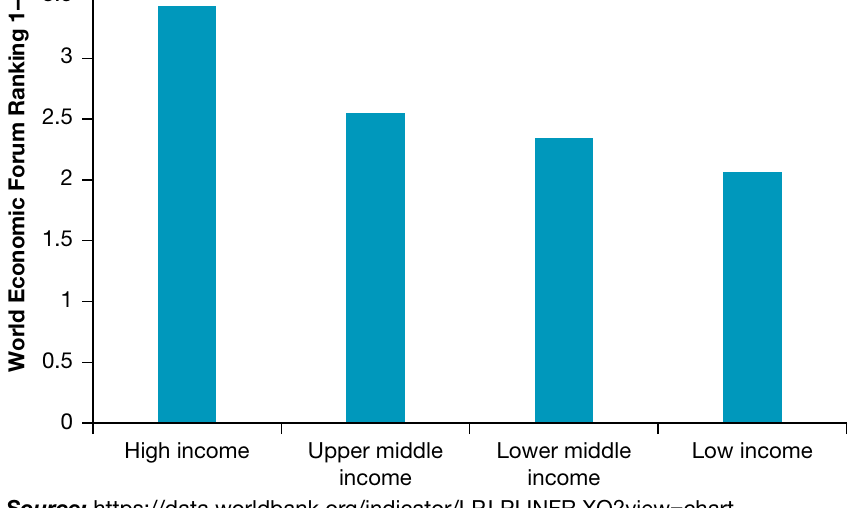
Middle-income countries are often in transition, developing their infrastructure and building trading relationships around the world. Low-income countries frequently lack the infrastructure, knowledge, and production capabilities needed to generate a diverse range of goods and services for global trade. This limitation prevents their economies from growing and contributes to the low average incomes they experience.
The proportion of GDP generated from exports illustrates these differences:
3. High average incomes
GNI per capita is the measure used to categorise countries in the World Bank system, so by definition, it increases from low-income to middle-income to high-income countries.
Average income can also be measured using Gross Domestic Product (GDP) per capita. This measure is similar to GNI per capita but doesn't account for income earned by foreign citizens or income earned by citizens working abroad. As a result, GNI per capita is increasingly used as a more accurate indicator of a country's average income.
Note
Gross Domestic Product (GDP) is a measure that reflects the economic state of a country. GDP is the value of all goods and services produced in a country over a 12-month period.
Lower incomes in low-income and middle-income countries have far-reaching impacts on many aspects of life, including access to:
- Education
- Healthcare
- Housing
- Clean water
- Food
All these factors significantly affect quality of life and health status.
4. Lower levels of poverty
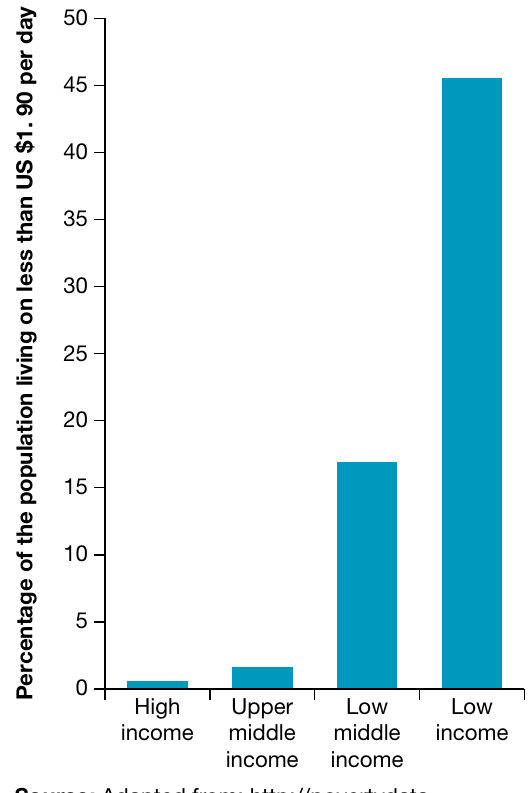
Poverty levels can be measured using the proportion of people living in extreme poverty, defined as living on less than US$1.90 per day.
Note
Extreme poverty means living on less than US$1.90 per day.
Low-income and middle-income countries experience a much higher proportion of their population living in extreme poverty compared to high-income countries:
Economic characteristics of middle-income countries
Middle-income countries often reflect aspects of both high-income and low-income countries. Many are in a transition period, characterised by:
- Increasing trade opportunities
- Growing economies
- Developing infrastructure
- Expanding range of industries
The degree to which they show characteristics of high-income or low-income countries varies depending on whether they are classified as upper middle-income or lower middle-income.
Economic characteristics of low-income countries
Low-income countries typically demonstrate opposite characteristics to high-income countries:
- Limited range of industries: Economies are usually centred on farming and primary production, with up to 70% or more of the workforce in agriculture
- Limited global trade: Lack of infrastructure, knowledge, and diverse production capabilities restricts their ability to trade internationally
- Low average incomes: By definition, GNI per capita is $1,035 or less
- High levels of poverty: A much larger proportion of the population lives in extreme poverty
Important
These economic characteristics are interconnected, creating a cycle that can be difficult to break without external support or significant internal changes.
Understanding purchasing power parity (PPP)
Purchasing Power Parity (PPP) provides a way to compare countries with different currencies and costs of living. PPP takes into account factors such as average income and living costs to create a standardised, comparable currency. It's often expressed in US dollars (US$) or international dollars (PPP$), which is a theoretical currency used for comparison.
Note
This standardisation allows for more meaningful comparisons between countries at different income levels. Without PPP adjustments, direct comparisons of income between countries with vastly different costs of living can be misleading.
Exam tip: Avoiding absolute statements
Important
Exam Tip: Avoiding Absolute Statements
When writing about country characteristics, avoid making absolute statements that are technically incorrect.
❌ Incorrect: "People in low-income countries live on less than US$1.90 per day"
This implies all people in low-income countries live in extreme poverty, which is not true.
✓ Correct: "People in low-income countries are more likely to live on less than US$1.90 per day than those in high-income countries"
This statement is accurate and acknowledges that variations exist. Always use comparative language like "more likely," "tend to," or "often" rather than definitive statements.
Summary
Key Points to Remember:
- The World Bank classifies countries into four income groups based on GNI per capita: high-income, upper middle-income, lower middle-income, and low-income
- High-income countries typically have a wide range of industries, opportunities for global trade, high average incomes, and lower levels of poverty
- Low-income countries often rely on primary production and subsistence farming, have limited global trade opportunities, low average incomes, and higher levels of poverty
- Middle-income countries are often in transition, showing characteristics of both high-income and low-income countries
- Economic characteristics are interconnected with social and environmental characteristics, and understanding these relationships helps explain differences between income groups