Development in Early Childhood (VCE SSCE Health and Human Development): Revision Notes
📚Revision Notes
Development in Early Childhood
Early childhood spans from a child's second birthday until six years of age, typically known as the preschool years. Although this period covers only a few years, it is marked by significant developmental changes across all areas: physical, social, emotional and intellectual.
Note
During early childhood, children need opportunities to develop both fine and gross motor skills through activities that build a sense of mastery and encourage creativity. Parents and carers play a crucial role in supporting language development through talking, reading aloud, singing and providing opportunities for early writing and reading experiences.
This stage is also important for learning cooperation, helping, sharing and making choices, as well as developing self-control, persistence and self-worth.
Physical development
Growth
Early childhood is characterised by slow and steady growth patterns. Children typically grow at a predictable rate, though individual variations exist:
- Height: Increases by approximately 6 centimetres per year
- Weight: Increases by around 2.5 kilograms per year
- Bones: Continue to lengthen and ossify (harden), resulting in height increases
- Body proportions: The limbs and torso become more proportionate to the head, and children appear less top-heavy
- Body fat: Decreases, giving the child a leaner appearance
- Brain growth: Slows down but remains significant, reaching 75% of adult size by age three and 90% by age five
Between ages three to five years, children become less toddler-like as growth occurs predominantly in the trunk and legs.
Example
Growth Pattern Example:
Consider a child who is 85 cm tall and weighs 12 kg at age two:
- By age three: approximately 91 cm tall and 14.5 kg
- By age four: approximately 97 cm tall and 17 kg
- By age five: approximately 103 cm tall and 19.5 kg
This steady progression demonstrates the predictable nature of growth during early childhood.
Changes to systems
An important milestone during early childhood is the completion of the first set of teeth by the third year of age.
Motor skill development
Large muscle groups, particularly in the legs and arms, develop extensively during early childhood. Motor skill development continues at a rapid pace during this stage.
Gross motor skills become more refined and fluid:
- Walking becomes smoother and more coordinated
- Climbing stairs is possible, though children initially place both feet on each step before progressing to alternating feet
- Kicking, catching and throwing skills develop
- Skipping may be learned
- Coordination improves enough to pedal and steer a tricycle
Fine motor skills progress significantly, enabling children to:
- Manipulate buttons on clothing
- Hold crayons with increasing control
- Use scissors
- Tie shoelaces

Through these various activities, children begin to show preference for left- or right-handedness in certain tasks.
Important
Physical activity is essential for young children, as movement develops motor skills, supports cognitive development and provides opportunities to explore their environment. Children need plenty of opportunities for active play, both indoors and outdoors.
Social development
Relationship and communication skills
The family remains the primary social contact during early childhood and plays a vital role in a child's social development achievements. Children begin participating in a wider range of family routines, including:
- Attending social functions
- Eating meals at the table
- Helping with shopping
- Participating in household activities
These experiences help develop communication skills and teach acceptable social behaviours.
As children grow, they need opportunities to socialise with other children beyond the family. Attending playgroups, kindergarten or childcare centres provides valuable experiences for developing social skills such as:
- Sharing with others
- Taking turns
- Spending time away from family members
- Developing independence
During this stage, children often begin wanting to do things independently, such as dressing or washing themselves, although they may not yet be completely successful in these attempts.
Behaviours and social roles
Play provides the primary context for learning many social skills, including sharing and taking turns. These experiences occur with siblings and parents at home, as well as with peers at childcare or playgroup.
Through social interactions, children learn culturally acceptable behaviours, such as:
- Listening to parents and caregivers
- Not using physical aggression towards others
- Following basic social rules
Children also begin imitating social roles through play, such as pushing a pram with a doll inside, mimicking parental or caregiver behaviours.
Note
Behaviours like eating with a knife and fork are established during early childhood, though they continue to be refined over time. Children at this age desire acceptance from others and may behave in ways that attract attention, including showing off or performing for family and friends.
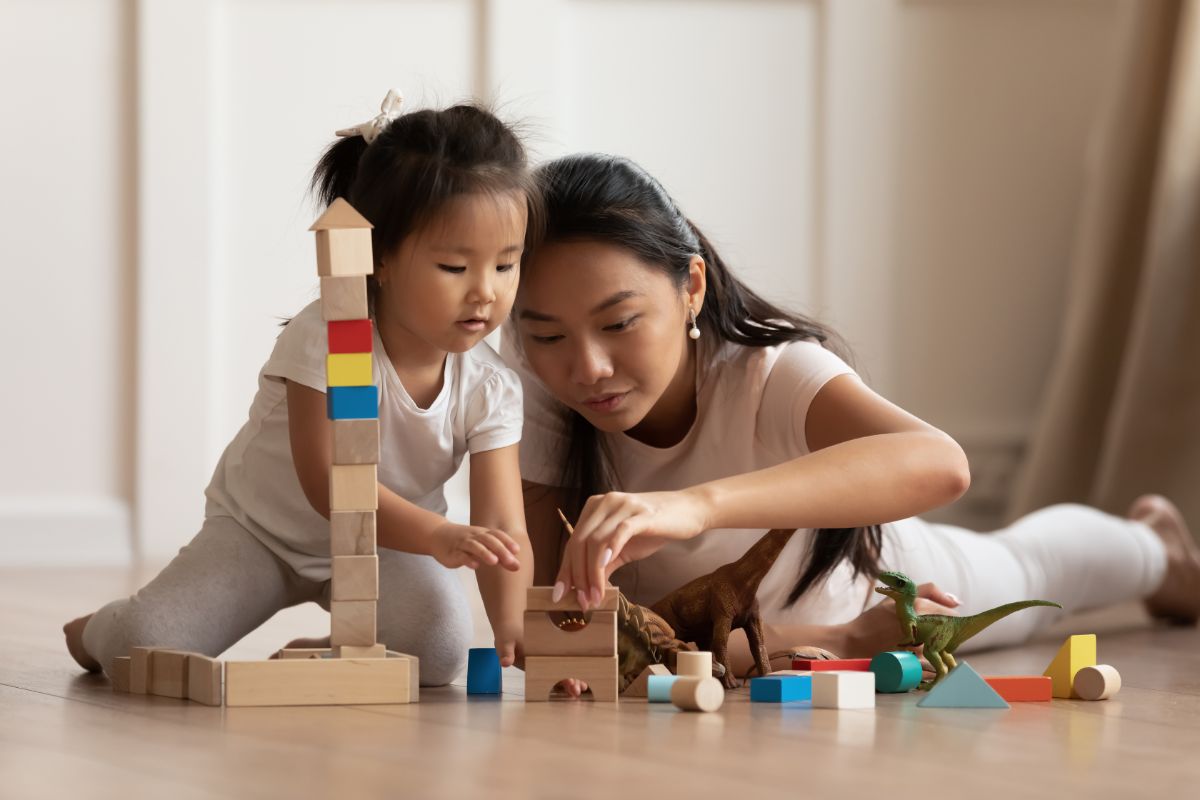
Play becomes more advanced than in infancy. Children may develop particular friendships and prefer certain playmates. Some children create imaginary friends. Make-believe play helps children learn about social roles and expected behaviours in different situations.
Emotional development
Experiencing a range of emotions
Emotional development occurs rapidly during early childhood. Play often provides children with a way to express their feelings and work through different emotional experiences.
Children take pride in their achievements and often want to display them to everyone. As they enjoy positive feedback from others, they may also experience jealousy when another child receives attention.
Learning appropriate ways of expressing and communicating emotions
The emotional development of a two-year-old differs significantly from that of a six-year-old. During early childhood, children:
- Begin developing a sense of empathy, showing care for people who are crying or upset
- Are still learning to manage emotions appropriately
- May use physical violence to express frustration, particularly with other children or siblings
- Experience rapid mood changes, switching from happy to upset and back again quickly, as they lack fully developed emotional regulation skills
Important
Play continues to serve as an important outlet for expressing feelings throughout this stage. Children are still developing emotional regulation skills, so patience and guidance from caregivers is essential during this period.
Developing self-concept
Children begin developing an identity that will continue forming for years to come. They learn to see themselves as separate individuals from others and start associating certain things with themselves, such as ownership of toys or personal possessions.
Intellectual development
Language
Learning new words and how to use language occurs fairly rapidly during early childhood and represents a key aspect of intellectual development. By age five, most children have a vocabulary of approximately 1,500 to 2,500 words.
Knowledge, memory and attention
As children's interest in their environment increases, they begin questioning many aspects of the world around them. Common characteristics include:
- Frequently asking parents or caregivers "why?" questions
- Enjoying sharing knowledge about colours, objects and animals
- Following basic instructions as their attention span lengthens
- Demonstrating improved memory capabilities
Example
Memory and Instruction Following:
A child can now remember and follow multi-step instructions such as:
- Getting a toy from the bedroom
- Bringing it to the lounge room
- Sitting in a designated place with it
This demonstrates the developing memory and attention capabilities during early childhood.
Classification skills develop progressively during this stage:
- Initially, children can classify objects based on one aspect, such as colour (separating orange blocks from green blocks)
- Classifying items according to multiple aspects, such as both colour and size, proves more difficult but develops over time
Benefits of types of play
Different types of play support various aspects of development. Understanding these benefits helps caregivers provide appropriate play opportunities:
Note
Physical play develops:
- Muscle and bone development
- Nerve connections in the central nervous system
- Fine and gross motor skills
- Strength, coordination and agility
- Self-esteem and confidence
- Fitness
- Stress management abilities
Note
Discovery play promotes:
- Collecting information through the senses
- Trial and error learning
- Thinking and problem-solving skills
Note
Creative and pretend play encourages:
- Imagination
- Language development
- Understanding characteristics of objects
- Fine motor skills
- Self-esteem
- Empathy
Note
Social play develops:
- Independence
- Language skills
- Expressing emotions
- Self-control
- Appropriate behaviour
- Conflict resolution
- Communication skills
- Sharing
- Sense of self
- Understanding social roles and behaviour
- Cooperation
Note
Manipulative play builds:
- Concentration
- Eye-hand coordination
- Spatial awareness
- Creativity
Thought patterns and problem solving
Children in early childhood may begin learning to:
- Write basic letters
- Read simple books
- Count to 10 or 20 (though often memorised without fully understanding number formation)
Important
Cognitive limitations at this stage include:
- Difficulty with abstract thought
- Challenges predicting outcomes of events
- Greater comfort thinking about objects and experiences they have already encountered
- Limited ability to think about hypothetical situations
These limitations are a normal part of development and gradually improve as children mature.
Summary
Key Points to Remember:
-
Early childhood (ages 2-6) is a period of slow, steady physical growth, with children gaining approximately 6 cm in height and 2.5 kg in weight annually.
-
Motor skills develop rapidly, with both gross motor skills (running, climbing, skipping) and fine motor skills (buttoning, using scissors, writing) showing significant improvement.
-
Social development centres around the family initially but expands to include peers through playgroup, kindergarten or childcare, where children learn essential skills like sharing, taking turns and developing independence.
-
Emotional development is characterised by rapid mood changes, developing empathy and beginning to form a sense of identity, though children are still learning appropriate ways to express and manage their emotions.
-
Intellectual development includes rapid language acquisition (1,500-2,500 words by age five), improved memory and attention, and developing cognitive skills, though abstract thinking remains difficult at this stage.