Selections (VCE SSCE Mathematical Methods): Revision Notes
📚Revision Notes
Selections
Understanding selections
When counting objects, sometimes we only care about which items are chosen, not the order they're in. This is different from arrangements, where order matters.
Note
The Key Difference:
- Arrangements: Order matters (AB is different from BA)
- Selections: Order doesn't matter (AB and BA count as the same selection)
Consider the letters , , taken in groups of two. There are six possible arrangements: , , , , , . However, there are only three distinct selections: , , .
When order doesn't matter, we call these selections or combinations.
The combination notation
We use the notation to represent the number of different ways to choose groups of size r from a total of n objects when order is unimportant.
An alternative notation you might see is .
Example
Worked Example: Ice-cream selection
Four flavours of ice-cream are available at the school canteen: vanilla, chocolate, strawberry and caramel. How many different double-scoop selections are possible if two different flavours must be used?
Solution:
We can list all possibilities:
- vanilla and chocolate
- vanilla and strawberry
- vanilla and caramel
- chocolate and strawberry
- chocolate and caramel
- strawberry and caramel
This gives a total of six different selections.
Note that 'vanilla and chocolate' is the same selection as 'chocolate and vanilla', so we count it only once.
Deriving the combination formula
When the number of objects is small, we can list all combinations. For larger groups, we need a formula.
Important
Key Insight: Choose then Arrange
To derive the combination formula, think of the process in two steps:
- First choose the objects (this is what we want to count)
- Then arrange them (we know how to count this)
Consider choosing five colours from eight available colours (like on the Olympic flag). We can think of this as a two-step process: first choose the colours, then arrange them.
This gives us:
Choose the colours, then arrange them to get possible arrangements
Since , we can find by dividing both sides by :
Notice that the two numbers on the bottom line (3 and 5) add to 8.
The combination formula
In general, the number of combinations of n objects in groups of size r is:
Note
You can use a CAS calculator to find values of quickly.
Example
Worked Example: Using the combination formula
If four flavours of ice-cream are available, how many double-scoop selections are possible if two different flavours must be used?
Solution:
The number of combinations of four flavours in groups of size two is:
This matches the answer we found by listing all combinations.
Selecting from separate groups
When selecting from distinct groups, calculate the selections for each group separately, then use the multiplication rule to combine them.
Example
Worked Example: Team selection
A team of three boys and three girls is to be chosen from a group of eight boys and five girls. How many different teams are possible?
Solution:
First consider choosing boys and girls separately:
- Three boys can be chosen from eight boys in ways
- Three girls can be chosen from five girls in ways
Since we need to choose boys and girls, we multiply these together using the multiplication rule:
Selections of any size
When counting all possible selections from a group of objects (including selecting none), we have a useful formula:
Understanding the formula
Let's see why this works using three books: , , and . David can choose whichever books he likes, including none.
The set has these subsets:
, , , , , , ,
This gives eight choices.
Note
Two Ways to Count the Same Thing
We can count all possible selections using two different methods, and both must give the same answer.
Method 1: Focus on how many books David chooses
He can choose:
- 0 books in way (corresponds to )
- 1 book in ways (corresponds to , , )
- 2 books in ways (corresponds to , , )
- 3 books in way (corresponds to )
By the addition rule, total choices =
Method 2: Focus on each book individually
For each book, David has 2 choices: choose it or don't choose it.
- Book : chosen or not (2 ways)
- Book : chosen or not (2 ways)
- Book : chosen or not (2 ways)
By the multiplication rule, total choices =
Therefore:
This argument extends to any number of objects.
Example
Worked Example: Party invitation list
Nick is making an invitation list for his party, and has seven friends to choose from. If he may invite any number of friends (from one to all seven), how many possible party lists does he have? (Assume he will invite at least one person.)
Solution:
Nick's total number of choices would be:
Since we know that:
The required answer is:
Pascal's triangle
Pascal's triangle is a pattern showing combination values. Each row corresponds to selections from objects.
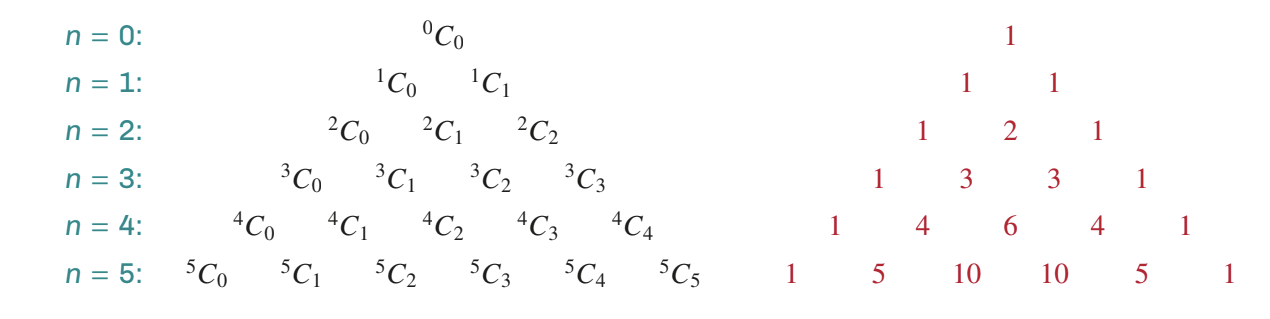
This triangle is named after French mathematician Blaise Pascal, who used it extensively in probability studies.
Pattern in Pascal's triangle
The triangle continues indefinitely following these rules:
Note
Building Pascal's Triangle:
- The first and last numbers in every row are always 1
- Any other number equals the sum of the two numbers directly above it in the previous row
Pascal's identity
The pattern in Pascal's triangle is explained by this identity:
Important
Pascal's Identity
This formula shows that each number in Pascal's triangle equals the sum of the two numbers above it.
Proof of Pascal's identity
Using the combination formula:
This proves that each number in Pascal's triangle equals the sum of the two numbers above it.
Summary
Key Points to Remember:
- Selections vs arrangements: Order doesn't matter in selections, but it does in arrangements
- Combination formula: gives the number of ways to choose objects from
- Separate groups: When selecting from distinct groups, calculate each separately then multiply
- All possible selections: The total number of selections of any size from objects is
- Pascal's triangle: Each number equals the sum of the two numbers directly above it