Conditional Probability and Independence (VCE SSCE Mathematical Methods): Revision Notes
📚Revision Notes
Conditional Probability and Independence
What is conditional probability?
When we know that one event has already happened, this information can change the probability of another event occurring. This updated probability is called conditional probability.
We write conditional probability as , which we read as "the probability of given ". This represents the probability that event occurs when we already know that event has occurred.
Understanding independence
Sometimes knowing about one event doesn't change the probability of another event. For example, if you toss two coins, the result of the second coin doesn't depend on what happened with the first coin. These events are independent.
Note
For independent events like coin tosses:
However, in other situations, a previous event does affect the probability. For instance, the probability of rain today is usually different if it rained yesterday compared to if it didn't rain yesterday.
The conditional probability formula
The conditional probability of event , given that event has already occurred, is calculated using:
Important
Conditional Probability Formula:
This formula can be rearranged to give us the multiplication rule of probability:
Using tree diagrams for multi-stage experiments
Tree diagrams help us visualise and calculate probabilities for experiments that happen in stages. We multiply the probabilities along the branches to find the probability of combined events.
Example
Worked Example: Rain Probability
In a certain town, the probability that it rains on any Monday is . If it rains on Monday, then the probability that it rains on Tuesday is . If it does not rain on Monday, then the probability of rain on Tuesday is . For a given week, find the probability that it rains:
a) on both Monday and Tuesday
b) on Tuesday
Solution
Let represent the event 'rain on Monday' and represent the event 'rain on Tuesday'.
We can represent this situation using a tree diagram:
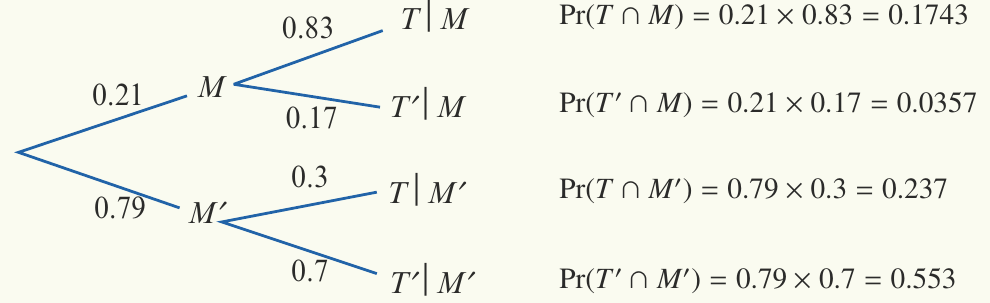
a) The probability that it rains on both Monday and Tuesday is:
b) The probability that it rains on Tuesday is:
The law of total probability
Part b of the previous example demonstrates an important rule called the law of total probability.
Important
Law of Total Probability
For two events and , the law of total probability states:
This formula allows us to find the overall probability of an event by considering all the different ways it can occur.
Example
Worked Example: Broken Dishes
Adrienne, Regan and Michael are doing the dishes. Since Adrienne is the oldest, she washes the dishes 40% of the time. Regan and Michael each wash 30% of the time. When Adrienne washes, the probability of at least one dish being broken is . When Regan washes, the probability is . When Michael washes, the probability is . Their parents don't know who is washing the dishes one particular night.
a) What is the probability that at least one dish will be broken?
b) Given that at least one dish is broken, what is the probability that the person washing was Michael?
Solution
Let be the event 'Adrienne washes the dishes', let be the event 'Regan washes the dishes', and let be the event 'Michael washes the dishes'. Then:
Let be the event 'at least one dish is broken'. Then:
This information can be summarised in a tree diagram:
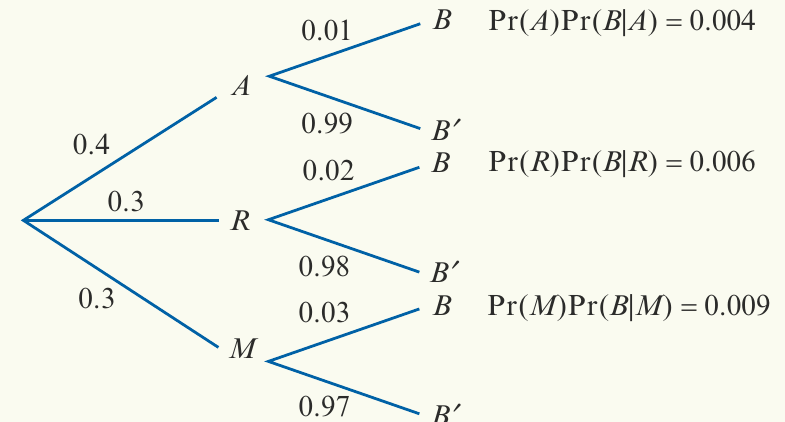
a) The probability of at least one dish being broken is:
b) The required probability is:
Working with contingency tables
Sometimes we can calculate conditional probabilities directly from a table without using the conditional probability formula. This is often simpler and more intuitive.
Example
Worked Example: Canteen Ratings
As part of an evaluation of the school canteen, all students at a Senior Secondary College (Years 10–12) were asked to rate the canteen as poor, good or excellent. The results are shown in the table below.
| Rating | Year 10 | Year 11 | Year 12 | Total |
|---|---|---|---|---|
| Poor | 30 | 20 | 10 | 60 |
| Good | 80 | 65 | 35 | 180 |
| Excellent | 60 | 65 | 35 | 160 |
| Total | 170 | 150 | 80 | 400 |
What is the probability that a student chosen at random from this college:
a) is in Year 12
b) is in Year 12 and rates the canteen as excellent
c) is in Year 12, given that they rate the canteen as excellent
d) rates the canteen as excellent, given that they are in Year 12?
Solution
Let be the event 'the student is in Year 12' and let be the event 'the rating is excellent'.
a)
From the table, there are 80 students in Year 12 and 400 students altogether.
b)
From the table, there are 35 students who are in Year 12 and also rate the canteen as excellent.
c)
From the table, a total of 160 students rate the canteen as excellent, and of these 35 are in Year 12.
d)
From the table, there are 80 students in Year 12, and of these 35 rate the canteen as excellent.
Note
Parts c and d could also have been calculated using the conditional probability formula, but working directly from the table is more straightforward in this case.
Independent events
Two events and are independent if the probability of occurring is the same whether or not has occurred. In other words, knowing that happened doesn't change the probability of .
Three equivalent conditions for independence
For events and with and , the following three conditions are all equivalent ways to express that and are independent:
Important
Three Equivalent Conditions for Independence:
The third condition is often the most useful for calculations. If two events are independent, we can find the probability of both occurring by simply multiplying their individual probabilities.
Note
This definition is sometimes called pairwise independence. In the special case where or , the condition holds (since both sides equal zero), and we say that and are independent.
Example
Worked Example: Homework Probability
The probability that Monica remembers to do her homework is , while the probability that Patrick remembers to do his homework is . If these events are independent, what is the probability that:
a) both will do their homework
b) Monica will do her homework but Patrick forgets?
Solution
Let be the event 'Monica does her homework' and let be the event 'Patrick does his homework'. Since these events are independent:
a)
b)
Summary
Key Points to Remember:
-
Conditional probability represents the probability of event occurring when we know that event has already occurred. The formula is:
-
The multiplication rule states that . Use this when working with tree diagrams by multiplying probabilities along the branches.
-
The law of total probability allows you to find the overall probability of an event by considering all possible ways it can occur:
-
Two events are independent if knowing one has occurred doesn't change the probability of the other. For independent events:
-
When working with contingency tables, you can often calculate conditional probabilities directly by looking at the relevant rows and columns, rather than using the formula.