Discrete Random Variables (VCE SSCE Mathematical Methods): Revision Notes
📚Revision Notes
Discrete Random Variables
Understanding random variables
In probability, we often want to link each outcome of an experiment to a numerical value. This is where random variables become useful.
A random variable is a function that links each outcome in a sample space to a specific number. We typically use capital letters like , , or to represent random variables.
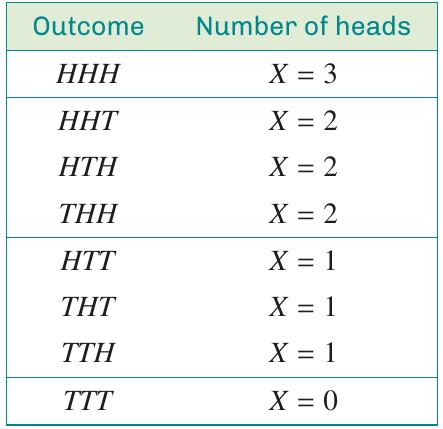
Let's explore this concept with a concrete example. Consider tossing a fair coin three times. The sample space contains all possible outcomes:
Suppose we're interested in counting the number of heads. We can define a random variable to represent "the number of heads observed when a coin is tossed three times." Each outcome in the sample space corresponds to a value of :
Note
From this table, we can see that can take the values , , , or . The actual value of depends on the random outcome of our coin tosses, which is why we call it a random variable.
Types of random variables
Random variables fall into two main categories: discrete and continuous.
Discrete random variables
A discrete random variable can only take separate, countable values, such as , , , , and so on. These variables typically arise from counting processes.
Examples of discrete random variables:
- The number of children in a family
- The number of brown eggs in a carton of a dozen eggs
- The number of times you roll a die before getting a six
- The number of heads when tossing three coins
Continuous random variables
A continuous random variable can take any value within an interval on the real number line. These variables usually arise from measuring processes.
Examples of continuous random variables:
- Height of a person
- Weight of an object
- Time taken to complete a puzzle
- Temperature on a given day
Important
Exam tip: While discrete variables are usually generated by counting and continuous variables by measuring, this isn't always the case. The key distinction is whether the variable can take only specific, separate values (discrete) or any value in an interval (continuous).
Discrete probability distributions
Since the values of a random variable are linked to outcomes in the sample space, we can work out the probability of each value occurring.
Let's return to our three-coin toss example. If we assume the coin is fair, we can determine the probability for each value of :
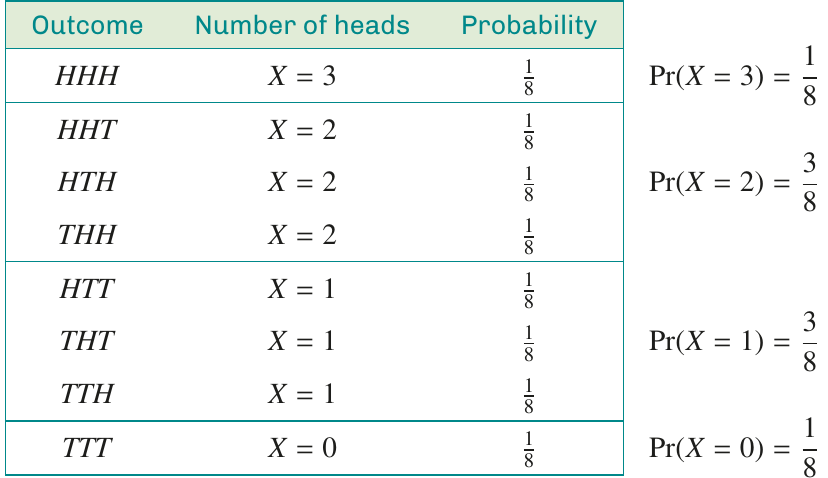
The complete list of all possible values of a random variable , together with the probability of each value, is called the probability distribution of .
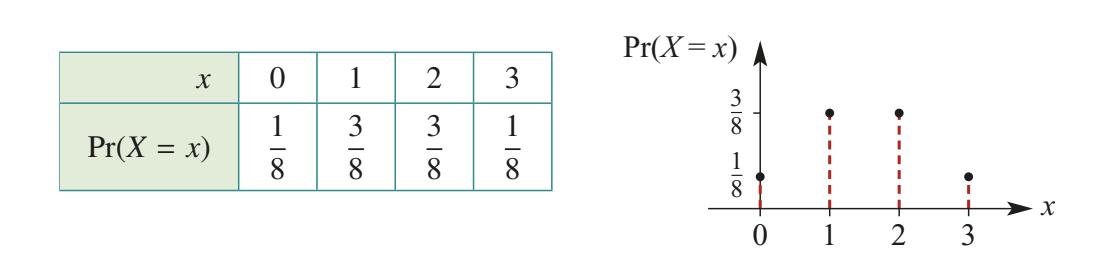
We typically present probability distributions in a simplified table or graph:
Note
Since every possible value of the random variable is included, the probabilities must sum to 1.
The probability distribution of a discrete random variable is a function:
that assigns a probability to each value of . It can be represented by a rule, a table, or a graph, and must give a probability for every value that can take.
Conditions for valid probability distributions
For any discrete probability distribution, two essential conditions must hold:
Important
Two Essential Conditions for Valid Probability Distributions:
-
Each probability is between 0 and 1: for all values of
-
All probabilities sum to 1: The sum of all values of equals
These conditions ensure that the distribution represents a legitimate probability model.
Working with probability distributions
Once we have a probability distribution, we can answer various questions about the random variable. Let's explore this through worked examples.
Worked example: Basic probability calculations
Example
Worked Example: Finding Probabilities from a Distribution Table
Consider the following probability distribution:

a)
Reading directly from the table:
b)
If is less than , then can be or :
c)
If is greater than or equal to , then can be , , or :
d)
Here can take the values , , or :
e)
The probability that is not equal to is the complement of :
Note
Exam tip: When finding the probability that does not equal a particular value, use the complement: .
Worked example: Finding an unknown constant
Sometimes a probability distribution involves an unknown constant that we need to find.
Example
Worked Example: Determining the Value of an Unknown Constant
Consider this probability distribution:

To find the value of , we use the fact that all probabilities must sum to 1:
This gives us a complete probability distribution where each probability can now be calculated.
Worked example: Conditional probability
Conditional probability questions ask about the probability of an event given that another event has occurred.
Example
Worked Example: Calculating Conditional Probabilities
Consider this probability distribution for the number of people on a carnival ride:

a)
b)
c)
This asks: "What is the probability that is less than , given that we know is less than ?"
Using the conditional probability formula:
Since if , then automatically , we have:
First, find :
Next, find :
Therefore:
Remember!
Summary
Key Points to Remember:
- A random variable links each outcome in a sample space to a numerical value
- Discrete random variables take separate, countable values (usually from counting), whilst continuous random variables can take any value in an interval (usually from measuring)
- A probability distribution lists all possible values of a random variable with their probabilities
- Valid probability distributions must satisfy: for all , and the sum of all probabilities equals 1
- To find probabilities from a distribution table, identify which values of the random variable satisfy the given condition and add their probabilities