Sampling Without Replacement (VCE SSCE Mathematical Methods): Revision Notes
📚Revision Notes
Sampling Without Replacement
What is sampling without replacement?
When we sample without replacement, we select items from a group and don't put them back before making the next selection. This is different from sampling with replacement, where items are returned to the group after each selection.
The key feature of sampling without replacement is that the probability of selecting a particular item changes after each selection. This happens because the composition of the group changes as items are removed.
Note
In sampling with replacement, probabilities stay constant because the population doesn't change between selections. In sampling without replacement, probabilities are dependent on previous selections, making the events dependent rather than independent.
Understanding through an example
Let's explore this concept with a practical example.
Imagine a jar containing three mints and four toffees (seven lollies in total). Bob selects two lollies from the jar without looking, and without replacing the first one before selecting the second.
Let represent the number of mints Bob selects. The random variable can take the values , , or .
Initially, the probability that Bob selects a mint is , and the probability he selects a toffee is .
However, when Bob makes his second selection, only six lollies remain. The probability of selecting a mint or toffee on the second draw depends entirely on what he selected first. This dependency is the hallmark of sampling without replacement.
Method 1: Using a tree diagram
We can visualize this problem using a tree diagram, which shows all possible outcomes across the two selections.
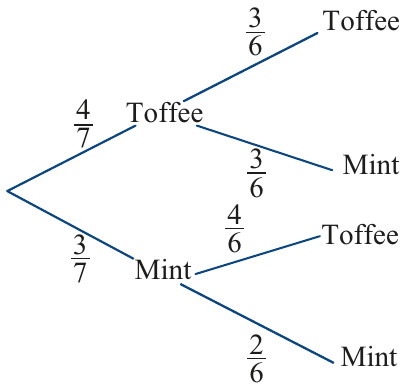
The tree diagram branches out from the first selection to show the second selection. Notice how the probabilities on the second set of branches change depending on the first selection:
- If Bob selects a toffee first (probability ), then three toffees and three mints remain, giving probabilities for each on the second selection.
- If Bob selects a mint first (probability ), then four toffees and two mints remain, giving probabilities and respectively.
Since this involves a sequence of two dependent trials, we use the multiplication rule to find the probability of each complete outcome. We multiply along the branches:
For (no mints selected, i.e., two toffees):
For (one mint selected):
This can happen in two ways: toffee then mint, or mint then toffee. We add these probabilities:
For (two mints selected):
Note
Tree diagram strategy:
- Multiply along the branches to find the probability of a complete path
- Add across different paths that lead to the same outcome
- This approach works well for problems with a small number of selections
Method 2: Using combinations
For larger problems, drawing a complete tree diagram becomes impractical. Fortunately, we can calculate the same probabilities using combinations.
Important
Notation note: The binomial coefficient (read as "n choose r") represents the number of ways to select objects from objects. This is the same as notation you may have seen previously.
The general approach is:
For (no mints, so two toffees):
Number of ways to select mints from available:
Number of ways to select toffees from available:
Total ways to select lollies from :
Therefore:
For (one mint, one toffee):
For (two mints):
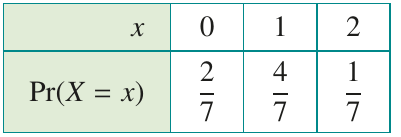
The complete probability distribution for is:
Important
Verification check: Notice that the probabilities must sum to :
Always verify your probability distribution sums to exactly 1 — this is an essential check that your calculations are correct.
The hypergeometric distribution
The type of probability distribution we've just explored is called the hypergeometric distribution. This distribution arises whenever we sample without replacement from a finite population containing two distinct types of items.
The hypergeometric distribution is particularly useful in quality control, ecological studies, and many other real-world applications where sampling without replacement occurs naturally.
Note
The hypergeometric distribution is characterized by:
- Sampling from a finite population
- Two distinct categories or types within the population
- Sampling without replacement
- Interest in the number of items from one category in the sample
Worked example: tagged dolphins
Example
Worked Example: Marine Biology Study
Marine biologists are studying a group of dolphins in a small bay. They know there are dolphins in total. Four dolphins have been caught, tagged, and released back into the population.
The researchers return the following week and catch a sample of three dolphins. What is the probability that exactly two of these three dolphins are already tagged?
Solution:
Let represent the number of tagged dolphins in the sample of three.
We need to find .
Step 1: Identify the groups
- Total population: dolphins
- Tagged dolphins:
- Non-tagged dolphins:
- Sample size: dolphins
- We want: exactly tagged dolphins
Step 2: Set up the combination formula
We're selecting tagged dolphins from the available tagged dolphins, and non-tagged dolphin from the non-tagged dolphins:
Step 3: Calculate the combinations
Step 4: Simplify
Answer: The probability that exactly two of the three caught dolphins are already tagged is (approximately or ).
Remember!
Summary
Key Points to Remember:
-
Sampling without replacement means items are not returned to the group after selection, causing probabilities to change with each draw.
-
Tree diagrams work well for small problems with few stages. Multiply along branches and add across different paths leading to the same outcome.
-
The combination method is more efficient for larger problems. Use where you're selecting items from group and items from group , with total population and sample size .
-
The hypergeometric distribution describes the probability distribution when sampling without replacement from a population with two distinct types.
-
Always check that your probabilities sum to 1 as a verification of your calculations.