Logarithms (VCE SSCE Mathematical Methods): Revision Notes
📚Revision Notes
Logarithms
Introduction to logarithms
A logarithm provides an alternative way to express an exponential relationship. Let's examine the example:
We can rewrite this same relationship using logarithms as:
This is read as "the logarithm of 8 to the base 2 is equal to 3".
Definition
For , the logarithm function with base is defined as follows:
Important
Since is always positive, the expression is only defined when is positive. This means we cannot take the logarithm of zero or negative numbers.
Converting between forms
Here are some examples showing how to convert between exponential and logarithmic forms:
-
is equivalent to
-
is equivalent to
-
is equivalent to
Evaluating logarithms
To find the value of a logarithm, we ask ourselves a key question: "What power of the base gives this number?"
For example:
- To find , we ask "What power of 2 gives 32?"
- To find , we ask "What power of 3 gives 81?"
Example
Worked Example: Evaluating Logarithms
Evaluate without a calculator:
a)
b)
Solution
a) Let
Then
Therefore , giving log₂ 32 = 5
b) Let
Then
Therefore , giving log₃ 81 = 4
Logarithms as inverse functions
For each base , the exponential function , is one-to-one and therefore has an inverse function.
The inverse of the exponential function , is the logarithmic function , .
Key inverse properties
Note
Because logarithmic and exponential functions are inverses of each other, they satisfy these important properties:
-
for all
-
for all
These properties tell us that applying a logarithm and then an exponential (or vice versa) with the same base returns the original value.
Graphical representation
Since exponential and logarithmic functions are inverses, their graphs are reflections of each other in the line .
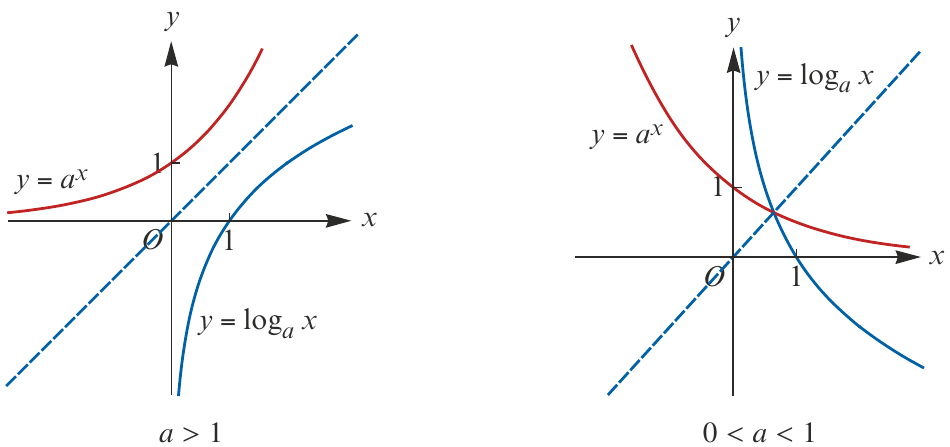
The left graph shows the case where , and the right graph shows the case where . Notice how the exponential curve and logarithmic curve are mirror images across the line .
Natural logarithm
Earlier we defined the number and the important function . The inverse of this function is .
Because the logarithm function with base is known as the natural logarithm, the expression is also written as ln x.
This notation is commonly used in mathematics and science, so you should be familiar with both forms:
Common logarithm
The function has both historical and practical importance. Before calculators were widely available, logarithms were used as a calculating device, and it was often base 10 that was used. By simplifying calculations, logarithms contributed to the advancement of science, especially astronomy. In schools, books of tables of logarithms were provided for calculations up to the 1970s.
Note
Base 10 logarithms are still used for scales in science such as the Richter scale, decibels, and pH.
You can understand the practicality of base 10 by observing:
This pattern makes base 10 logarithms particularly useful for expressing very large or very small numbers in a compact form.
Laws of logarithms
The index laws are used to establish rules for computations with logarithms. These laws are essential for simplifying logarithmic expressions and solving logarithmic equations.
Law 1: Logarithm of a product
The logarithm of a product equals the sum of the logarithms:
Proof: Let and , where and are positive real numbers.
Then and , and therefore:
(using the first index law)
Hence
Example:
Law 2: Logarithm of a quotient
The logarithm of a quotient equals the difference of the logarithms:
Proof: Let and , where and are positive real numbers.
Then as before and , and therefore:
(using the second index law)
Hence
Example:
Law 3: Logarithm of a power
Proof: Let . Then , and therefore:
(using the third index law)
Hence
Example:
Law 4: Logarithm of a reciprocal
Proof: This follows from Law 3 with .
Example:
Law 5: Special values
Proof: Since , we have
Since , we have
Example
Worked Example: Combining Logarithms
Express the following as the logarithm of a single term:
Solution
Solving logarithmic equations
When solving logarithmic equations, we use the laws of logarithms and the relationship between logarithmic and exponential forms.
Example
Worked Example: Basic Logarithmic Equations
Solve each of the following equations for :
a)
b)
c)
Solution
a)
b)
c)
Example
Worked Example: Using Logarithm Laws
Solve each of the following equations for :
a)
b)
Solution
a)
Note: The solutions must satisfy , , and . Both solutions satisfy these conditions, so both are valid.
b)
Example
Worked Example: More Complex Equations
Solve each of the following equations for :
a)
b)
Solution
a)
b)
However, the original equation is not defined for (because would be negative), so the only solution is .
Important
Always check that your solutions satisfy the domain restrictions. Remember that logarithms are only defined for positive arguments.
Example
Worked Example: Finding the Base
Solve the equation for .
Solution
is equivalent to
Summary
Key Points to Remember:
-
Definition: is equivalent to (logarithms answer the question what power?)
-
Domain: Logarithms are only defined for positive numbers ()
-
Inverse relationship: and (logarithmic and exponential functions undo each other)
-
Five key laws:
- Product:
- Quotient:
- Power:
- Reciprocal:
- Special values: and
-
Always check domain restrictions when solving logarithmic equations to ensure all arguments are positive