Applying Function Notation (VCE SSCE Mathematical Methods): Revision Notes
📚Revision Notes
Applying Function Notation
Introduction
Function notation provides a systematic and formal way to work with mathematical relationships. This allows us to clearly identify inputs and outputs, and makes it easier to solve problems involving functions. In this topic, we'll apply function notation to various types of functions including linear and quadratic functions.
Understanding practical domain
The practical domain of a function consists of all input values that make sense in a real-world context. While a function may be mathematically defined for many values, practical considerations often restrict the domain.
Note
The mathematical domain might allow any real number, but the practical domain is often more restricted. For example, you cannot have negative lengths, negative time periods, or negative populations in real-world applications.
For example, if a function represents the volume of a physical object in terms of its radius, negative values wouldn't make sense. Similarly, if a function models temperature, there may be physical limits to consider.
Worked example: Finding practical domain and evaluating functions
Example
Worked Example: Volume of a Sphere
Problem: The volume of a sphere of radius is given by the function . State the practical domain of function and find .
Solution:
Since radius must be positive in physical contexts, the practical domain is , meaning all positive real numbers.
To find , substitute into the formula:
The volume of a sphere with radius 10 units is cubic units (approximately 4188.79 cubic units).
Finding parameters in linear functions
When working with linear functions in the form , we often need to find the values of parameters and . If we know the function values at two different points, we can create simultaneous equations to solve for these parameters.
Note
Key Steps for Finding Linear Parameters:
- Substitute each known point into the function rule
- Form two equations with two unknowns ( and )
- Solve the simultaneous equations
Worked example: Determining linear function parameters
Example
Worked Example: Finding Linear Function Parameters
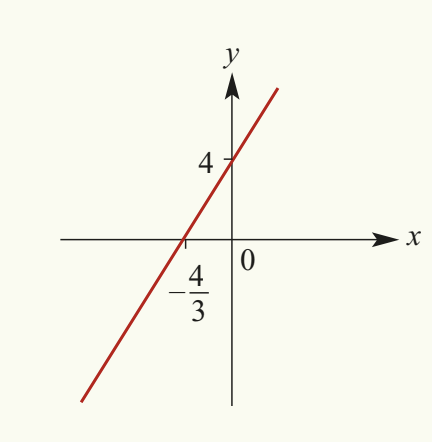
Problem: If , such that and , find and and sketch the graph of .
Solution:
Since and , we can substitute these values into the function rule.
When :
When :
To eliminate , subtract equation (1) from equation (2):
Substituting into equation (1):
Therefore, the function is .
The graph is a straight line with gradient 3 and y-intercept 4. The -intercept can be found by setting :
Finding quadratic functions from given conditions
Quadratic functions can be determined using various pieces of information. When we know the zeros (roots) of the function, we can write it in factored form: , where an additional point on the graph allows us to find the value of .
Important
When you know the zeros of a quadratic function, always start with the factored form . This makes finding the complete function much simpler than trying to work with the expanded form immediately.
This approach is particularly useful when working with quadratics in practical problems.
Worked example: Determining a quadratic function
Example
Worked Example: Finding a Quadratic from Zeros and a Point
Problem: Find the quadratic function such that and .
Solution:
Since 4 and -2 are zeros of the function (they make ), we can write the function in factored form:
Here, is a constant we need to determine. We can find using the condition .
Substitute :
Therefore:
We can expand this to get the standard form:
This is our final quadratic function in standard form.
Key problem types
When applying function notation, you might encounter problems involving:
- Linear functions: Finding gradient and y-intercept from given conditions
- Quadratic functions: Using zeros and additional points to determine the complete function
- Parallel lines: Functions with the same gradient
- Completing the square: Rewriting quadratics to identify maximum/minimum values and range
- Practical domains: Determining sensible input values for real-world contexts
Important
Common Mistakes to Avoid:
- Forgetting to check domain restrictions in word problems
- Not clearly labeling equations when solving simultaneous equations
- Expanding quadratics too early instead of working with factored form when zeros are given
- Forgetting to simplify final answers completely
Exam tips
Note
Exam Strategy:
- Always check whether a domain restriction is stated or implied by the context
- When finding parameters, clearly label your equations before solving
- For quadratics, factored form is useful when you know the zeros
- Remember to expand and simplify your final answer when required
- Sketch graphs when asked to help visualise the function
Remember!
Summary
Key Points to Remember:
- Function notation like helps us formally describe the relationship between inputs and outputs
- The practical domain includes only values that make sense in real-world contexts (e.g., positive values for physical measurements)
- For linear functions , two known points give you two equations to solve for and
- For quadratic functions, if you know the zeros and , write then use another point to find
- Always show your working clearly, particularly when solving simultaneous equations