More Power Functions (VCE SSCE Mathematical Methods): Revision Notes
📚Revision Notes
More Power Functions
Introduction
Previously, we have studied power functions of the form , , and , where is a positive integer. We also explored how to transform these functions. Now we will examine additional types of power functions that complete our understanding of this family of functions.
Note
In this section, we'll explore two important types of power functions: those with negative fractional powers () and those with general fractional powers (). Understanding these functions will complete your knowledge of power functions and their behaviors.
The function where is a positive integer
Definition and notation
A function with a negative fractional power can be written in several equivalent ways. The function can be expressed as:
This shows us that a negative fractional power creates a reciprocal of the corresponding root function.
Domain considerations
The maximal domain of the function depends on whether is odd or even:
- When is odd: the maximal domain is (all real numbers except zero)
- When is even: the maximal domain is (positive real numbers only)
Important
The domain excludes zero in both cases because division by zero is undefined. For even values of , we also exclude negative numbers because even roots of negative numbers are not real.
Quick rule: "Odd lets negatives in, even needs positive values"
Graph characteristics
Let's examine how these functions behave graphically by comparing them to the basic reciprocal function .
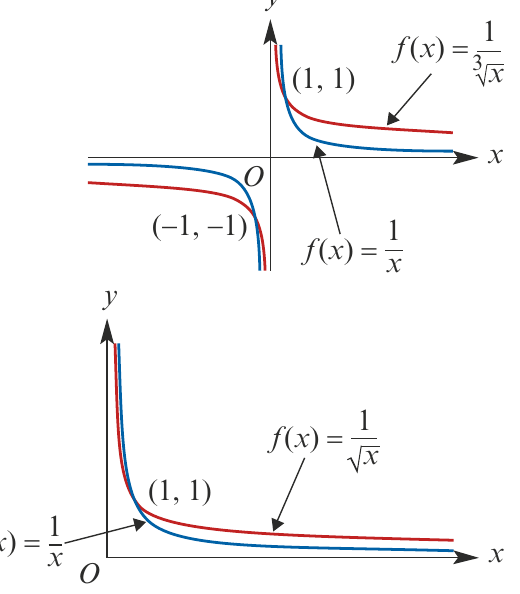
The graphs show important features common to all functions of the form :
- Each graph has a horizontal asymptote with equation (the function approaches zero as increases)
- Each graph has a vertical asymptote with equation (the function becomes unbounded near zero)
- All graphs pass through the point
- When is odd, the graph exists in both positive and negative regions and also passes through
Odd and even function properties
An important property emerges when is an odd positive integer: the function is an odd function. This means:
This symmetry property means the graph is symmetric about the origin (rotational symmetry of 180°).
Worked example
Example
Worked Example: Sketching Graphs of Functions with Negative Fractional Powers
Question: For each of the following, sketch the graph of for the maximal domain. State the maximal domain, the range, and whether the function is odd, even, or neither.
a)
b)
Solution:
Part a:
The maximal domain is (because the power has an even denominator).
The range is .
The function is neither odd nor even.
To find the -axis intercept, we set :
The graph shows a curve with a vertical asymptote at and a horizontal asymptote at .
Part b:
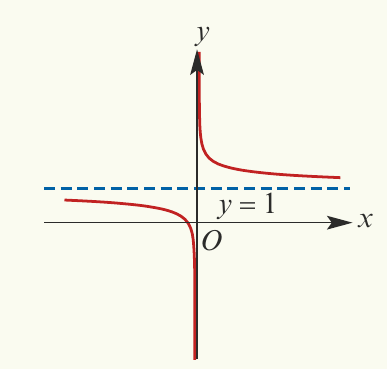
The maximal domain is (because the power has an odd denominator).
The range is (all real numbers except 1).
The function is neither odd nor even.
The line is a vertical asymptote.
The line is a horizontal asymptote.
The function where and are positive integers
Definition and evaluation
When we have a fractional power where both the numerator and denominator are positive integers, we can express it in two equivalent ways:
Important
Critical Rule: To use this definition correctly, we must always first write the fractional power in simplest form. For example, should be simplified to before evaluation.
Domain considerations
For the function (where is in simplest form), the maximal domain depends on whether is odd or even:
- When is odd: the maximal domain is (all real numbers)
- When is even: the maximal domain is (non-negative real numbers)
Note
The denominator determines what type of root we're taking, and even roots require non-negative inputs. This is why (not ) determines the domain restrictions.
Evaluating fractional powers
Here are some examples showing how to evaluate expressions with fractional powers:
Notice that even when the base is negative (like ), if the power in simplest form has an even numerator , the result will be positive.
Worked example
Example
Worked Example: Sketching Graphs of Functions with General Fractional Powers
Question: For each of the following, sketch the graph of for the maximal domain. State the maximal domain, the range, and whether the function is odd, even, or neither.
a)
b)
Solution:
Part a:
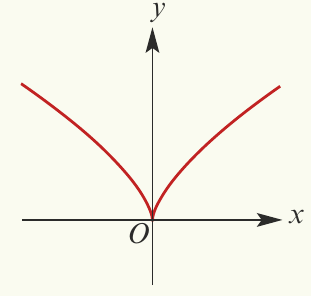
The maximal domain is (because the denominator 3 is odd).
The range is (all non-negative real numbers).
The function is even, since .
The graph has a V-shape opening upward from the origin, showing symmetry about the -axis (characteristic of even functions).
Part b:
The maximal domain is (because the denominator 2 is even).
The range is .
The function is neither odd nor even.
The graph starts at the origin and curves upward, existing only for non-negative values.
Remember!
Summary
Key Points to Remember:
-
For : The domain is if is odd, or if is even. These functions always have asymptotes at and .
-
When is odd in , the function is odd (symmetric about the origin).
-
For (in simplest form): The domain is if is odd, or if is even.
-
Always simplify fractional powers before evaluating:
-
The denominator determines the domain (whether negative inputs are allowed), while the numerator affects the shape of the graph.