Sums and Products of Functions and Addition of Ordinates (VCE SSCE Mathematical Methods): Revision Notes
📚Revision Notes
Sums and Products of Functions and Addition of Ordinates
Introduction
When working with functions, we can combine them in various ways to create new functions. The most common operations are addition, subtraction, and multiplication of functions. Understanding how to work with these combined functions is essential for analysing more complex mathematical relationships.
Note
Function operations allow us to build more sophisticated mathematical models by combining simpler functions. This is particularly useful in applications such as physics, economics, and engineering, where complex phenomena can often be described by combining basic function types.
Sum of functions
The sum of two functions and is a new function denoted , defined by the rule:
This means that at any point , the value of the sum function is found by adding the values of and .
The domain of the sum function is:
The symbol represents the intersection, meaning the domain of the sum includes only those values that are in both the domain of and the domain of .
Important
Domain Rule: The domain of any combined function (sum, difference, or product) is always the intersection of the individual domains. This ensures that both original functions are defined at every point in the new function's domain.
Product of functions
The product of two functions and is a new function denoted or , defined by the rule:
This means that at any point , the value of the product function is found by multiplying the values of and .
The domain of the product function is:
Just like with the sum, the domain is the intersection of the individual domains.
Difference of functions
The difference of two functions and is a new function denoted , defined by the rule:
At any point , the value of the difference function is found by subtracting from .
The domain of the difference function is:
Addition of ordinates
Addition of ordinates is a graphical technique used to sketch the graph of the sum of two functions. The term ordinate refers to the -coordinate of a point, so this technique involves adding the -values of the two functions at each -value.
Note
Understanding Ordinates: In coordinate geometry, the ordinate is the -coordinate, while the -coordinate is called the abscissa. When we add ordinates, we're literally adding the heights of the two function graphs at each horizontal position.
Key points for sketching using addition of ordinates
When sketching , consider the following important points:
-
When , the sum function equals just the other function:
-
When , the sum function equals just the other function:
-
If both and are positive, then the sum is greater than either individual function: and
-
If both and are negative, then the sum is less than either individual function: and
-
If is positive and is negative (or vice versa), then the sum lies between the two functions: (assuming is the positive one)
-
Look for values of where , as these give the x-intercepts of the sum function
Important
Key Insight: When sketching using addition of ordinates, identify where each original function crosses the axes. At these crossing points, one function equals zero, so the sum function will equal the other function. This gives you critical points for your sketch.
Worked examples
Example
Worked Example: Basic Function Operations
For and :
a) Find the rules for and
b) Evaluate and
Note that and .
Example
Worked Example: Sketching Using Addition of Ordinates
For and , sketch the graph of .
Solution:
First, note that , giving us the y-intercept at .
To find where the sum function crosses the -axis, we solve :
This equation cannot be solved analytically, but using a calculator we can find the approximate solution x = -0.43 (to two decimal places).
As , the exponential term , so from above. This means the sum function approaches the line asymptotically as becomes very negative.
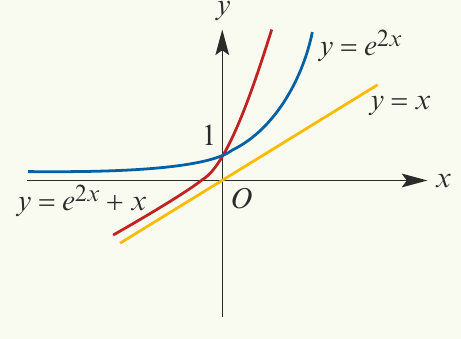
The graph shows three functions: the exponential (blue curve), the linear function (yellow line), and their sum (teal curve). Notice how the sum function combines features of both original functions, passing through and crossing the -axis at approximately .
Exam tips
Note
Exam Success Tips:
-
Always remember that the domain of any combined function is the intersection of the individual domains
-
When sketching using addition of ordinates, start by identifying where each original function crosses the axes
-
Look for points where one function equals zero, as the sum will equal the other function at these points
-
Check the behaviour of the sum function at key points and as
Summary
Key Points to Remember:
-
The sum of functions is defined by , with domain
-
The product of functions is defined by , with domain
-
The difference of functions is defined by , with domain
-
Addition of ordinates is a graphical technique where you add the -values of two functions at each -value to sketch their sum
-
When using addition of ordinates, pay special attention to points where one function equals zero, as the sum will equal the other function at these locations