Constant Rate of Change (VCE SSCE Mathematical Methods): Revision Notes
📚Revision Notes
Constant Rate of Change
What is constant rate of change?
When we talk about a constant rate of change, we mean that something is changing at the same rate throughout. Think of driving a car at a steady speed - you're covering the same distance every minute. This steady, unchanging pattern is what we call a constant rate of change.
Linear functions are special because they always have a constant rate of change. If you have a function in the form , the rate of change is simply - the gradient of the line. This gradient stays the same no matter where you look on the graph.
Note
For any linear function, the rate of change equals the gradient of its graph. This is a fundamental property that makes linear functions predictable and easy to work with.
Finding the constant rate
There are two main ways to find the constant rate of change:
From the graph: Calculate the gradient by finding the change in the vertical direction divided by the change in the horizontal direction. The gradient of a straight line is the same between any two points you choose.
From the function rule: If the function is written as , then m is the constant rate of change. For example, if , the constant rate of change is 3.
Important
Two methods to find constant rate:
- Graphically: Calculate gradient =
- Algebraically: Identify the coefficient in the function
Both methods will give you the same result for a linear function!
Worked example: calculating speed from a distance-time graph
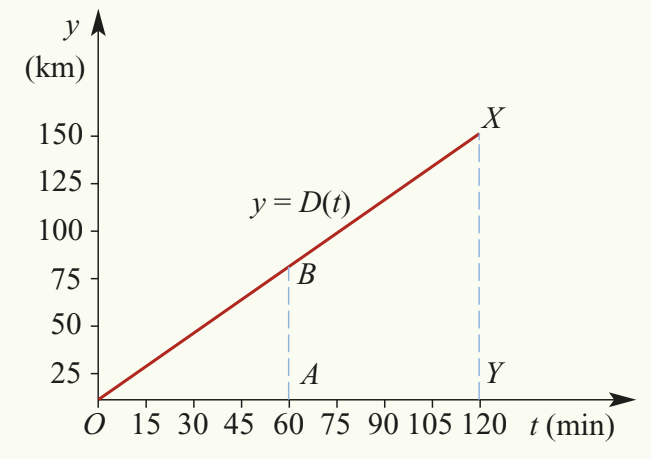
A car travels from Copahunga to Charlegum, which is a distance of km, in hours ( minutes). Assuming the car travels at a constant speed, we can draw a distance-time graph and calculate the speed.
Example
Worked Example: Finding Speed from a Distance-Time Graph
Setting up the problem:
Let's call the distance function , where represents the distance traveled after minutes.
Since the car travels at constant speed, the graph will be a straight line starting from the origin.
After minutes, the car has traveled km, so the point is on our graph.
Finding the function rule:
The gradient of the line is:
Since the line passes through the origin, the function is:
Interpreting the gradient:
The gradient of the graph gives us the speed. Therefore, the speed of the car is kilometres per minute.
Converting units:
To express this in kilometres per hour, we multiply by (since there are minutes in an hour):
Therefore, the car is traveling at 75 km/h.
Worked example: comparing different constant rates
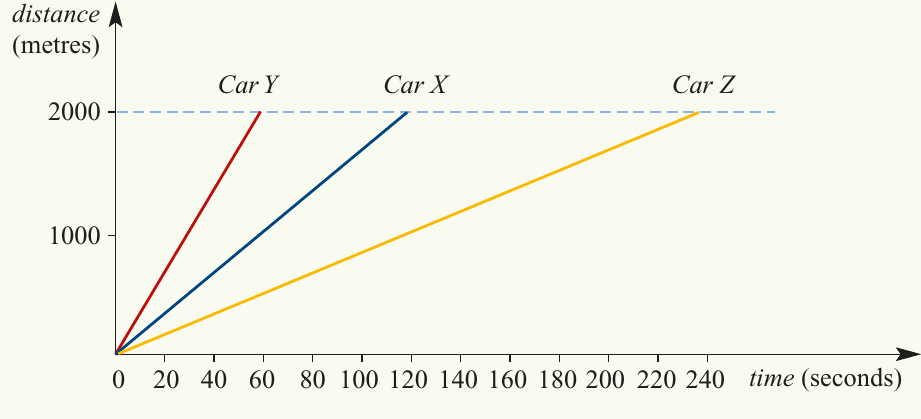
Three cars are driven over a -kilometre straight track from point A to point B. Each car travels at constant speed, but:
- Car Y travels at twice the speed of car X
- Car Z travels at half the speed of car X
- Car X travels at km/min
We can illustrate this situation with a distance-time graph.
Example
Worked Example: Comparing Multiple Constant Rates
Understanding the graph:
Each car's journey is represented by a straight line starting from the origin. The steeper the line, the faster the car is traveling.
Calculating the gradients:
For car X:
For car Y:
For car Z:
Key observation: Car Y has the steepest gradient and reaches the metre mark first. Car Z has the gentlest gradient and takes the longest time. The gradient of each line directly represents the speed of that car.
Note
When an object's motion can be described by a linear distance-time graph, the object is traveling at a constant speed. This constant speed equals the gradient of the line.
Real-world applications of constant rate
Distance-time graphs are just one example of how constant rates appear in real life. Any situation that can be modeled with a straight-line graph involves a constant rate of change.
Currency exchange
Currency exchange is another perfect example. When you exchange money between two currencies, the exchange rate is constant (at any given time).
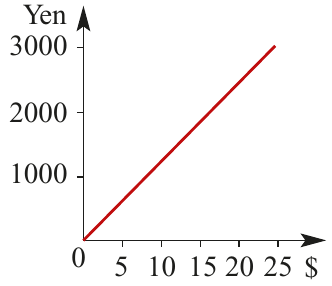
The graph shows the conversion between dollars and yen. The gradient of this straight line gives us the exchange rate - how many yen you get for each dollar.
Note
Understanding the gradient: If the line passes through the point , the gradient is . This means the exchange rate is 120 yen per dollar.
The gradient directly tells you the conversion rate between the two currencies!
Other examples
Many other situations involve constant rates:
- Water filling a container at steady rate: Volume increases linearly with time
- Constant pay rate: Earnings increase linearly with hours worked
- Unit pricing: Total cost increases linearly with quantity purchased
In all these situations, the gradient of the straight-line graph represents the rate at which one quantity changes with respect to another.
Summary
Key Points to Remember:
- Linear functions have a constant rate of change equal to their gradient
- For , the constant rate of change is m
- In distance-time graphs, the gradient represents speed when traveling at constant velocity
- Steeper gradients mean faster rates of change
- Many real-world situations (like currency exchange and constant speed motion) can be modeled with linear functions
- The rate of change can be calculated from the graph or read directly from the function rule