Approximating the Distribution of the Sample Proportion (VCE SSCE Mathematical Methods): Revision Notes
📚Revision Notes
Approximating the Distribution of the Sample Proportion
Introduction
When working with sample proportions, we often need to calculate probabilities for different sample outcomes. While we can determine the exact distribution of a sample proportion using probability theory, this approach is only practical for small sample sizes (typically less than 10). In real-world situations, we usually work with much larger samples, which makes exact calculations impractical. Fortunately, we can overcome this limitation by using an approximation method based on the normal distribution.
Note
For samples with fewer than 10 observations, we can calculate exact probabilities using the binomial distribution. However, as sample sizes increase, these calculations become increasingly complex and time-consuming, making the normal approximation both practical and necessary.
Understanding sample proportion variation
Let's explore this concept with a practical example. Suppose we know that 55% of people in Australia have blue eyes, so the population proportion is . We're interested in understanding what values of the sample proportion we might observe when we take random samples of size 100 from this population.
Single sample observations
If we select one sample of 100 people and find that 50 have blue eyes, the sample proportion is:
If we select a second sample of 100 people and this time 58 have blue eyes, the sample proportion for this second sample is:
Note
Notice that even though both samples come from the same population, they yield different sample proportions. This variation is a natural consequence of random sampling.
Visualising multiple samples
When we continue this sampling process and take 10 samples, the observed values of might look like this:

From this dotplot, we can see that the proportion of people with blue eyes varies from sample to sample. In these particular 10 samples, the sample proportion ranges from as low as 0.44 to as high as 0.61.
The pattern emerges with more samples
What happens when we increase the number of samples? The following dotplot shows the distribution of sample proportions when 200 samples (each of size 100) were selected:
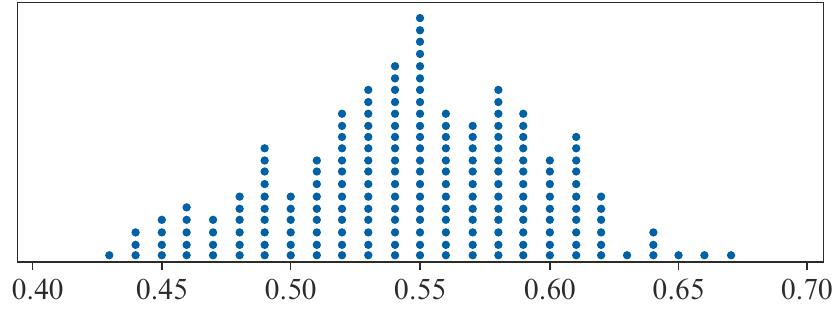
We can observe several important features:
- The distribution is reasonably symmetric
- The values are centred around 0.55 (the population proportion)
- The values range from approximately 0.43 to 0.67
When we repeat this experiment with another 200 samples from the same population, we get:
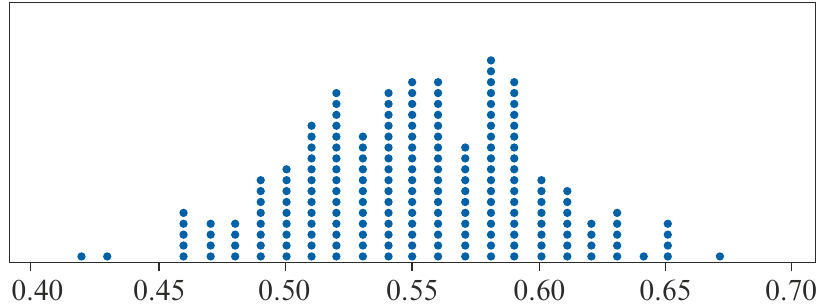
Again, the distribution is:
- Reasonably symmetric
- Centred at 0.55
- Ranging from approximately 0.42 to 0.67
Important
Key Principle: While there will be variation in the specific details each time we collect samples, the distribution of sample proportions tends to follow a predictable pattern in terms of shape, centre, and spread. This predictability is what allows us to use the normal approximation effectively.
The normal approximation
The predictable pattern we observe has a theoretical foundation. We know from probability theory that when the sample size is large enough, the distribution of a binomial random variable can be well approximated by a normal distribution.
Rule of thumb for approximation
Important
Normal Approximation Conditions
The normal approximation to the binomial distribution is appropriate when:
- Both and
The sample proportion can be considered a linear function of a binomial random variable, which means the normal approximation also applies to the distribution of sample proportions.
The approximation formula
Note
Normal Approximation for Sample Proportions
When the sample size is large, the sample proportion has an approximately normal distribution with:
Mean:
Standard deviation:
For our blue eyes example with and :
Investigating with technology
We can use a calculator to simulate the sampling process and verify the normal approximation.
Example
Worked Example: Using Technology to Simulate Sampling
Question: Assume that 55% of people in Australia have blue eyes. Use your calculator to illustrate a possible distribution of sample proportions that may be obtained when 200 different samples (each of size 100) are selected from the population.
Solution using TI-Nspire:
Step 1: Generate the sample proportions
- Start from a Lists & Spreadsheet page
- Name the list propblue in Column A
- In the formula cell of Column A, enter the formula: = randbin(100, 0.55, 200)/100
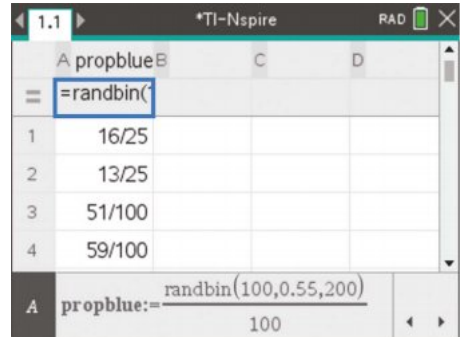
The syntax for this function is: randbin(sample size, population proportion, number of samples). We divide by the sample size to convert counts to proportions.
Step 2: Display the distribution
- Insert a Data & Statistics page
- Click on 'Click to add variable' on the horizontal axis and select propblue
- A dotplot is displayed
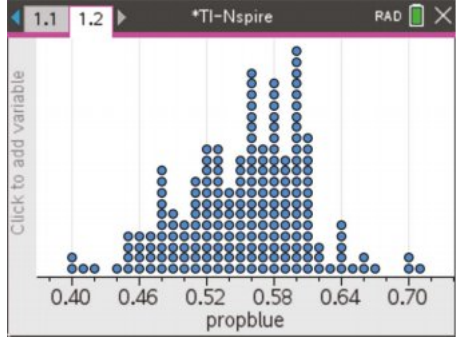
You can recalculate the random sample proportions using ctrl+R while in the Lists & Spreadsheet page.
Step 3: Fit a normal curve to the distribution
- Menu > Plot Type > Histogram
- Menu > Analyze > Show Normal PDF
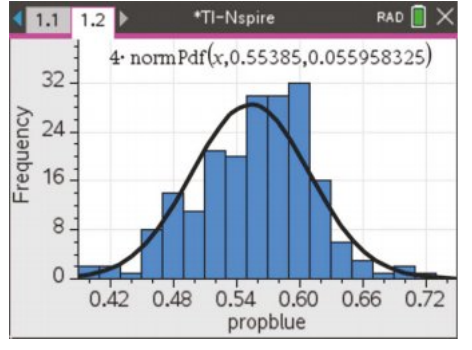
The calculated normal PDF is superimposed on the plot, showing the mean and standard deviation of the sample proportion.
Step 4: Obtain statistics from the distribution
- Navigate to Calc > One-Variable
- The results show that the mean of the sample proportions estimates the population proportion
Using the normal approximation
Example
Worked Example: Finding Probabilities
Question: Assume that 60% of people have a driver's licence. Using the normal approximation, find the approximate probability that, in a randomly selected sample of size 200, more than 65% of people have a driver's licence.
Solution:
Step 1: Identify the given information
Given: and
Step 2: Determine the distribution parameters
Since is large, the distribution of is approximately normal with:
Step 3: Calculate the required probability
We need to find .
Using the normal distribution with mean 0.6 and standard deviation 0.0346:
Example
Worked Example: Finding Sample Size
Question: Suppose again that 60% of people have a driver's licence, and that a random sample of size is selected from the population. If the probability that the proportion of people in the sample with a driver's licence is less than 58% is equal to 0.3446, what size sample was chosen?
Solution:
Step 1: Identify the given information
Given: and , find .
We assume is large enough for the normal approximation to apply.
Step 2: Set up the distribution parameters
The distribution of is approximately normal with:
Step 3: Standardize and use the inverse normal
Converting to the standard normal distribution:
Using the inverse normal function with probability 0.3446:
Step 4: Solve for
Therefore, the sample size was 96.
Summary
Key Points to Remember:
- For small samples (less than 10), use the exact binomial distribution to find probabilities for sample proportions
- For large samples, the normal approximation is more practical and efficient
- The sample proportion has an approximately normal distribution when is large, with mean and standard deviation
- The rule of thumb for using the normal approximation is that both and
- The mean of the sample proportions from repeated samples estimates the population proportion
- Technology can be used to simulate sampling distributions and verify the normal approximation