Muon Decay (VCE SSCE Physics): Revision Notes
📚Revision Notes
Muon Decay
Introduction: muons and the particle zoo
Muons are small fundamental particles that were first discovered in 1936 by American physicist Carl Anderson. He detected them when cosmic rays collided with atoms in Earth's atmosphere. Anderson had previously won a Nobel Prize for discovering the positron, another elementary particle.
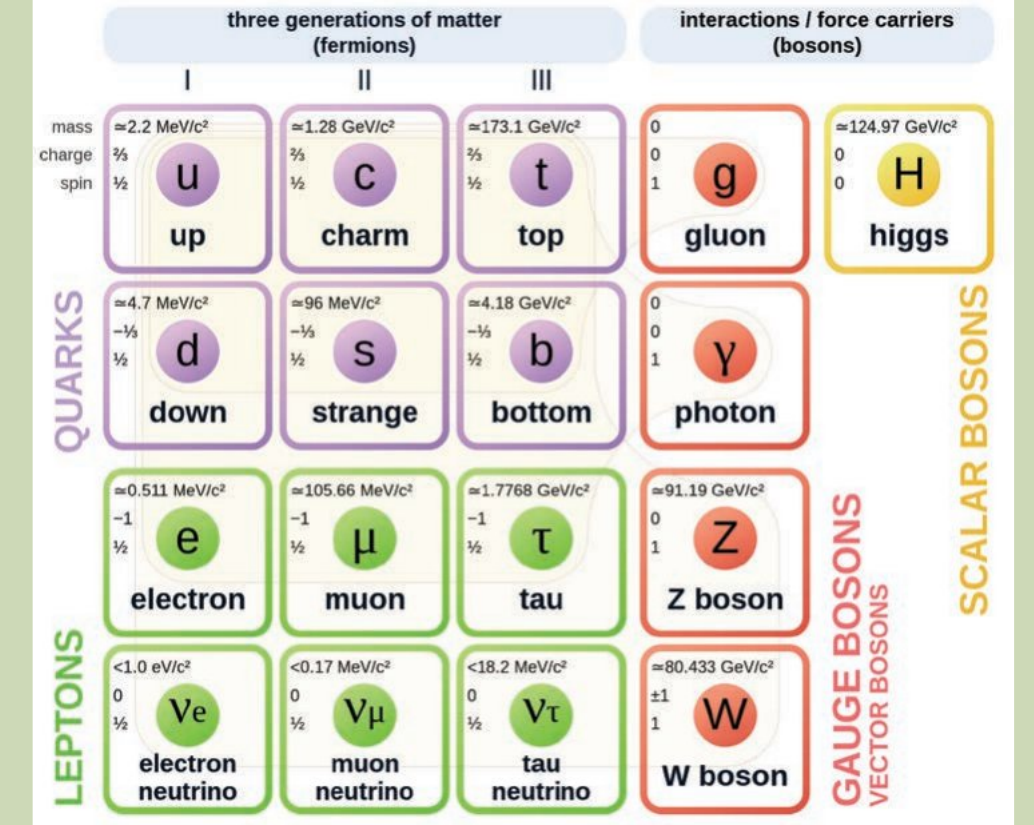
By the 1950s, physicists had observed so many new particles from cosmic ray collisions and particle accelerator experiments that they called them the "particle zoo." Over time, scientists worked out which particles were truly fundamental (unable to be broken down further) and which were made up of smaller particles. They organised these fundamental particles into a classification system based on their properties, which became known as the Standard Model.
Note
The Standard Model represents one of physics' greatest achievements - a complete classification system that organizes all known fundamental particles and explains three of the four fundamental forces in nature.
The Standard Model groups particles into three main categories:
- Quarks (purple boxes) - make up protons and neutrons
- Leptons (green boxes) - includes electrons, muons, and neutrinos
- Bosons (orange/red/yellow boxes) - force carrier particles
Muons belong to the lepton family, appearing in the second generation alongside the muon neutrino. Organising knowledge into patterns and classifications like this is a key scientific technique, and many discoveries have come from attempting to fill gaps in such systems.
Evidence of special relativity: muon decay
What are muons?
Muons are small fundamental particles classified as a type of lepton. They have several important properties:
- Mass: 207 times the mass of an electron (but still much smaller than atoms)
- Mean lifetime when stationary: s (proper time)
- Formation: Created when cosmic rays (mainly high-energy protons) collide with atoms in the upper atmosphere
- Height of formation: Approximately 5000 m above Earth's surface
- Velocity: Travel at around (where is the speed of light)
Despite their extremely short lifetimes, muons are frequently detected hitting Earth's surface. This observation provides compelling evidence for Einstein's special theory of relativity.
The classical physics problem
According to classical (Newtonian) physics, we can calculate how far a muon should travel during its lifetime using the basic distance formula:
Substituting the known values:
Important
The Muon Paradox
Classical physics predicts that an average muon can only travel 656.7 m before decaying. However, muons are created at approximately 5000 m above Earth's surface. How can they possibly reach the ground when they should decay after travelling less than 700 m?
This apparent impossibility provided some of the earliest experimental evidence for Einstein's theory of special relativity!
Solution from Earth's reference frame: time dilation
The answer lies in the effects of special relativity, specifically time dilation. Understanding this requires thinking carefully about different reference frames.
When muons are measured in a laboratory, they are stationary relative to the scientist observing them. In this case, both the muon and scientist agree on the decay time ( s) because there is no relative motion. This measurement is called proper time () - the time interval measured in the reference frame where the events occur at the same location.
Note
Understanding Proper Time
Proper time is always the shortest time interval measured between two events. It's the time measured by a clock that is present at both events - in this case, a clock travelling with the muon from creation to decay.
However, when muons are created in the upper atmosphere, they travel at relative to a scientist on Earth. Because the muon is moving in the Earth observer's reference frame, time dilation occurs. The muon still experiences its own proper lifetime of s, but the Earth-based scientist measures a longer, dilated lifetime.
We can calculate the dilated lifetime using the time dilation formula:
Substituting values:
The scientist on Earth observes the moving muon's lifetime to be s - ten times longer than the laboratory measurement. This extended lifetime explains why muons reach Earth's surface.
Recalculating the distance with the dilated time:
From Earth's reference frame, muons can travel 6575 m, which is greater than the 5000 m needed to reach the surface.

Solution from the muon's reference frame: length contraction
A fundamental principle of special relativity is that all inertial reference frames are equally valid. This means the phenomenon must also make sense from the muon's perspective.
From the muon's reference frame, its own lifetime is still s (proper time). The muon doesn't experience time dilation in its own frame. So how does it travel the required distance?
The answer is length contraction. In the muon's reference frame, Earth is travelling towards it at . Due to this relative motion, the distance between the muon's creation point and Earth's surface becomes contracted.
Note
Why Length Contraction?
Just as time dilates for moving clocks, lengths contract for moving objects. From the muon's perspective, it is stationary and Earth is rushing towards it. This means the distance to Earth must be contracted by the same relativistic factor that caused time dilation in Earth's frame.
To calculate the contracted length, we first need the Lorentz factor ():
The contracted length is then:
Where m is the proper length (measured in Earth's frame):
From the muon's frame of reference, the distance to Earth's surface is only 499 m. The muon can easily cover this distance in its proper lifetime of s when travelling at .

Note
Consistency Between Reference Frames
Both explanations are consistent: whether we use time dilation (Earth's frame) or length contraction (muon's frame), the result is the same - muons successfully reach Earth's surface. This agreement between different reference frames is a requirement of special relativity and demonstrates the theory's internal consistency.
Being clear on your reference frame
Important
Critical Exam Skill: Identifying Reference Frames
When answering questions about special relativity, it is crucial to identify which reference frame you are discussing. Different effects occur in different frames:
- Time dilation is observed in Earth's reference frame (moving muons live longer)
- Length contraction occurs in the muon's reference frame (distance to Earth is shorter)
Using the wrong reference frame will cost you marks, even if your calculations are correct!
Example
Worked Example: Explaining Muon Detection from the Muon's Frame
Question: Muons are created in the upper atmosphere about 5000 m from Earth's surface. They have a half-life of seconds when observed stationary in a laboratory and travel at relative to an observer on Earth's surface. Classical physics predicts muons can only travel 657 m in their lifetime, yet many muons are detected on Earth's surface. Using special relativity, explain why muons reach the ground from the muon's frame of reference.
Solution:
In the muon's frame of reference, Earth is travelling towards it at . This means the distance between the muon and Earth must be contracted.
Step 1: Calculate the Lorentz factor:
Step 2: Calculate the contracted length from the upper atmosphere to Earth's surface:
Step 3: Compare with classical prediction:
Since the muon can travel 657 m in its proper lifetime (as calculated by classical physics), and this is greater than the contracted distance of 499 m, the muons will reach Earth's surface.
Important note: The question specifically asks for an explanation "from the muon's frame of reference." This means only answers discussing length contraction can receive full marks. Time dilation occurs in Earth's reference frame, so discussing time dilation does not address the question asked. Always be clear about which reference frame you are using.
Remember!
Summary
Key Points to Remember:
-
Muons are fundamental particles (leptons) with a proper lifetime of s and travel at .
-
Classical physics problem: Muons should only travel ~657 m but are detected at Earth's surface 5000 m away.
-
Earth's reference frame: Time dilation extends the muon's observed lifetime by a factor of 10, allowing it to travel ~6575 m before decaying.
-
Muon's reference frame: Length contraction reduces the distance to Earth's surface to ~499 m, which the muon can cover in its proper lifetime.
-
Key exam skill: Always clearly identify which reference frame you are analysing - time dilation applies in Earth's frame, length contraction applies in the muon's frame.