Time Dilation and Length Contraction (VCE SSCE Physics): Revision Notes
📚Revision Notes
Time Dilation and Length Contraction
Introduction: the twin paradox
One of the most famous thought experiments in special relativity is the twin paradox. This example helps us understand how time and space behave differently at high speeds.

Imagine two identical twins, Sophie and Amanda, who synchronise their accurate clocks on Earth. Sophie boards a spaceship that travels close to the speed of light to a distant star and then returns, while Amanda remains on Earth. When Sophie returns, she has aged only a few years, but Amanda has become an old woman. How can this be?
The answer lies in understanding reference frames. While both observers experience time passing normally from their own perspective, they are in different situations:
- Amanda's perspective: She remains in a single inertial reference frame throughout the journey. When she observes Sophie's spaceship travelling at constant velocity, she measures more time passing on her own clock than on Sophie's clock.
- Sophie's perspective: She is actually in two different inertial reference frames - one for the outbound journey and another for the return journey. The key difference is that Sophie must accelerate to turn around, changing her reference frame.
Important
This is not a true paradox. Amanda is the one who ages more because Sophie's journey involves changing reference frames, whilst Amanda stays in one consistent frame. Neglecting the acceleration phases, Sophie's journey to the star is one inertial reference frame, and her return is another.
Time dilation
Understanding proper time and dilated time
Before we explore the mathematics, we need to understand two important concepts:
Proper time () is the time interval between two events when those events occur at the same point in space in your reference frame. This is always the shortest time interval that any observer can measure for those events.
Dilated time () is the time interval between two events when those events occur at different points in space in your reference frame. This is always longer than the proper time.
The light clock thought experiment
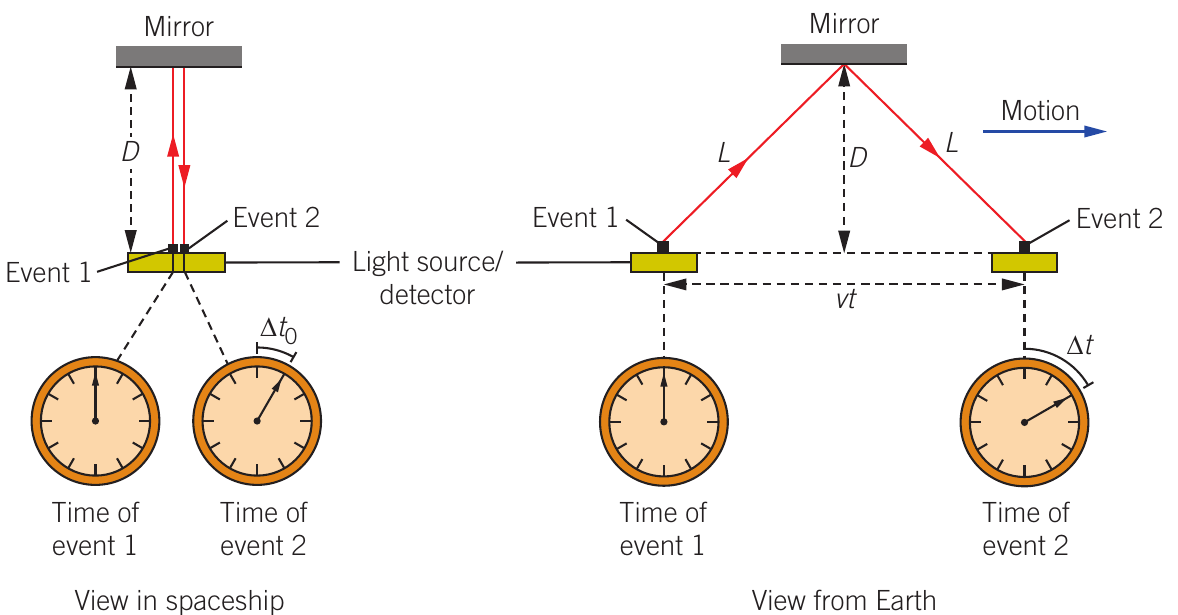
To understand time dilation, imagine you are standing on Earth watching a rocket pass by at a significant fraction of the speed of light. The rocket has a special clock called a light clock, which works by firing a light beam towards a mirror. The light bounces off the mirror and returns to a detector.
Both you (on Earth) and a passenger on the rocket agree to measure the time for one complete cycle: light leaving the detector, hitting the mirror, and returning to the detector.
From the passenger's perspective (on the rocket):
- The light clock is stationary relative to them
- The light travels straight up and down
- The distance travelled by light is (up to mirror and back)
- The events (light leaving and returning) occur at the same point in space
- Therefore, they measure proper time:
From your perspective (on Earth):
- The light clock is moving relative to you
- The light traces a diagonal path because the rocket is moving
- The distance travelled by light is (where )
- The events occur at different points in space (the rocket has moved)
- Therefore, you measure dilated time:
Note
Since , we have . The observer on Earth measures more time passing than the passenger on the rocket for the same events. This is the essence of time dilation - observers in different reference frames measure different time intervals for the same events.
The time dilation formula
The relationship between proper time, dilated time, and relative velocity is given by:
Where:
- = proper time (measured when events occur at same point in space)
- = dilated time (measured when events occur at different points in space)
- = relative velocity between reference frames (in )
- = speed of light ()
- = Lorentz factor (explained below)
Important
Time measured in other inertial frames is never shorter than proper time. Proper time is always the shortest time interval.
The Lorentz factor
The term appears so frequently in special relativity that it has its own symbol and name: the Lorentz factor. This factor determines how much time, length, and energy change due to relative velocity.
The Lorentz factor can be rearranged in several useful forms:
The term is called the velocity ratio. When (i.e., when velocity exceeds about ), relativistic effects become significant and should be checked.
Note
Key point for calculations: Any unit for time can be used in the time dilation formula. If you give proper time in minutes, the dilated time will be in minutes. If proper time is in years, dilated time will be in years. The units must be consistent on both sides of the equation.
Worked example: basic time dilation
Example
Worked Example: Basic Time Dilation
Question: A rocket has an accurate atomic clock that ticks every seconds, as seen by the crew. An observer on Earth sees the rocket pass at (). How long are the clock ticks in the observer's reference frame?
Solution:
First, identify who measures proper time. The crew measure proper time because the clock ticks occur at the same point in space in their reference frame. The Earth observer measures dilated time.
Using the formula:
The Earth observer measures each tick as seconds - twice as long as the crew measures.
Worked example: finding proper time
Example
Worked Example: Finding Proper Time
Question: An Earth observer sees a rocket pass at (). A flash of light occurs on the rocket, lasting seconds as measured by the Earth observer. How long does the flash last in the crew's reference frame?
Solution:
To the Earth observer, the flash occurs at different points in space (the rocket is moving). Therefore, the Earth observer measures dilated time ( s), and the crew measures proper time.
Rearranging the formula:
The flash lasts seconds in the crew's reference frame - less than what the Earth observer measures.
Worked example: finding velocity from time dilation
Example
Worked Example: Finding Velocity from Time Dilation
Question: In a laboratory, a scientist observes a moving particle decay after ps ( s). When the same particles are stationary, they decay after ps. Calculate the particle's speed.
Solution:
When particles are stationary relative to the scientist, creation and decay occur at the same point in space, so this is proper time: s.
The moving particle measurement is dilated time: s.
First, find the Lorentz factor:
Now find the velocity:
The particles are travelling at of the speed of light.
The effect of increasing speed
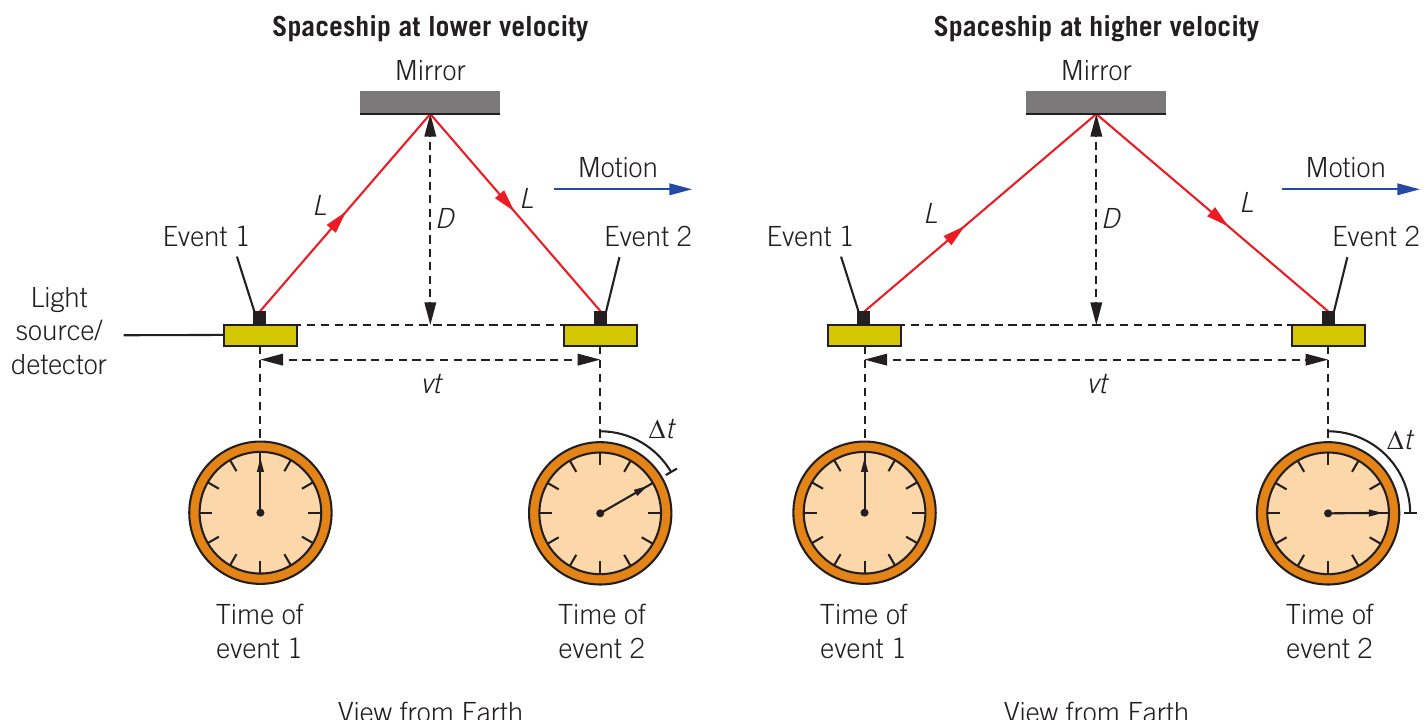
As the rocket's speed increases, the diagonal path traced by the light (as seen from Earth) becomes longer. Since light always travels at speed , a longer path means more time must pass. Therefore, as relative speed increases, time dilation increases.
At very high speeds approaching , the Lorentz factor becomes very large, and time dilation becomes extreme.
Evidence: atomic clocks in relative motion
Atomic clocks use the regular oscillations of atoms to keep extremely precise time. The theory that clocks in relative motion will disagree on time passage was tested experimentally by Joseph Hafele and Richard Keating in 1971.
They flew caesium atomic clocks on commercial flights around the world. One set flew eastward, another westward, and one set remained at the US Naval Observatory. After completing trips around the world, all three sets of clocks showed different times. The differences matched the predictions from Einstein's special relativity theory (and general relativity, which also affects time).
Note
This experiment provided direct evidence that time dilation is real and measurable. The Hafele-Keating experiment was one of the first direct confirmations of special relativity using everyday technology - commercial airplanes and portable atomic clocks.
Length contraction
Understanding proper length
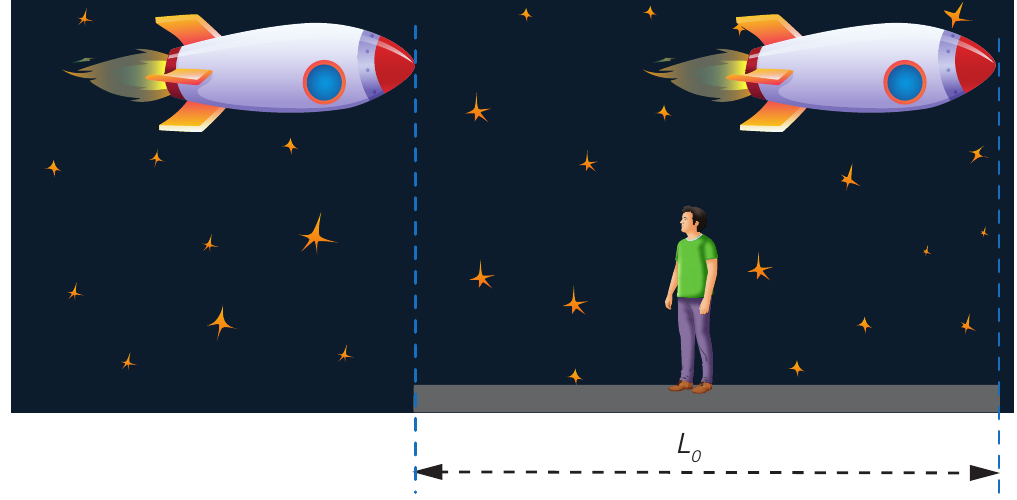
Einstein's special theory of relativity also predicts that objects contract (shorten) in their direction of motion when measured by observers in different reference frames.
Proper length () is the length of an object measured by an observer who is at rest relative to that object (in the same reference frame). This is always the longest length that any observer can measure for that object.
How length contraction works
Imagine a rocket moving at speed past an observer standing on a platform. The observer measures the platform to have length - this is the proper length because the observer is at rest relative to the platform.
To understand length contraction, we can calculate the rocket's speed from two different perspectives:
Observer on platform's calculation: The observer measures how long it takes for the rocket's nose to travel from one end of the platform to the other:
Here, is the dilated time (the event occurs at different points in space in the observer's frame).
Crew on rocket's calculation: From the crew's perspective, the rocket is stationary and the platform is moving. They measure:
Here, is the proper time (the event occurs at the same point in space in their frame - the nose of the rocket), and is the platform length as they measure it.
Since both observers must measure the same relative speed:
We know that , so:
Note
The crew, who measure a shorter time interval (), must also measure a shorter platform length (). The platform is contracted in the direction of travel from their perspective. This demonstrates the deep connection between time dilation and length contraction - they are complementary effects arising from the same underlying physics.
The length contraction formula
Where:
- = contracted length (measured when there is relative motion)
- = proper length (measured when at rest relative to the object)
- = relative velocity ()
- = speed of light ()
- = Lorentz factor =
Important
Important points:
- Contracted length is always less than proper length
- Contraction only occurs in the direction of motion
- Any unit for length can be used (metres, kilometres, light-years, etc.)
- As velocity increases, the Lorentz factor increases, and length contracts further
Worked example: length contraction of a drift tube
Example
Worked Example: Length Contraction of a Drift Tube
Question: In a laboratory, a proton travels at () through a drift tube of a linear accelerator. The tube is cm long in the particle's reference frame. Calculate the tube's length in the laboratory.
Solution:
In the particle's reference frame, the particle is stationary and the drift tube is moving. Therefore, the drift tube is contracted in the particle's frame. The cm measurement is the contracted length.
We need the proper length (the laboratory measurement):
The drift tube is cm long in the laboratory frame - much longer than the particle "sees" it.
Worked example: time and space in different reference frames
Example
Worked Example: Time and Space in Different Reference Frames
Question: A spacecraft travels from Earth to a planet light-years away (as measured by the crew). The spacecraft travels at (). Calculate the distance in Earth's frame and the time taken in both frames. (Assume Earth and the planet are stationary relative to each other.)
Solution:
Finding the distance in Earth's frame:
From the Earth observer's perspective, the distance to the planet isn't changing (Earth and planet are stationary relative to each other). Therefore, the Earth observer measures proper length.
From the spacecraft's perspective, the planet is moving towards them at , so the distance is contracted. The light-year measurement is the contracted length.
Using :
Time in spacecraft's frame:
Using distance and velocity:
Or more precisely:
Time in Earth's frame:
Or:
The journey takes years for the crew but years for Earth observers - a difference of years due to time dilation.
Applications and evidence
Particle accelerators must account for length contraction
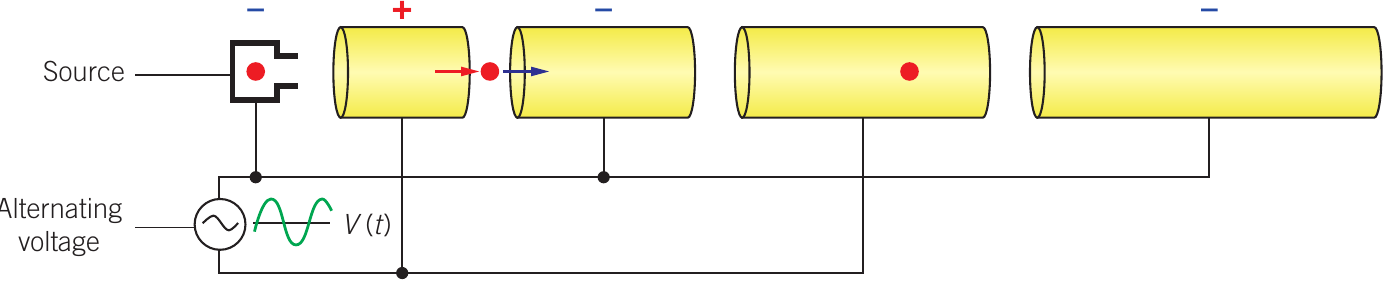
Linear accelerators (linacs) use high voltage to accelerate charged particles in a straight line. Particles travel through a series of drift tubes. The voltage alternates so that particles are always repelled by the tube behind them and attracted to the tube ahead.
The drift tubes increase in length to account for the particle's increasing velocity. However, since particles travel at significant fractions of light speed, the tube lengths appear contracted in the particle's reference frame.
Important
Engineers must account for special relativity when designing accelerator tube lengths. Otherwise, the timing of the alternating voltage would be incorrect, and particles wouldn't accelerate properly. This is a practical application where relativistic effects cannot be ignored.
GPS satellites require relativistic corrections

The Global Positioning System (GPS) uses 30 satellites in orbit around Earth. Each satellite carries an accurate atomic clock and broadcasts radio signals containing time information. GPS receivers calculate their distance from each satellite using (where is the time difference between broadcast and reception). By comparing distances to at least four satellites, the receiver determines its position.
GPS satellites travel at approximately . At this velocity, time dilation causes the satellite clocks to run slow by about μs per day compared to Earth clocks.
Additionally, general relativity predicts that clocks further from Earth's gravitational field run faster. At km altitude, this adds μs per day. The net effect is that satellite clocks gain μs per day relative to Earth clocks.
Note
Impact if not corrected: Without accounting for relativity, GPS would become highly inaccurate within 2 minutes and would be off by about km after one day. GPS systems correct for these effects by electronically adjusting satellite clock rates and using mathematical corrections in receivers.
This is direct evidence that special relativity is essential for modern technology.
Calculation tips
The Lorentz factor timesaver
Note
When velocity is given as a fraction of (like ), the terms cancel in the Lorentz factor calculation. This saves time and reduces errors.
Example: For :
Notice the terms cancel, leaving just the numbers. This makes calculations much simpler!
Identifying proper vs dilated measurements
Note
For time measurements:
- Proper time: Events occur at the same point in space in this frame
- Dilated time: Events occur at different points in space in this frame
- Remember: "Same Space = Proper time"
For length measurements:
- Proper length: Observer is at rest relative to the object being measured
- Contracted length: Observer is moving relative to the object being measured
- Remember: proper length is always the longest length
Remember!
Summary
Key Points to Remember:
-
Proper time () is measured when two events occur at the same point in space in your reference frame. It is always the shortest time interval.
-
Dilated time () is measured when two events occur at different points in space in your reference frame. It is always longer than proper time: .
-
Proper length () is measured when you are at rest relative to the object. It is always the longest length.
-
Contracted length () is measured when there is relative motion. It is always shorter than proper length: , and contraction only occurs in the direction of motion.
-
The Lorentz factor determines how much time dilates and length contracts. As velocity approaches , increases dramatically.
-
Real-world evidence for special relativity includes atomic clock experiments, GPS satellite corrections, and particle accelerator design requirements.
-
Time dilation and length contraction are reciprocal effects - if you observe someone else's clock running slow, they observe your clock running slow. The key is identifying which reference frame measures proper time or proper length for each specific measurement.