Electromagnetic Waves (VCE SSCE Physics): Revision Notes
📚Revision Notes
Electromagnetic Waves
Introduction to electromagnetic waves
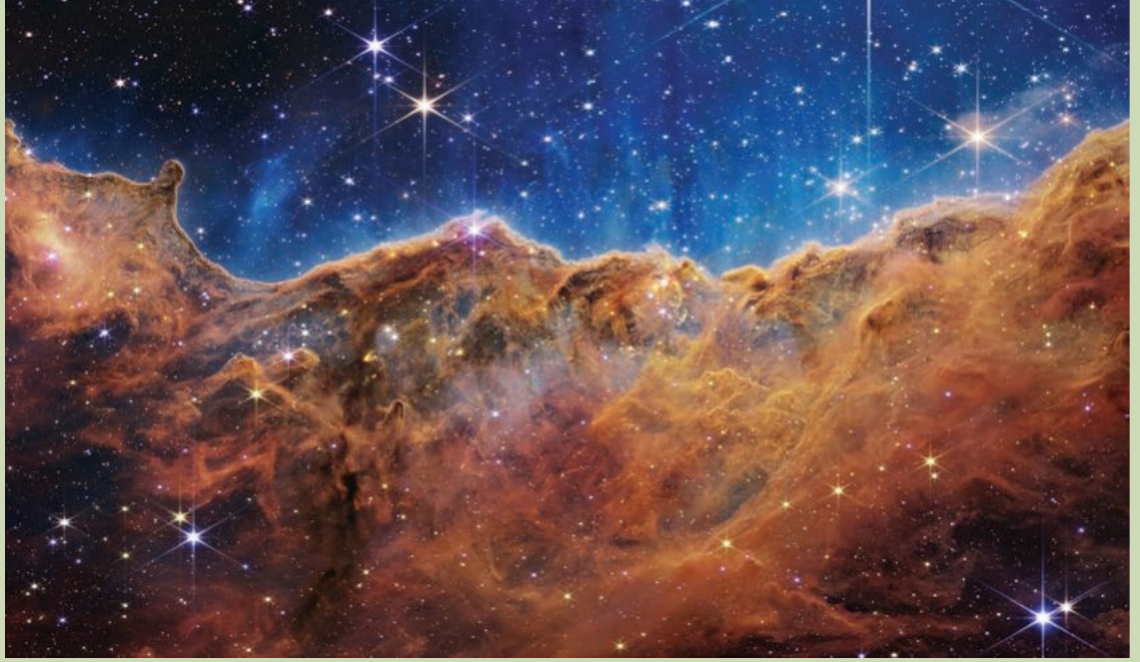
Light is a form of electromagnetic radiation that plays a vital role in our lives. Through photosynthesis, light sustains life on Earth. We use electromagnetic radiation in medicine, communications, energy production, weather forecasting, scientific research, and in understanding the Universe. For example, the James Webb Space Telescope captures infrared light from distant regions of space, allowing us to observe events from billions of years ago.
What is light?
For centuries, scientists debated the nature of light. Isaac Newton believed light consisted of tiny particles, while others thought it was a type of wave. In 1862, Scottish physicist James Clerk Maxwell proposed a revolutionary idea: light is made of waves consisting of vibrating electric and magnetic fields that can travel through a vacuum at without needing a medium.
Note
Maxwell's electromagnetic theory predicted that accelerating electric charges generate waves made of changing electric and magnetic fields. These fields interact with each other: the changing electric field creates a changing magnetic field, which in turn generates a changing electric field, and so on.
This self-propagating wave can travel through empty space, unlike mechanical waves (such as sound) which require a medium to travel through. This was a revolutionary concept because it meant electromagnetic waves could propagate through the vacuum of space.
Structure of electromagnetic waves
Electric field: An electric field is a region of space that exerts a force on charged particles. Electric fields are produced by charged particles and by changing magnetic fields. A changing electric field also produces a changing magnetic field.
Magnetic field: A magnetic field is a region of space that exerts a force on moving charged particles and magnetic materials. Magnetic fields are produced by changing electric fields and by magnetic materials. A changing magnetic field also produces a changing electric field.
Electromagnetic wave: An electromagnetic wave is a transverse wave consisting of perpendicular oscillating electric and magnetic fields that can propagate through space without requiring a medium.
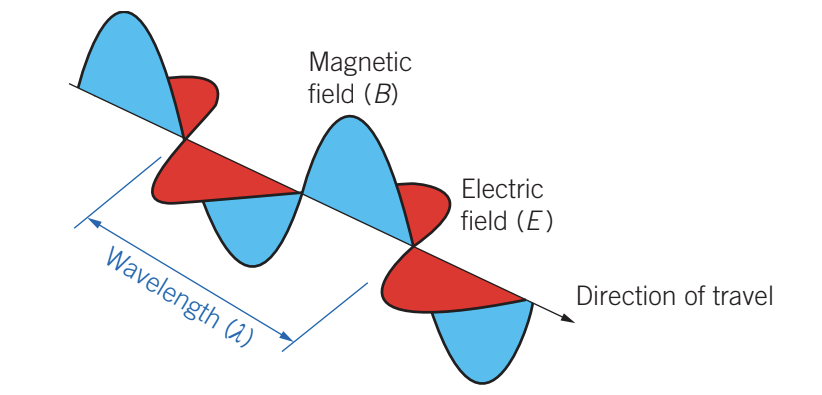
The key features of electromagnetic waves are:
- The electric field () and magnetic field () oscillate perpendicular to each other
- Both fields are perpendicular to the direction the wave travels
- All electromagnetic waves are transverse waves
- They travel at the speed of light, , in a vacuum
- They can travel through empty space without a medium
Note
The wavelength () is the same for both the electric and magnetic field components of the wave. This means both fields oscillate with the same spatial periodicity as they propagate through space.
The wave equation for electromagnetic waves
All electromagnetic waves obey the wave equation. In a vacuum, all electromagnetic waves travel at the same speed, equal to , the speed of light. This gives us the fundamental equation:
Where:
- = speed of light in vacuum ()
- = frequency of the wave (Hz)
- = wavelength of the wave (m)
Important
This equation shows an inverse relationship between frequency and wavelength. Since the speed is constant in a vacuum, if the frequency increases, the wavelength must decrease proportionally, and vice versa. The frequency is determined by the source producing the electromagnetic wave.
In media other than a vacuum, electromagnetic waves travel more slowly. For example, green light travels at in water.
The electromagnetic spectrum
Electromagnetic spectrum: The electromagnetic spectrum is the complete range of all types of electromagnetic waves, arranged by their wavelengths and frequencies.
Maxwell correctly predicted that a whole family of electromagnetic waves could exist, with different wavelengths and frequencies. This range is called the electromagnetic spectrum. The spectrum is divided into approximate regions based on wavelength, because this helps us identify the different processes that create electromagnetic waves and classify their properties and applications.
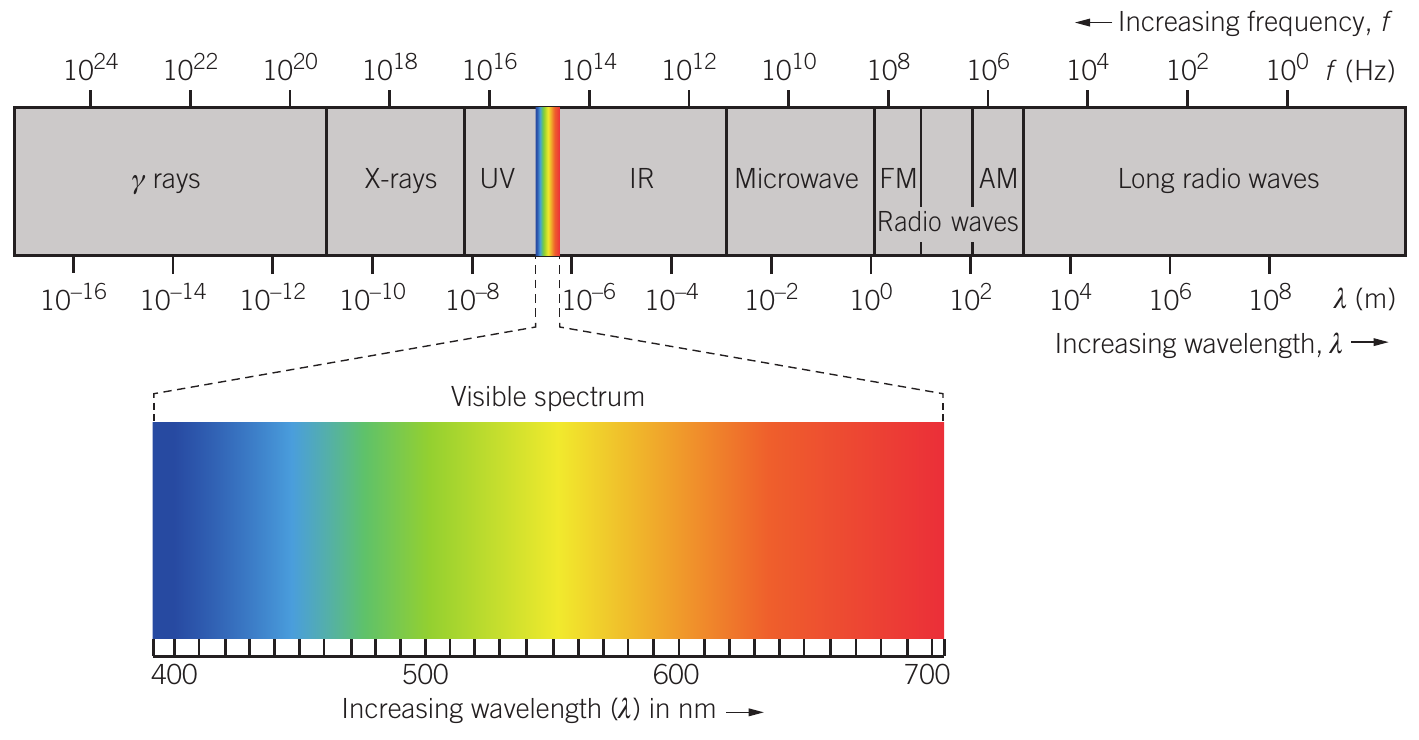
The diagram shows that frequency increases from right to left as wavelength decreases from left to right. This inverse relationship is explained by the equation . Since is constant in a vacuum, increasing frequency must result in decreasing wavelength.
The electromagnetic spectrum regions, in order of increasing frequency (and therefore decreasing wavelength) are:
- Radio waves - longest wavelength, lowest frequency
- Microwaves
- Infrared (IR)
- Visible light
- Ultraviolet (UV)
- X-rays
- Gamma rays - shortest wavelength, highest frequency
Note
Mnemonic for remembering the order (increasing frequency): "Richard May Invite Visitors Using eXcellent Greetings" Radio, Microwave, Infrared, Visible, Ultraviolet, X-ray, Gamma
Regions of the electromagnetic spectrum
Radio waves
Radio waves are the region of the electromagnetic spectrum with the longest wavelengths and lowest frequencies.
- Wavelength: Greater than
- Frequency: Less than
Microwaves
Microwaves are the region of the electromagnetic spectrum with wavelengths between radio waves and infrared radiation.
- Wavelength: to
- Frequency: to
Infrared (IR)
Infrared is the region of the electromagnetic spectrum between microwaves and visible red light. Infrared radiation is produced by sources of heat and cannot be seen by human eyes, but can be detected as warmth on the skin.
- Wavelength: to
- Frequency: to
Visible light
Visible light is the only region of the electromagnetic spectrum that can be detected by human eyes. It spans from red light (longest wavelength in visible range) to violet light (shortest wavelength in visible range).
- Wavelength: to
- Frequency: to
Note
The visible spectrum contains all the colours we can see: red, orange, yellow, green, blue, indigo, and violet (remembered by the mnemonic ROY G BIV).
Ultraviolet (UV)
Ultraviolet is the region of the electromagnetic spectrum between visible light and X-rays.
- Wavelength: to
- Frequency: to
X-rays
X-rays are the region of the electromagnetic spectrum between UV and gamma rays. They have very short wavelengths and very high frequencies.
- Wavelength: to
- Frequency: to
Gamma rays
Gamma rays are the region of the electromagnetic spectrum with the shortest wavelengths and highest frequencies.
- Wavelength: Less than
- Frequency: Greater than
Applications of the electromagnetic spectrum in society
Each region of the electromagnetic spectrum has important and diverse applications in society. The properties of each region determine how we can use them.
Radio waves and microwaves
Radio wave applications:
- Communication technologies: AM and FM radio, television, CB radios, mobile phones
- Radioastronomy: observing the Universe
- Navigation: aircraft and ship navigation (radio direction finding)
- Global Positioning Systems (GPS)
- Metal detectors
- Magnetic Resonance Imaging (MRI)
- Radio Frequency Identification (RFID) chips
Microwave applications:
- Heating in microwave ovens
- Radar systems
- Remote sensing: microwaves penetrate clouds, haze, dust and rain better than visible light
- Microwave astronomy
- Communications including mobile phones
Infrared, visible light, ultraviolet and X-rays
Infrared applications:
- Thermal imaging, including night vision goggles
- Remote controls for TVs and other devices
- Heat lamps in infrared saunas
- Infrared astronomy
- Optical fibre communication signals
Visible light applications:
- Vision - allows us to see our environment
- Lighting
- Optical astronomy
- Laser applications: surgery, laser pointers, cutting tools, communication
- Phototherapy: treatment for seasonal affective disorder (SAD) and jaundice
- Photosynthesis: enables plant growth
Ultraviolet applications:
- Vitamin D generation in human skin
- UV astronomy
- Medical and food sterilisation
- Detection of counterfeit money
X-ray applications:
- X-ray astronomy
- Industrial scanning for quality control
- Medical imaging including Computerised Tomography (CT) scans
- Cancer treatment (radiotherapy)
- Security imaging at airports and other locations
- Detection of art forgeries
Gamma rays
Gamma ray applications:
- Medical and food sterilisation
- Medical imaging using PET (Positron Emission Tomography) scanners
- Cancer treatment (radiotherapy)
- Gamma ray astronomy
- Industrial fault finding and tracing
- Electrostatic discharging
Why different applications for different regions?
Note
Longer wavelength waves (radio and microwaves) are used primarily for communications and radar because:
- They carry lower energy and are safer for continuous use
- Their longer wavelengths allow them to diffract (bend) around buildings more easily
- They can travel long distances without being absorbed
Note
Shorter wavelength waves (UV, X-rays, gamma rays) are not used for communications but instead for sterilisation, medical imaging, and cancer treatment because:
- They have much higher energy density
- They can penetrate materials and tissue
- They can damage or kill cells, which is useful for destroying cancer cells or bacteria
- They are potentially harmful to living organisms in large doses
Each region of the spectrum is also useful for different types of astronomy, allowing us to detect different objects and processes occurring in space.
Electromagnetic radiation from the Sun
Electromagnetic radiation: This is another term commonly used to refer to electromagnetic waves.
Almost all energy that Earth receives from the Sun arrives as electromagnetic radiation. Understanding the distribution of this radiation is crucial for making best use of solar energy and avoiding its dangers.
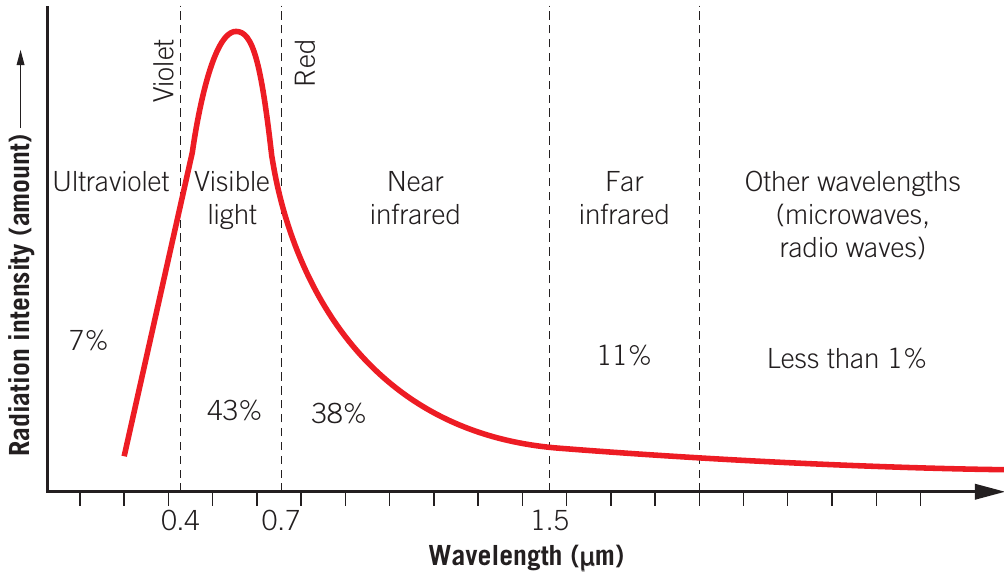
The graph shows how solar radiation is distributed across different wavelengths. The composition of sunlight reaching Earth is:
- Visible light: (wavelength to )
- Near infrared:
- Ultraviolet:
- Far infrared:
- Other wavelengths (including microwaves and radio waves): Less than
Important
When we combine these figures, we can see that Earth receives:
- Infrared radiation: (near + far IR combined)
- Visible light:
- Ultraviolet:
- Other:
The main contribution to warming our planet comes from infrared radiation.
We can detect visible light with our eyes, infrared with our skin (as warmth), and ultraviolet with instruments (or through skin damage if exposure is excessive).
Benefits of solar radiation
- Solar cells: absorb visible and infrared light to generate electricity
- Phototherapy: visible light can treat seasonal affective disorder (SAD)
- Vitamin D production: UV radiation in our skin produces vitamin D
- Photosynthesis: plants use light for growth, with the most effective wavelengths being blue light (around ) and red light (around )
Dangers of solar radiation
Important
Potential hazards of solar radiation:
- Skin damage and cancer: caused by UV radiation
- Sleep disruption: too much blue wavelength light can affect sleep patterns
Working with units in the electromagnetic spectrum
Because the electromagnetic spectrum covers such a wide range of values, we use SI prefixes to make numbers more manageable. You must be able to convert between different units.
SI prefixes
| Name | Value (times base unit) | Example |
|---|---|---|
| tera (T) | THz (terahertz) | |
| giga (G) | GHz (gigahertz) | |
| mega (M) | MHz (megahertz) | |
| kilo (k) | km (kilometre) | |
| (Base unit) | metre, hertz, gram | |
| centi (c) | cm (centimetre) | |
| milli (m) | mm (millimetre) | |
| micro (μ) | μm (micrometre) | |
| nano (n) | nm (nanometre) | |
| pico (p) | pm (picometre) |
Converting units
To convert from a prefixed unit to the base unit: Multiply by the prefix value.
Example
Worked Example: Converting GHz to Hz
Convert to hertz:
Step 1: Identify the prefix value Giga (G) =
Step 2: Multiply by the prefix value
Example
Worked Example: Converting nm to m
Convert to metres:
Step 1: Identify the prefix value Nano (n) =
Step 2: Multiply by the prefix value
To convert from the base unit to a prefixed unit: Divide by the prefix value.
Example
Worked Example: Converting m to nm
Convert to nanometres:
Step 1: Identify the prefix value Nano (n) =
Step 2: Divide by the prefix value
Remember!
Summary
Key Points to Remember:
- Electromagnetic waves are transverse waves made of perpendicular oscillating electric and magnetic fields that travel at in a vacuum
- All electromagnetic waves obey the equation , showing that frequency and wavelength are inversely related
- The electromagnetic spectrum ranges from radio waves (longest wavelength) through microwaves, infrared, visible light, ultraviolet, and X-rays to gamma rays (shortest wavelength)
- Each region of the spectrum has unique applications in society, from communications (radio/microwaves) to medical imaging (X-rays/gamma rays)
- Solar radiation reaching Earth is mainly infrared (48%), visible light (44%), and ultraviolet (7%)
- You must be able to convert between units using SI prefixes, remembering that longer prefixes (like giga, mega) represent larger values while shorter prefixes (like nano, pico) represent smaller fractions