The Properties of Waves (VCE SSCE Physics): Revision Notes
📚Revision Notes
The Properties of Waves
What are waves?
Waves are all around us and play crucial roles in our everyday lives. From the sound waves we use to communicate to the light waves that allow us to see, waves are fundamental to how we interact with the world.
Examples of waves include:
- Sound waves - used for communication, music, and technologies like ultrasound
- Water waves - ranging from small ripples to massive ocean waves and tsunamis
- Seismic waves - caused by movements in Earth's crust, travelling through solid rock at speeds up to
- Light waves - travelling through space at , allowing us to see distant objects in the universe

Note
What makes waves special is that they transfer energy from one place to another without transferring matter. The particles of the medium vibrate in place, but the energy travels through the medium.
The nature of waves
All waves begin with a vibration or oscillation of some kind. This vibration then creates a disturbance that propagates (travels) through space, carrying energy with it.
Mechanical and non-mechanical waves
Waves can be classified into two main categories based on whether they need a medium to travel through:
Mechanical waves require a medium (a substance or material) to carry their vibrations. The vibrations spread through the medium by causing particles to vibrate. Examples include:
- Sound waves (travel through air, water, or solids)
- Water waves (travel through water)
- Seismic waves (travel through Earth's crust)
Non-mechanical waves do not require a medium. Light waves are the most important example - their vibrations are electrical and magnetic in nature, allowing them to travel through both transparent materials and through a vacuum (like the space between the Sun and Earth).
Transverse waves
In a transverse wave, the particles of the medium vibrate perpendicular (at right angles) to the direction the wave is travelling. You can visualise this by shaking a slinky spring up and down while the wave travels horizontally along the spring.

As the diagram shows, although the wave's energy moves horizontally to the left, the individual coils of the spring vibrate vertically up and down. They don't travel along with the wave - they simply oscillate in place.
Note
A helpful way to remember transverse waves: "Trans-verse crosses" - the vibrations cross perpendicular to the wave's direction of travel.
Common examples of transverse waves include:
- Water waves (water particles move up and down while the wave travels horizontally)
- Light waves
- Waves on a string or rope
Longitudinal waves
In a longitudinal wave, the particles of the medium vibrate parallel to the direction the wave is travelling. You can create this type of wave by pushing and pulling a slinky spring back and forth along its length.
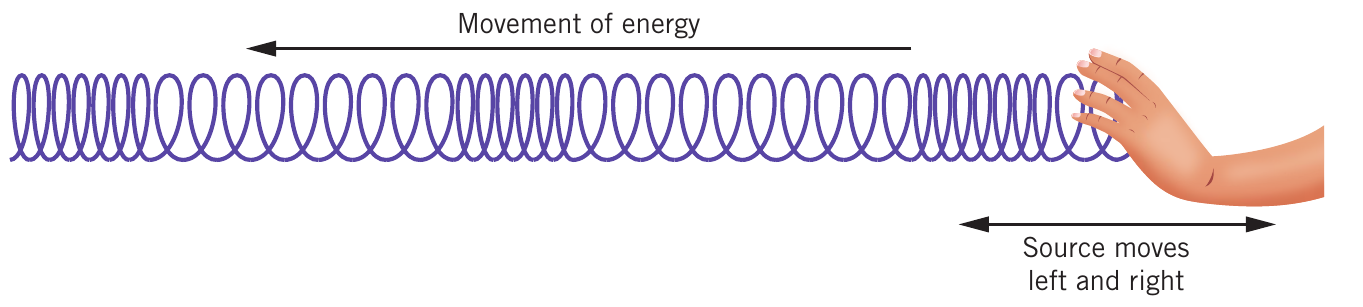
In longitudinal waves, the vibrations create alternating regions:
- Compressions - regions where the particles are squeezed closer together (more closely spaced)
- Rarefactions - regions where the particles are spread further apart (more spread out)
Note
Memory tip for longitudinal waves: "Longi-tudinal goes along" - the vibrations go along the same direction as the wave travels.
For the terms:
- Compressed = squashed together
- Rare-faction = rarely spaced, spread out
Sound waves are the most common example of longitudinal waves. When sound travels through air, it creates regions of compressed air (higher pressure) and rarefied air (lower pressure).
Important
The key point for all waves is that while energy travels from one end of the medium to the other, the particles themselves only vibrate back and forth in place - they don't travel along with the wave.
Describing waves
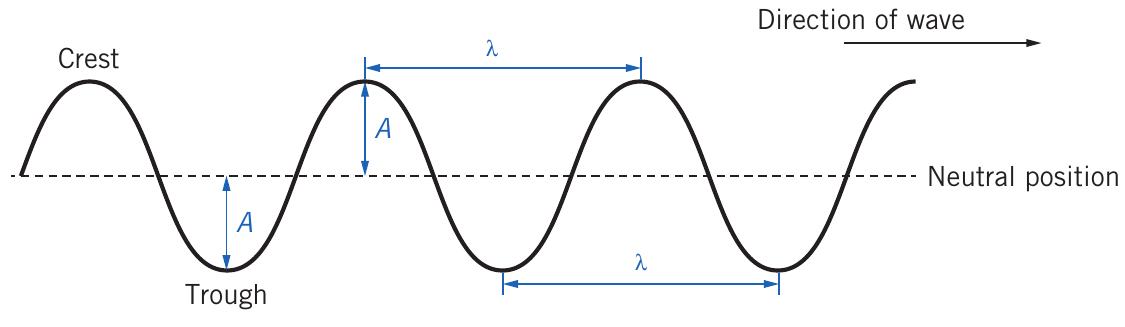
All waves, whether transverse or longitudinal, can be described using five key properties: amplitude, wavelength, speed, period, and frequency. Understanding these properties is essential for working with waves in physics.
Amplitude ()
The amplitude is a measure of how large the vibrations are in a wave. More precisely, it is the maximum displacement from the neutral (equilibrium) position. Think of it as how far the wave "reaches" from its resting position.
- For a transverse wave, amplitude is the vertical distance from the neutral position to either a crest (peak) or trough (valley)
- For a longitudinal wave, amplitude relates to how compressed or rarefied the regions become
- Amplitude is measured in metres (m)
- Larger amplitude means more energy is being transferred by the wave
Wavelength ()
The wavelength (represented by the Greek letter lambda, ) is the distance between any two identical points on consecutive wave cycles. In other words, it's how long one complete wave pattern is.
Note
For a transverse wave, you can measure wavelength as:
- The distance from one crest to the next crest
- The distance from one trough to the next trough
- The distance for one complete cycle of the wave pattern
Wavelength is measured in metres (m). The wavelength of a wave depends on both the speed of the wave and its frequency.
Speed ()
The speed of a wave is how fast the wave pattern travels through the medium. This is different from how fast the individual particles vibrate - the wave speed refers to how quickly the energy propagates.
- Speed is measured in metres per second ()
- The speed of a wave is determined entirely by the properties of the medium it travels through
- Different media allow waves to travel at different speeds
- For example, light travels at different speeds in air, water, and glass
Period ()
The period is the time it takes for one complete wavelength to pass a fixed point. Alternatively, it's the time for the wave pattern to move forward by one wavelength.
- Period is measured in seconds (s)
- A longer period means the wave oscillates more slowly
- Period is related to frequency by the equation:
Frequency ()
The frequency is the number of complete wavelengths that pass a fixed point every second. It tells us how many vibrations or cycles occur per second.
- Frequency is measured in hertz (Hz), where vibration per second
- Higher frequency means more vibrations per second
- The frequency of a wave is determined only by the source that generates it
- Unlike wavelength and speed, frequency does not change when a wave enters a different medium
The wave equation
The five wave properties are not independent - they are connected through a fundamental relationship called the wave equation. Understanding this equation is crucial for solving wave problems.
The fundamental relationship
If a wave travels at speed metres per second, then in one second it travels a distance of metres. During that same second, if the wave has frequency Hz, then complete wavelengths pass by a fixed point. Therefore, the length of each wavelength must be:
This can also be written as:
Where:
- = wavelength (m)
- = speed of the wave ()
- = frequency (Hz)
- = period (s)
Note
Memory tip: "Very Fast Learners" helps remember the wave equation (speed = frequency × wavelength)
Understanding the relationships
The wave equation reveals important relationships between wave properties:
Frequency and source: The frequency of a wave depends only on the source that produces it. If you shake a slinky faster, you create a higher frequency wave. The frequency doesn't change when the wave enters a different medium.
Speed and medium: The speed of a wave is determined entirely by the properties of the medium through which it travels. Different materials allow waves to propagate at different speeds. When a wave enters a new medium, its speed changes.
Wavelength depends on both: Since and frequency stays constant while speed changes between media, the wavelength must adjust to compensate. If a wave speeds up when entering a new medium, its wavelength increases proportionally. If it slows down, its wavelength decreases.
Important
This is why the same sound can have different wavelengths in air versus water - the frequency stays the same (determined by the source), but the speed changes (determined by the medium), so the wavelength must change too.
Worked example: Period and frequency of a wave
Example
Worked Example: Finding Period and Frequency
Question: Find the period and frequency of a water wave with wavelength m and speed .
Solution:
First, we'll find the frequency using the wave equation .
Rearranging to make the subject:
Substituting the values:
Now we can find the period using the relationship between period and frequency:
Answer: The wave has a frequency of Hz and a period of seconds. This means that wavelengths pass a fixed point every second, and it takes seconds for one complete wavelength to pass by.
Remember!
Summary
Key Points to Remember:
-
Waves transfer energy without transferring matter - particles vibrate in place while energy travels through the medium
-
Transverse waves have vibrations perpendicular to the direction of travel (e.g., light, water waves)
-
Longitudinal waves have vibrations parallel to the direction of travel (e.g., sound waves), creating compressions and rarefactions
-
The five key wave properties are: amplitude (size of vibrations), wavelength (distance between repeats), frequency (vibrations per second), period (time for one wavelength), and speed (how fast the wave travels)
-
The wave equation connects these properties: frequency is determined by the source, speed is determined by the medium, and wavelength adjusts accordingly