Equilibrium (VCE SSCE Physics): Revision Notes
📚Revision Notes
Equilibrium
Introduction to equilibrium
When you look around a room, most objects appear stationary. This doesn't mean there are no forces acting on them. Rather, it means these objects are in equilibrium. An object is in equilibrium when the sum of all translational forces and rotational forces (torques) acting on it equals zero.
Note
Equilibrium is the state where the sum of the translational and rotational forces on an object are equal to zero.
There are two types of forces to consider:
- Translational force: A force that can cause an object to change its position (move from one place to another)
- Rotational force: A force that can cause an object to rotate about an axis of rotation
A simple example
Consider a ruler resting on a table with half of it hanging over the edge. If you place an eraser at both ends of the ruler, the system remains balanced.
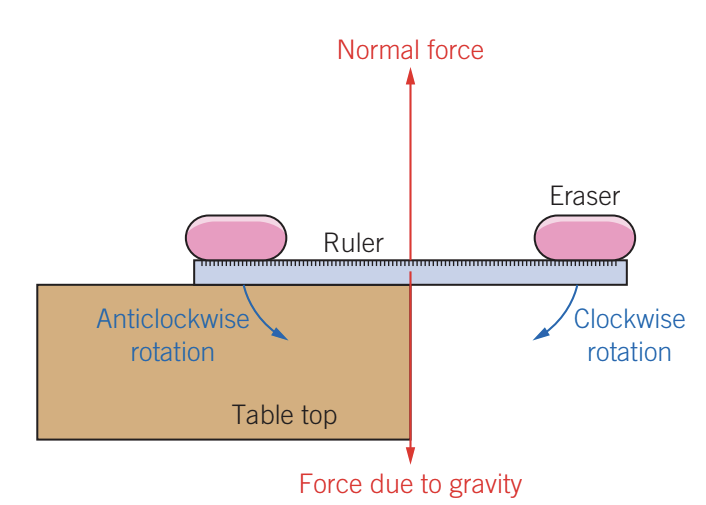
The ruler experiences:
- A downward force due to gravity
- An upward normal force from the table
- These translational forces balance each other
When erasers are placed at both ends, the ruler is also in rotational equilibrium because the eraser on the left creates an equal rotational force to the eraser on the right.
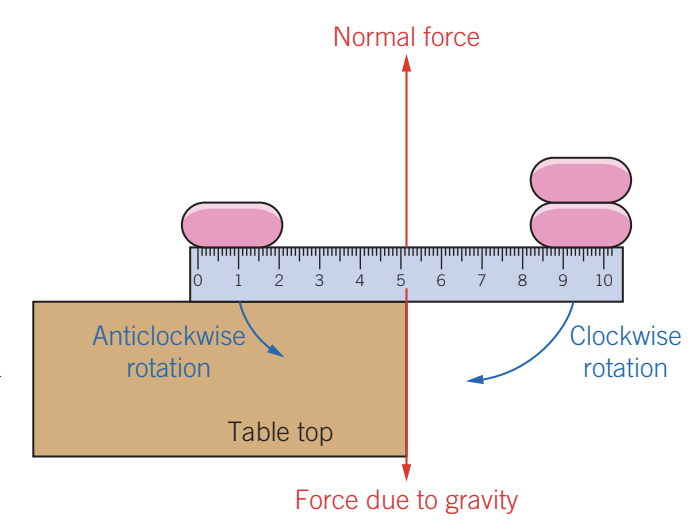
Note
If you add another eraser to the right side, the system is no longer in equilibrium and will rotate clockwise, as the clockwise torques now exceed the anticlockwise torques.
Torque
Torque (also called rotational force) is a measure of how much a force acting on an object causes it to rotate. The amount of torque depends on both the force applied and the distance from the pivot point.
The torque formula
Important
Torque Formula:
Where:
- = Torque (N m)
- = Perpendicular distance from the line of action of the force to the pivot point (m)
- = Force (N)
Note
This formula can also be expressed as , where is the perpendicular component of the force and is the distance from the pivot point.
Understanding the perpendicular distance
The perpendicular distance is crucial for calculating torque. It's the shortest distance from the pivot point to the line along which the force acts.
There are different scenarios for finding this distance:
- Scenario a: The perpendicular distance passes through the object
- Scenario b: The perpendicular distance lies outside the object
- Scenario c: Use the distance from the pivot to where the force is applied, then find the perpendicular component of the force
Direction of torque
Torque is a vector quantity, meaning it has both magnitude and direction. The direction is either:
- Clockwise (like clock hands moving)
- Anticlockwise (opposite to clock hands)
The pivot point
The pivot point is the point that an object rotates around, also known as the axis of rotation.
Important
Critical Rule: No force that passes directly through the pivot point will cause a torque.

Note
For example, if you push on a door so that all the force goes through the hinges (the pivot point), the door will not swing open. This is why door handles are placed far from the hinges – to maximise the torque you can apply with a given force.
Centre of mass
The centre of mass is the mean position of all the parts of a system, weighed according to their masses.
When solving torque problems, remember:
- If a force is applied through the centre of mass, it causes linear acceleration without creating a torque
- The force due to gravity acts at the centre of mass of the object
Example
Worked Example: Torque on a lever
A force of 100 N is applied 5.00 m from the pivot point as shown below.
Calculate the torque and state the direction (clockwise or anticlockwise) in which this bar will rotate.
Solution:
Example
Worked Example: Torque when force is not perpendicular
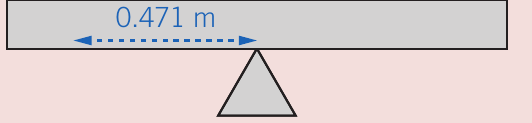
A see-saw is pushed with a force of 50.0 N, 0.471 m to the left of the pivot point. The force makes an angle of 20° to the horizontal.
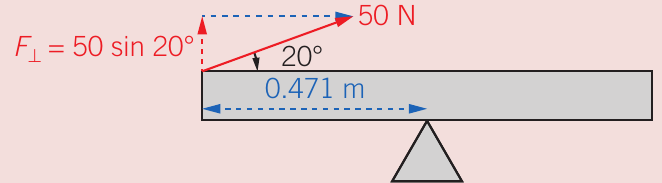
Calculate the torque generated by the force. Include a direction for the torque.
Solution:
In this example, we find the perpendicular component of the force, :
Vertical component = N
Note that since torque is a vector quantity, it must have a direction. In this case, the direction is clockwise as the see-saw will rotate in the same direction that a clock hand would move.
Levers in life
Humans have used levers for thousands of years to gain mechanical advantage. By placing a handle or point of force application far from the pivot point, we can generate large torques with relatively small forces.
Note
Quote from Archimedes: "Give me a lever long enough and a fulcrum on which to place it, and I shall move the world."

Everyday examples of levers include:
- Door handles (placed far from hinges)
- Wheel braces and wrenches (for tightening and loosening bolts)
- Wheelbarrows (to lift heavy loads more easily)
- Pliers, tongs, and tweezers (to grip objects tightly)
The Woomera
Aboriginal peoples use leverage to throw spears more effectively. A woomera is a device that the spear sits in. It increases the length of the lever arm, allowing a greater force to be applied to the spear, which increases the distance it can be thrown.
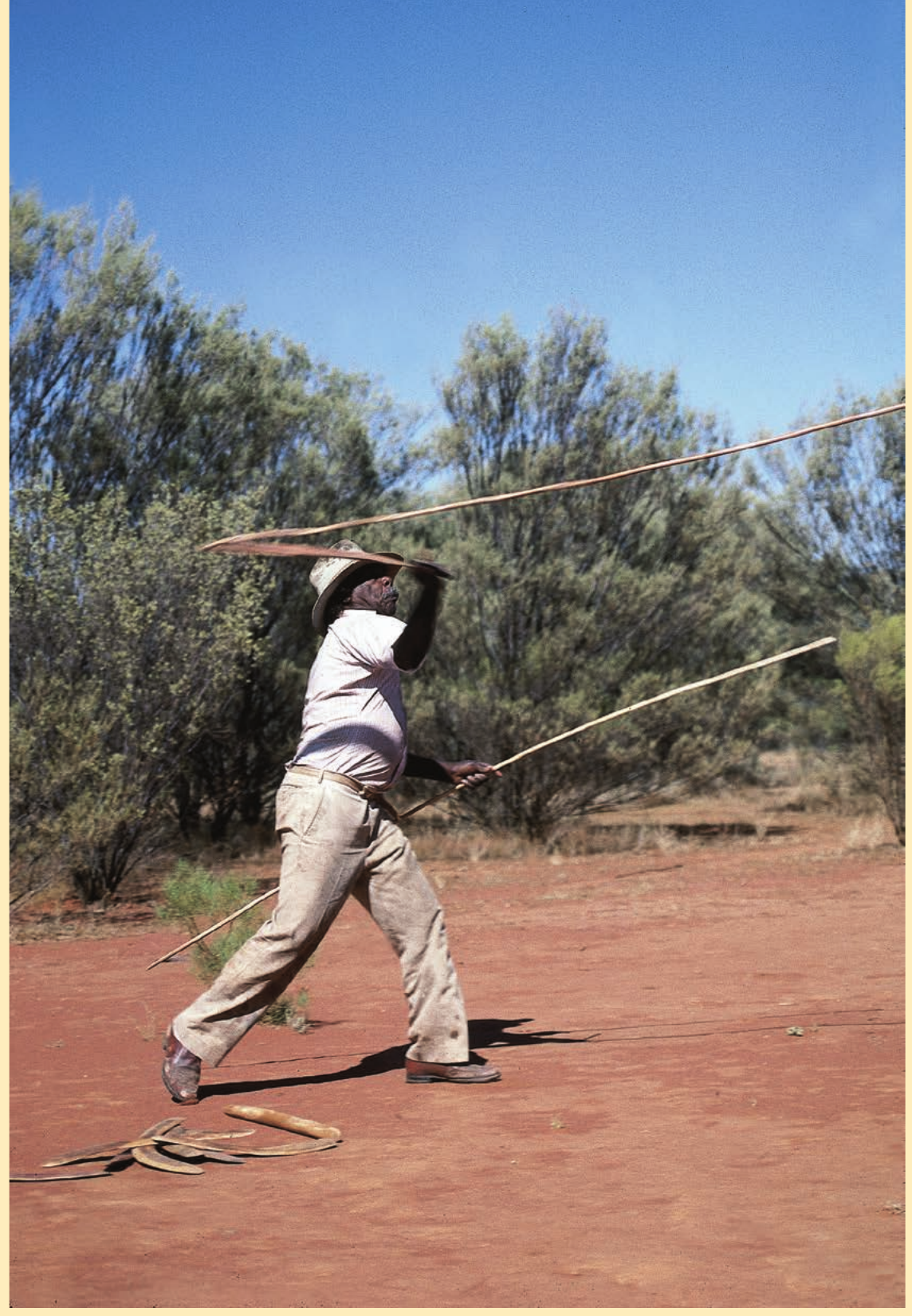
This traditional tool demonstrates the principle that increasing the distance from the pivot point increases the torque for a given force.
Types of equilibrium
When solving physics problems, you'll often encounter systems "in equilibrium". This means not only are all forces balanced, but all torques are also balanced.
Rotational equilibrium
Rotational equilibrium occurs when a system is not rotating. The sum of the torques is equal to zero.
When a system is in rotational equilibrium, the clockwise and anticlockwise torques are equal in magnitude:
Example
Worked Example: Finding rotational equilibrium
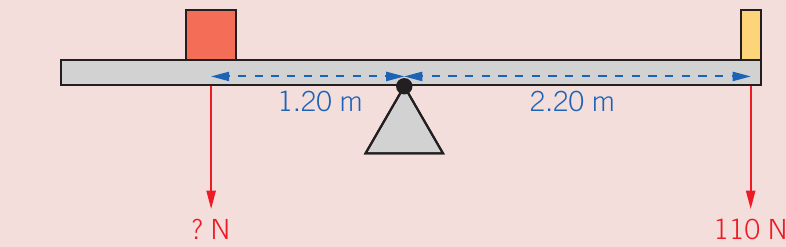
If the see-saw shown in the diagram is in equilibrium, calculate the mass of the block on the left.
Solution:
Translational equilibrium
Translational equilibrium occurs when the velocity of an object is constant. This means that the net force acting on the object is equal to zero.
Any object that is stationary or moving at a constant velocity is in translational equilibrium. When an object is in translational equilibrium, the sum of all forces equals zero:
Example
Worked Example: Force exerted by the pivot
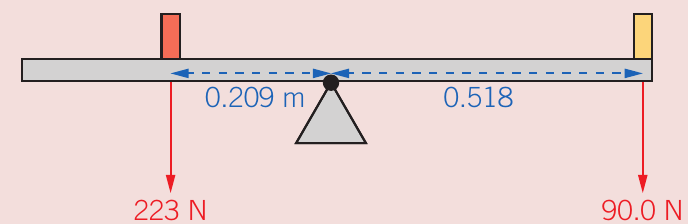
Two masses are placed on a see-saw as shown. If the see-saw is in equilibrium, calculate the force exerted by the pivot.
Solution:
(there are no left or right forces on the pivot, so this is zero on both sides)
The upwards force exerted by the pivot point is 313 N.
Example
Worked Example: Finding tension in a sign
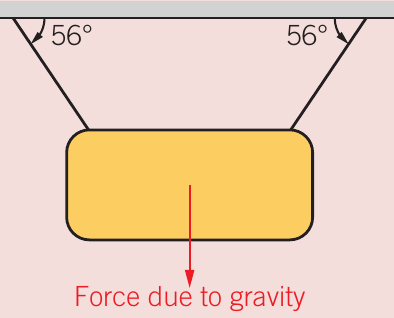
A sign is hung by two cables from the ceiling of a shop. The sign has a mass of 35.0 kg and the cables make an angle of 56° to the horizontal. If the mass of the cables is negligible, calculate the tension in each cable.
Solution:
Since the sign is stationary and not rotating, it is in translational equilibrium. Therefore:
The downwards force due to gravity must be balanced by the upwards components of the tension force. We need to break the tension force into its component forces:
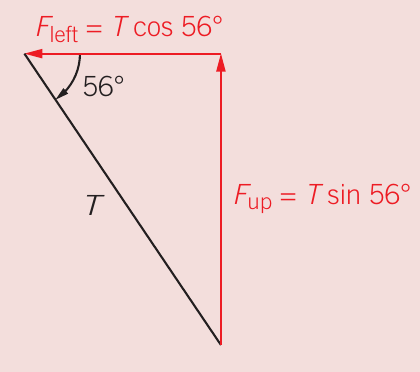
Note that will be equal as they will both be equal to N.
Solving equilibrium problems
For a system to be in equilibrium, both the rotational and translational forces must be in equilibrium. Here's a systematic approach to solving these problems:
Step-by-step method
Important
Systematic Approach to Equilibrium Problems:
- Draw all forces acting on the relevant object
- Solve rotational equilibrium first - Choose a pivot point that eliminates one of the unknown forces (since any force passing through the pivot point causes no rotation). You can choose any point as the pivot, but some choices make calculations easier
- Solve for unknowns by equating clockwise and anticlockwise torques
- Break all forces into their up, down, left, and right components
- Solve remaining unknowns by equating up and down forces, and left and right forces
Example
Worked Example: Application to cantilever with support
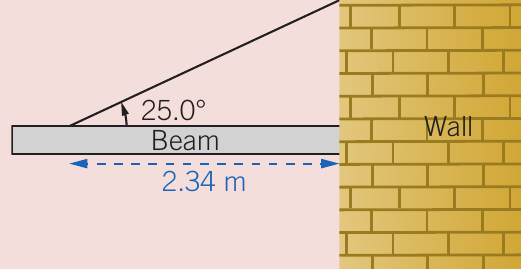
A uniform beam with a length of 2.50 m and a mass of 13.0 kg is held to a wall by a metal cable. The metal cable is attached to the beam 2.34 m away from the wall and makes an angle of 25.0° to the horizontal.
Calculate the tension in the metal cable.
Solution:
Use the join between the wall and the beam as the pivot point.
Draw all forces acting on the beam:
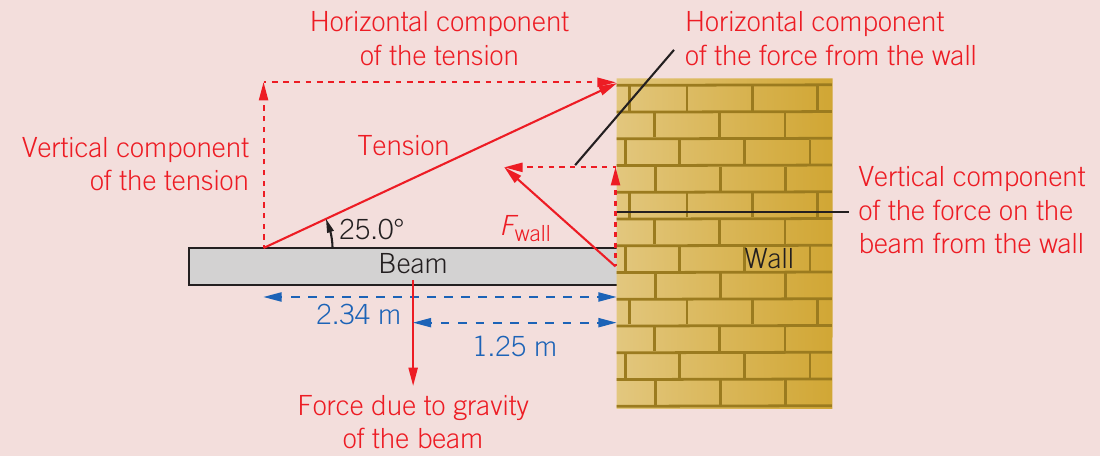
The force due to gravity of the beam acts 1.25 m away from the wall (the pivot point):
Example
Worked Example: Equilibrium in a table
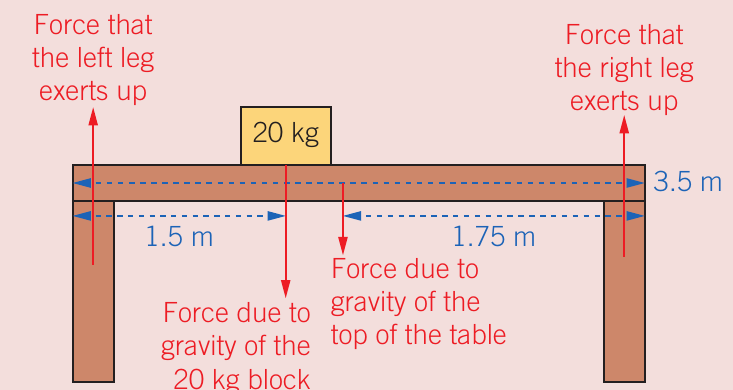
A 20 kg box is placed 1.5 m away from the left leg of a table. The table is supported by two legs and the top of the table is a uniform mass of 5.8 kg. The table is 3.5 m long. Calculate the force that the left leg is exerting.
Solution:
The first step is to draw all forces acting on the relevant object.
You can eliminate one force by choosing the location of your pivot point. Make the pivot point at the right leg, then solve for the force on the left leg:
Using diagrams to answer questions
Physics questions often contain many quantities that must be considered. When large amounts of information are given, it can be overwhelming to know where to start. This is why you should use diagrams to help visualise the information.
Diagram strategy
Important
Strategy for Using Diagrams:
As you read through a question, you should:
- Circle or highlight all quantities immediately
- Convert quantities to SI units so they can be used in formulas
- If a diagram is provided, write quantities on the diagram as you read them
- If no diagram is provided, sketch a diagram of the situation as you read, inserting all relevant values
Example
Worked Example: Using diagrams
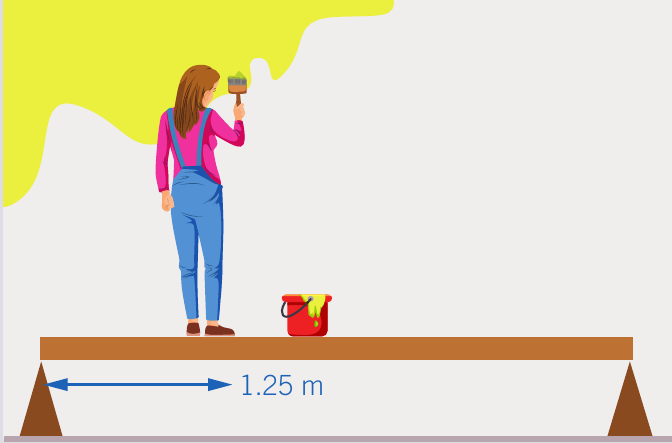
A 54.0 kg woman is painting a wall. She is standing on a 4.00 m long plank that has supports at both ends. The plank has a mass of 15.2 kg and its centre of mass acts from its midpoint. The woman is standing so that her centre of mass is 1.25 m from the left support. Calculate the force that the right support applies to the plank.
Solution:
Adding all relevant information to the diagram:
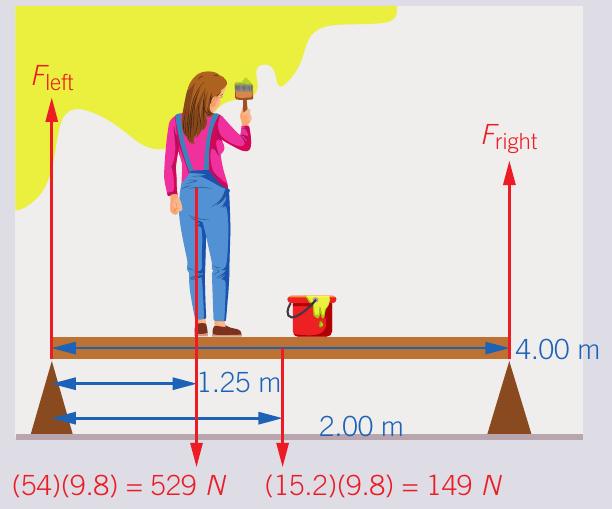
Since the system is in equilibrium, we know that the sum of torques and forces will be equal to zero. We have two unknown forces, so we need to eliminate one by making the left support the pivot point:
Practice questions
Question 1
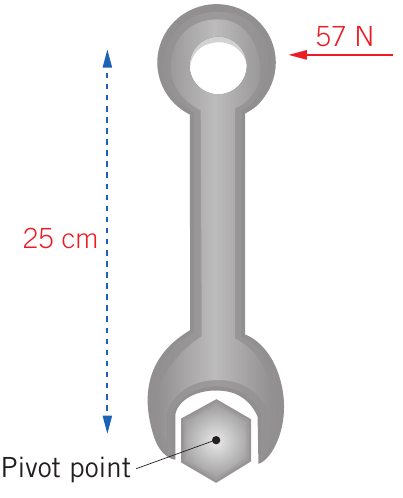
A builder uses a spanner to turn a bolt. The builder applies a force of 57 N at a distance of 25 cm from the pivot point.
a) Calculate the torque applied to the bolt b) Other than applying more force, how could the builder increase the torque?
Example
Solution:
a) Convert to SI units: 25 cm = 0.25 m
b) The builder could increase the distance from the pivot point (use a longer spanner)
Question 2
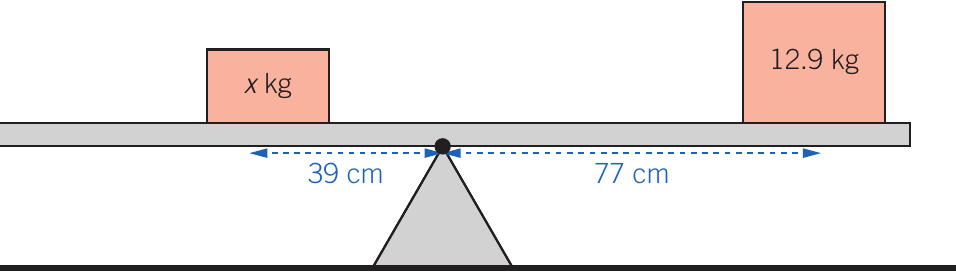
Two blocks are placed on a see-saw. The first block has a mass of kg and is placed so that its centre of mass acts 39 cm to the left of the pivot point. The second block has a mass of 12.9 kg and is placed so that its centre of mass acts 77 cm to the right of the pivot point. Calculate the mass of , given that the system is in equilibrium.
Example
Solution:
Convert to SI units: 39 cm = 0.39 m, 77 cm = 0.77 m
Question 3
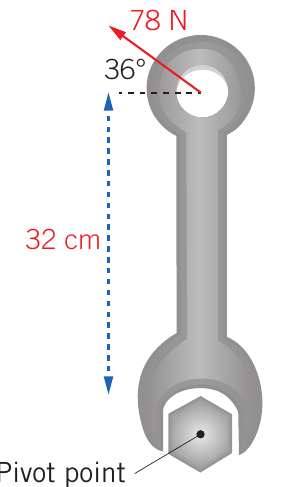
A builder uses a spanner to turn a bolt. The builder applies a force of 78 N at an angle of 36° from the horizontal and a distance of 32 cm from the pivot point. Calculate the torque generated by the builder.
Example
Solution:
Convert to SI units: 32 cm = 0.32 m
Find the perpendicular component:
Question 4
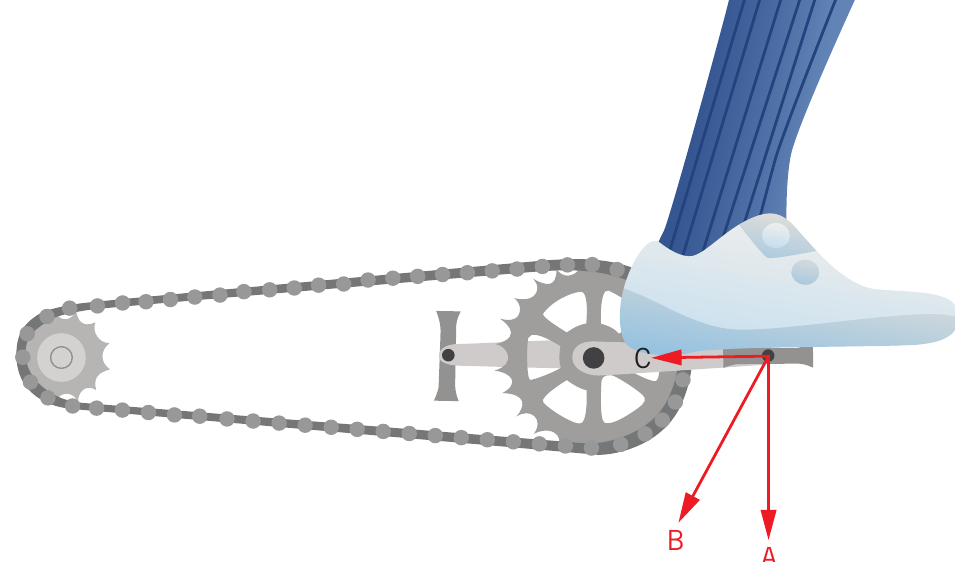
When cycling, a cyclist attaches their shoe to the bike pedal that turns the gears. In which direction, A, B or C, should the cyclist push? Justify your answer.
Example
Answer:
Direction B is best because it creates the maximum perpendicular distance from the pivot point (the pedal axle), therefore generating the maximum torque. Direction A passes close to the pivot point, and direction C has a smaller perpendicular component.
Remember!
Summary
Key Points to Remember:
- Equilibrium means all forces and torques are balanced (sum equals zero)
- Torque is calculated using - the perpendicular distance is crucial
- For rotational equilibrium: sum of clockwise torques = sum of anticlockwise torques
- For translational equilibrium: sum of upward forces = sum of downward forces, and sum of left forces = sum of right forces
- When solving problems, choose your pivot point wisely to eliminate unknown forces
- Always draw a diagram showing all forces and their directions - this makes complex problems much easier to solve
- Levers give us mechanical advantage - a small force applied far from the pivot creates a large torque