Circular Motion (VCE SSCE Physics): Revision Notes
📚Revision Notes
Circular Motion
Introduction to circular motion
When you swing a ball on a string around your head, ride on a merry-go-round, or drive around a roundabout, you're experiencing circular motion. Understanding the physics behind circular motion helps explain everything from how cars navigate curves to how centrifuges separate blood samples in medical laboratories.
Note
A centrifuge is a practical example of circular motion in action. As it spins rapidly, denser materials (like red blood cells) are forced outward from the center, while less dense materials (like plasma) stay closer to the center. This principle is used in medicine to analyze blood samples, in chemistry to purify substances, and even to train astronauts by simulating high acceleration forces.

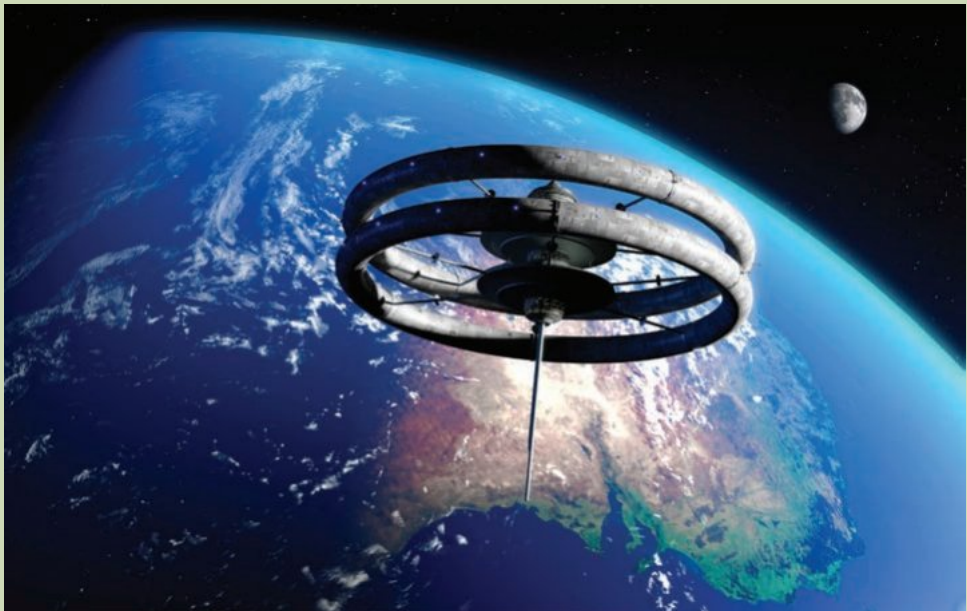
In the future, spacecraft designers may use large rotating structures to create artificial gravity for astronauts on long space journeys. The circular motion would produce a force that feels like gravity to people inside the rotating spacecraft.
Understanding uniform circular motion
When an object moves in a circle at constant speed, we call this uniform circular motion. The word "uniform" tells us the speed stays the same, but something important is still changing: the direction of motion.
Important
Even though the speed is constant, the velocity is continuously changing because velocity includes both speed and direction. Since the object is always turning, its direction is always changing, which means the velocity vector is always changing. According to Newton's laws, any change in velocity means there must be an acceleration, and therefore a net force acting on the object.
Centripetal acceleration and force
The acceleration that keeps an object moving in a circle is called centripetal acceleration. The term "centripetal" means "center-seeking" - this acceleration always points directly toward the center of the circular path. Similarly, the net force causing this acceleration is called the centripetal force, which also points toward the center.
Note
An important point to remember: the velocity of an object in circular motion is always tangent to the circle (perpendicular to the radius), while the centripetal acceleration and force point along the radius toward the center.
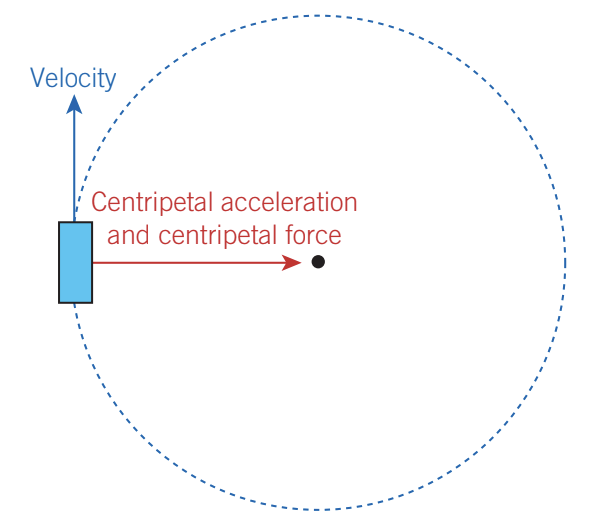
The centripetal force isn't a new type of force - it's the net result of other forces acting on the object. For a car turning a corner, friction between the tires and road provides the centripetal force. For a satellite orbiting Earth, gravity provides the centripetal force. For a ball on a string, tension in the string provides the centripetal force.
Key formulas
Important
The centripetal acceleration can be calculated using:
Where:
- = centripetal acceleration (in )
- = speed of the object (in )
- = radius of the circular path (in )
Using Newton's second law (), we can find the centripetal force:
Where:
- = centripetal force (in )
- = mass of the object (in )
- = speed of the object (in )
- = radius of the circular path (in )
Notice that centripetal force increases with the square of velocity. This means if you double your speed around a curve, you need four times as much centripetal force to stay on the path.
Horizontal circular motion
Cars turning corners
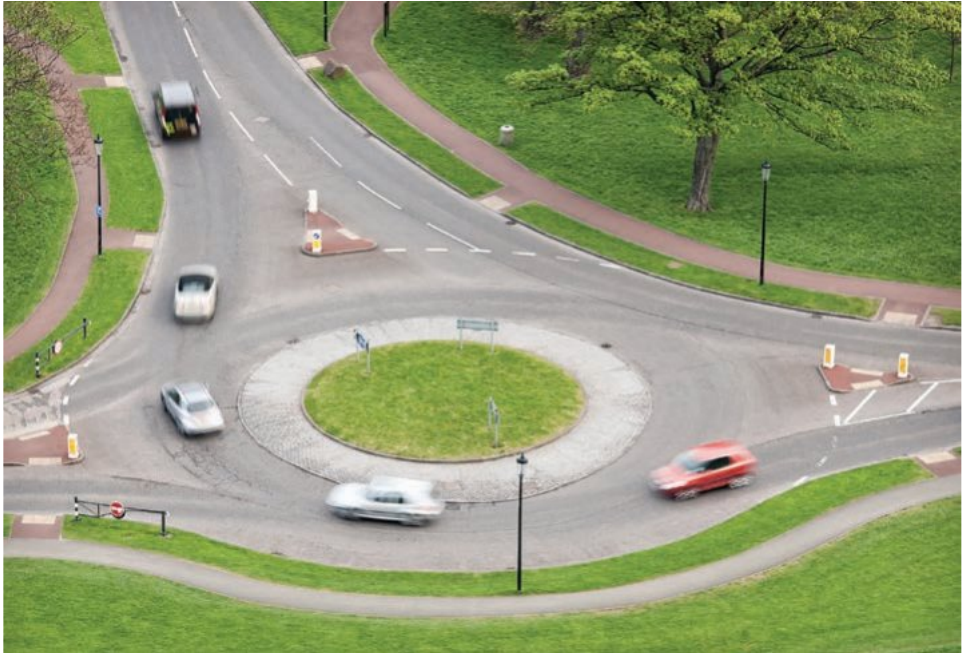
When a car turns a corner on a flat road, the friction between the tires and the road surface provides the centripetal force needed to keep the car moving in a curve. The wheels turn in the direction of the curve, creating a friction force component that points toward the center of the circular path.
Important
If the car is moving too fast for the available friction (perhaps on a wet or icy road), the friction force cannot provide enough centripetal force, and the car will slide outward from the curve. This is why you must slow down when taking sharp corners, especially in poor conditions.
Worked example: horizontal circular motion
Example
Worked Example: Calculating Centripetal Force for a Car
Problem: A car travels at around a roundabout with a radius of . Calculate the centripetal force required to keep the car in circular motion.
Solution:
First, convert the speed to meters per second:
Now apply the centripetal force formula:
The friction between the tires and road must provide 22,800 N of force to maintain this circular path.
Vertical circular motion
When an object moves in a vertical circle, gravity always acts on it in addition to other forces. This makes vertical circular motion more complex than horizontal circular motion, because the effect of gravity changes as the object moves around the circle.
Object on the end of a string
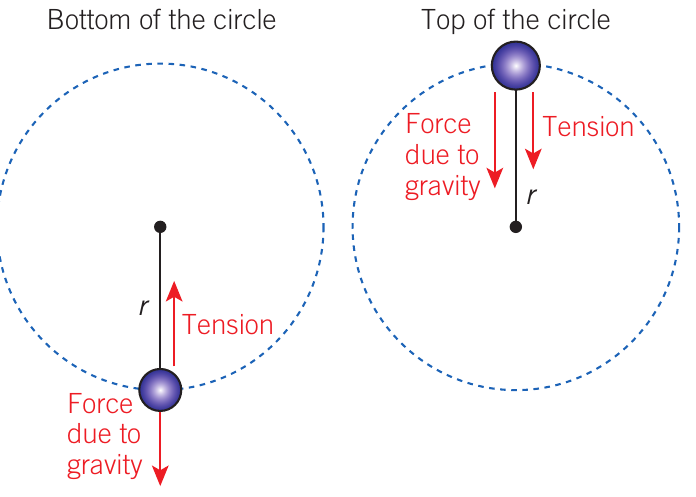
Imagine swinging a ball on a string in a vertical circle. Two forces act on the ball: the tension in the string and the gravitational force pulling downward. The key is to analyze the forces at different positions around the circle.

At the bottom of the circle, tension pulls upward (toward the center) while gravity pulls downward (away from the center). The net force toward the center is the difference between these forces:
At the top of the circle, both tension and gravity point downward (both toward the center). The net force toward the center is the sum of these forces:
Important
This tells us something important: the tension is greatest at the bottom of the circle, which is where the string is most likely to break if you swing the ball too fast. At the top, the tension is smallest, and if you swing too slowly, the tension can become zero - at which point the ball will fall rather than complete the circle.
Worked example: vertical circular motion
Example
Worked Example: Ball Swinging in a Vertical Circle
Problem: A ball is attached to a string and swung in a vertical circle.
a) If the ball moves at a constant speed of , calculate the tension at the bottom of the circle.
b) Calculate the minimum speed needed so that the tension at the top of the circle is zero.
Solution:
Part a) At the bottom of the circle:
Rearranging for tension:
Part b) When tension is zero at the top:
The mass cancels:
This is the minimum speed at the top for the ball to maintain its circular path. Any slower and the ball will fall before reaching the top.
Vehicles on hilly roads
Understanding the forces
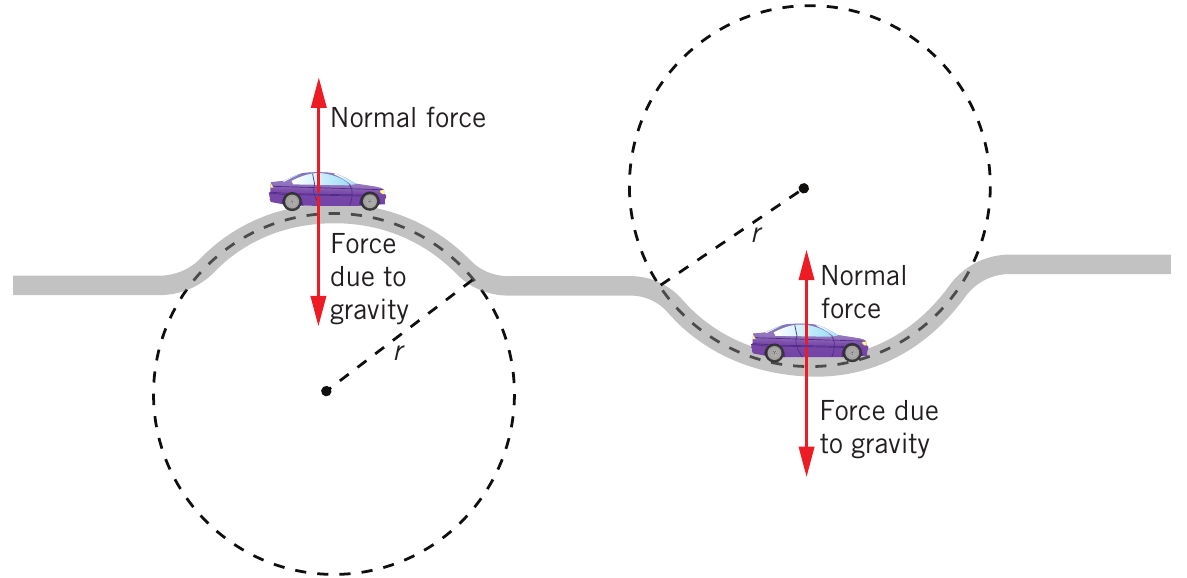
Have you ever felt your stomach "drop" when driving over a hill? This sensation occurs because of changes in the normal force as your body undergoes vertical circular motion.
When a vehicle goes over a bump or through a dip in the road, it's actually moving along a circular arc. At the top of a bump, gravity points toward the center of the circular path while the normal force (from the road pushing up on the car) points away from the center. Through a dip, the situation reverses: the normal force points toward the center while gravity points away.
At the top of a bump:
At the bottom of a dip:
Note
Notice that at the top of a bump, if you're moving fast enough, the centripetal force can become large enough that the normal force approaches zero. This is when you feel "weightless" or like you're lifting off your seat. If the normal force actually reaches zero, the car would briefly lose contact with the road.
Why roller-coasters are teardrop shaped
Early roller-coaster designers used perfectly circular loops, but these required dangerously high entry speeds and subjected riders to excessive forces. Modern roller-coasters use teardrop-shaped loops instead, with a smaller radius at the top than at the bottom.
Note
This clever design works because the required centripetal force is . At the top of the loop, the car is moving more slowly (gravity has slowed it down), so a smaller radius is acceptable. At the bottom, the car is moving faster (gravity has sped it up), so the larger radius keeps the required force reasonable. This allows the cars to enter the loop at safe speeds while still completing the full circle.
Worked example: car over a bump
Example
Worked Example: Car Traveling Over a Bump and Through a Dip
Problem: A car travels over a bump with a circular radius of .
a) If the car travels at , calculate the centripetal force required.
b) Calculate the speed at which occupants would experience no normal force.
c) After the bump, the car goes through a dip (radius ) at . Calculate the normal force.
Solution:
Part a) Convert speed and calculate:
Part b) When :
At this speed, the occupants would feel completely weightless at the top of the bump.
Part c) In the dip:
The normal force is much larger than the car's weight (), which is why you feel pressed into your seat at the bottom of a dip.
Banked tracks
The physics of banking
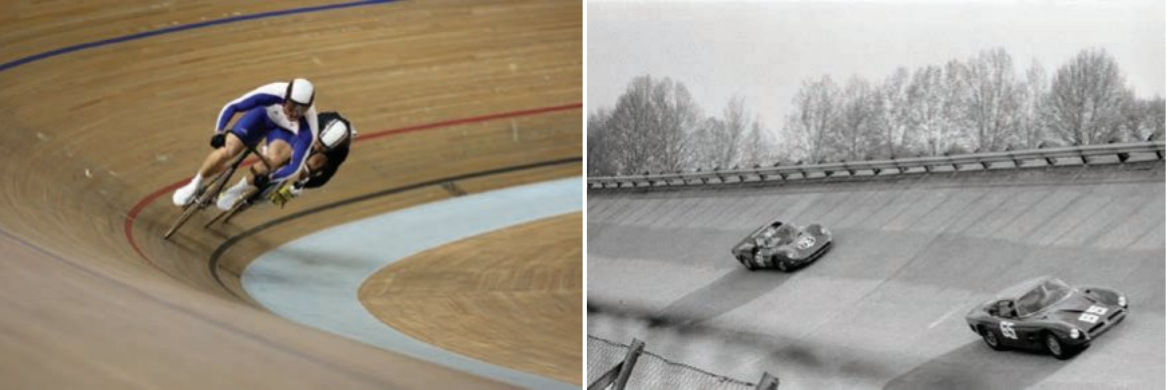
When vehicles need to navigate curves at high speeds - on highways, racing circuits, or cycling velodromes - engineers often design banked tracks. Banking means tilting the track surface so that the horizontal component of the normal force helps provide the centripetal force.
Note
On a flat curve, only friction between the tires and road provides centripetal force. If the curve is too sharp or the speed too high, friction alone may not be sufficient, and the vehicle will skid outward. Banking solves this problem by allowing the normal force from the road to contribute to keeping the vehicle in the curve.
Forces on a banked track
When a vehicle travels on a banked curve at the ideal speed (where no sideways friction is needed), two forces act on it:
- The gravitational force () acting straight downward
- The normal force () acting perpendicular to the banked surface
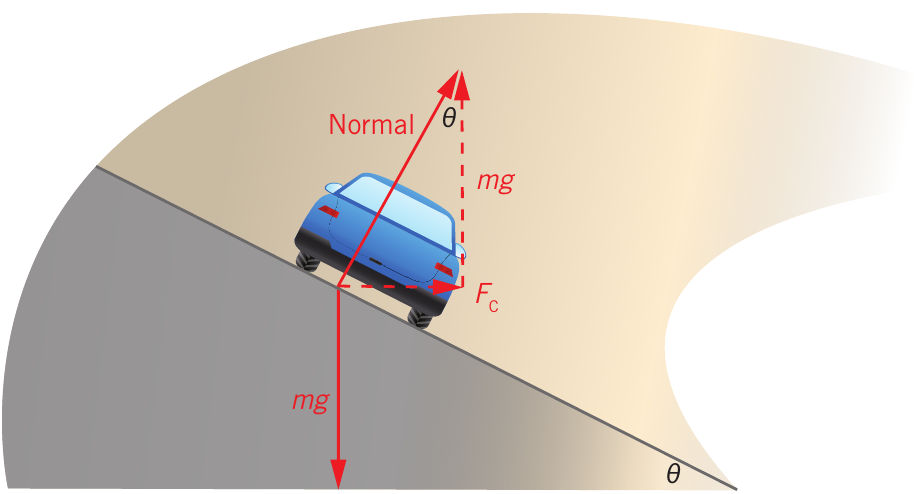
The normal force can be split into two components:
- A vertical component that balances the gravitational force
- A horizontal component that points toward the center of the curve and provides the centripetal force
Since the vertical forces must balance (the car isn't accelerating up or down), and the forces form a right-angled triangle, we can derive the following relationships:
This can be rearranged to find the ideal speed for a banked curve:
Important
Notice that the mass cancels out - the ideal speed for a banked curve depends only on the radius, the banking angle, and gravity, not on the mass of the vehicle.
Worked example: banked turn
Example
Worked Example: Truck on a Banked Track
Problem: A truck travels on a banked track angled at to the horizontal. The track has a circular radius of .
a) Explain how the banking helps the truck maintain circular motion.
b) If the truck travels at , calculate the centripetal force required.
c) Calculate the maximum speed for the truck without relying on sideways friction.
Solution:
Part a) When the track is banked correctly, the horizontal component of the truck's normal force provides all of the centripetal force. This means the truck no longer relies on sideways friction between the tires and road to maintain its circular path, making the turn safer and allowing higher speeds.
Part b) Convert speed and calculate:
Part c) Use the banked track formula:
At this speed, the truck can safely navigate the curve without any contribution from friction. Going faster would require additional friction force.
Conical pendulum (horizontal string motion)
When a ball attached to a string is swung in a horizontal circle (like a conical pendulum), the string makes an angle with the vertical. This creates an interesting situation where we can analyze both the vertical and horizontal motion.
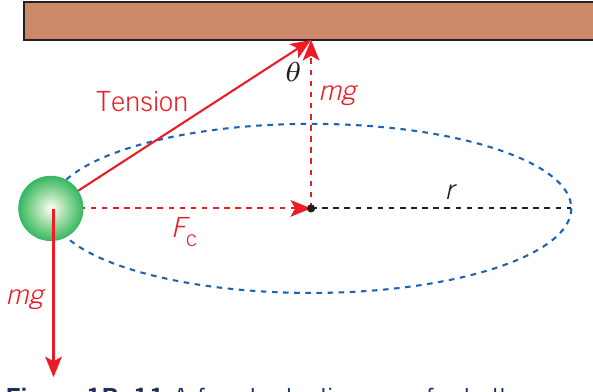
Two forces act on the ball:
- Gravitational force () acting downward
- Tension () acting along the string at an angle
Note
Since the ball moves in a horizontal circle (not rising or falling), the vertical forces must balance. This means the vertical component of tension equals the gravitational force. The horizontal component of tension provides the centripetal force needed for circular motion.
Using right-angled triangle trigonometry:
Vertical direction (balanced forces):
Therefore:
Horizontal direction (centripetal force):
Worked example: object on a string
Example
Worked Example: Ball Spinning in a Horizontal Circle
Problem: A ball is attached to a fixed beam via a rope and spun in a horizontal circle. The rope makes an angle of with the beam.
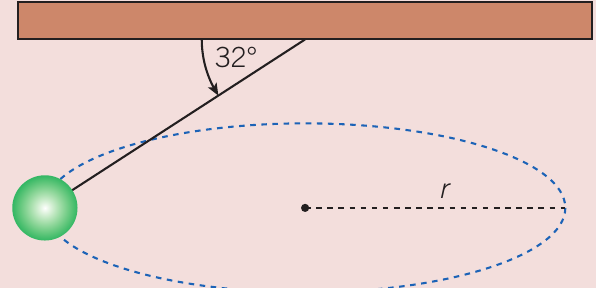
a) Calculate the tension in the rope.
b) What is the magnitude of the net force on the ball?
Solution:
Part a) First, draw the force components. The vertical component of tension must equal the weight:
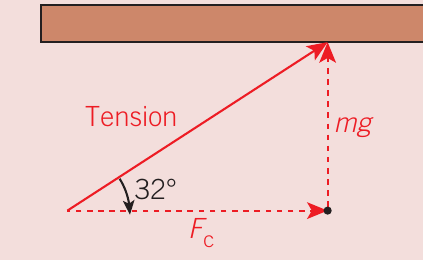
Part b) The net force is the centripetal force, which equals the horizontal component of tension:
This net force is directed horizontally toward the center of the circular path.
Remember!
Summary
Key Points to Remember:
-
Uniform circular motion means constant speed but continuously changing direction, which requires centripetal acceleration and force directed toward the center of the circle.
-
The centripetal force formula shows that required force increases with speed squared - doubling your speed requires four times the force.
-
In vertical circular motion, analyze forces at the top and bottom separately. At the bottom, forces oppose each other (tension up, gravity down), while at the top, both forces act toward the center (tension and gravity both point down).
-
Banking curves allows the normal force to contribute to centripetal force, reducing reliance on friction and enabling safer high-speed turns. The ideal speed depends on the banking angle and radius, not the vehicle's mass.
-
Free-body diagrams are essential for solving circular motion problems. Always identify all forces, determine which point toward or away from the center, and apply the appropriate formula based on the situation.