Alpha, Beta, and Gamma Radiation (VCE SSCE Physics): Revision Notes
📚Revision Notes
Alpha, Beta, and Gamma Radiation
Introduction to radioactivity
In 1896, Henri Becquerel discovered radioactivity. Three years later, Ernest Rutherford began studying how radioactive emissions interact with materials. By testing thin metal foils, he identified three distinct types of radiation based on their ability to penetrate matter. These were named alpha (α), beta (β), and gamma (γ) radiation, using the first three letters of the Greek alphabet in order of increasing penetration ability.
Unstable atomic nuclei spontaneously emit these different types of radiation as they transform into more stable forms. Understanding these three radiation types is fundamental to nuclear physics.
Properties of the three radiation types
The three types of natural nuclear radiation have very different properties in terms of their composition, charge, mass, speed, penetrating power, and ionizing ability.
Note
Penetration Power Comparison:
- Alpha (α) radiation consists of particles that are stopped by paper or a few centimetres of air
- Beta (β) radiation has greater penetrating power and can pass through paper but is stopped by a few millimetres of aluminium
- Gamma (γ) radiation has the highest penetrating power and requires several centimetres of lead to stop it completely
When Rutherford first discovered these radiations, their exact nature was unknown. He simply named them according to how easily they were absorbed by materials, from least penetrating (α) to most penetrating (γ).
Ionization
All three types of nuclear radiation carry enough energy to ionize atoms they encounter. Ionization means removing or adding electrons to a neutral atom, creating an ion.
Key points about ionization:
- Positive ions form when electrons are removed from a neutral atom
- Negative ions form when electrons are added to a neutral atom
- α-, β-, and γ-radiation can all ionize atoms they come into contact with
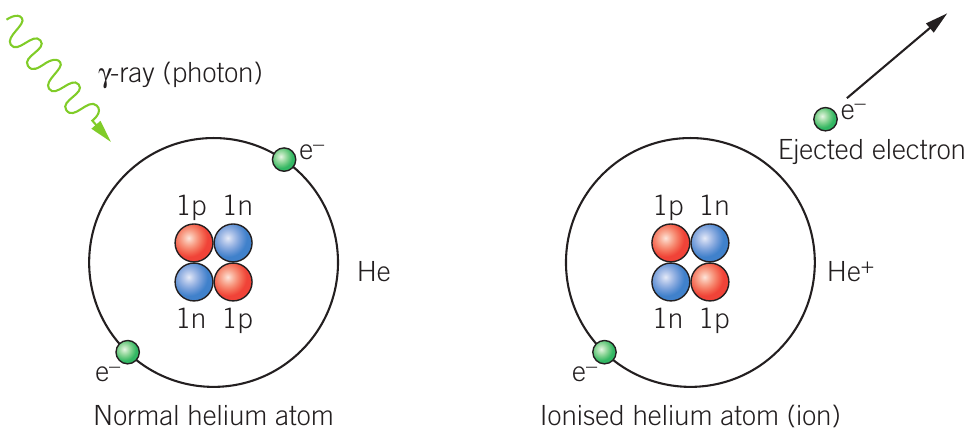
Example
Example: Gamma Ray Ionization
The diagram above shows how a gamma ray can ionize a helium atom by ejecting one of its electrons, creating a He⁺ ion. This demonstrates the ionizing capability of electromagnetic radiation.
Alpha particle radiation
Composition and properties
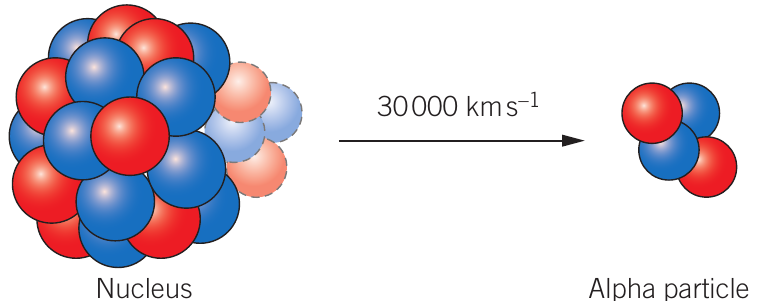
An alpha (α) particle consists of two protons and two neutrons bound together. This is identical to a helium nucleus. Because it contains two protons, an α-particle carries a charge of +2 (or +3.2 × 10⁻¹⁹ coulombs).
Alpha particles are relatively massive compared to other forms of radiation. They travel at speeds around 30,000 km s⁻¹, which is approximately 10% of the speed of light.
Penetration and ionizing power
Alpha particles have very limited penetrating ability:
- They travel only a few centimetres in air
- They are stopped by a sheet of paper
- They cannot penetrate human skin
Despite their poor penetration, α-particles are extremely effective at ionizing atoms. Because they are relatively massive and fast-moving, they can ionize a large number of atoms over their short range before losing all their kinetic energy.
Important
Safety Considerations for Alpha Radiation:
- External α-particle sources more than a metre away pose minimal danger because the radiation is absorbed by air
- However, if α-emitting materials are ingested or inhaled, they become extremely dangerous as they can directly irradiate sensitive internal organs
Transmutation through alpha decay
Transmutation is the conversion of one element into another through changes in the atomic nucleus. Alpha particle emission causes transmutation because the parent nucleus loses two protons and two neutrons.
When a nucleus emits an α-particle:
- The mass number (A) decreases by 4
- The atomic number (Z) decreases by 2
- A different element is formed (the daughter nucleus)
Example
Example: Uranium-238 Decay
In this decay:
- Uranium-238 (parent nucleus) has 92 protons and 146 neutrons
- It emits an α-particle (helium nucleus with 2 protons and 2 neutrons)
- The daughter nucleus has 90 protons and 144 neutrons
- This is thorium-234 (element with atomic number 90)
- The α-particle carries away 4.3 MeV of energy
Worked example: energy conversion
Example
Worked Example: Converting Joules to Electronvolts
Question: An α-particle emitted from a radioactive element has an energy of 2.99 × 10⁻¹² J. How much energy does this represent in electronvolts (eV)?
Solution:
The conversion factor is: 1 eV = 1.6 × 10⁻¹⁹ J
Therefore:
Answer: The energy is 18.7 MeV
Applications of alpha radiation
Despite their low penetrating power, α-particles have several useful applications:
- Smoke detectors: Americium-241 ionizes air in smoke detectors. When smoke enters, it reduces the ionization current, triggering the alarm
- Static eliminators: Polonium-210 α-particles neutralize static electric charges on equipment
- Cancer treatment: α-emitters can be used in targeted radiotherapy
- Power generation: Plutonium-238 in radioisotope thermoelectric generators produces heat from α-decay, which is converted to electricity

Note
Real-World Application:
The Mars Perseverance Rover uses a plutonium-238 radioisotope thermoelectric generator to produce 110 W of electrical power for its operations. This demonstrates how α-decay can provide reliable, long-lasting power in extreme environments.
Beta radiation
Composition and properties
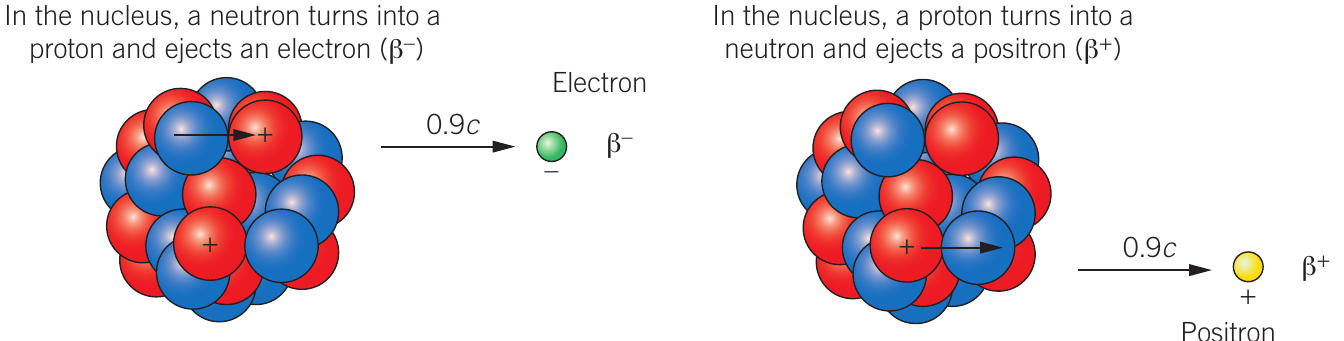
Beta (β) particles are high-speed electrons (β⁻) or positrons (β⁺) emitted from the nucleus. Each β-particle carries either one negative charge (electron: -1.6 × 10⁻¹⁹ coulombs) or one positive charge (positron: +1.6 × 10⁻¹⁹ coulombs).
Beta particles typically travel at speeds up to 90% of the speed of light (0.9c or 270,000 km s⁻¹). They are much lighter than α-particles but faster.
Penetration and ionizing power
Beta particles have moderate penetrating ability:
- They can travel up to 1 metre in air
- They are absorbed by a few millimetres of aluminium
- They can penetrate paper and several millimetres of skin
Their ionizing capacity is considerably less than α-radiation, but their greater penetration makes them dangerous at closer distances (within a metre externally) and very dangerous if ingested internally.
Beta minus (β⁻) decay
In β⁻-decay, an electron is emitted from inside the nucleus. This seems paradoxical since nuclei contain only protons and neutrons, not electrons. The explanation is that a neutron transforms into a proton, emitting an electron in the process:
Or using β notation:
This transformation is an example of the weak nuclear force in action.
Example
Example: Thorium-234 β⁻-Decay
In this decay:
- A neutron in thorium-234 converts to a proton
- An electron is emitted
- The atomic number increases by 1 (thorium → protactinium)
- The mass number remains unchanged
Beta plus (β⁺) decay
In β⁺-decay, a positron is emitted when a proton transforms into a neutron:
Or using β notation:
The neutrino
When physicists measured the energy of β-particles, they discovered that not all the initial energy could be accounted for in the products. This appeared to violate energy conservation.
Note
Discovery of the Neutrino:
In 1930, Wolfgang Pauli proposed that another particle was being emitted. This particle would have:
- No electrical charge (all charge was already accounted for)
- Negligible mass
Enrico Fermi named this particle the neutrino, from Italian meaning "little neutral one." It was experimentally detected in 1956.
The complete β⁻-decay process is:
The complete β⁺-decay process is:
The neutrino carries away the "missing" energy, ensuring energy conservation.
Applications of beta radiation
The medium penetrating power of β-particles provides useful applications:
- Thickness detectors: Quality control for thin materials like paper
- Cancer treatment: Strontium-89 for treating eye and bone cancers
- Medical imaging: Fluorine-18 as a tracer in positron emission tomography (PET)
Gamma radiation
Nature and properties
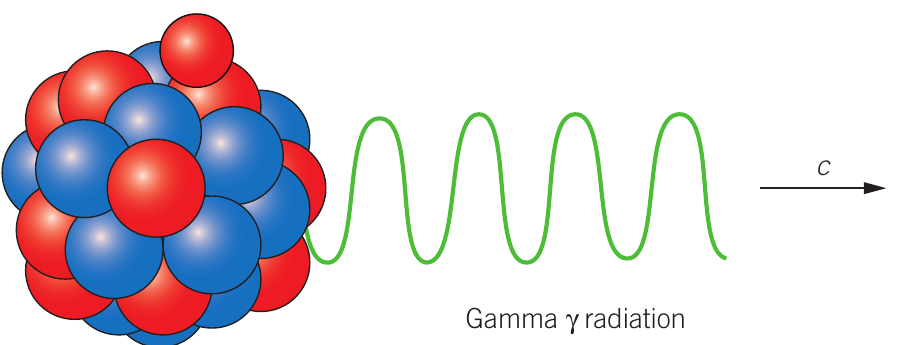
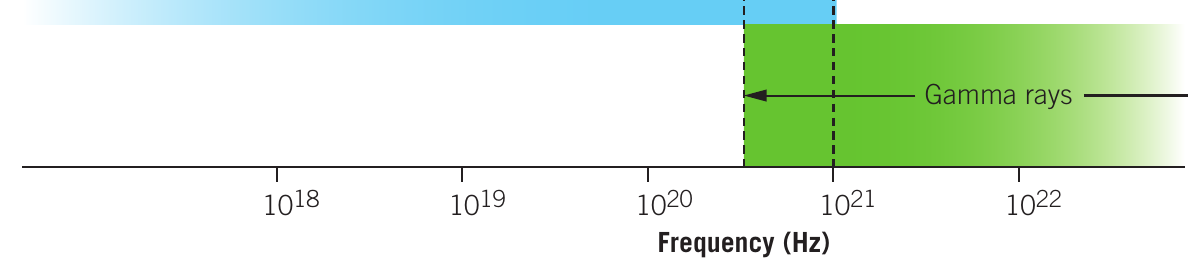
Gamma (γ) radiation is fundamentally different from α- and β-radiation. It does not consist of particles but rather is a form of very short wavelength electromagnetic energy, similar to X-rays.
Gamma rays can be considered as discrete packages of energy called photons. They travel at the speed of light (300,000 km s⁻¹ or c) and carry no electrical charge.
Penetration and ionizing power
Gamma radiation has the highest penetrating ability of the three radiation types:
- Several centimetres of lead do not stop all γ-radiation
- They can easily penetrate the human body and reach internal organs
Important
Although γ-rays have considerably lower ionizing capacity than β-radiation, their high penetration makes them dangerous even at a distance. They are extremely hazardous both as external sources and if radioactive γ-emitters are ingested or inhaled.
Gamma decay process
Gamma emission typically occurs after α- or β-decay. When a nucleus emits an α-particle or β-particle, it may remain in an excited (unstable) energy state. The nucleus then releases excess energy by emitting a γ-ray photon.
Since γ-emission releases energy without ejecting particles:
- The mass number (A) remains unchanged
- The atomic number (Z) remains unchanged
- No transmutation occurs
Example
Example: Sodium-24 Decay
The asterisk (*) indicates an excited nucleus. The magnesium-24 nucleus releases its excess energy almost instantaneously as a γ-ray.
Comparison with X-rays
Both γ-rays and X-rays are part of the electromagnetic spectrum and their wavelength ranges overlap. They have similar properties but originate from different parts of the atom:
Note
Key Difference Between Gamma Rays and X-Rays:
- X-rays: Produced by processes outside the nucleus (electron transitions)
- Gamma rays: Originate inside the nucleus
X-rays are generally lower in energy and less penetrating than γ-rays, but both have sufficient energy to ionize atoms.

Applications of gamma radiation
Gamma-emitting radioisotopes are the most widely used radiation sources due to their strong penetrating power. The three most useful γ-emitters are caesium-137, technetium-99m, and cobalt-60.
Cobalt-60 applications:
- Sterilization of medical equipment
- Food pasteurization through irradiation
- Thickness gauges in industry
- Industrial radiography
- Cancer treatment using a gamma "knife"
Caesium-137 applications:
- Flow measurement in industrial processes
- Investigation of underground strata (oil, coal, gas exploration)
- Soil moisture-density measurement at construction sites
- Cancer treatment
Technetium-99m applications:
- Medical diagnostic imaging (brain, bone, liver, spleen, kidney)
- Blood flow studies
- Most widely used medical diagnostic radioisotope
Note
Cobalt-60 is particularly useful as it decays by emitting both low-energy β-particles and high-energy γ-rays. It does not exist naturally but is produced artificially in nuclear reactors.
Nuclear transformations
What is a nuclear transformation?
A nuclear transformation is the conversion of one nuclide into another. This can occur through:
- Natural radioactive decay
- Artificial bombardment with nuclear particles
Both α-radiation and β-radiation cause transmutation because they change the number of protons in the nucleus, creating a different element. Gamma radiation does not cause transmutation.
Conservation laws in nuclear equations
Important
Conservation Laws:
When writing nuclear equations, two quantities must be conserved:
- Total atomic number (Z) – sum of protons
- Total mass number (A) – sum of nucleons
Example
Example: Carbon-14 β-Decay
Checking conservation:
- Atomic numbers (Z): LHS = 6, RHS = 7 + (-1) = 6 ✓
- Mass numbers (A): LHS = 14, RHS = 14 + 0 = 14 ✓
Example
Example: Uranium-238 α-Decay
Checking conservation:
- Atomic numbers (Z): LHS = 92, RHS = 90 + 2 = 92 ✓
- Mass numbers (A): LHS = 238, RHS = 234 + 4 = 238 ✓
Summary table of nuclear transformations
The table below summarizes the four main types of nuclear decay:
| Type | Nuclear equation | Mass number change | Atomic number change |
|---|---|---|---|
| Alpha decay | Decreases by 4 | Decreases by 2 | |
| Beta decay | Unchanged | Increases by 1 | |
| Positron emission | Unchanged | Decreases by 1 | |
| Gamma decay | Unchanged | Unchanged |
Artificial nuclear transformations
Nuclear transformations can also be induced artificially by bombarding elements with nuclear particles.
Example
Historical Example: First Artificial Nucleus (1917)
Ernest Rutherford produced the first artificial nucleus by bombarding nitrogen with α-particles:
Both the oxygen-17 and hydrogen-1 nuclei produced are stable.
Note
Neutron Discovery (1932):
James Chadwick bombarded beryllium with α-particles and detected radiation that:
- Passed through lead shields
- Was unaffected by electric or magnetic fields
This was the neutron – a neutral particle with nearly the same mass as a proton. Neutrons make excellent probes for exploring nuclei because they experience no electrostatic repulsion.
Remember!
Summary
Key Points to Remember:
-
Three types of radiation: Alpha (α), beta (β), and gamma (γ) were discovered by Ernest Rutherford based on their penetrating abilities
-
Alpha particles are helium nuclei (2 protons + 2 neutrons), travel at ~10% the speed of light, stopped by paper, but highly ionizing
-
Beta particles are high-speed electrons (β⁻) or positrons (β⁺), travel at ~90% the speed of light, stopped by aluminium, and arise from neutron-proton transformations
-
Gamma rays are high-energy photons, travel at the speed of light, require lead to stop, and are emitted when excited nuclei release excess energy
-
Nuclear equations must conserve both atomic number (Z) and mass number (A) on both sides of the equation
-
Practical applications include smoke detectors (α), medical imaging (β), and cancer treatment (γ)