Nuclear Stability: Forces in the Nucleus (VCE SSCE Physics): Revision Notes
📚Revision Notes
Nuclear Stability: Forces in the Nucleus
Introduction to nuclear stability
Most natural elements are stable, meaning they do not spontaneously change into other elements. For example, a gold ring remains gold and does not transform into iron or lead over time. However, some elements can transform into other elements. Understanding why some nuclei are stable while others are radioactive requires us to examine the forces acting within the atomic nucleus.
Note
Nuclear stability is fundamental to understanding why some elements exist naturally on Earth while others are only created artificially, and why radioactive decay occurs in unstable isotopes.
Atomic structure basics
The nucleus and nucleons
Atoms consist of a central nucleus surrounded by orbiting electrons. The nucleus is the solid centre of an atom where most of the atom's mass is concentrated.
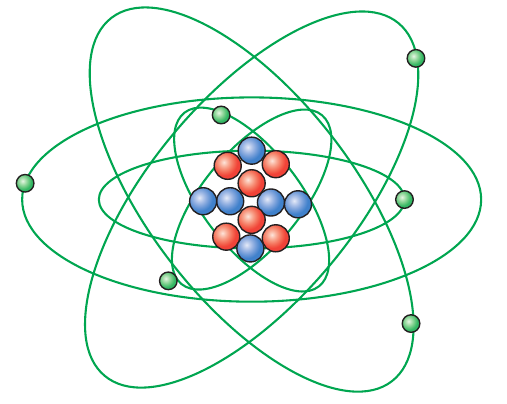
The nucleus contains two types of particles:
- Protons: positively charged particles
- Neutrons: particles with no electrical charge
Together, protons and neutrons are called nucleons.
Note
Understanding Nucleons
The term "nucleon" is simply a collective name for the particles found in the nucleus. Think of it as a family name: protons and neutrons are both members of the nucleon family, just as apples and oranges are both members of the fruit family.
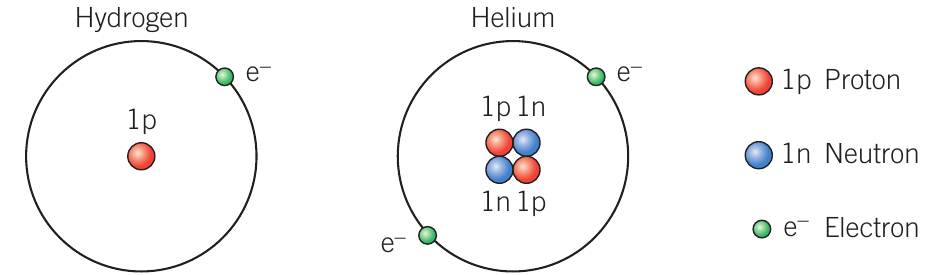
The simplest atom is hydrogen, which normally has just one proton in its nucleus and one orbiting electron. The next simplest element is helium, which typically has two protons, two neutrons, and two orbiting electrons.
Elements and atomic number
The number of protons in the nucleus determines which element an atom represents. This is called the atomic number, represented by the symbol .
- All atoms with 1 proton are hydrogen atoms ()
- All atoms with 2 protons are helium atoms ()
- All atoms with 6 protons are carbon atoms ()
- All atoms with 92 protons are uranium atoms ()
An element is a pure substance consisting only of atoms that all have the same number of protons in their nuclei.
Important
Key Principle: The atomic number (number of protons) is what defines an element. Change the number of protons, and you change the element itself. This is why nuclear reactions that change the number of protons in an atom can transform one element into another.
The periodic table
The periodic table organizes all known elements by atomic number. The number above each element symbol shows the atomic number (number of protons).
Elements with more than 92 protons are called transuranic elements. These have all been produced artificially in laboratories, nuclear reactors, or nuclear explosions. They are all unstable and radioactive.
Mass number and element notation
The mass number () is the sum of the number of protons and neutrons in the nucleus. Since electrons have negligible mass, we ignore them when calculating atomic mass.
For any element X, we write:
where:
- = mass number (protons + neutrons)
- = atomic number (number of protons)
- = element symbol
Example
Worked Example: Element Notation
Let's write the notation for three common elements:
- Hydrogen: (1 proton, 0 neutrons)
- Helium: (2 protons, 2 neutrons)
- Uranium: (92 protons, 146 neutrons)
Notice that the mass number (top) is always larger than or equal to the atomic number (bottom), since it includes both protons and neutrons.
Isotopes
Although all atoms of a particular element have the same number of protons, they may have different numbers of neutrons. These different forms are called isotopes.
Hydrogen isotopes:
Hydrogen has three naturally occurring isotopes:
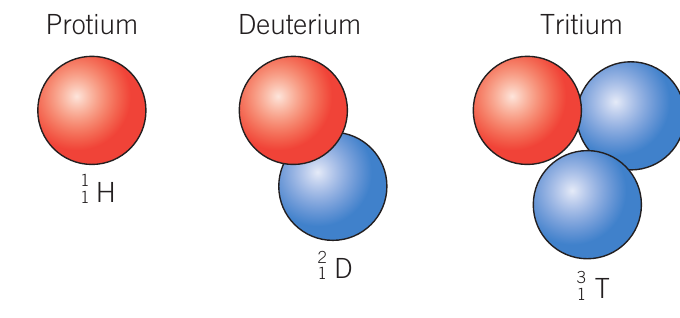
- Protium (): 1 proton, 0 neutrons
- Deuterium ( or ): 1 proton, 1 neutron
- Tritium ( or ): 1 proton, 2 neutrons (radioactive)
Helium isotopes:
Helium has two naturally occurring isotopes:
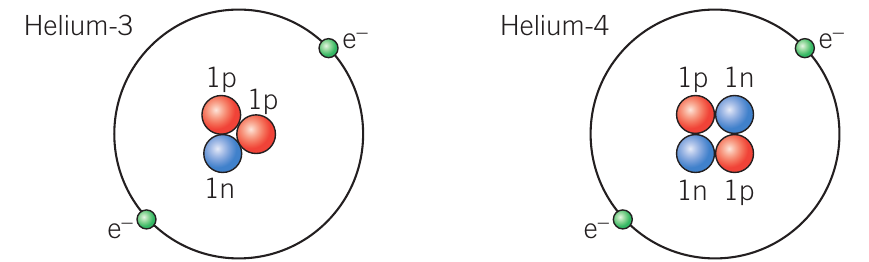
- Helium-3 (): 2 protons, 1 neutron
- Helium-4 (): 2 protons, 2 neutrons
Natural helium consists almost entirely of helium-4, with only about 0.0001% helium-3.
Note
Chemical vs Physical Properties of Isotopes
Different isotopes of an element have the same chemical properties (because they have the same number of electrons) but different physical properties (because they have different masses). This is why deuterium (heavy water) behaves chemically like regular water but has different physical characteristics such as a higher boiling point.
Nuclear stability and the belt of stability
Neutron-to-proton ratio
The stability of any nucleus depends on the ratio of neutrons to protons:
- Small nuclei: Need roughly equal numbers of protons and neutrons (1:1 ratio)
- Larger nuclei: Need more neutrons than protons for stability (up to 1.5:1 ratio)
This increasing neutron requirement is due to the competing electrostatic and strong nuclear forces, which we'll examine in the next section.
Important
The Neutron Requirement Rule
Remember: Light elements need equal numbers of protons and neutrons (1:1), while heavy elements need more neutrons (up to 1.5:1). This isn't arbitrary—it's a consequence of how nuclear forces work at different scales.
The belt of stability
When we plot the number of neutrons versus the number of protons for all stable isotopes, they form a curved band called the belt of stability (also known as the valley of stability).
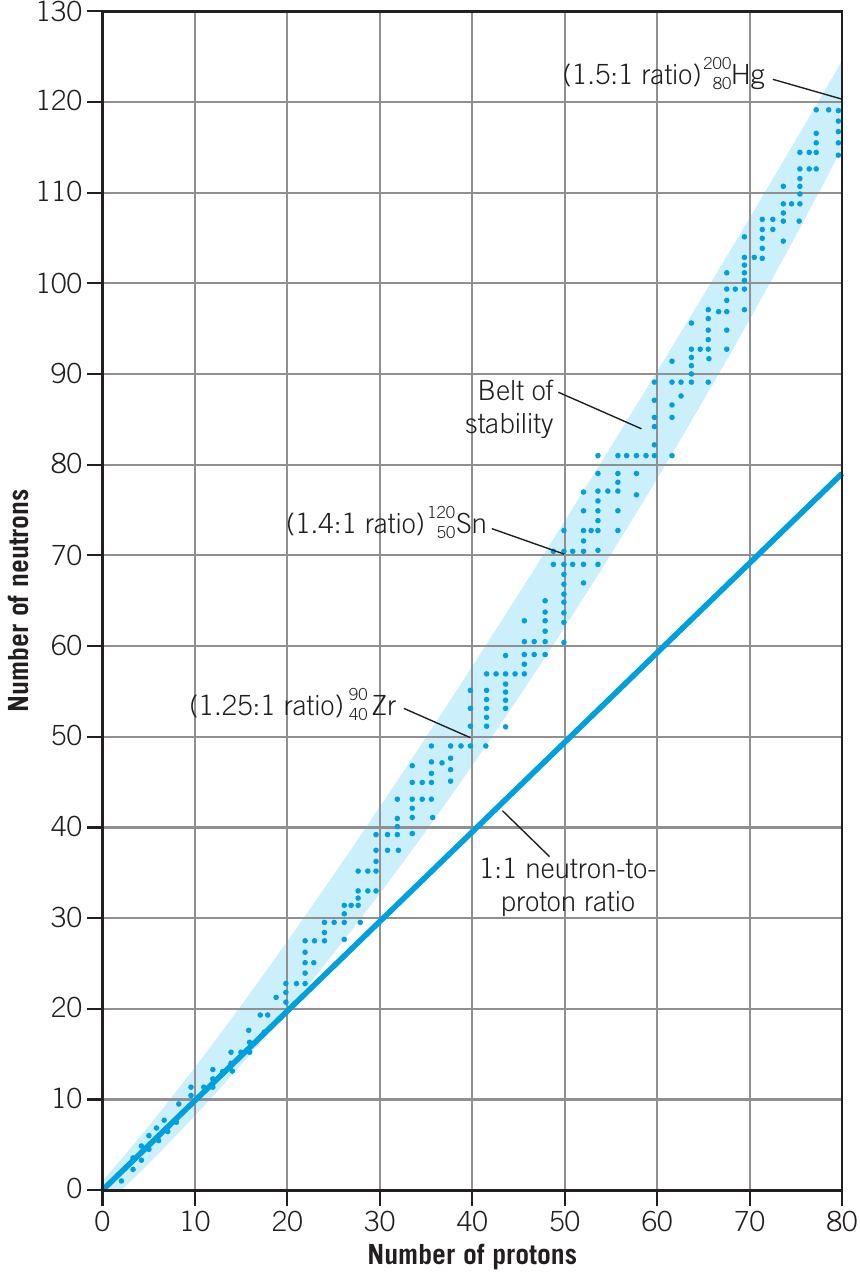
Key observations from the belt of stability:
- Stable nuclei have neutron-to-proton ratios between 1:1 and 1.5:1
- For lighter elements (up to about calcium), the ratio is close to 1:1
- For heavier elements, more neutrons are needed
- Example ratios:
- Zirconium-90: 1.25:1
- Tin-120: 1.4:1
- Mercury-200: 1.5:1
Radioactive isotopes
Isotopes that fall outside the belt of stability are radioactive. These unstable nuclei undergo nuclear decay, spontaneously emitting energy in the form of radiation.
Although there are 254 stable isotopes, more than 3000 radioactive isotopes are known. Only about 84 of these occur naturally; the rest are produced artificially.
Example
Worked Example: Cobalt-60 Instability
Cobalt-60 has 27 protons and 33 neutrons, giving a neutron-to-proton ratio of 1:1.22.
This places it outside the belt of stability, making it radioactive. It spontaneously emits beta particles and gamma rays as it decays toward a more stable configuration.
Cobalt-60 is used in cancer treatment (radiotherapy) but must be produced artificially in nuclear reactors because it doesn't occur naturally in sufficient quantities.
Forces in the nucleus
The four fundamental forces
There are only four fundamental forces in the Universe:
| Force | Relative strength | Range |
|---|---|---|
| Strong nuclear | 1 | m (diameter of a nucleus) |
| Electromagnetic | Infinite | |
| Weak nuclear | m (1/1000th of proton diameter) | |
| Gravitational | Infinite |
To understand nuclear physics, we can ignore gravitational forces (they're far too weak at the nuclear scale) and focus on the other three forces.
Note
Notice the enormous range in force strengths—the strong nuclear force is times stronger than gravity! However, the strong force only acts over incredibly short distances, while gravity acts over infinite distances, which is why gravity dominates at large scales despite being so weak.
Electrostatic forces in the nucleus
The electrostatic force is the force that exists between charged particles. Key principles:
- Like charges repel (positive-positive or negative-negative)
- Unlike charges attract (positive-negative)
- The force is stronger when charges are closer together
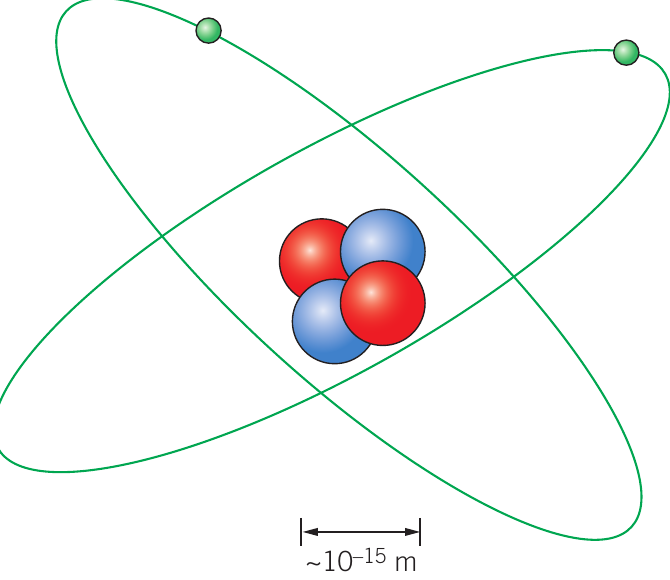
Inside a nucleus, all protons are packed extremely close together (a helium nucleus is only about m in diameter). Since protons are all positively charged, they experience an enormous electrostatic repulsion force.
Important
The Nuclear Puzzle
With such strong repulsion between protons packed so closely together, why doesn't the nucleus fly apart?
The answer: An even stronger force must be holding the nucleus together—the strong nuclear force.
Strong nuclear force
The strong nuclear force is the force that holds nucleons (protons and neutrons) together in the nucleus.
Key characteristics:
- Extremely powerful: About 100 times stronger than the electrostatic force
- Very short range: Only acts over distances of about m (the diameter of a nucleus)
- Acts on all nucleons: Affects both protons and neutrons equally
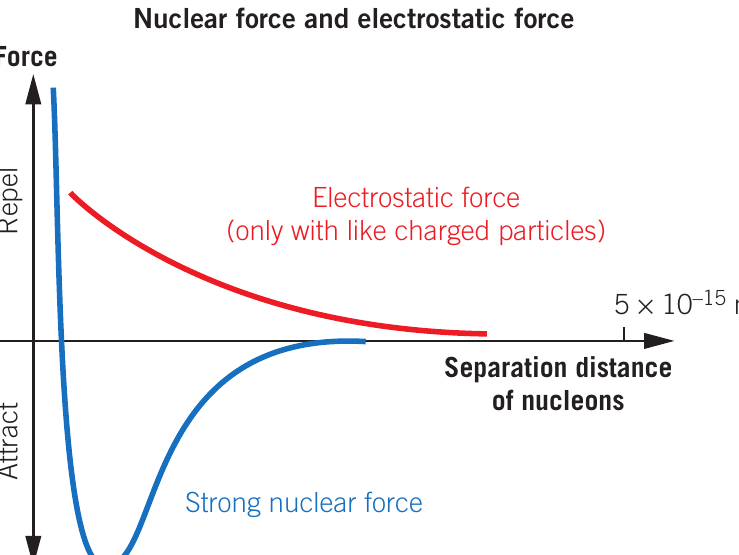
The graph shows how the strong nuclear force and electrostatic force vary with distance:
- At very close range (inside the nucleus), the strong nuclear force is much stronger and attractive
- The electrostatic force decreases more slowly with distance
- Beyond about m, the strong force becomes negligible
Note
Why Larger Nuclei Need More Neutrons
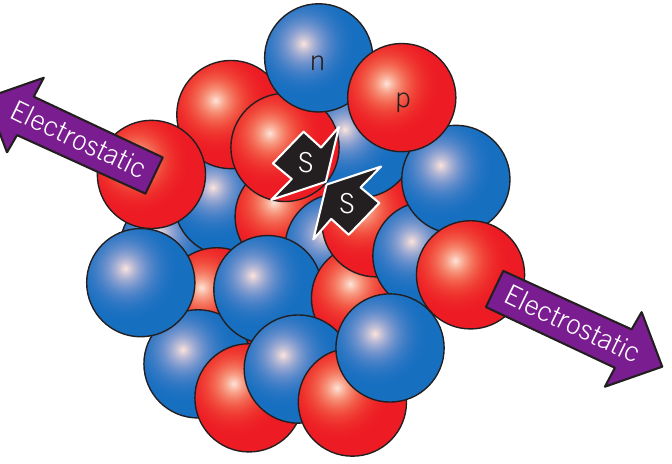
As nuclei get larger, protons on opposite sides of the nucleus are farther apart. While they're still bound to their immediate neighbours by the strong force, protons across the nucleus begin to repel each other electrostatically.
Adding more neutrons helps because:
- Neutrons contribute to the strong nuclear force (helping bind the nucleus)
- Neutrons don't contribute to electrostatic repulsion (they have no charge)
- This extra "nuclear glue" helps overcome the increasing electrostatic repulsion
Important
The Stability Limit
For natural elements with more than 82 protons (lead has 82 protons), nuclei become unstable and radioactive. The electrostatic repulsion becomes too strong to overcome, even with extra neutrons. This is why all elements heavier than lead found in nature are radioactive.
Weak nuclear force
The weak nuclear force is responsible for radioactive beta decay. It explains how neutrons can transform into protons and vice versa.
Processes involving the weak force:
- A neutron can decay into a proton, emitting a beta-minus particle (electron) and a neutrino
- A proton can decay into a neutron, emitting a beta-plus particle (positron) and a neutrino
The neutrino is a neutral subatomic particle with a mass close to zero that rarely interacts with normal matter. Despite being difficult to detect, about 100 trillion neutrinos pass through our bodies every second from sources like the Sun.
Nuclear vs chemical energy
The strong nuclear forces holding the nucleus together are much stronger than the electrostatic forces holding electrons to the nucleus. This means:
- Nuclear reactions release much more energy than chemical reactions
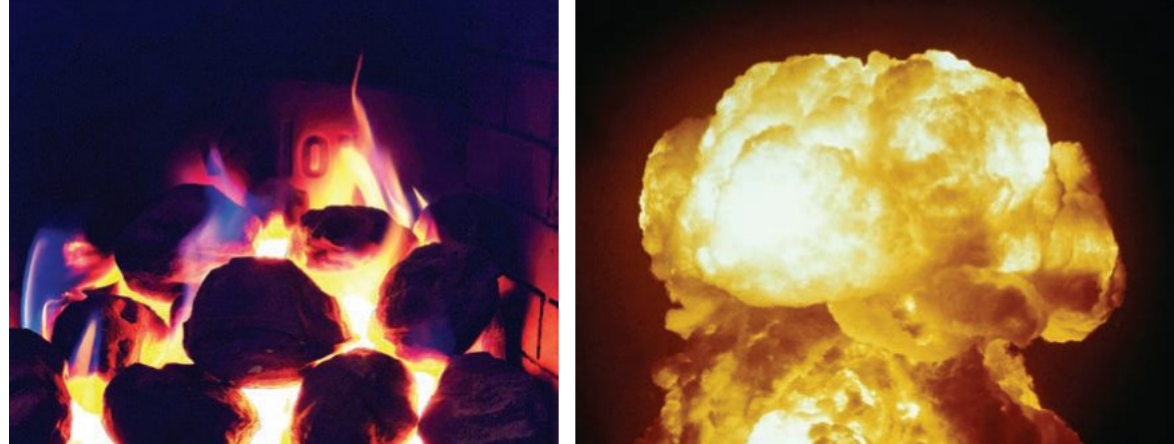
- A 2-kg lump of coal releases similar energy to 480 g of TNT when burned (chemical reaction)
- A similar-sized lump of uranium-235 (about 28 kg) can release energy equivalent to 20,000 tonnes of TNT (nuclear reaction)
Note
Nuclear energy is millions of times more powerful than chemical energy for the same mass of fuel. This explains both the enormous potential of nuclear power and the devastating power of nuclear weapons.
Binding energy
What is binding energy?
Binding energy is the amount of energy needed to overcome the strong nuclear force and pull a nucleus apart into its individual nucleons. It's the energy required to split a nucleus completely.
Conversely, when nucleons come together to form a nucleus, this same amount of energy is released.
Example
Worked Example: Deuterium Binding Energy
To split a deuterium nucleus () into a separate proton and neutron requires 2.23 MeV of energy.
Conversely, when a proton and neutron combine to form deuterium, 2.23 MeV of energy is released.
This demonstrates the fundamental principle: breaking bonds requires energy input, while forming bonds releases energy.
Binding energy per nucleon
To compare the stability of different nuclei, we use the average binding energy per nucleon:
Example
Worked Example: Oxygen-16 Binding Energy
Oxygen-16 has a total binding energy of 127 MeV.
Step 1: Identify the number of nucleons Number of nucleons in O-16 = 16
Step 2: Calculate binding energy per nucleon
Interpretation: Each nucleon in oxygen-16 is bound with an average energy of 7.94 MeV.
Important
Higher binding energy per nucleon means the nucleus is more stable (harder to break apart). This is why we use this measure to compare nuclear stability across different elements.
The binding energy curve
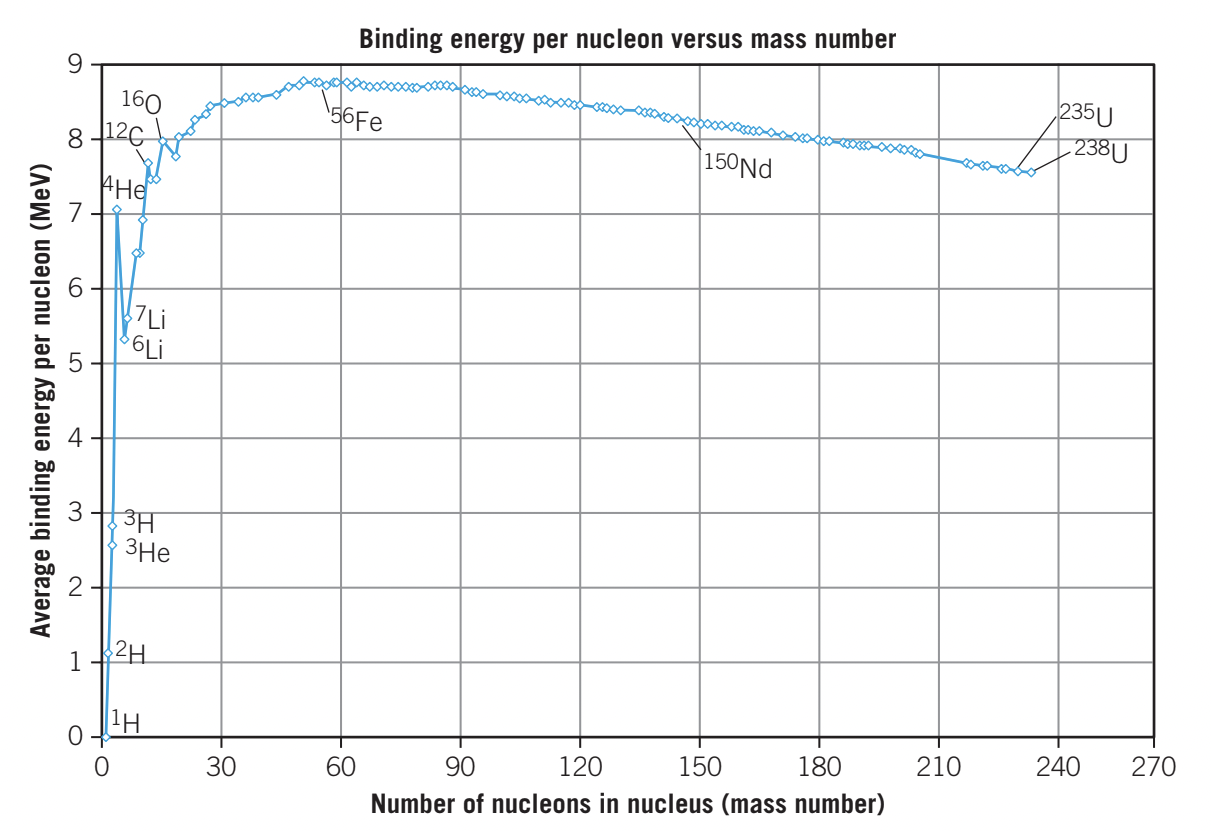
The binding energy curve plots average binding energy per nucleon against mass number for all stable nuclei:
Key features of the curve:
- Iron-56 is at the peak: Iron-56 () has the highest binding energy per nucleon (8.8 MeV), making it the most stable nucleus in the Universe.
- Light elements have lower binding energy: Hydrogen, helium, and lithium have lower binding energies per nucleon, meaning they're less stable.
- Heavy elements beyond iron have decreasing binding energy: Elements heavier than iron are less stable than iron.
Important
Energy Release Principles
The binding energy curve explains why both fusion and fission can release energy:
-
Fusion of light elements releases energy: When light nuclei (like hydrogen) fuse to form heavier nuclei (like helium), they move up the curve toward higher binding energy, releasing energy. This is how stars produce energy.
-
Fission of heavy elements releases energy: When heavy nuclei (like uranium) split into medium-sized nuclei, they also move toward higher binding energy (toward iron), releasing energy. This is used in nuclear power stations.
-
Fusion beyond iron requires energy: Fusing iron nuclei or heavier elements would move down the curve (toward lower binding energy), which requires energy input rather than releasing it. This is why stellar fusion stops at iron.
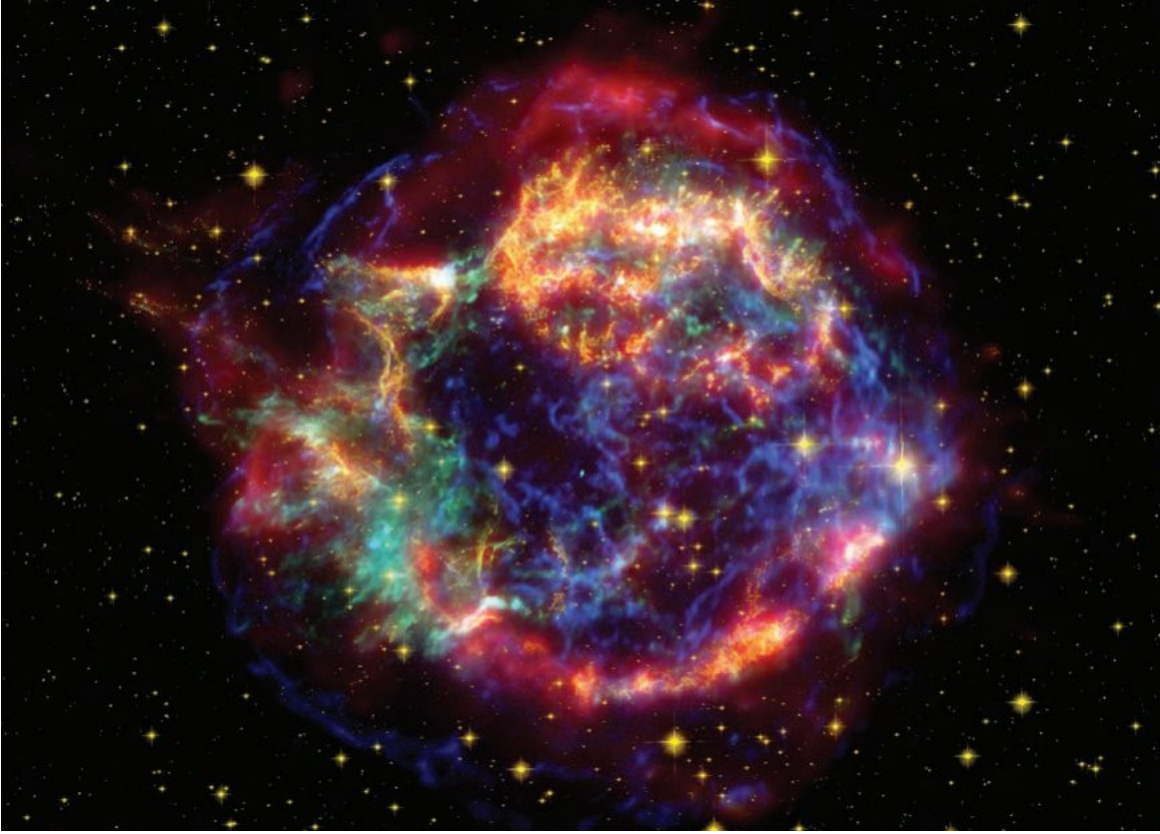
Formation of heavy elements: Elements heavier than iron can only be produced in extremely energetic cosmic events like supernova explosions, where enormous amounts of energy are available.
Energy units in nuclear physics
In nuclear physics, energy is often measured in electronvolts (eV):
- 1 eV = J
- 1 MeV = eV (one million electronvolts)
Nuclear radiation energies typically range from 0.1 to 10 MeV.
Summary
Key Points to Remember:
-
Protons define the element: The number of protons (atomic number) determines which element an atom is.
-
Isotopes have different neutron numbers: Atoms of the same element can have different numbers of neutrons, creating isotopes with different masses but the same chemical properties.
-
Stability requires the right neutron-to-proton ratio: Light nuclei are stable with roughly equal numbers of protons and neutrons (1:1), while heavy nuclei need more neutrons (up to 1.5:1) to remain stable.
-
Three nuclear forces compete: The electrostatic force (pushing protons apart), the strong nuclear force (pulling nucleons together over short distances), and the weak nuclear force (enabling beta decay) determine nuclear behaviour.
-
The strong force is powerful but short-range: It holds nucleons together but only works over distances of about m. This is why larger nuclei need extra neutrons for stability.
-
Iron-56 is the most stable nucleus: It has the highest binding energy per nucleon (8.8 MeV), meaning it takes the most energy to break apart. This is why fusion in stars stops at iron.
-
Binding energy explains fusion and fission: Both processes release energy because they move nuclei toward the iron peak on the binding energy curve, creating more stable configurations.