Planning and Conducting Investigations: Methodology and Design (VCE SSCE Psychology): Revision Notes
📚Revision Notes
Planning and Conducting Investigations: Methodology and Design
Understanding investigation methodology
Research can be conducted using various methodologies depending on what the researcher wants to investigate and what type of data they need. An investigation methodology refers to the particular type of research study chosen for a project.
Not all research is an 'experiment'. A controlled experiment represents just one option among several methodologies, including:
- Case studies
- Classification and identification
- Controlled experiments
- Correlational studies
- Fieldwork
- Literature reviews
- Modelling and simulation
- Product, process or system development
Each methodology has particular strengths and limitations. Researchers select the most appropriate methodology based on their research requirements and consideration of potential sources of error and uncertainty.
Note
When choosing an investigation methodology, researchers must carefully consider what they want to discover, the type of data needed, and the practical and ethical constraints of their research context. The methodology selected will determine the type of conclusions that can be drawn from the study.
Controlled experiments
What is a controlled experiment?
A controlled experiment investigates the relationship between one or more independent variables (IVs) and a dependent variable (DV), whilst controlling all other variables. The purpose is to determine whether an IV affects a DV.
Example
Example: Energy Drinks and Driving Performance
A researcher wants to test whether consuming energy drinks affects driving performance. They could design a controlled experiment where:
- Independent variable (IV): Consumption of energy drinks
- Dependent variable (DV): Driving performance measured using a driving simulation test
- Controlled variables: Time of day, type of simulation, participant age range
Experimental and control groups
In controlled experiments, participants are divided between two types of groups:
Experimental group: The group exposed to the independent variable and receiving the experimental treatment. Members participate in the experimental condition.
Control group: The group that establishes a baseline level for comparison. Members participate in the control condition and are not exposed to the independent variable or experimental treatment.
Example
Example: Sugar and Attention Study
To investigate whether sugar affects children's attention:
- Experimental group: Children consume sugar by eating lolly snakes before taking an attention test
- Control group: Children do not consume sugar and do not eat lolly snakes before taking the same attention test
The control group provides the baseline attention level without sugar, allowing researchers to measure any changes caused by sugar consumption.
Important
A control group is essential for establishing natural baseline levels of the dependent variable before any influence from the independent variable. Without a control group, researchers cannot determine whether observed changes are due to the IV or would have occurred naturally.
Studies always include one control group, but may include multiple experimental groups. For example, one experimental group might consume five lolly snakes whilst a second experimental group consumes ten lolly snakes before their attention test.
Allocating participants to groups
Once the sample has been selected, participants must be divided into different groups. This process is called allocation.
Random allocation divides the sample into so that each participant has an equal chance of being placed into either the experimental or control group. A simple method involves placing all participants' names in a box, drawing them one by one, and placing them into alternating groups.
Random allocation ensures that groups are equal in participant characteristics. This means any changes in results are more likely due to the independent variable rather than unwanted differences in participant variables between groups.
Note
Why Random Allocation Matters
Random allocation is a critical component of experimental design because it:
- Minimises bias in group assignment
- Distributes participant characteristics evenly across groups
- Increases the validity of conclusions about cause-and-effect relationships
- Reduces the influence of extraneous variables
Strengths and limitations of controlled experiments
Strengths:
- Can identify cause-and-effect relationships between an IV and a DV
- Results may be generalised to the population if the study has good validity
- Can be repeated to gather more data and test reliability of results
Limitations:
- Require strictly controlled conditions which are difficult to maintain, so results may be influenced by extraneous variables
- Participant behaviour may be influenced by the artificial setting
- May be unethical or impossible to conduct a controlled experiment on certain variables
- External validity may be low if conditions are too artificial to extrapolate results to the real-world population
Investigation designs
What is an investigation design?
An investigation design provides a framework determining how participants experience the experimental and control conditions. Three main designs exist, each with particular strengths and limitations. The choice depends on the study's goals, the type of data being collected, and which variables are most important to control.
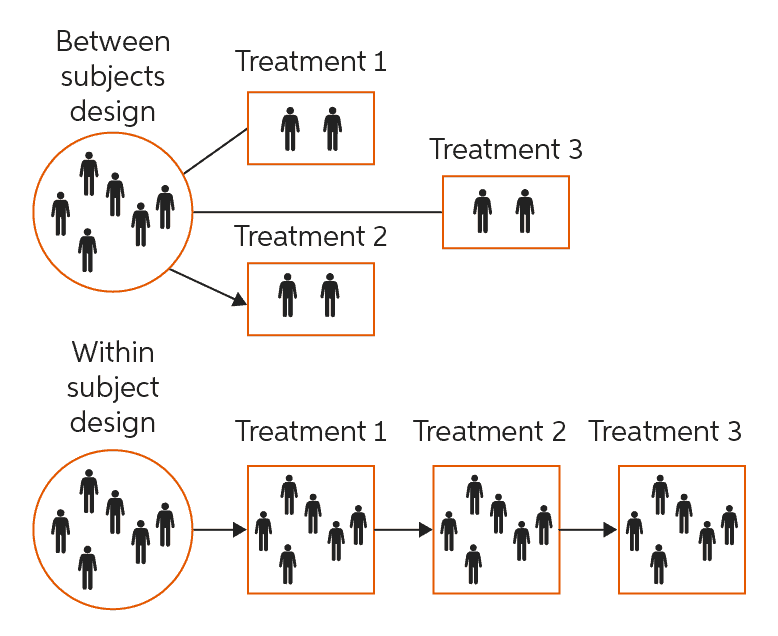
Between subjects design
A between subjects design involves randomly allocating participants to either the control or the experimental condition. Each participant completes only one condition.
Note
Think: "EITHER/OR"
In a between subjects design, participants go to one group OR the other - never both. Each person experiences only one condition in the study.
Example
Example: Sugar and Attention (Between Subjects)
In a between subjects design for the sugar and attention study:
- Half the children are randomly allocated to the experimental condition (consume sugar)
- The other half are allocated to the control condition (no sugar)
- Each child completes the attention test only once, under their assigned condition
A key challenge with between subjects designs is ensuring groups are matched on important participant characteristics. If groups differ on relevant characteristics, these differences become extraneous variables that can affect the DV. For example, if half the children in the experimental group usually eat sugar daily, but only a quarter of the control group do, the groups are not equal on an important characteristic for this study.
Strengths:
- Most time-efficient design because both groups can be tested simultaneously with no pre-testing required
- Lower participant withdrawal rate than within subjects designs because participants complete only one condition
- Better control of participant knowledge about the study with no effect of prior participation extraneous variables compared to within subjects designs
Limitations:
- Requires more participants than within subjects designs
- Less control over extraneous variables related to participant differences between groups, which may influence results and lower validity
Within subjects design
A within subjects design involves all participants in the sample completing both the experimental and control conditions.
Note
Think: "BOTH/ALL"
In a within subjects design, ALL participants do BOTH conditions. Every person experiences both the control and experimental conditions in the study.
In this design, any effects of participant variables can be completely removed because the same participants are in both conditions. For example, all children in the sample would first complete the attention test without consuming sugar, then complete the test again after consuming sugar.
Because identical participants complete both conditions, each participant's unique characteristics influence results in both conditions equally. For instance, a child with an attention disorder may react to sugar differently than a child without such a disorder. However, by participating in both conditions, their disorder affects their attention results equally in both the control and experimental conditions, eliminating weighted influence towards either condition.
Example
Example: Sugar and Attention (Within Subjects)
In a within subjects design for the sugar and attention study:
- Session 1: All children complete the attention test without consuming sugar (control condition)
- Session 2: The same children complete the attention test after consuming sugar (experimental condition)
- Each child's performance can be compared across both conditions, controlling for individual differences
Strengths:
- No extraneous variable of participant differences between groups, improving validity
- Requires fewer participants than between subjects designs
Limitations:
-
Less control over participant knowledge of the study - prior participation in the first condition may influence behaviour during the second condition
-
More time consuming than between subjects designs because both conditions cannot be tested simultaneously
-
Higher participant withdrawal rate than between subjects designs because the DV must be measured multiple times
Mixed design
A mixed design combines elements of between subjects and within subjects designs. This approach integrates some strengths of both designs whilst potentially reducing some limitations.
A simple mixed design might test the effect of one independent variable at two time periods, such as through a pre-test and post-test.
Example
Example: Classical Music and Study Performance
Investigating whether listening to classical music whilst studying improves performance:
- Between subjects element: Allocate each participant to either experimental (classical music) or control (no music) condition
- Within subjects element: All participants complete a pre-test to determine baseline scores, then complete a post-test after studying under their assigned condition
- This design controls for initial ability differences (pre-test) whilst comparing the effect of music between groups
A mixed design may also involve two independent variables, where one variable is tested through a between subjects design and the second through a within subjects design.
Note
Complex Mixed Designs
Mixed designs can test multiple independent variables simultaneously. For example, investigating whether male or female students benefit from listening to classical or pop music whilst studying could involve:
- Between subjects element: Whether the student is male or female (naturally occurring variable)
- Within subjects element: Listening first to classical music, then to pop music whilst studying
One variable could be a naturally occurring variable the researcher has not manipulated, such as age, sex, geographical location or the presence of another particular characteristic.
Strengths:
- Differences in participant variables between groups are controlled in the within subjects element
- Can test the effect of multiple independent variables on a dependent variable in one investigation
- Testing multiple independent variables in one investigation can be time and cost effective compared to conducting separate investigations
Limitations:
- Higher participant withdrawal rate than using between subjects design alone, which can harm internal validity
- Less control over participant knowledge - prior participation in the first condition may influence behaviour during the second condition
- Less control over differences in participant variables between groups in the between subjects element, which may influence results and lower validity
Case studies
What is a case study?
A case study is an investigation of a particular activity, behaviour, event or problem containing a real or hypothetical situation and including real-world complexities.
Several formats exist for case studies:
Historical case studies: Analyse causes, consequences and lessons learned from a case.
Real or role-play situations: Examine actual situations or imagined scenarios where plausible recommendations are needed.
Problem-solving cases: Develop new designs, methodologies or methods.
Example
Example: Famous Case Studies in Psychology
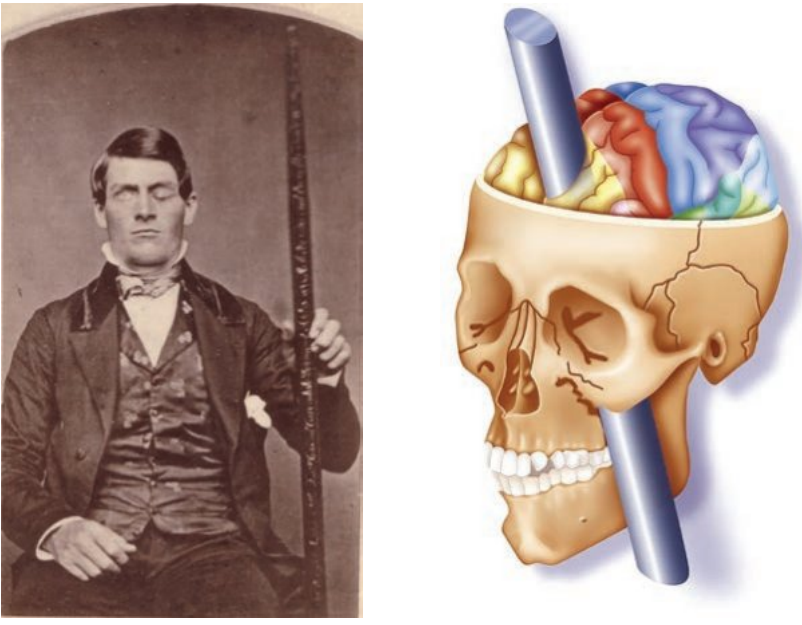
Historical Case Study - Phineas Gage: Learning about the frontal lobe's role by investigating the case of Phineas Gage, a railroad worker who survived a severe brain injury that damaged his frontal lobe, leading to significant personality changes.
Real Situation - Genie 'Wild Child': Studying language acquisition due to neglect in the case of Genie, a child raised in social isolation who suffered abuse and did not develop speech until rescue. This case provided insights into critical periods for language development.
Problem-Solving Case: Identifying unique situations requiring new treatment processes, such as developing interventions for rare psychological conditions.
When to use case studies
Case studies typically involve an individual or small group of people. They are used when:
- Only a limited number of participants are available
- Examining effects of a rare experience
- It would be unethical or impossible to expose a person to a particular variable
Important
Ethics and Practicality in Case Studies
Case studies are often the only ethical option for research into certain phenomena. For example, research into fatal familial insomnia (a rare brain disorder characterised by inability to sleep) would struggle to find a large sample of eligible participants. Additionally, it would be unethical to cause someone to develop fatal familial insomnia to study its effects.
In case studies, the person or small group may undergo various tests, observations and questionnaires to collect data.
Strengths and limitations of case studies
Strengths:
- Useful when limited participants are available
- Can study experiences where conducting a controlled experiment would be unethical or impossible
- Provide rich qualitative data
- Can provide a basis for further research
Limitations:
- One person or small group cannot represent a population, so results cannot be generalised and external validity is low
- Researcher bias may influence data recording, collation and treatment
- May not be repeatable to gather more data or test reliability of results
- Typically time consuming
Classification and identification
What is classification and identification?
Classification and identification is an investigation methodology involving two distinct components:
- Classification: Arranging phenomena, objects or events into manageable sets
- Identification: Recognising phenomena as belonging to a particular set or being part of a new or unique set

In psychology, classification organises human behaviour, mental processes and events into common groupings with similar features, from which an individual's experience can then be identified.
Applications in research
Classification and identification help determine whether experiences are usual or unusual and can lead to further research into areas of need.
Example
Example: The DSM Classification System
The Diagnostic and Statistical Manual of Mental Disorders (DSM) is a classification system grouping mental health disorders into categories based on similar characteristics, such as:
- Anxiety-related symptoms
- Psychosis-related symptoms
- Mood-related symptoms
Standardised classification allows for consistent identification using a common language based on rules. This common language helps the identification process pinpoint particular mental health disorders based on symptoms, allowing people to seek specific treatment for that disorder whilst excluding other similar disorders.
Note
Other Applications of Classification and Identification
Beyond psychology, this methodology is widely used across disciplines:
- Education: Determining learning difficulties in children or behaviours considered abnormal for their developmental age
- Environmental science: Classifying animal species as endangered, allowing countries to make protective laws
- Agriculture: Differentiating between agricultural pests, allowing farmers to use appropriate crop protection products
Classification and identification enable correct decisions and predictions of expected behaviour.
Strengths and limitations of classification and identification
Strengths:
- Allow for a narrowed focus of research
- People identified as having similar classifications can feel a sense of belonging and support
- Enables efficient processing of large amounts of information
- Helps make predictions and inferences
Limitations:
- Labelling through identification can lead to stereotyping, prejudice or discrimination
- Classifications may be based on subjective criteria
- Large amounts of information are required to create classifications
Important
The Risk of Labelling
While classification and identification can be helpful for diagnosis and treatment, it's critical to be aware that labelling individuals can lead to stereotyping and discrimination. Classifications should be used as tools for understanding and helping, not for limiting or stigmatising individuals.
Correlational studies
What is a correlational study?
A correlational study involves planned observation and recording of events and behaviours that have not been manipulated or controlled to:
- Understand relationships or associations existing between variables
- Identify which factors may be of greater importance
- Make predictions
Correlational studies describe the statistical association and strength of the relationship between two variables. However, because variables are not controlled by experimenters, correlational studies cannot determine how changing one variable causes a change in another variable.
Important
Correlation ≠ Causation
A fundamental principle in research: correlational studies cannot determine cause-and-effect relationships. Even if two variables show a strong correlation, this does not prove that one causes the other. Controlled experiments with variable manipulation are required to establish causation.
Types of correlations
Correlational studies collecting quantitative (numerical) data can present relationships between variables in scatterplots, with three main interpretations:
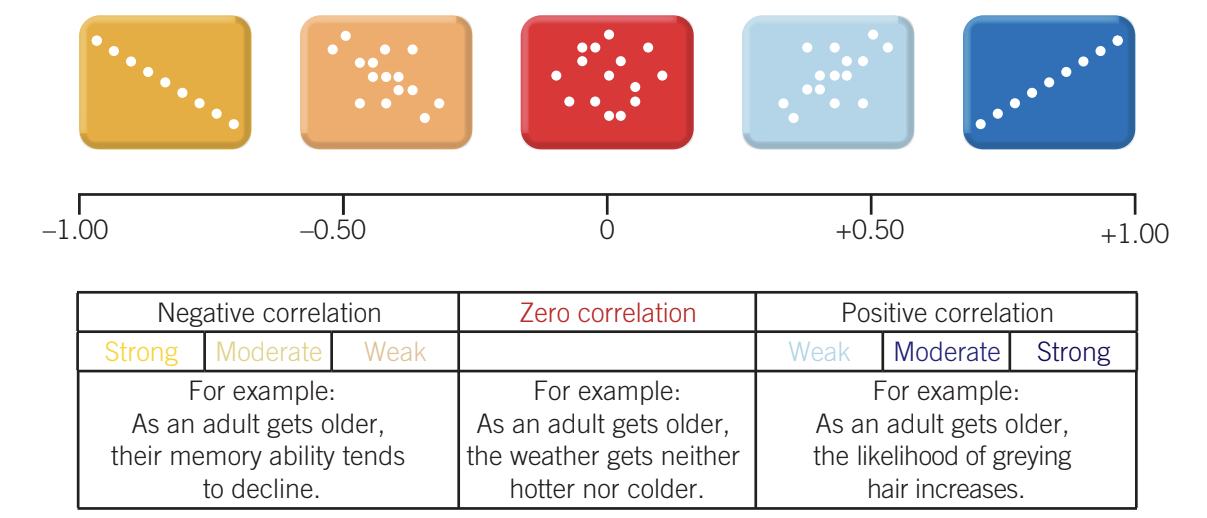
Positive correlation: A relationship where both variables increase or decrease together.
Negative correlation: A relationship where an increase in one variable results in a decrease in the other variable.
Zero correlation: No relationship exists between the variables.
Example
Examples of Different Correlation Types
Positive Correlation: As an adult gets older, the likelihood of greying hair increases. Both age and grey hair increase together.
Negative Correlation: As an adult gets older, their memory ability tends to decline. As one variable (age) increases, the other (memory ability) decreases.
Zero Correlation: As an adult gets older, the weather gets neither hotter nor colder. There is no relationship between these variables.
Note
Remember the Pattern: P.N.Z
- Positive: Variables move together in the same direction
- Negative: Variables move in opposite directions
- Zero: No relationship between variables
Measuring correlation strength
The strength of a correlational relationship is measured by statistical tests determining correlation coefficients such as Pearson's r. Correlation coefficients range from:
- (strongest possible negative relationship)
- (zero correlation)
- (strongest possible positive relationship)
Correlations are described as strong, moderate or weak depending on how close the value is to or .
Note
Interpreting Pearson's r
The closer the coefficient is to or , the stronger the correlation. Values near indicate weak or no correlation.
For example:
- indicates a very strong positive correlation
- indicates a strong negative correlation
- indicates a weak positive correlation
- indicates essentially no correlation
Example of correlational research
Example
Example: Happiness and Work Hours
A researcher could use a correlational study to measure the relationship between happiness and hours spent at work:
Method:
- Participants complete a questionnaire indicating weekly work hours
- Participants self-report happiness levels on a scale of 1 to 10
- Statistical analysis determines the correlation between these variables
Potential Result: Statistical analysis might determine a negative correlation where increased work hours are associated with decreased happiness.
Important Limitation: However, it cannot be determined that working more caused decreased happiness because many other uncontrolled variables could affect happiness, such as:
- Type of job participants were working in
- Work-life balance
- Job satisfaction
- Financial stress
- Workplace relationships
Strengths and limitations of correlational studies
Strengths:
- Can determine direction and strength of relationships between variables
- Can gather initial information investigated further or research behaviours where controlled experiments cannot be used for practical or ethical reasons
- Observation of real-life behaviours without variable manipulation may result in more natural behaviours
- Can use secondary data
- If a relationship is determined, one variable's value can predict the other variable's value
- Can determine repeatability, reproducibility and validity of measurements, often with high external validity
- Extra procedures to control extraneous variables are not needed
Limitations:
- Correlation does not equal or imply causation - even with strong relationships, cannot assume one variable causes change in the other
- Relationships are bi-directional - cannot determine which variable has more influence
- Requires large amounts of data
- Cannot control extraneous variables, so cannot determine whether a third variable influenced results, meaning low internal validity
Important
The Third Variable Problem
When interpreting correlations, always consider that a third, unmeasured variable might be influencing both variables under study. For example, a correlation between ice cream sales and drowning rates doesn't mean ice cream causes drowning - both are influenced by a third variable: warm weather.
Summary
Summary
Key Points to Remember:
-
Investigation methodology refers to the type of research study chosen, with each methodology having particular strengths and limitations suited to different research needs. Choose the methodology based on research goals, available resources, and ethical considerations.
-
Controlled experiments use random allocation to divide participants between experimental and control groups to identify cause-and-effect relationships, but require strict control of conditions to maintain internal validity.
-
Investigation designs determine how participants experience conditions:
- Between subjects: One condition per participant (EITHER/OR) - time efficient but requires more participants
- Within subjects: All conditions per participant (BOTH/ALL) - controls participant variables but more time consuming
- Mixed: Combination of both approaches - can test multiple IVs but complex to implement
-
Case studies provide in-depth investigation of individuals or small groups when larger samples are unavailable or unethical, offering rich qualitative data but limited generalisability to broader populations.
-
Correlation ≠ Causation - whilst correlational studies can identify relationships between variables (positive, negative or zero), they cannot determine that one variable causes changes in another due to lack of variable control. Remember: correlation coefficients range from to , with values closer to these extremes indicating stronger relationships.