Internal Biological Mechanisms that Regulate Sleep–Wake Patterns (VCE SSCE Psychology): Revision Notes
📚Revision Notes
Internal Biological Mechanisms that Regulate Sleep–Wake Patterns
The sleep–wake cycle follows predictable patterns that can be explained by several internal biological mechanisms working together. These include circadian rhythms, ultradian rhythms, the suprachiasmatic nucleus in the brain, and the hormone melatonin. Understanding how these mechanisms interact helps explain why humans typically sleep at night and remain awake during the day.
Circadian rhythms
Circadian rhythms are biological processes that coordinate the timing of body activities over a 24-hour period. These rhythms allow the body to function optimally at specific times throughout the day by controlling the sleep–wake cycle, hormone release, and body temperature regulation.
In humans, circadian rhythms typically follow a 24-hour pattern aligned with the day–night cycle. Most people sleep during the night and remain awake and active during the day. This pattern develops and changes across the lifespan, adapting to different physiological and environmental demands.
Note
The circadian rhythm naturally runs slightly longer than 24 hours. Without external time cues, it tends to "free-run" at approximately 24.25 hours. However, environmental cues known as zeitgebers (such as light, exercise, social activity, eating patterns, and temperature) help synchronise the internal rhythm to precisely 24 hours.
Light is the most powerful zeitgeber, which explains why the human circadian rhythm aligns so closely with the day–night cycle.
Note
Individual Variations in Sleep Timing
Individual variations in circadian rhythms may explain differences between "morning larks" (people who feel more alert in the morning) and "night owls" (people who feel more alert in the evening).
Ultradian rhythms
Ultradian rhythms are biological processes that coordinate the timing of body activities over periods shorter than 24 hours. These rhythms may last from a few minutes to several hours, allowing them to cycle repeatedly throughout a single day. Biological processes following ultradian rhythms include heart rate, digestion, blood pressure, certain hormone secretions, and appetite.
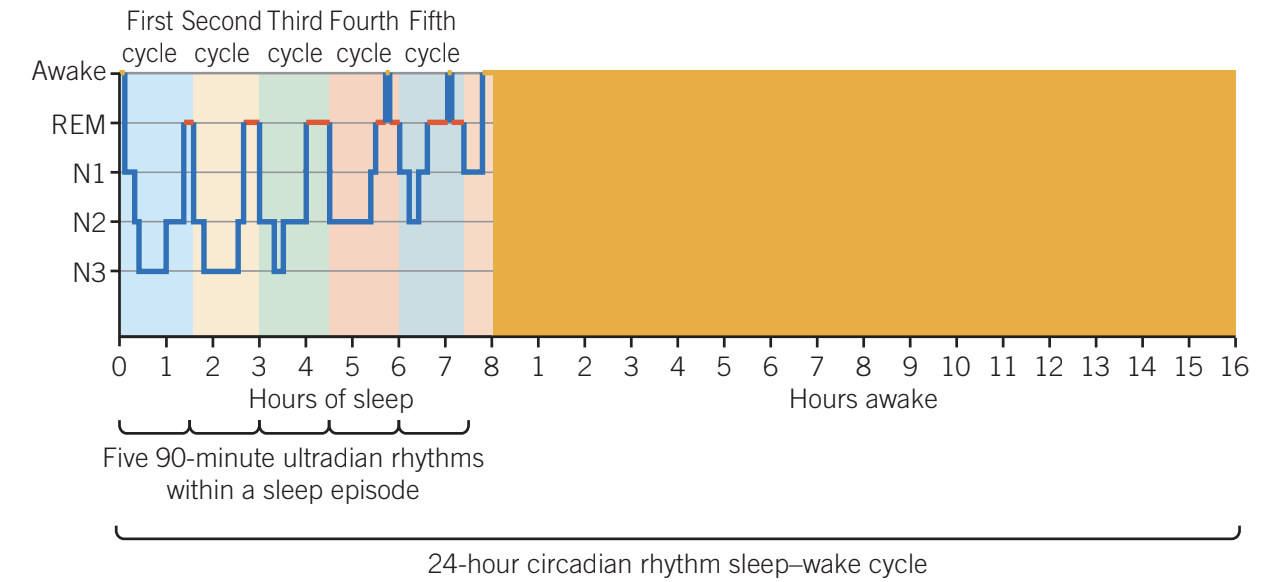
Although the overall sleep–wake cycle follows a circadian rhythm, the sleep portion comprises several sleep cycles that occur as ultradian rhythms. During a typical 8-hour sleep episode, a person experiences approximately five sleep cycles, each lasting around 90 minutes. These cycles progress through a repetitive and reasonably predictable pattern of REM and NREM sleep stages.
Sleep cycles show characteristic changes across the night. They tend to increase slightly in length over the course of a sleep episode, with a general pattern of:
- Increased REM sleep duration in later cycles
- Decreased N3 (deep sleep) duration in later cycles
Note
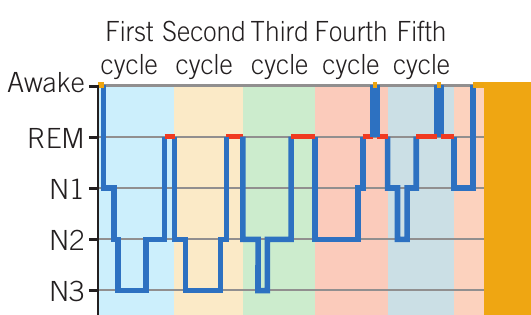
The hypnogram above displays a typical sleep episode for a healthy adult, illustrating the cyclical patterns of REM and NREM sleep across the five ultradian rhythms within the broader circadian sleep–wake cycle.
Suprachiasmatic nucleus
Many cells throughout the body can independently maintain a 24-hour circadian rhythm. However, these individual cellular rhythms are ultimately synchronised and controlled by a small region in the brain's hypothalamus called the suprachiasmatic nucleus (SCN), which functions as the master body clock.
At specific times during each 24-hour period, the suprachiasmatic nucleus sends signals to regulate various bodily activities, maintaining a coordinated daily schedule of sleep and wakefulness across all body systems.
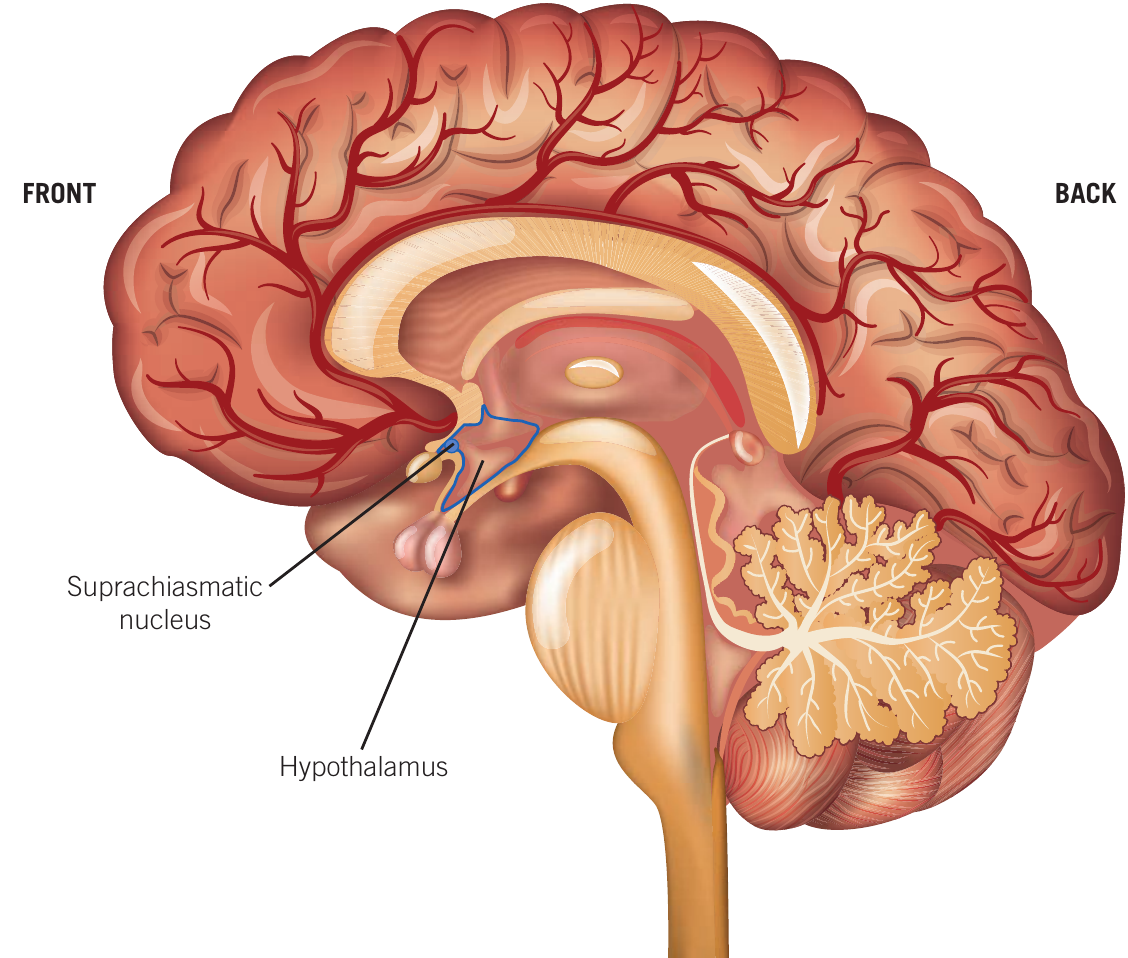
The suprachiasmatic nucleus can maintain an approximately 24-hour cycle independently through a precise feedback loop of gene expression and inhibition. However, it is particularly sensitive to environmental cues, especially light. This sensitivity to light explains why human circadian rhythms remain so tightly connected to the day–night cycle.
Important
The Light Detection Pathway
Light-sensitive neurons in the retinas detect incoming light and transmit information to the suprachiasmatic nucleus about ambient light levels. Higher light levels indicate daytime; lower light levels indicate night-time.
The suprachiasmatic nucleus uses this information to coordinate the body's circadian responses, particularly the release of melatonin.
Melatonin
Melatonin is a hormone that induces drowsiness and decreases cellular activity throughout the body. The production and release of melatonin follows a circadian pattern controlled by the suprachiasmatic nucleus in response to light levels detected by the eyes.
Night-time: melatonin release
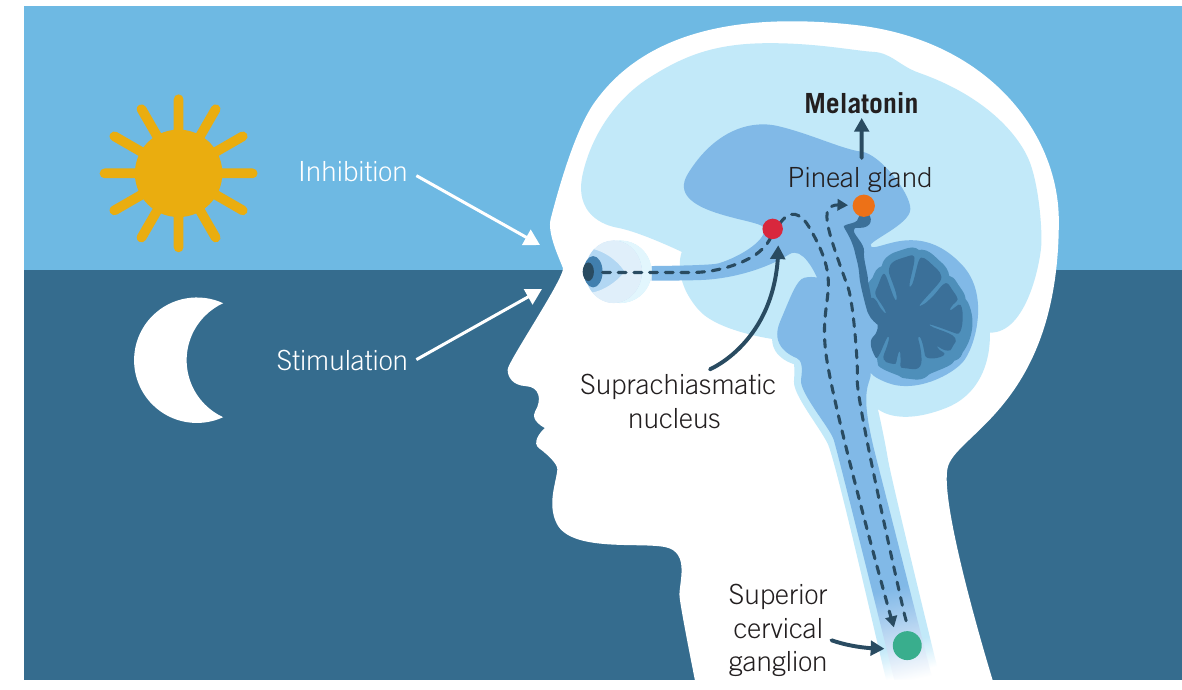
When the eyes detect low or no light (indicating night-time), the suprachiasmatic nucleus sends a signal to the pineal gland in the brain. This signal triggers the pineal gland to release melatonin into the bloodstream. The increased melatonin secretion at night-time induces sleepiness and decreases cellular activity, ensuring that sleep is connected to the night-time period.
Daytime: melatonin inhibition
When the eyes detect bright light (indicating daytime), the suprachiasmatic nucleus sends inhibitory signals to the pineal gland. These signals prevent the release of melatonin. Decreased melatonin levels increase cellular activity in the body, meaning a person does not feel drowsy, and wakefulness is promoted during daylight hours.
Note
This diagram illustrates the complete pathway: light enters the eye, travels to the suprachiasmatic nucleus, which then signals the pineal gland (via the superior cervical ganglion) to either release or inhibit melatonin depending on light conditions.
The 24-hour melatonin cycle
The circadian rhythm remains synchronised with the external environment through this light-dependent melatonin system, creating a stable cycle that promotes wakefulness during the day and sleep at night. This mechanism regulates when you sleep and wake up, though separate processes regulate how much you sleep.
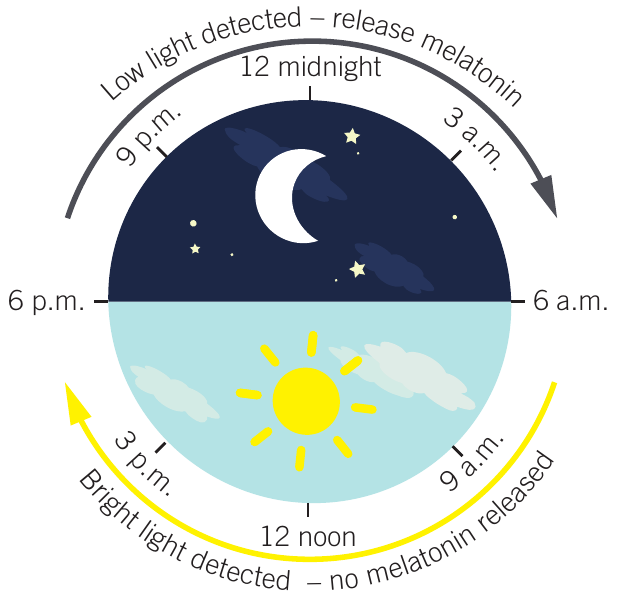
Note
The circular diagram shows how melatonin release follows the 24-hour day–night cycle. During night-time hours (approximately 9 p.m. to 3 a.m.), low light detection triggers melatonin release. During daylight hours (approximately 9 a.m. to 3 p.m.), bright light detection prevents melatonin release.
Melatonin regulation in different scenarios
The interaction between light detection, the suprachiasmatic nucleus, and melatonin production can be observed in various situations:
| Scenario | Suprachiasmatic nucleus | Melatonin | Effect on wakefulness |
|---|---|---|---|
| Driving at night | Detects low light | Increased melatonin secretion | Sleepiness |
| Getting up in the night with lights on | Detects bright light | Decreased melatonin secretion | Wakefulness |
| In bed during the day with a sleep mask | Detects low light | Increased melatonin secretion | Sleepiness |
| Flying in daylight | Detects bright light | Decreased melatonin secretion | Wakefulness |
Important
Key Insight: Light Detection, Not Time of Day
These examples demonstrate that melatonin secretion depends on light detection by the eyes, not simply on the time of day.
When the suprachiasmatic nucleus detects low light (even during daytime if wearing a sleep mask), it signals increased melatonin release, inducing sleepiness. Conversely, when it detects bright light (even at night-time), it inhibits melatonin release, promoting wakefulness.
Typical melatonin pattern over 24 hours
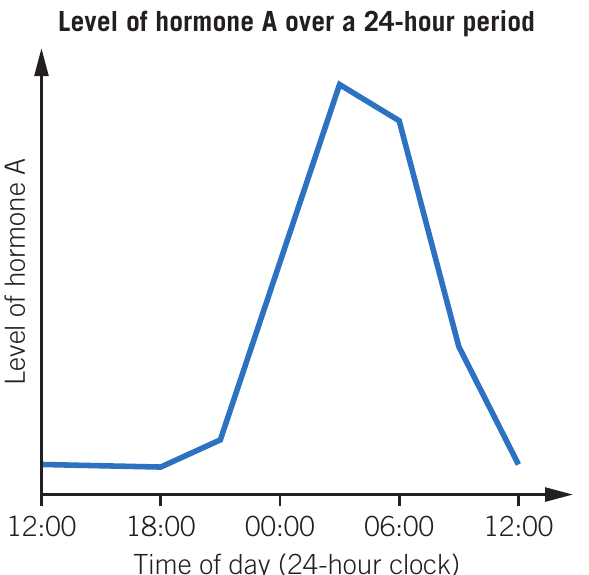
The graph displays the typical pattern of melatonin secretion over a 24-hour period. Melatonin levels:
- Remain low during afternoon and early evening hours (12:00–18:00)
- Begin rising sharply after sunset (18:00–21:00)
- Peak during the middle of the night (midnight–03:00)
- Gradually decline during early morning hours (03:00–09:00)
- Return to baseline low levels during the day (09:00–12:00)
This pattern demonstrates the strong circadian regulation of melatonin secretion in response to the day–night cycle.
Summary
Key Points to Remember:
-
Circadian rhythms coordinate body activities over a 24-hour period, controlling the overall sleep–wake cycle, hormone release, and body temperature
-
Ultradian rhythms coordinate body activities over periods shorter than 24 hours; each 90-minute sleep cycle within a sleep episode is an ultradian rhythm
-
The suprachiasmatic nucleus in the hypothalamus acts as the master body clock, synchronising all body rhythms and being particularly sensitive to light detected by the eyes
-
Melatonin is a hormone released by the pineal gland that induces drowsiness; its release is controlled by the suprachiasmatic nucleus based on light levels
-
When eyes detect low light, the suprachiasmatic nucleus signals the pineal gland to release melatonin, causing sleepiness; when eyes detect bright light, the suprachiasmatic nucleus inhibits melatonin release, promoting wakefulness