A Psychological Model of Stress (VCE SSCE Psychology): Revision Notes
📚Revision Notes
A Psychological Model of Stress
Introduction to the transactional model of stress and coping
The transactional model of stress and coping represents a shift from viewing stress as a purely biological response to understanding it as a psychological process. Developed by US psychologists Richard Lazarus and Susan Folkman in 1984, this model addresses a major limitation of Selye's General Adaptation Syndrome by recognising that individuals respond differently to the same stressor.
The model is termed 'transactional' because it focuses on the interaction between an event (the stressor) and the individual experiencing it. Rather than assuming all stressors trigger the same universal response, this model proposes that whether something produces stress depends on how the individual perceives and evaluates the situation. The stress response only occurs if a person believes the stressor may exceed their available resources to cope with it.
This psychological approach emphasises personal perception and cognitive processes in determining stress. Two people may face identical situations—such as failing an exam or going through a relationship breakup—yet one person may experience it as devastatingly stressful whilst the other views it as a manageable challenge. The difference lies in their appraisal of the situation.
Important
Appraisal refers to the process of categorising an event based on its perceived significance and how it may affect our wellbeing. The transactional model proposes that we engage in two distinct forms of appraisal when encountering a potential stressor: primary appraisal and secondary appraisal.
Primary appraisal
Primary appraisal is the initial evaluation stage where an individual determines whether a situation or event holds significance for them. During this cognitive process, we ask ourselves questions such as "Is this event significant?", "Is this something I have to deal with?", and "Does this matter to me?" Based on this assessment, we categorise the event as either stressful or not stressful.
Non-stressful categorisations
If we determine that an event is not stressful, it will be further classified into one of two categories:
Note
Irrelevant: An event is considered irrelevant when it has no implications for our wellbeing. Nothing is to be gained or lost, and we have no investment in the situation. For example, if a school assessment date is changed for a subject you do not study, this event is irrelevant to you because it does not affect your circumstances in any way. Events judged as irrelevant require no further appraisal or coping response.
Note
Benign/positive: An event falls into this category when its outcome is perceived as positive. Such situations either maintain our wellbeing (benign) or actively enhance it (positive). These experiences are accompanied by pleasurable emotions such as joy, love, and happiness. For instance, if you move house and are pleased because you now live closer to school and have a shorter commute, you would appraise this as benign/positive. Like irrelevant events, benign/positive situations do not require further appraisal because they pose no threat to wellbeing.
Stressful categorisations
If an event is deemed stressful during primary appraisal, it will be further categorised according to the nature of the stress:
Note
Threat: A threat appraisal occurs when we anticipate harm or loss in the future as a result of the event. This category is characterised by emotions such as fear, anxiety, and apprehension. For example, if you fail a Psychology assessment, you might appraise this as a threat because you worry that you will not achieve the study score you need for university entrance. The harm has not yet occurred, but you fear potential future consequences.
Note
Harm/loss: This category applies when damage to the individual has already occurred. Harm/loss appraisals are accompanied by emotions such as sadness, despair, or anger. Using the same example of failing an assessment, you might appraise this as harm/loss if you focus on the fact that you have already lost valuable marks that could have contributed to your final study score. The damage is in the past and cannot be undone.
Note
Challenge: When an event is perceived as having potential for personal gain or growth, it is appraised as a challenge. This appraisal is characterised by positive emotions such as eagerness, excitement, and exhilaration. For instance, you might view failing an assessment as an opportunity to develop better study skills and improve your learning strategies. Whilst still stressful, challenge appraisals have a more optimistic outlook than threat or harm/loss appraisals.
Important
These categories are not mutually exclusive. An event may be appraised as both a threat and harm/loss, or as a combination of different categories. For example, a divorce might involve both harm/loss (the relationship has ended) and threat (worry about future financial stability and dating prospects).
Once an event has been established as stressful through primary appraisal, the individual moves to the second stage of evaluation: secondary appraisal.
Secondary appraisal
Secondary appraisal is the process where an individual considers their available resources and personal coping strategies to decide the best way of dealing with the stressor. During this stage, we ask ourselves questions such as "What, if anything, can be done?", "How am I going to deal with this?", and "What do I need to do to cope?"
In secondary appraisal, we evaluate whether our coping resources are adequate or inadequate to manage the stressor.
Note
Coping resources might include:
- Personal skills and abilities
- Social support from friends and family
- Financial resources
- Knowledge and experience
- Time availability
- Physical health and energy
The outcome of secondary appraisal determines the level of stress experienced:
Adequate coping resources: If we judge that our resources are sufficient to handle the situation, stress is minimised or managed. We feel confident in our ability to cope, which reduces the negative impact of the stressor. For instance, if you fail an assessment but have strong study skills, supportive friends, and time to improve before the next test, you may feel the stress is manageable.
Inadequate coping resources: If we determine that our resources are insufficient to deal with the stressor, stress is heightened and the person experiences greater distress. This occurs when the perceived demands of the situation exceed our perceived ability to cope. Using the same example, if you lack effective study strategies, have no one to turn to for help, and feel overwhelmed by competing demands, the stress becomes more intense.
Important
The transactional model recognises that appraisal is a dynamic process. After enacting a coping strategy, individuals can reappraise the outcome to determine its success and modify their approach if needed. This flexibility means that stress responses can change over time as circumstances evolve or as individuals develop new coping skills.
By improving coping skills or helping individuals reappraise stressors in a more positive light, the transactional model suggests it is possible to avoid negative stress responses. This makes the model particularly valuable for developing stress management interventions.
Explanatory power of the transactional model
Lazarus and Folkman's transactional model was groundbreaking as one of the first frameworks to explain stress as a psychological process rather than purely a biological response. However, like all psychological models, it has both strengths and limitations that affect its explanatory power.
Strengths of the model
The transactional model offers several important advantages in understanding stress:
Note
Acknowledges psychological determinants: The model recognises that cognitive processes—specifically, how we think about and evaluate situations—play a central role in our experience of stress. This cognitive emphasis helps explain why stress is such a complex and varied phenomenon, moving beyond simplistic stimulus-response explanations.
Note
Emphasises individuality: The model accounts for why individuals respond so differently to the same event, which biological models struggle to explain. This recognition of individual differences makes the model more applicable to real-world situations where identical stressors produce vastly different outcomes for different people.
Note
Active role in stress response: The model suggests that individuals have an active role in their own stress response. Because stress involves an interaction with the environment rather than a passive reaction, people can learn to manage their stress more effectively. This empowering perspective has led to the development of cognitive-based stress management techniques that help people reappraise situations and build coping skills.
Note
Flexibility and change over time: The model recognises that stressors and circumstances can evolve, and that our thinking about a stressor and our response to it can also change. This temporal dimension makes the model more realistic and applicable to chronic or ongoing stressful situations.
Limitations of the model
Despite its strengths, several criticisms have been made of the transactional model:
Important
Difficulty of experimental testing: A primary limitation is the difficulty of testing the model through experimental research due to the subjective nature of individual stress responses. Since appraisals are internal cognitive processes that vary between individuals, it is challenging to design controlled experiments that can measure these processes reliably or that would apply to larger populations. This makes it harder to gather empirical evidence supporting the model.
Important
Lack of conscious awareness: Individuals may not always be consciously aware of all the factors causing them stress or the thought processes occurring when they experience stress. This lack of conscious awareness means that self-report measures—often used to assess appraisal—may not capture the full picture of how people evaluate stressors.
Important
Narrow cognitive focus: The model is narrowly focused on cognitive processes, which means it does not adequately account for physiological variations in individual responses to stress. Whilst it recognises that perception matters, it largely ignores the biological factors that also influence how we experience and respond to stressors.
Important
Ignores sociocultural factors: The model does not account for external sociocultural factors such as race, socio-economic status, or education level, which can significantly influence both the stressors people face and their available coping resources.
Important
Oversimplifies the appraisal process: Research has shown that the model does not always allow for individual variation in progression through its stages. Primary and secondary appraisals have been found to interact with one another and often occur simultaneously rather than sequentially. This means the neat stage-by-stage process depicted in the model may oversimplify what is actually a more complex and interrelated set of cognitive evaluations.
Application: Using flow charts to represent the appraisal process
Because the steps involved in primary and secondary appraisal are complex, flow charts provide a useful tool for visualising and understanding the process. Flow charts help track how an individual moves through different stages of appraisal and how various factors influence the final stress outcome.
To illustrate how the transactional model applies to real-life situations, consider the following scenario:
Example
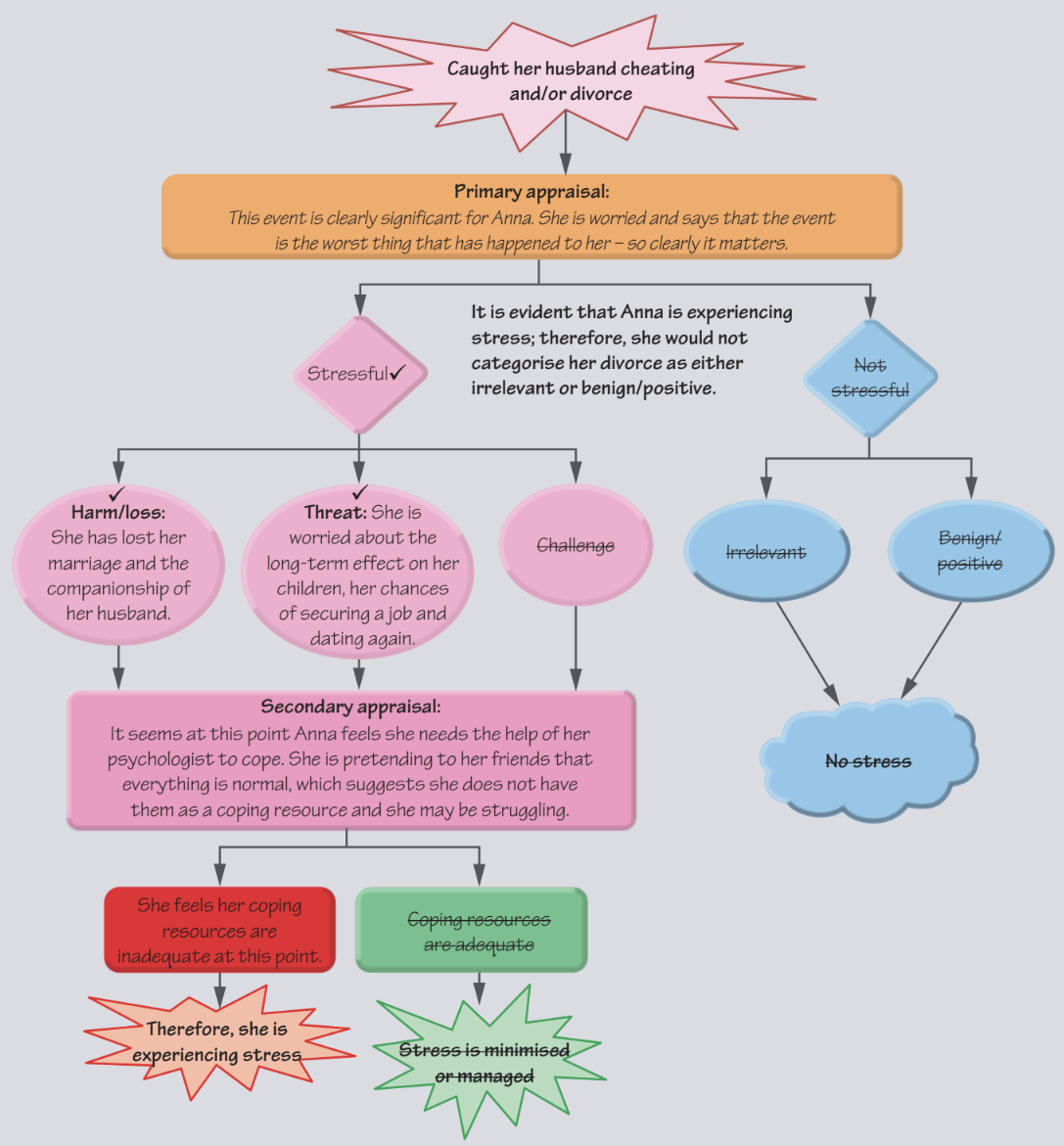
Worked Example: Anna's Divorce — Applying the Transactional Model
The Scenario: Anna is a 40-year-old woman who was married for 15 years. Her husband was the CEO of a large company whilst Anna was a stay-at-home mother. Anna's husband liked to spoil her with gifts, and she enjoyed living an extravagant lifestyle. Last year, Anna discovered that her husband was having an affair, and they are now going through a divorce. In her psychologist appointments, Anna describes her divorce as the worst thing that has ever happened to her. She is worried about the long-term effect it will have on her children, her chances of securing employment, and dating again. When Anna encounters her friends, she pretends that she is still happily married because it is easier than admitting the truth.
Step 1: Primary appraisal in Anna's case
The triggering event for Anna is catching her husband cheating and going through a divorce. In primary appraisal, Anna must assess whether this event is significant to her. The evidence clearly indicates that Anna deems this event highly significant and stressful. She describes the divorce as "the worst thing that has ever happened to her" and is visibly worried about multiple aspects of her future. This means Anna would not categorise the event as either irrelevant or benign/positive—both of which would result in no stress.
Instead, Anna's appraisal falls into the stressful categories. Specifically, she experiences both harm/loss and threat:
- Harm/loss: Anna has lost her marriage and the companionship of her husband. This damage has already occurred and cannot be undone, which explains the emotions of sadness and despair she might feel.
- Threat: Anna anticipates future harm, worrying about the long-term effects on her children, her job prospects (having been out of the workforce), and her ability to date again. These are anticipated losses that have not yet occurred but cause anxiety and apprehension.
The scenario does not suggest Anna views the divorce as a challenge—an opportunity for personal growth—at least not at this stage of her adjustment.
Step 2: Secondary appraisal in Anna's case
Having established that the divorce is stressful in primary appraisal, Anna must now assess her coping resources in secondary appraisal. She needs to evaluate whether she has adequate resources to deal with this situation.
The evidence suggests Anna's coping resources are inadequate at this point:
- She is seeing a psychologist, indicating she needs professional help to cope
- She is lying to her friends about her marital status, which means she is not accessing their potential support
- By depriving herself of social support from friends, she has reduced her available coping resources
Outcome: Since Anna judges her coping resources as inadequate, the model predicts that she is experiencing heightened stress. If Anna could develop better coping strategies—such as being honest with friends, building new skills for employment, or reappraising the divorce more positively—her stress might be reduced. This demonstrates how the transactional model provides a framework for understanding not just why people experience stress, but also how interventions might help reduce it.
Investigation methodologies for studying the transactional model
The transactional model of stress and coping can be investigated using various research methodologies, each offering different insights into how the model operates in practice:
Controlled experiments could test whether thinking about stress more positively influences coping ability, manipulating the independent variable (type of stress appraisal) whilst measuring the dependent variable (coping effectiveness) under controlled conditions.
Case studies might involve in-depth interviews with individuals about stressful events, using carefully designed questions to gain insight into their primary and secondary appraisals. This qualitative approach captures the subjective, personal nature of the appraisal process.
Classification and identification research could involve collecting data on people's primary appraisals and categorising them as benign/positive, irrelevant, harm/loss, threat, or challenge, then calculating the proportion of people using each type of appraisal.
Correlational studies might explore the relationship between positive primary appraisals (such as viewing something as a challenge) and perceived ability to cope in secondary appraisal, helping to understand which appraisals lead to better coping outcomes.
Fieldwork in natural settings, such as schools, could examine how VCE students appraise different stressors and how these appraisals affect their performance, providing ecologically valid data.
Literature reviews can evaluate the explanatory power of the transactional model by collating secondary data that either supports or contradicts its predictions, helping to identify strengths and weaknesses in the model.
Modelling and simulation techniques, such as creating simulated stressful events using virtual reality, could investigate the subjective nature of appraisal in controlled yet realistic environments.
Product, process, or system development might involve designing interventions such as chatbots or phone apps to help people alter their cognitive perceptions of stressful events, assisting them in reappraising situations to cope more successfully.
Note
Each methodology offers unique advantages and limitations for investigating how people appraise and cope with stress, contributing to our overall understanding of this psychological process.
Remember!
Summary
Key Points to Remember:
-
The transactional model views stress as an interaction between an event and the individual's perception of it, not as a universal biological response
-
Primary appraisal involves evaluating whether an event is significant and categorising it as either not stressful (irrelevant or benign/positive) or stressful (threat, harm/loss, or challenge)
-
Secondary appraisal involves assessing available coping resources to determine if they are adequate or inadequate for managing the stressor
-
The model's strengths include recognising individual differences, emphasising cognitive processes, and suggesting that stress can be managed by changing appraisals or building coping skills
-
Key limitations include difficulty testing the model experimentally, narrow focus on cognition whilst ignoring physiological and sociocultural factors, and oversimplification of the appraisal process as sequential stages