The Process of Psychological Development: Emotional Development (VCE SSCE Psychology): Revision Notes
📚Revision Notes
The Process of Psychological Development: Emotional Development
Introduction to psychological development
Psychological development is an ongoing process that begins at conception and continues throughout life. This development occurs across several distinct life stages: infancy (0-2 years), childhood (2 years to puberty), adolescence (puberty to 18 years), adulthood (18-65 years), and old age (65+ years).
Psychologists categorise psychological development into three interconnected areas:
- Emotional development
- Social development
- Cognitive development
Note
Whilst theories often examine these areas separately, it is important to recognise that they interact with and influence one another throughout development. This interconnection means that theories focusing on just one area have inherent limitations.
What is emotional development?
Emotional development refers to the ongoing process through which individuals learn to experience, understand, express, and regulate the full range of emotions effectively. This developmental area is essential for navigating and understanding the world around us.

Strong emotional development enables children to:
- Build and maintain relationships
- Develop social awareness
- Make responsible decisions
These skills subsequently influence success across multiple contexts, including school, home, and broader community and societal interactions.
Emotional development across the life span
Emotional capabilities and characteristics change substantially as individuals progress through different life stages. The table below illustrates key examples of emotional development at each stage:
Infancy (0-2 years)
During infancy, basic emotional expressions begin to emerge. Infants start smiling and frowning at approximately 8 weeks of age, with laughter developing around 3-4 months. By 6 months, infants can express a variety of emotions including delight, fear, anger, and disgust. As they approach their second year, affection and jealousy become evident in their emotional repertoire.
Childhood (2 years to puberty)
The childhood period sees the emergence of rage through temper tantrums, typically appearing around 2-3 years of age. During this time, children begin labelling their own emotions and recognising these same emotions in others. By middle childhood, they develop an understanding that different situations affect emotions differently and that emotional responses vary between individuals. Older children also develop empathy and helping behaviours.
Note
The development of empathy and helping behaviours in childhood forms the foundation for more complex social relationships and moral reasoning that emerges in later developmental stages.
Adolescence (puberty to 18 years)
Adolescents demonstrate reduced emotional dependence on their parents and tend to experience emotions more intensely, both negative and positive. When confronting increasingly complex social challenges, adolescents often rely on stable peer groups to help manage their emotions. Identity development becomes particularly important during this period as adolescents explore different options and develop greater self-understanding in preparation for adulthood.
Adulthood (18-65 years)
Early adulthood involves establishing a stable sense of identity, which leads to increased empathy and improved emotion management. Adults make important decisions regarding careers and living arrangements, with these choices having profound effects on self-perception and emotional wellbeing. Developing intimate relationships, marriage, and family formation typically occur during early adulthood. Some middle-aged adults experience a "mid-life crisis" when they perceive they have not achieved their life goals, resulting in dissatisfaction.
Old age (65+ years)
Older adults demonstrate greater emotional calmness, improved emotion management, and enhanced ability to negotiate social situations. They possess greater emotional wisdom, shown through increased empathy and understanding of others. Compared to younger adults, older individuals tend to focus more on positive rather than negative information.
Note
A sense that time is limited may enhance older adults' gratitude and present-moment awareness, whilst reducing their focus on maximising future rewards. This shift in temporal perspective represents an adaptive emotional strategy that contributes to greater life satisfaction in later years.
Emotional development: relevant models and theories
The importance of attachment
An integral component of early emotional development is the formation of attachment. Attachment is a close, social, and emotional bond between an infant and their caregivers. Understanding how attachments form and why they are necessary for healthy emotional development has been a major focus of psychological research.

Three theorists have made particularly prominent contributions to attachment research: John Bowlby, Harry Harlow, and Mary Ainsworth.
John Bowlby's evolutionary theory of attachment
Background and research context
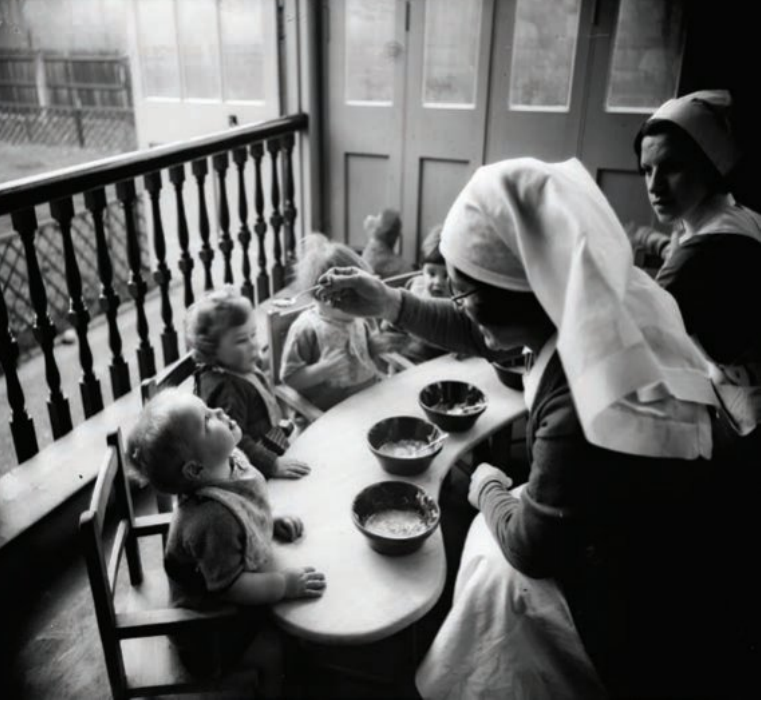
John Bowlby developed his influential attachment theory based on his work as a psychiatrist in London during the 1930s, where he treated emotionally disturbed children. Bowlby was particularly affected by cases of children who were isolated, distant, and affectionless. Through extensive research across multiple studies, he examined children who had been deprived of a stable mother figure (or caregiver) during their first few years of life.
Key findings
Important
Bowlby's research established that children deprived of a stable caregiver during early life showed several negative outcomes:
- Increased likelihood of developing mental disorders such as depression
- Reduced IQ scores compared to control groups
- Greater levels of antisocial behaviour and delinquency
- More abnormal social interactions
- Potential inability to form healthy attachments with their own offspring
These findings highlighted the critical importance of consistent caregiving in early childhood for long-term mental health and social functioning.
Main propositions of the theory
From his research findings, Bowlby concluded that infants require a warm, intimate, and continuous relationship with a caregiver to develop mental health and emotional wellbeing. The attachment figure serves as a "safe base for exploration" - a secure point to which the child can periodically return for emotional support. This pattern is observable when toddlers at play periodically look up to locate their attachment figure, run to them briefly for comfort, then return to playing.
Bowlby proposed that the need to form attachments is innate (inborn) and evolutionarily adaptive, enhancing the infant's chances of survival. He suggested that attachment has a strong biological basis, with infants being programmed to display specific behaviours - such as smiling, cooing, and clinging - that elicit affectionate, protective responses from adults. Bowlby further proposed that adults are innately drawn to these infant behaviours because of evolutionary forces, leading them to provide warmth, security, and care.
Note
Bowlby's evolutionary perspective on attachment suggests that both infant attachment behaviours and adult caregiving responses have been naturally selected because they increased survival rates throughout human evolutionary history.
Harry Harlow's work on infant-mother attachment
Aim
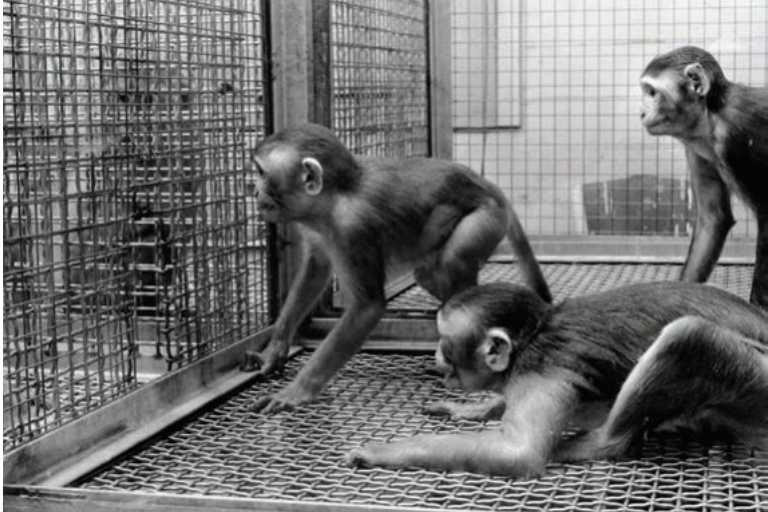
Concurrent with Bowlby's theoretical development, Harry Harlow (1958) conducted experimental research on attachment using rhesus monkeys. His experiments investigated the factors influencing attachment development between infant monkeys and their mothers. One famous experiment specifically examined the role of food provision (breastfeeding) in forming infant-mother attachments.
Procedure
Example
Harlow's Wire vs Cloth Mother Experiment
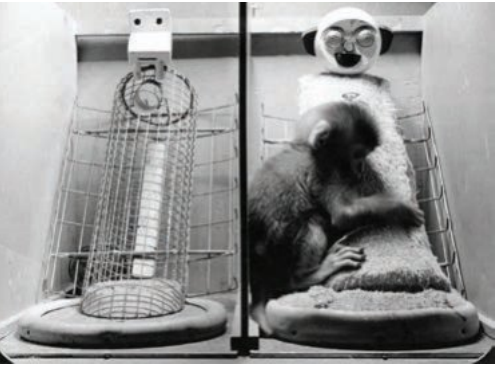
Setup: Eight infant rhesus monkeys were separated from their mothers at birth and reared individually in cages. Each cage contained two surrogate (substitute) mothers of roughly the same size and shape as a real rhesus monkey mother.
The two surrogates:
- One covered in towel-like cloth fabric
- One left uncovered, exposing bare wire
- A feeding bottle was attached to one surrogate in the location where a natural mother's breast would be
Conditions: The infant monkeys were assigned to one of two conditions:
- Half the cages: cloth mother provided milk through the feeding bottle
- Other half: wire mother provided milk
Initial prediction: Harlow predicted that infant monkeys would prefer and become attached to whichever surrogate provided milk, as he initially believed infant-mother attachment was based primarily on feeding.
Findings
The results contradicted Harlow's initial predictions. In both conditions, infant monkeys spent considerably more time clinging to or cuddling the cloth surrogate than the wire mother. When the wire mother provided food, infant monkeys would approach her only to feed, then immediately return to cling to the cloth surrogate.
Further observations revealed additional evidence for the importance of contact comfort. When placed in novel and frightening situations, infant monkeys turned to their surrogate mothers for comfort. With a surrogate present in a new environment, infants would initially explore but run back to the surrogate when startled. Without a surrogate present, infants were paralysed with fear, with some huddling in balls and sucking their thumbs. Similarly, when confronted with an alarming, noisy, monster toy, infant monkeys with a surrogate present would explore and attack the toy, whilst those without a surrogate would cower in fear.
Conclusions
Important
These results led Harlow to conclude that the "contact comfort" provided by the cloth surrogate was more important than feeding in forming infant-mother attachments in rhesus monkeys. Based on these findings, he proposed that contact comfort was also likely to be an important factor in human infant-caregiver attachment formation.
This challenged the prevailing belief that attachment was primarily based on feeding and highlighted the fundamental importance of physical comfort and closeness in bonding.
Mary Ainsworth's types of attachment
Background and the strange situation
Mary Ainsworth (1970) built upon Bowlby's work by examining separation anxiety in detail. She observed that when caregivers need to leave, infants experience distress demonstrated through loud protests, agitation, and crying. Ainsworth proposed that these behaviours clearly indicated that attachment had formed between infant and parent.
To observe different attachment styles, Ainsworth developed an experimental procedure called the "strange situation". This involved mothers and infants aged 12-18 months in a small room equipped with a transparent mirror serving as an observation window, allowing discrete observation of behaviours.
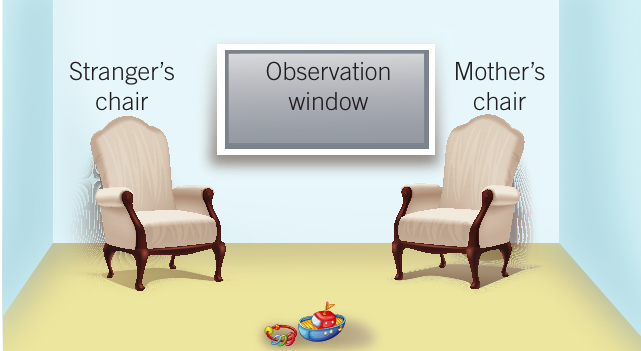
The procedure consisted of eight episodes, each lasting approximately three minutes:
- Mother, baby, and experimenter together in room (less than one minute)
- Mother and baby play alone
- A stranger joins mother and infant
- Mother leaves infant and stranger alone
- Mother returns and stranger leaves
- Mother leaves and infant is left completely alone
- Stranger returns
- Mother returns and stranger leaves
Types of attachment identified
Through the strange situation experiments, Ainsworth initially identified three distinct attachment patterns:
Secure attachment (Type B) - 65% of attachments
Note
Infants with secure attachment play and explore comfortably when their caregiver is present, using them as a secure base. They become quite upset when the caregiver leaves and are not easily comforted by strangers. However, these infants quickly calm down when their caregiver returns, and overall cry less than other attachment types.
This attachment pattern develops when caregivers respond to infants appropriately and consistently, so infants learn their caregiver will always be available and responsive.
Insecure-resistant attachment (Type A) - 10% of attachments
Note
These infants appear quite anxious whilst playing, even with their caregiver nearby. They become angry when caregivers leave and are not particularly comforted upon their return. Rather than using their caregiver as a base for exploration, they tend to cling.
This attachment pattern typically develops when caregivers are inconsistent in responding to the infant's needs.
Insecure-avoidant attachment (Type C) - 25% of attachments
Note
Infants showing this pattern seek little contact with their caregiver during play and show minimal distress when they depart. When reunited with caregivers after brief separations, these children may be quite distant and avoid contact. They are equally comfortable with their caregiver or a stranger and cry frequently.
This attachment style typically develops when caregivers are inconsistent in appropriately responding to infant needs - sometimes very caring but sometimes dismissive.
Additional attachment type
Important
Later research by Main and Solomon (1990) identified a fourth attachment style: insecure-disorganised attachment. Children with this attachment exhibit odd or contradictory behaviour towards their caregivers, such as first running up to them but then immediately pulling away, running away from the caregiver, curling up in a ball, or hitting the caregiver.
These children's instinct is to seek comfort, but they feel fear as they approach their caregiver, demonstrating the disorganised nature of their attachment. This pattern is often seen in individuals who experienced physical, verbal, or sexual abuse during childhood. In adulthood, these individuals tend to be extremely inconsistent in their behaviour and have difficulty trusting others. Insecure-disorganised attachment has been identified as a risk factor for developing mental health disorders.
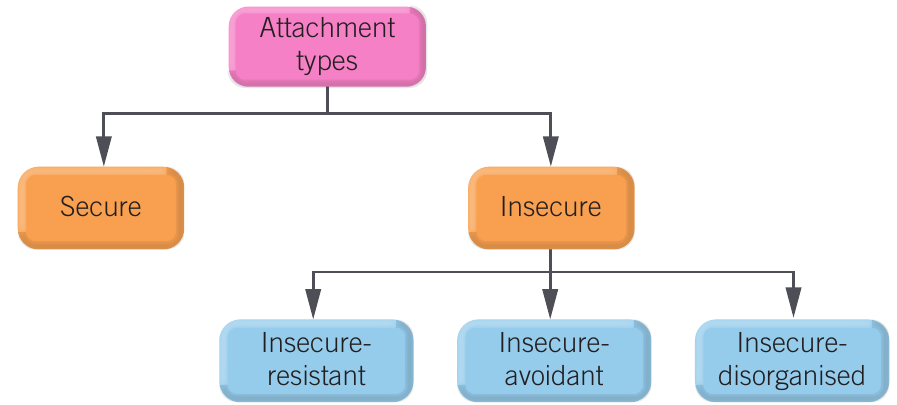
Ainsworth concluded that these attachment styles result from early interactions between infants and caregivers, with caregiver responsiveness patterns shaping the type of attachment that develops.
Remember!
Summary
Key Points to Remember:
-
Emotional development is lifelong: Changes in how we experience, understand, express, and manage emotions occur from infancy through old age, with each stage showing distinct emotional characteristics.
-
Attachment is foundational: The formation of close emotional bonds between infants and caregivers is essential for healthy emotional development and influences relationship patterns throughout life.
-
Multiple factors shape attachment: Bowlby emphasised the evolutionary and innate basis of attachment behaviours, whilst Harlow demonstrated that contact comfort matters more than feeding, and Ainsworth showed how caregiver responsiveness determines attachment quality.
-
Attachment styles vary: Secure attachment (65%) results from consistent, appropriate caregiver responses; insecure-resistant (10%) from inconsistent responses; and insecure-avoidant (25%) from inconsistent appropriate responses. A fourth style, insecure-disorganised, is associated with childhood abuse.
-
Development areas interconnect: Whilst emotional, social, and cognitive development are studied separately, they interact with and influence one another throughout the life span, meaning single-domain theories have inherent limitations.