Criteria Used to Categorise Typical and Atypical Behaviour (VCE SSCE Psychology): Revision Notes
📚Revision Notes
Criteria Used to Categorise Typical and Atypical Behaviour
Introduction: understanding typical and atypical behaviours
When psychologists assess whether behaviour is typical or atypical, they must first understand what we mean by normal. This is not always straightforward, as definitions of normality vary based on subjective ideas and individual perspectives. What we consider typical behaviour can be influenced by various factors, including cultural perspectives and social norms.
Note
The concept of "normal" behaviour is complex and multifaceted. There is no single, universal definition that applies across all contexts, cultures, and situations. What is considered normal in one setting may be viewed as abnormal in another.
Typical development
Typical development occurs when a child's behaviours, skills or abilities fall within the expected range of development or progress at a similar pace compared to peers of the same age. This represents what we understand as "normal" when it comes to reaching developmental milestones.
Example
Developmental Milestones: Examples of Typical Development
- Most babies start to crawl between 6 and 12 months of age
- Children usually speak their first word between 10 and 14 months of age
When children develop within these expected timeframes, they are experiencing typical development.
Typical behaviours
Typical behaviours refer to patterns of behaviour that are expected of an individual or that conform to standards of what is acceptable for a given situation. These behaviours align with what society or a particular context deems appropriate.
Examples of typical behaviours include:
- Being quiet and sombre at a funeral rather than upbeat and joyous
- Asking permission to use the toilet during class time (but not during break times)
- Following established social customs in your cultural context
Atypical development
Atypical development occurs when behaviours, skills or abilities fall outside the expected range of development or progress at a different pace compared to similar-aged peers. For instance, if a child has not spoken their first word by 18 months of age, this could suggest that their language development is atypical, indicating that diagnosis, management and support for the child and their family may be needed.
Note
Sometimes atypical behaviours, such as a delay in speech, are isolated events that have little or no impact on later development. However, at other times they are an early sign of considerable developmental differences, such as those seen with autism spectrum disorder.

Atypical behaviours
Atypical behaviours are patterns of behaviour that are not expected for an individual or that deviate from the norm and can be harmful or distressing for the individual and those around them. These types of behaviours tend to violate what society feels is appropriate and can include a wide range of behaviours, from excessive violence or aggression to social withdrawal or self-harm.
Example
Distinguishing Typical from Atypical: The Case of Daydreaming
It is estimated that we spend up to half of our waking lives daydreaming, making it a common and typical cognitive process.
However, there is a rare mental health problem called maladaptive daydreaming, which is a dysfunctional form of imaginative involvement characterised by excessive, vivid daydreaming for hours on end. This often causes the individual to:
- Neglect real-life relationships and responsibilities
- Experience distress and impairment in social functioning
- Suffer from impairment in occupational functioning
This demonstrates how the same behaviour (daydreaming) can be typical in moderation but atypical when excessive.
Psychological criteria for categorising behaviour
Psychologists use a broad set of criteria to determine whether an individual's behaviour is typical (and therefore normal) or atypical (and therefore abnormal). These criteria can be used both in the context of development to determine whether a child is developing typically, and in the context of mental wellbeing to assess whether an individual requires management or treatment.
Important
The Multi-Criteria Approach
Psychologists usually assess an individual's behaviours using a multi-criteria approach. Before categorising a behaviour as atypical and diagnosing someone with a mental disorder, they consider the complete set of criteria together, rather than relying on just one criterion.
This approach is essential because no single criterion is sufficient on its own to determine whether behaviour is truly atypical or problematic.
The five main criteria used by psychologists are:
- Cultural perspectives
- Social norms
- Statistical rarity
- Personal distress
- Maladaptive behaviour
Cultural perspectives
Cultural perspectives involve using cultural norms or standards to determine whether behaviours are acceptable or typical for a certain culture. This criterion recognises that what is often viewed as normal, acceptable or typical behaviour in one culture can be considered atypical in another.
Examples of cultural variations in typical behaviour:
- Displays of affection: Overt displays of affection in public are typical in many Western cultures, but in Muslim, Asian and other cultures, such displays are generally not socially acceptable.
- Eye contact: In many cultures, including Hispanic, Asian and Middle Eastern cultures, making eye contact is thought to be disrespectful or rude. In Western cultures, however, a lack of eye contact suggests that a person is not paying attention or is uninterested.
- Polygamy: In some African cultures, having multiple wives is commonly accepted, whereas this is socially unacceptable and even illegal in many Western cultures.
- Table manners: Chewing with your mouth open is considered good etiquette in some Asian cultures, but it is seen as impolite in Western cultures. Making slurping sounds with noodles is expected in Japan but frowned upon in Western cultures. Burping at the table is a sign that you enjoyed your meal in some cultures but is considered unpleasant or rude in Western cultures.

Note
Despite cultural variations, cultural perspectives are useful as they provide a broad understanding of social norms and standards for appropriate behaviours within a specific country or culture. They can also provide individual members of the country or culture with guidelines about what is considered acceptable or typical behaviour and what behaviour is unacceptable or atypical.
Limitations of using cultural perspectives
Important
Key Limitations of Cultural Perspectives:
-
No universal agreement: What is considered typical or atypical behaviour differs from one country or culture to another, so there is no universal standard that can be applied globally.
-
Cultural diversity within countries: Within certain countries, there is considerable cultural diversity. Therefore, there may be many different and conflicting ideas about what should be considered acceptable or typical behaviour, even within a single nation.
-
Difficulty distinguishing atypical from unconventional: It may be difficult to differentiate between behaviour considered atypical or abnormal and behaviour that is simply unusual or unconventional but not necessarily problematic.
Social norms
Social norms are shared standards or social beliefs about what is normal, acceptable or typical behaviour. These norms can be informal understandings or formal rules and laws. Norms generally function to provide order and predictability in society.
Examples of social norms include:
- Shaking hands when you meet someone
- Being kind to the elderly, such as by opening doors for them or giving up your seat on public transport
- Going to the end of a queue rather than pushing to the front
- Apologising if you accidentally hit or bump into someone
- Turning around to face the doors when in a lift
- Wearing a seatbelt when driving (a legal requirement)
Overall, people want approval and they want to belong. When an individual violates a social norm, their behaviour is considered abnormal or atypical. If a behaviour deviates sufficiently from accepted social standards, values and norms, then the behaviour is deemed abnormal or atypical. Often, severe violations of a social norm, such as aggressive acts that harm others, cannot be understood by most in society and can cause individuals great discomfort.
Limitations of using social norms
Important
Key Limitations of Social Norms:
-
No universal agreement: There is no universal agreement about social norms, as they can differ considerably between individuals and groups, even within the same culture.
-
Social norms change over time: Social norms evolve alongside changes in society itself. Therefore, behaviour that was once seen as atypical may in time become acceptable, and vice versa. For example, drink driving was acceptable in the 1970s but is now not only socially unacceptable but illegal. Conversely, as recently as 1987, homosexuality was listed as a psychological disorder in the DSM, and being homosexual was illegal in some Australian states until as late as 1997. Now, same-sex couples can legally marry.
-
Context-dependent: Social norms can change depending on the situation or context. For example, cannibalism would usually be considered atypical and is illegal, but in 1972, survivors of a plane crash in the Andes mountains who were trapped for 72 days resorted to cannibalism to survive. Given the extreme situation, there is general agreement that what these people did was not atypical or illegal – the context made it acceptable.
The Diagnostic and Statistical Manual of Mental Disorders (DSM)
Note
Understanding the DSM
The Diagnostic and Statistical Manual of Mental Disorders (DSM) is a handbook widely used around the world by general practitioners (GPs), psychologists and psychiatrists to diagnose psychiatric illnesses. It is published by the American Psychiatric Association (APA) and covers all categories of mental health disorders for both adults and children.
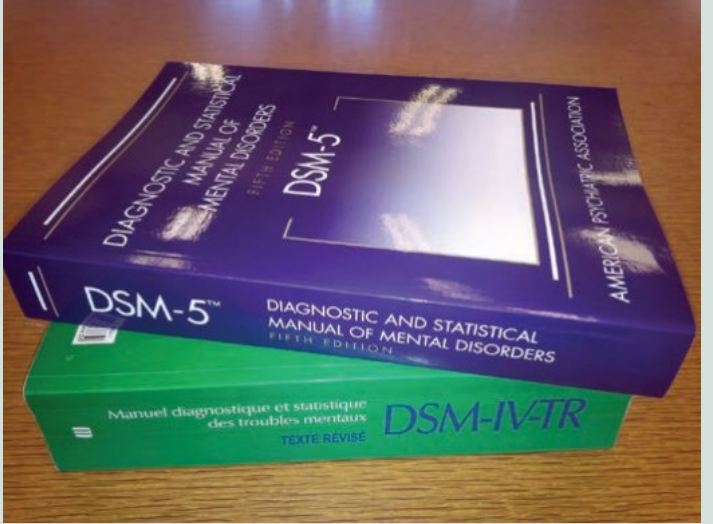
The DSM contains:
- Descriptions of mental health disorders
- Symptoms and diagnostic criteria
- Statistics such as typical age of onset
- Effects of treatment and common treatment approaches
The DSM has been updated numerous times since it was first published in 1952, with each revision involving changes. For example, when the DSM-5 was released, four separate autistic disorders that had been listed in the fourth edition, including Asperger's syndrome, were combined into a single illness: autism spectrum disorder. A new edition titled DSM-5-TR was released in 2022.
Statistical rarity
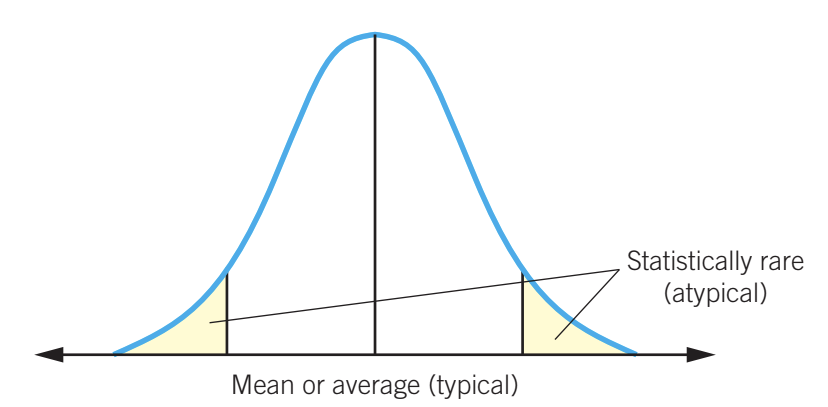
According to the criterion of statistical rarity, behaviours that are considered abnormal or atypical deviate considerably from the statistical average or mean. In other words, they are statistically rare. Behaviours that are common or that most people engage in are therefore considered normal or typical.
For example, if most people drive or take public transport to work rather than riding a bike or walking, driving or taking public transport would be the typical behaviour, and riding or walking would be atypical.
The normal distribution curve
The statistical approach is based on a normal distribution curve. If any behaviour of a very large group of individuals is measured and plotted as a graph, the data will tend to fall in a bell shape, as shown below.
Note
On the normal distribution curve, normal or typical behaviour is generally considered to fall in the middle area closest to the average, whereas any behaviour that is atypical or abnormal falls outside this area at each end.
Example
Applying the Normal Distribution: Sleep Patterns
If this graph represented how many hours of sleep students get on average per night during a school term:
- Students who sit closest to the average of 7 hours (between a range of 5.5 and 8.5 hours) would be getting a typical amount of sleep
- Students who fall outside this range – getting less than 5.5 hours or more than 8.5 hours on average – would be getting an atypical amount of sleep
Limitations of using statistical rarity
Important
Key Limitations of Statistical Rarity:
-
Common behaviours can still be problematic: Many statistically rare behaviours or characteristics are regarded as atypical or abnormal, even though they are quite frequent or common. For example, 26.3% of Australians aged 16–85 have experienced an anxiety disorder, which makes it common. However, that does not mean having anxiety is not a problem.
-
Subjective cut-off points: The decision of where the cut-off point for atypical or statistically rare behaviour sits is subjective. Who makes this decision? How do they decide? For example, if an IQ of 70 is the cut-off point for statistical normality, how can we justify that someone with an IQ of 69 is statistically abnormal whilst someone with an IQ of 70 is not?
-
Both ends of the curve treated equally: When viewing behaviour according to this criterion, both ends of the normal curve are considered atypical. For example, if an individual has very high anxiety and another individual has extremely low anxiety, both situations would be considered atypical. In the real world, however, it is usually only one end of the curve that is viewed as problematic or abnormal. Therefore, individuals with extremely low anxiety would probably not be viewed as demonstrating atypical behaviour because this would not be problematic for them. By contrast, individuals with extremely high anxiety would be considered to have a mental disorder, even though they are no more deviant from the mean.
Personal distress
Another way of categorising typical or atypical behaviour is to ask whether the behaviour causes personal distress to the individual concerned. If it does, then the behaviour would be considered atypical.
Personal distress refers to a state in which a person experiences unpleasant or upsetting emotions, such as sadness, anxiety or feeling overwhelmed, as well as physiological pain or suffering. For example, excessive alcohol consumption might lead someone to develop alcohol dependency or associated health problems, which may cause them to feel unpleasant emotions such as shame, anxiety and sadness.

Limitations of using personal distress
Important
Key Limitations of Personal Distress:
-
Absence of distress doesn't mean behaviour is typical: Sometimes, despite a behaviour being maladaptive or unhelpful for the individual, personal distress may not occur. For example, smoking causes health problems, but the individual who smokes may not feel any negative emotions about their smoking.
-
Normal life experiences cause distress: Personal distress alone is not sufficient to describe behaviour as atypical. For example, if an individual loses a loved one, they will inevitably experience pain and suffering. Similarly, an athlete who experiences a career-ending injury would display considerable distress. Suffering is part of life and cannot be avoided, so it often comes down to the severity of the distress rather than its mere presence.
Maladaptive behaviour
If it is determined that a behaviour is unhelpful, dysfunctional and non-productive, it will be labelled as maladaptive and atypical. Maladaptive behaviour tends to interfere with a person's ability to adjust appropriately and effectively to their environment.
Example
Understanding Maladaptive Behaviour: Assessment Stress
Imagine you have an assessment that you are stressed about. Rather than studying more or cutting back on your hours at your part-time job (which would be helpful), you avoid studying and binge-watch your favourite show to distract yourself.
This behaviour may alleviate your stress in the short term, but it will potentially worsen your stress and hinder your ability to perform well on the assessment. Ultimately, this maladaptive behaviour is unhelpful for you and has made you less productive.

Limitations of using maladaptive behaviour
Important
Key Limitations of Maladaptive Behaviour:
-
Subjective assessment: How adaptive or maladaptive a behaviour may be is hard to objectively quantify. It is subjective and based on the opinion or judgement of a professional, such as a psychologist or psychiatrist.
-
Context-dependent: Whether a behaviour is maladaptive or not can depend on the situation. For example, if a person is engaging in coercive behaviours, stealing and lying to others, most people would say those are maladaptive behaviours. But what if this person was using these behaviours to obtain food or get medicine for their sick family? Would that still be maladaptive?
-
Cultural variations: Culture can play a considerable role in determining the adaptiveness of a behaviour. For example, for many Aboriginal and Torres Strait Islander peoples, it is considered disrespectful to look someone directly in the eye when talking to them. In other cultures, however, it is considered disrespectful not to make eye contact.
-
Clash with statistical rarity: The idea of maladaptive behaviours being atypical can sometimes clash with the criterion of statistical rarity. This is because some statistically rare behaviours (such as having an eidetic or photographic memory, or an extremely high IQ) can be highly adaptive, whilst many maladaptive behaviours (such as having a fear of public speaking) are extremely common in the population.
Summary
Key Points to Remember:
-
Psychologists use five main criteria to categorise behaviour as typical or atypical: cultural perspectives, social norms, statistical rarity, personal distress and maladaptive behaviour.
-
A multi-criteria approach is used in practice, meaning psychologists consider all criteria together rather than relying on a single criterion to make a diagnosis or assessment.
-
Each criterion has limitations, including issues with universal agreement, subjectivity, context-dependence and cultural variation. This is why multiple criteria must be considered together.
-
Typical development occurs when a child's behaviours, skills or abilities fall within the expected range compared to same-age peers, whilst atypical development occurs when they fall outside this expected range.
-
Context matters: Whether a behaviour is considered typical or atypical often depends on the cultural context, social situation, historical period and specific circumstances in which it occurs.