Normality and Neurotypicality (VCE SSCE Psychology): Revision Notes
📚Revision Notes
Normality and Neurotypicality
Introduction to key concepts
Understanding what constitutes typical psychological development requires clear definitions of normality, neurotypicality, and their counterparts. These concepts help psychologists assess whether an individual's development is progressing as expected.
Normality
Normality refers to patterns of behaviour that are typical and expected, or that conform to standards of what is considered acceptable within a given context. This concept has two aspects:
- Social expectations: Behaviours that align with societal norms and expectations in specific situations
- Individual consistency: Behaviours that are consistent with a person's usual way of behaving
Note
For example, in a cinema setting, normal behaviour includes silencing your mobile phone and refraining from talking loudly during the film. Similarly, if you typically enjoy regular social interaction with friends, having a busy weekend filled with social activities would be normal for you.

Abnormality
Abnormality describes behaviours that are unusual, bizarre, atypical or out of the ordinary. This includes:
- Behaviours that are unusual for the individual (e.g., a typically social person suddenly withdrawing and ignoring friends' calls)
- Behaviours that deviate significantly from societal norms
- Behaviours that cause distress to the individual or their family and friends
For instance, someone deciding to leave home and live on the streets would represent a deviation from social norms and would likely cause considerable distress to their family.
Neurotypicality
Neurotypicality refers to standard or typical brain functioning, processing and behaviours. A neurotypical individual is someone whose neurological development or functioning falls within the typical (average) range.
Note
For example, a two-year-old child who can walk and run, make eye contact, gesture and point, and use multiple words to express their needs would be considered neurotypical. Their neurological development is progressing within the expected range for their age.
Neurodiversity
While neurotypicality describes standard brain functioning, it exists alongside the concept of neurodiversity – the idea that every human has a unique nervous system with its own combination of abilities and needs.
A neurodiverse individual functions outside the typical range of neurological development. For example, a two-year-old who rarely makes eye contact, gestures or points infrequently, and uses minimal language might receive an early diagnosis of autism spectrum disorder and would therefore be considered neurodiverse. This means their brain functions differently in one or more ways compared to what is considered standard or typical.
Important
The distinction between neurotypicality and neurodiversity is not about "normal" versus "abnormal" – it's about recognising that neurological differences exist on a spectrum, and different doesn't mean deficient.
Distinguishing adaptive and maladaptive
When psychologists assess whether a child is developing typically or atypically, they examine the individual's emotional responses, behaviours and cognitions. These are categorised as either adaptive or maladaptive.
Adaptive
Adaptive describes any behaviours, emotional responses or cognitive processes that enable us to adjust to our environment appropriately and cope most effectively. These responses help us function well in daily life.
Maladaptive
Maladaptive describes emotions, behaviours and cognitions that interfere with our ability to adjust to our environment appropriately and effectively. These responses hinder our functioning and wellbeing.
Behaviours as adaptive or maladaptive
Adaptive behaviours
Behaviours are viewed as adaptive when they help us function effectively. These behaviours allow us to:
- Manage and achieve daily tasks
- Attend school or work
- Maintain personal hygiene
- Meet social responsibilities
Example
Example: Adaptive Response to Stress
If you feel stressed about an upcoming assessment, an adaptive behaviour would be requesting reduced hours at your part-time job to allow more study time. This response:
- Recognises the source of stress
- Takes constructive action to address it
- Enables better functioning in the important area (studying)
Maladaptive behaviours
Behaviours are labelled as maladaptive when they are unhelpful, dysfunctional or non-productive. These behaviours interfere with a person's ability to adjust to their environment appropriately and effectively.
For example, a child who does not make eye contact with peers may struggle to make friends and socialise effectively.
Maladaptive behaviours are often used as diagnostic criteria for various conditions, including:
- Mental disorders
- Neurodevelopmental disorders (e.g., ADHD)
- Intellectual disabilities
The spectrum of maladaptive behaviours
Maladaptive behaviours exist on a spectrum ranging from minor and less impairing to severely impairing:
Less impairing: Nail biting or avoidance when anxious

More severely impairing: Self-harming behaviours to cope with anxious feelings
Important
Maladaptive behaviours are typically associated with abnormal or atypical development and are often targets for intervention. The severity of impairment determines the urgency and type of intervention needed.
Note
In autism spectrum disorders, specific maladaptive behaviours may include:
- Self-injurious behaviours (e.g., hitting one's head or banging it against a wall)
- Aggression
- Severe temper tantrums
Comparison of adaptive and maladaptive behaviours
Summary
Key Distinctions Between Adaptive and Maladaptive Behaviours:
Definition: Adaptive behaviours enable appropriate environmental adjustment, whilst maladaptive behaviours hinder this adjustment.
Typicality: Adaptive behaviours are normal/typical, whilst maladaptive behaviours are atypical.
Functionality: Adaptive behaviours are helpful and allow fulfilment of daily tasks. Maladaptive behaviours are unhelpful, dysfunctional and non-productive, potentially hindering daily task completion.
Stress relief: Both can relieve stress or anxiety, but maladaptive behaviours only provide short-term relief.
Spectrum: Maladaptive behaviours exist on a spectrum from minor/less impairing to severely impairing, whilst adaptive behaviours do not.
Examples:
- Adaptive: Studying for an upcoming assessment causing stress, or reducing work hours to allow more study time
- Maladaptive: Avoiding studying for an upcoming assessment, or binge-watching television instead of studying
Emotions as adaptive or maladaptive
What are emotions?
Emotions are feelings that arise from our circumstances, mood or relationships with others. They play an important role in human functioning and survival.
The adaptive value of emotions
Emotions have adaptive or evolutionary value because they help ensure our survival. They serve several functions:
- Communication: Enabling us to communicate with others
- Need expression: Helping us convey our needs
- Survival responses: Allowing us to respond to threats or dangers
Note
Emotions can have adaptive benefits regardless of whether they are pleasant or unpleasant. For example, fear or distress (unpleasant emotions) benefit us by helping us respond to threats, such as an aggressive dog.
How emotions work
Emotions typically arise in response to stimuli, such as:
- External events
- Social interactions
- Thinking about or discussing past emotional experiences
They enable the body to respond to these stimuli, providing signals that help us protect or care for ourselves in the moment. Emotional responses are often unconscious – we do not choose to feel them; they happen automatically.
Important
The automatic nature of emotions suggests they are products of evolution, enabling us to be sensitive to the external world by interpreting and adapting our emotions to suit situations. This automatic response system has been crucial for human survival throughout our evolutionary history.
Universal emotions
Dr Paul Ekman's research demonstrated that facial expressions for basic emotions are universal across cultures. This means that regardless of language or culture, emotions are expressed and recognised in the same way, supporting the idea that emotions are adaptive and have evolutionary value.
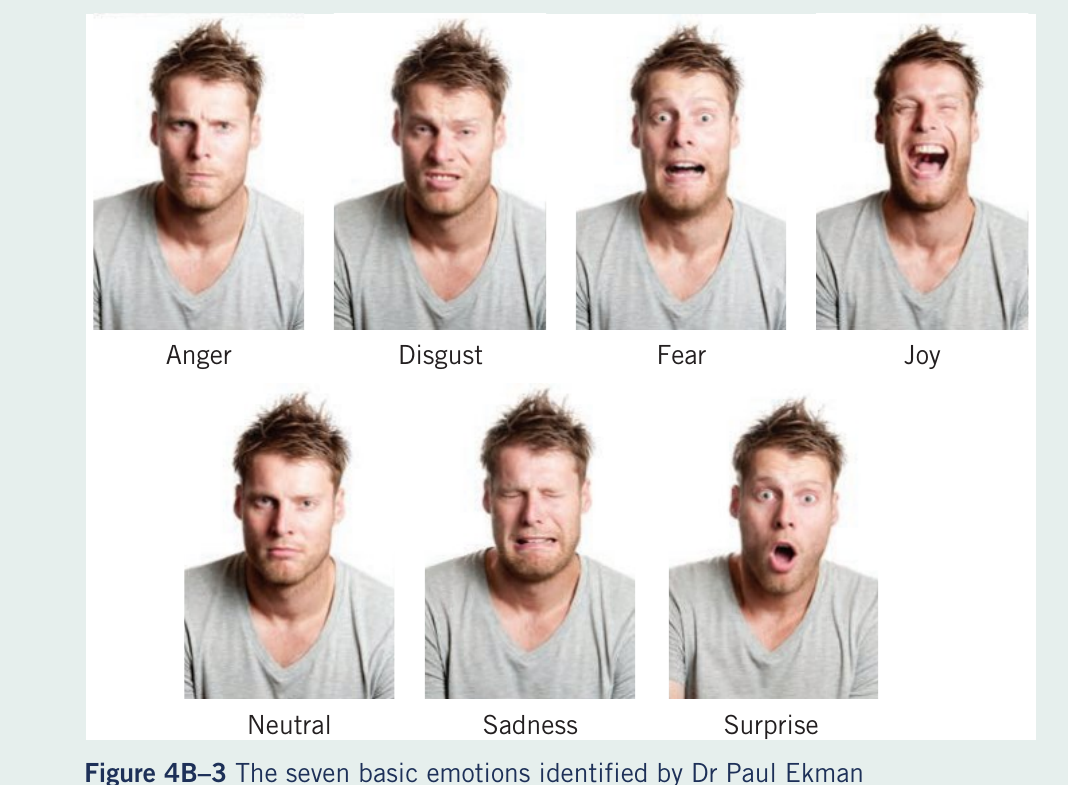
Ekman identified seven basic emotions:
- Anger
- Disgust
- Fear
- Joy
- Neutral
- Sadness
- Surprise
Maladaptive emotions
Maladaptive emotions are very intense or overwhelming emotions that occur frequently, persist for extended periods without interruption, or are inappropriate for the situation.
Important
When Emotions Become Maladaptive:
Emotions or emotional responses become maladaptive when they:
- Are very intense or overwhelming
- Occur frequently
- Persist for extended periods without interruption (typically, emotions do not last longer than an hour)
- Are inappropriate for the situation
When emotions persist for extended periods without interruption, they are more likely to be categorised as moods or disorders, such as depression or anxiety.
Maladaptive emotions usually involve dysfunctional or unhelpful emotional responses.
Example: Anger as adaptive and maladaptive
Anger, like fear, can be adaptive as it primes our body for defence. Evolutionarily, our ancestors needed this ability to prepare for life-threatening situations, such as attacks by predators or enemies.
Example
Example: Anger on the Adaptive-Maladaptive Spectrum
Adaptive anger: When anger is mild, infrequent, dissipates quickly, and is expressed assertively without aggression, it is considered adaptive. This type of anger helps us set boundaries and protect ourselves appropriately.
Maladaptive anger: If anger is more intense, experienced frequently, or results in aggressive verbal and physical actions, it becomes maladaptive. This type of anger damages relationships and interferes with daily functioning.

Developmental considerations
Note
The ability to express and manage emotions depends on age and stage of emotional development. For example, a toddler who is angry and frustrated because they can no longer play with a favourite toy may throw a tantrum involving screaming and hitting. For an adult, this behaviour would be considered maladaptive, but for the child, it would be considered somewhat adaptive, as they are still developing the ability to manage their emotions effectively.

Cognitions as adaptive or maladaptive
What are cognitions?
Cognitions are cognitive processes or mental actions that involve acquiring, processing and understanding information or knowledge. They include:
- Perception
- Memory
- Attention
- Pattern recognition
- Problem-solving
- Language
Adaptive cognitions
Adaptive cognitions are ways of thinking that benefit our survival and wellbeing.
Example
Example: Adaptive Thinking After a Mistake
If you make a mistake in a Maths test, an adaptive thought might be: "It's okay. I understand how I made the mistake, and I will ensure I don't repeat it next time."
This relatively positive thought should motivate you to practise and improve in the future, thereby benefiting your wellbeing.
The relationship between thoughts, emotions, and behaviours
Cognitions often involve taking in information from the environment, processing our emotional response to it, and then initiating behaviour. This highlights the interactive relationship between these three aspects of a person's wellbeing.
Example
Example: The Thought-Emotion-Behaviour Cycle
If your friend is ignoring you (environmental information) and this makes you feel sad and rejected (emotional response), you might avoid social situations involving this friend (behaviour).
Important
The Multidirectional Nature of the Relationship:
This relationship is not unidirectional:
- How we feel can impact what we think and do
- What we do can affect how we feel and think
- What we think can influence how we feel and what we do
Understanding this interconnectedness is crucial for psychological interventions.
Cognitive behavioural therapy (CBT)
One of the most popular and successful psychological treatments, cognitive behavioural therapy (CBT), targets the relationship between maladaptive thoughts, feelings and behaviours.
Note
CBT helps people to:
- Identify and challenge unhelpful thoughts (cognitions)
- Improve mood (emotions)
- Result in changes in daily actions (behaviour)
Maladaptive cognitions
Maladaptive cognitions are cognitive distortions or irrational, inflated thoughts or beliefs that distort a person's perception of reality, usually in a negative way.
Example
Example: Maladaptive Cognitions in Depression
An individual with depression might have ongoing negative thoughts about themselves, such as:
- "I am not good enough"
- "I am not likeable"
These negative thinking patterns can become automatic, meaning the individual does not notice when their judgement is irrational or unfair to themselves.
CBT Intervention: CBT helps people with depression by providing tools to challenge their negative thoughts and change them into more realistic and positive ones, such as:
- "I am enough"
- "I am likeable"
This has a flow-on effect on their emotions by improving mood, leading to changes in motivation and behaviour.
Remember!
Summary
Key Points to Remember:
-
Normality refers to patterns of behaviour that are typical, expected or conform to acceptable standards, whilst abnormality describes unusual, bizarre or atypical behaviours.
-
Neurotypicality describes standard brain functioning within the typical range, whilst neurodiversity acknowledges that every human has a unique nervous system with different abilities and needs.
-
Adaptive responses (behaviours, emotions, cognitions) enable us to adjust to our environment appropriately and cope effectively, whilst maladaptive responses interfere with our ability to adjust appropriately and effectively.
-
Emotions have adaptive value as they help ensure survival through communication, expressing needs, and responding to threats. They become maladaptive when they are very intense, occur frequently, persist for extended periods, or are inappropriate for the situation.
-
Thoughts, emotions, and behaviours are interconnected in a multidirectional relationship. Cognitive behavioural therapy targets this relationship to help people change maladaptive patterns into adaptive ones.