Energy Transfer & Productivity (AQA A-Level Biology): Revision Notes
📚Revision Notes
Energy Transfer & Productivity
Energy capture by producers
The Sun provides the energy source for all ecosystems. However, plants capture remarkably little of this available solar energy - typically only 1-3% is converted into organic matter through photosynthesis.
Note
Most solar energy fails to be captured by plants because:
- Over 90% of solar energy is reflected back into space by clouds and dust, or absorbed by the atmosphere
- Not all wavelengths of light can be absorbed and used for photosynthesis
- Light may not fall directly on chlorophyll molecules
- Limiting factors such as low carbon dioxide levels may restrict the rate of photosynthesis
This extremely low capture efficiency highlights why energy transfer through ecosystems is so inefficient and why food chains are typically short.
Primary productivity
Gross primary production (GPP) represents the total amount of chemical energy stored in plant biomass within a given area or volume over a specific time period. However, plants use 20-50% of this energy for their own respiration processes.
Important
Net primary production (NPP) is the chemical energy store remaining after respiratory losses have been accounted for:
Where represents respiratory losses.
Net primary production becomes available for plant growth and reproduction. It also provides the energy source for other trophic levels in the ecosystem, including consumers and decomposers. Understanding this relationship is crucial because NPP represents the energy foundation for all other organisms in the ecosystem.
Energy transfer between trophic levels
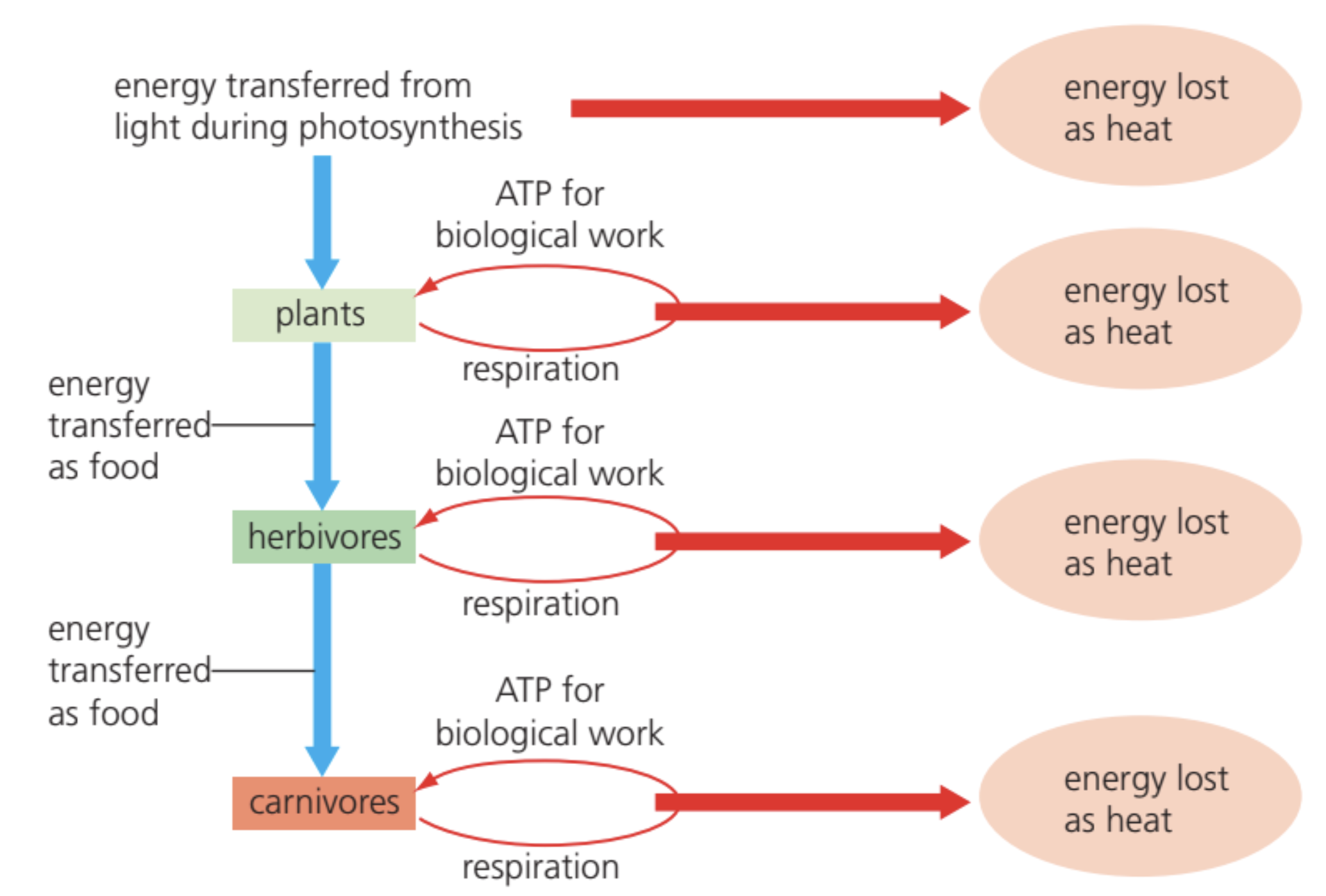
Usually less than 10% of net primary production in plants can be used by primary consumers for growth. Secondary and tertiary consumers show slightly better efficiency, transferring approximately 20% of available energy from their prey into their own bodies.
Note
The low percentage of energy transferred at each stage results from several factors:
- Some organisms are not consumed by the next trophic level
- Some parts consumed cannot be digested and are lost in faeces
- Energy is lost in excretory materials such as urine
- Energy losses occur as heat from respiration and body temperature maintenance
These losses are particularly high in mammals and birds due to their constant body temperature requirements, which demand continuous energy expenditure for thermoregulation.
Calculating energy transfer efficiency
Energy transfer calculations allow us to quantify the efficiency of ecosystems and understand energy flow patterns.
Important
The net production of consumers can be calculated using:
Where:
- = net production
- = chemical energy store of ingested food
- = energy lost in faeces and urine
- = energy lost in respiration
Energy transfer efficiency between trophic levels is calculated as:
Example
Worked Example: Calculating Energy Transfer Efficiency
If trout receive 250 kJ m⁻² year⁻¹ and humans receive 50 kJ m⁻² year⁻¹:
Efficiency =
This means that 20% of the energy available in trout is successfully transferred to humans, while 80% is lost through the various mechanisms described above.
Consequences of inefficient energy transfer
The relative inefficiency of energy transfer between trophic levels explains several fundamental ecological patterns that we observe in nature.
Note
Key Ecological Patterns:
- Most food chains have only four or five trophic levels because insufficient energy remains to support large breeding populations at higher levels
- Total biomass of organisms decreases at higher trophic levels
- Total energy available decreases as one moves up a food chain
This creates the characteristic pyramid shape when energy flow through ecosystems is represented diagrammatically. The pyramid structure demonstrates why there are typically few large predators compared to the abundance of producers at the base.
Productivity and farming practices
Many farming practices aim to increase yields by improving the efficiency of energy transfer along food chains. Since much energy is lost as heat during respiration, any practice reducing respiratory losses in the human food chain will reduce energy loss and increase yield.
Note
Intensive rearing of domestic livestock achieves this by:
- Restricting movement, reducing energy used in muscle contraction
- Maintaining warm environments to reduce heat loss (particularly important for homeothermic species)
- Controlling feeding to provide optimum nutrition with minimal wastage
- Excluding predators to prevent energy loss to other organisms in the food web
Note
Simplifying food webs by reducing losses to non-human food chains:
- Eliminating competitor organisms (weeds) that compete with crop plants for water, minerals, carbon dioxide, space and light
- Controlling pest insects that damage crop leaves and reduce photosynthetic capacity
- Using pesticides to prevent crop damage, though this must balance productivity gains against potential negative effects
These farming practices represent a balance between maximising food production efficiency and maintaining sustainable agricultural systems for future food security.
Summary
Key Points to Remember:
- Only 1-3% of solar energy is captured by plants through photosynthesis due to various limiting factors
- , representing energy available for ecosystem food chains
- Energy transfer between trophic levels is typically ~10% efficient due to multiple loss mechanisms
- Energy transfer efficiency =
- Farming practices improve efficiency by reducing respiratory losses and simplifying food webs