Light-independent Reaction (AQA A-Level Biology): Revision Notes
📚Revision Notes
Light-independent Reaction
Overview
The light-independent reaction represents the second stage of photosynthesis where carbon dioxide is incorporated into organic molecules. This process uses ATP and reduced NADP produced during the light-dependent reaction to convert CO₂ into useful organic compounds.
Important
Although this stage doesn't directly require light, it depends entirely on products from the light-dependent reaction. When light becomes unavailable, the reaction stops rapidly as ATP and reduced NADP supplies become depleted.
The reaction occurs in the stroma of chloroplasts and is also known as the Calvin cycle, named after scientist Melvin Calvin who worked out its details.
The Calvin cycle
The Calvin cycle is a series of enzyme-controlled reactions that fix carbon dioxide into organic molecules. The process involves several key compounds:
- Ribulose bisphosphate (RuBP): A 5-carbon sugar that acts as the CO₂ acceptor
- Glycerate 3-phosphate (GP): A 3-carbon molecule formed when CO₂ combines with RuBP
- Triose phosphate (TP): A 3-carbon sugar that can be converted into useful organic substances
- Rubisco: The enzyme (ribulose bisphosphate carboxylase) that catalyses the reaction between CO₂ and RuBP
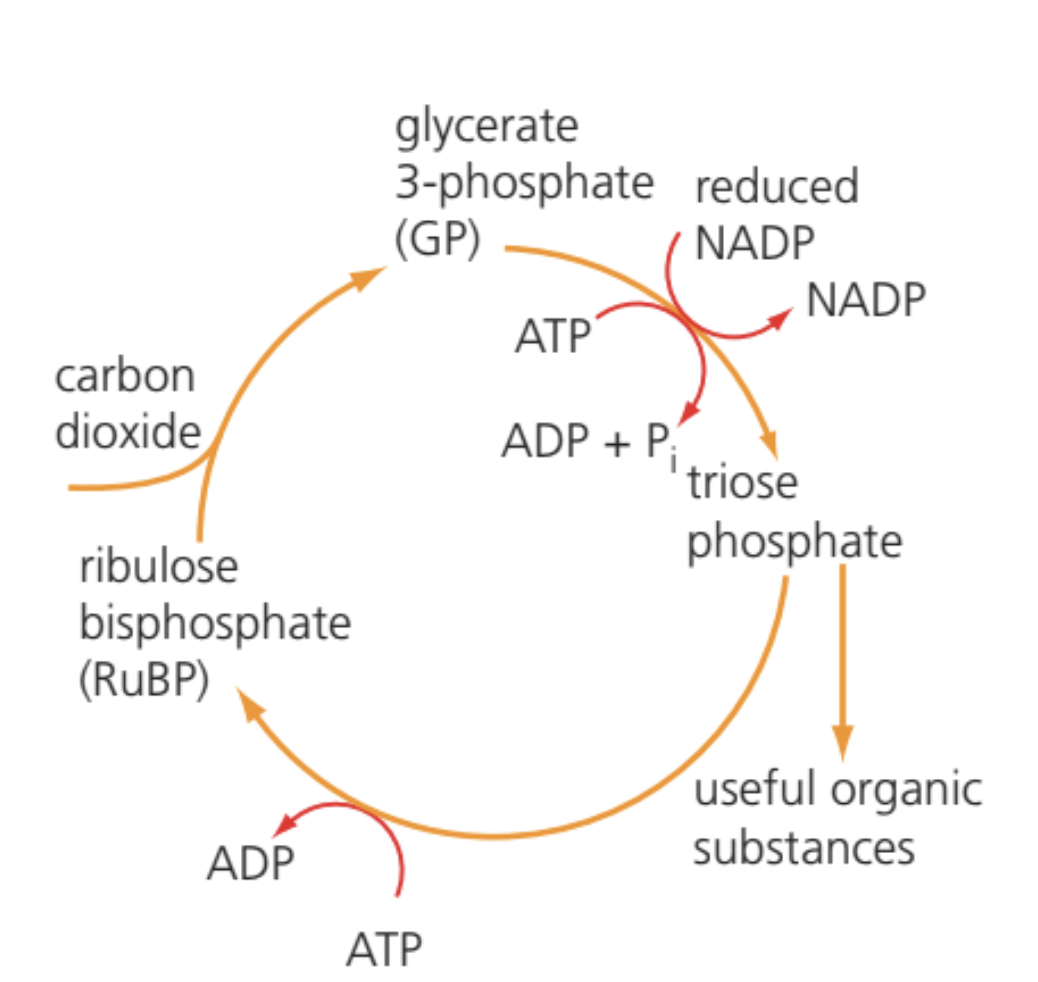
Stages of the Calvin cycle
The cycle involves seven main stages that can be grouped into three phases:
Example
Worked Example: The Complete Calvin Cycle Process
Carbon dioxide fixation (Stages 1-3):
- CO₂ entry: Carbon dioxide diffuses from the atmosphere into the leaf through stomata, dissolves in water around mesophyll cells, then passes through cell membranes into the chloroplast stroma
- CO₂ fixation: In the stroma, CO₂ reacts with the 5-carbon compound RuBP in a reaction catalysed by rubisco
- GP formation: This reaction produces two molecules of the 3-carbon compound glycerate 3-phosphate (GP)
Reduction phase (Stage 4):
- GP reduction: Reduced NADP from the light-dependent reaction provides reducing power to convert GP into triose phosphate (TP), using energy from ATP
Regeneration phase (Stages 5-7):
-
NADP recycling: NADP is reformed and returns to the light-dependent reaction to accept more protons
-
Organic compound synthesis: Some TP molecules are converted into useful organic substances including starch, cellulose, lipids, glucose, amino acids, and nucleotides
-
RuBP regeneration: Most TP molecules are used to regenerate RuBP using ATP from the light-dependent reaction, allowing the cycle to continue
Site of the light-independent reaction
The light-independent reaction takes place in the stroma of chloroplasts. This location provides several advantages:
Note
Stroma Adaptations for the Calvin Cycle
The stromal environment is specifically adapted to support the light-independent reaction through several key features that optimise the process efficiency.
- Enzyme concentration: The stromal fluid contains all enzymes needed for the Calvin cycle. Being membrane-bound within the chloroplast creates a distinct chemical environment with high concentrations of enzymes and substrates, separate from the cytoplasm.
- Product accessibility: The stroma surrounds the grana, so products from the light-dependent reaction can readily diffuse into the stroma where they're needed.
- Protein synthesis capability: The stroma contains both DNA and ribosomes, allowing quick manufacture of proteins involved in the light-independent reaction when required.
Summary
Key Points to Remember:
- The light-independent reaction uses ATP and reduced NADP from the light-dependent reaction to fix CO₂ into organic molecules
- The Calvin cycle occurs in the stroma and involves the key enzyme rubisco catalysing CO₂ fixation with RuBP
- The process produces GP (3-carbon) which is reduced to TP (3-carbon) using energy from ATP and reduced NADP
- Most TP regenerates RuBP to continue the cycle, while some forms useful organic compounds
- The stroma is specially adapted with high enzyme concentrations, DNA, and ribosomes to support this process