Limiting Factors (AQA A-Level Biology): Revision Notes
📚Revision Notes
Limiting Factors
What are limiting factors?
A limiting factor is any environmental condition that restricts the rate of photosynthesis when it is in short supply. Even if other conditions are perfect, photosynthesis can only occur as fast as the limiting factor allows.
Note
Think of it like the weakest link in a chain - it determines the overall strength. No matter how strong the other links are, the chain will only be as strong as its weakest point.
For photosynthesis to work at its maximum rate, plants need specific optimum conditions. These ideal conditions vary between plant species, but most plants in temperate climates like the UK perform best under similar conditions.
The three main limiting factors
- Light intensity
- Temperature
- Carbon dioxide
Light intensity and wavelength
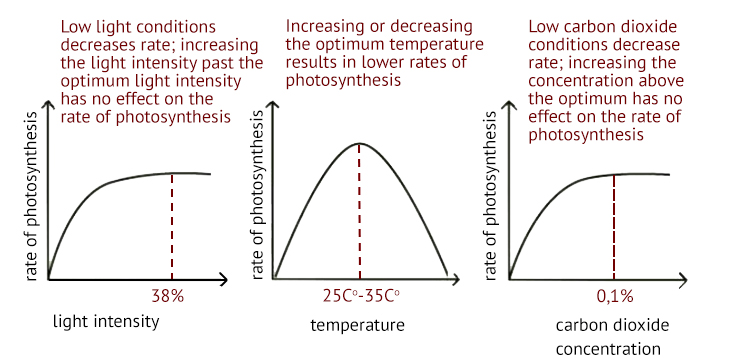
Light provides the energy needed for the light-dependent reactions of photosynthesis. The relationship between light and photosynthesis rate works in the following way:
- Higher light intensity provides more energy, increasing the rate of photosynthesis
- However, this only continues up to a saturation point, after which other factors become limiting
- Plants don't use all wavelengths of light equally - chlorophyll a, chlorophyll b and carotene absorb mainly red and blue light from sunlight
- Green light is mostly reflected, which explains why plants appear green to our eyes
Note
This is why plants appear green to our eyes - they're actually reflecting the green wavelengths of light that they can't use efficiently for photosynthesis, while absorbing the red and blue wavelengths they need.
Temperature effects
Temperature affects photosynthesis because the process depends on enzymes such as ATP synthase and RuBisCO. The temperature relationship follows predictable patterns:
Important
Critical Temperature Ranges for Photosynthesis:
- Below 10°C: Enzymes become inactive and photosynthesis slows dramatically
- Around 25°C: This represents the optimum temperature for most temperate plants
- Above 45°C: Enzymes start to denature and lose their shape, reducing photosynthesis rates
High temperatures also cause stomata to close to prevent water loss, which reduces CO₂ uptake.
Carbon dioxide concentration
Carbon dioxide makes up only 0.04% of atmospheric gases, making it frequently the limiting factor in photosynthesis.
Note
That's less than half of one percent! This incredibly low natural concentration means that CO₂ availability often becomes the bottleneck for photosynthesis, especially when other conditions are optimal.
Key points about CO₂ include:
- Increasing CO₂ concentration to 0.4% typically increases photosynthesis rates significantly
- Beyond this point, the stomata begin to close, limiting further increases
- On warm, bright days, CO₂ often becomes the limiting factor because light and temperature are already optimal
- At night, light intensity becomes the limiting factor instead
How limiting factors interact
The three factors work together, and all three must be at appropriate levels for maximum photosynthesis.
Important
The Law of Limiting Factors:
- If any one factor is too low or too high, it will limit the overall rate regardless of the other factors
- When the limiting factor is corrected, photosynthesis rate increases until another factor becomes limiting
- Environmental conditions determine which factor is most likely to be limiting at any given time
Water as an additional factor
Plants also need a constant water supply. Too little water forces photosynthesis to stop, while too much creates waterlogged conditions that reduce mineral uptake. Minerals like magnesium are essential for making chlorophyll, linking water availability to photosynthetic capacity.
Applications in agriculture
Agricultural producers use knowledge of limiting factors to maximise crop yields through controlled environment agriculture:
Example
Practical Application: Glasshouse Cultivation
Modern glasshouses use multiple techniques to control limiting factors:
- CO₂ enrichment: Adding CO₂ to air using small propane heaters or CO₂ generators
- Artificial lighting: Providing light during night-time or supplementing natural light
- Temperature control: Using heating systems and ventilation to maintain optimal temperatures around 25°C
- Climate management: Controlling humidity and air circulation
Polytunnels
Similar techniques can be used in polytunnel systems, though with less precise control than fully enclosed glasshouses.
Interpreting limiting factor data
Exam questions often require interpretation of graphs showing limiting factor effects.
Note
Key Graph Analysis Skills:
- Identifying saturation points where graphs level off, indicating another factor has become limiting
- Comparing rates at different light intensities, temperatures, or CO₂ concentrations
- Explaining differences between experimental conditions in terms of which factor is limiting
- Relating data to practical applications such as optimal growing conditions
When analysing data, remember that the steepness of a line indicates the rate of change, while levelling off suggests a limiting factor has been reached.
Remember!
Summary
Key Points to Remember:
- Any environmental factor can become limiting if it's in short supply or excess
- Light, temperature and CO₂ are the three main limiting factors for photosynthesis
- Only one factor limits at a time - improving others won't help until the limiting factor is addressed
- Agricultural applications use this knowledge to create optimal growing conditions in controlled environments
- Graph interpretation skills are essential for understanding how different factors affect photosynthesis rates