Respiration (AQA A-Level Biology): Revision Notes
📚Revision Notes
Glycolysis
Glycolysis is the metabolic pathway that breaks down glucose to release energy for cellular processes. This process represents the first stage of cellular respiration and occurs in the cytoplasm of all living cells.
Role in cellular respiration
Cells cannot use glucose directly as an energy source. Instead, they rely on ATP as their immediate energy currency. The breakdown of glucose during cellular respiration produces ATP through a series of enzyme-controlled reactions.
Note
The term "glycolysis" literally means "glucose splitting" - this gives us a clue about what happens during this essential metabolic process.
There are two main types of cellular respiration:
- Aerobic respiration - requires oxygen and generates carbon dioxide, water, and large amounts of ATP
- Anaerobic respiration - occurs without oxygen, producing lactate (in animals) or ethanol and carbon dioxide (in plants and fungi), but yielding much less ATP
Aerobic respiration consists of four sequential stages:
- Glycolysis - glucose breakdown to pyruvate
- Link reaction - pyruvate conversion to acetyl coenzyme A
- Krebs cycle - cyclical oxidation reactions producing ATP and reduced coenzymes
- Oxidative phosphorylation - ATP synthesis using electrons from reduced coenzymes
Glycolysis serves as the initial stage for both aerobic and anaerobic pathways, making it a universal metabolic process.
Important
Glycolysis is the only stage of respiration that can occur without oxygen. This makes it essential for survival in both aerobic and anaerobic conditions.
The four stages of glycolysis
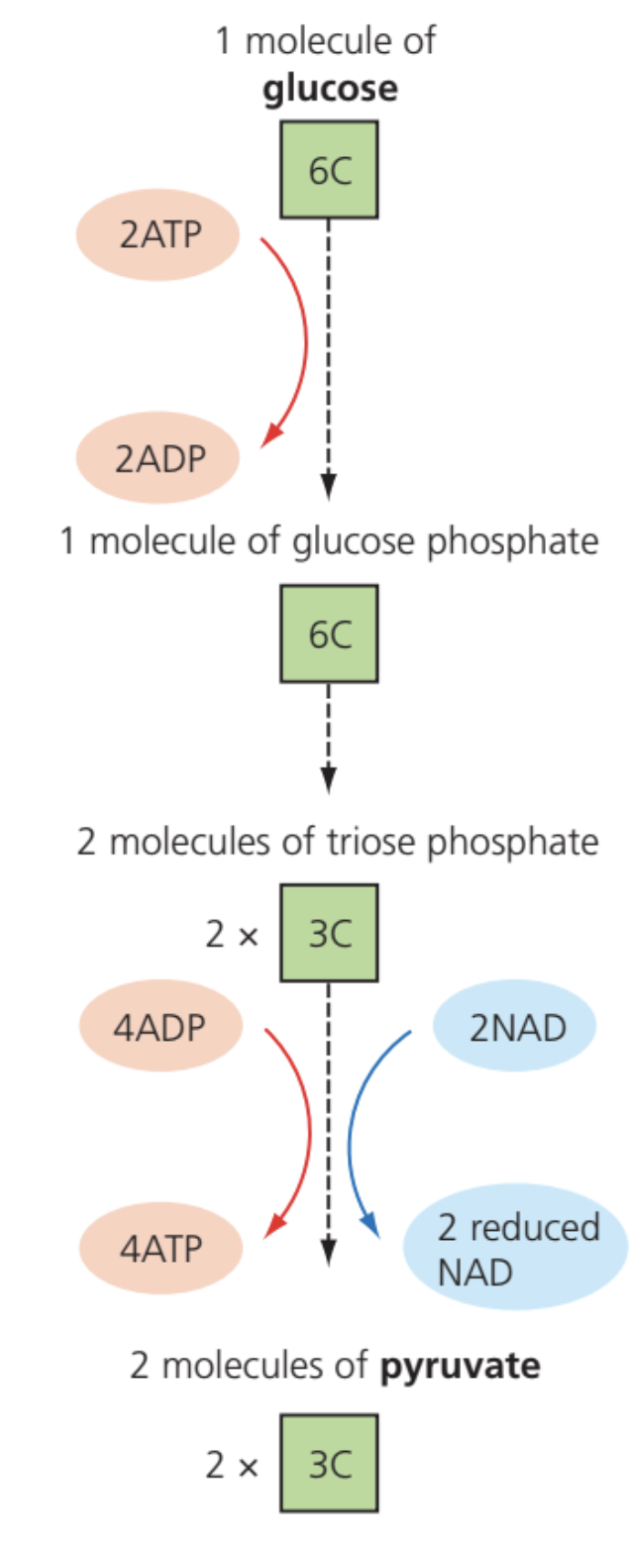
Glycolysis converts one glucose molecule (6-carbon sugar) into two pyruvate molecules (3-carbon compounds). This transformation occurs through four distinct stages:
Stage 1: Phosphorylation of glucose
Glucose must be activated before it can be metabolised effectively. This activation involves adding two phosphate groups to the glucose molecule through phosphorylation.
The phosphate groups come from the hydrolysis of two ATP molecules into ADP. This process provides the activation energy needed to make glucose more reactive and enables the subsequent enzyme-controlled reactions to proceed.
Note
Think of phosphorylation as "priming" the glucose molecule - like putting fuel in a car before starting the engine. The cell invests 2 ATP molecules upfront to make glucose ready for the energy-harvesting reactions that follow.
Stage 2: Splitting of phosphorylated glucose
The phosphorylated glucose molecule is then divided into two separate 3-carbon molecules called triose phosphate. Each of these molecules will continue through the remaining stages of glycolysis independently.
Stage 3: Oxidation of triose phosphate
During this stage, hydrogen atoms are removed from each triose phosphate molecule through oxidation. These hydrogen atoms are transferred to the coenzyme NAD, forming reduced NAD (NADH). This step is crucial because reduced NAD carries high-energy electrons that can be used to generate additional ATP in later stages of respiration.
Note
This oxidation step is where the cell begins to harvest energy from glucose. The electrons captured by NAD are like stored energy tokens that can be "cashed in" for ATP during oxidative phosphorylation.
Stage 4: ATP production
The final stage involves enzyme-controlled reactions that convert each triose phosphate molecule into pyruvate. During this conversion, ADP molecules are phosphorylated to regenerate ATP. Since two triose phosphate molecules are processed (from the original split glucose), this stage produces multiple ATP molecules.
Energy yields from glycolysis
The net energy yield from one glucose molecule undergoing glycolysis includes:
- Two molecules of ATP (net gain) - Four ATP molecules are produced, but two were consumed during the initial phosphorylation, resulting in a net gain of two
- Two molecules of reduced NAD - These carry electrons with the potential to generate additional ATP during oxidative phosphorylation
- Two molecules of pyruvate - These can be further metabolised through aerobic or anaerobic pathways
The yield calculations must account for the fact that each glucose molecule produces two triose phosphate molecules, so the gross yields are doubled from what each triose phosphate generates individually.
Important
Remember the "2-2-2 rule" for glycolysis yields: 2 ATP, 2 reduced NAD, and 2 pyruvate molecules per glucose. This makes it easy to recall the key products during exams.
Biological significance of glycolysis
Glycolysis is a key metabolic pathway in every living organism.
- Cellular location: The enzymes responsible for glycolysis are located in the cytoplasm, meaning the process does not require specialised organelles or membrane structures.
- Oxygen independence: Glycolysis does not require oxygen and can take place whether or not it is present (anaerobic respiration). However, anaerobic respiration yields only a small amount of the potential energy stored in the pyruvate molecule.
Summary
Key Points to Remember:
- Glycolysis occurs in the cytoplasm and converts glucose into two pyruvate molecules
- The process involves four key stages: phosphorylation, splitting, oxidation, and ATP production
- Net energy yield per glucose is 2 ATP, 2 reduced NAD, and 2 pyruvate molecules
- Glycolysis works without oxygen, making it essential for both aerobic and anaerobic respiration
- This universal pathway provides evidence for evolutionary relationships among all living organisms