Anaerobic Respiration (AQA A-Level Biology): Revision Notes
📚Revision Notes
Anaerobic Respiration
Anaerobic respiration occurs when oxygen becomes temporarily or permanently unavailable to tissues or entire organisms. Understanding this process is essential because it allows organisms to continue producing ATP when aerobic respiration cannot function effectively.
Note
Anaerobic respiration is a vital survival mechanism that enables organisms to maintain energy production during oxygen shortages, making it crucial for understanding cellular metabolism under stress conditions.
What happens when oxygen is unavailable
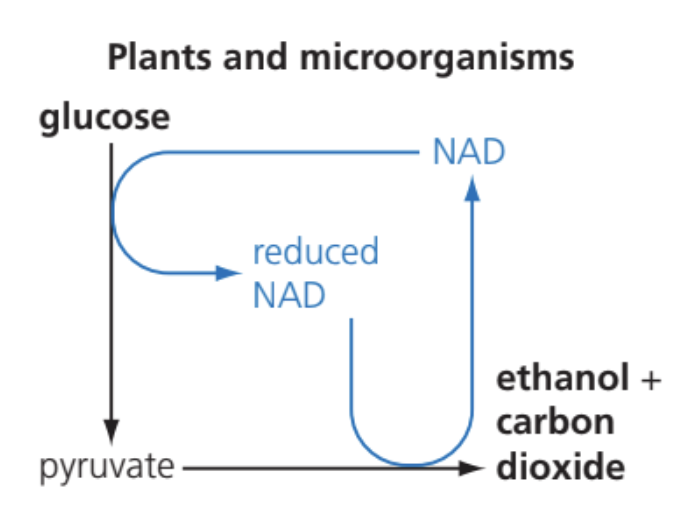
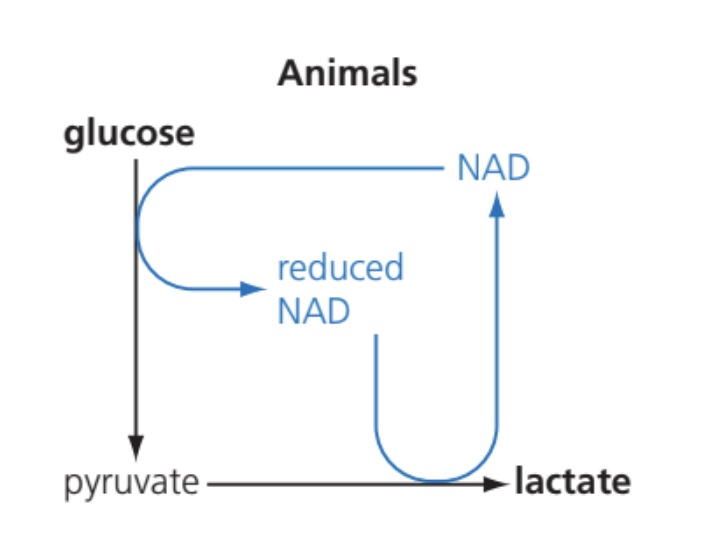
When oxygen is absent, both the Krebs cycle and electron transfer chain stop functioning because they require oxygen as the final electron acceptor. This creates a major problem: reduced NAD accumulates rapidly and cannot be reoxidised back to NAD.
Without available NAD to accept hydrogen atoms from glycolysis, this vital process would halt completely. Since glycolysis provides the pyruvate needed for energy production, organisms must find alternative ways to regenerate NAD.
Important
Problem: When oxygen is unavailable, the accumulation of reduced NAD would completely stop glycolysis - the primary source of ATP production. Anaerobic respiration pathways solve this by using pyruvate itself to reoxidise reduced NAD, ensuring energy production can continue.
Two main types of anaerobic respiration
In eukaryotic organisms, anaerobic respiration follows two distinct pathways depending on the organism type:
- Plants and microorganisms (such as yeast): Convert pyruvate to ethanol and carbon dioxide
- Animals: Convert pyruvate to lactate
Note
Both pathways serve the same fundamental purpose - regenerating NAD so that glycolysis can continue producing ATP. The difference lies in the end products and the specific organisms that use each pathway.
Ethanol production in plants and microorganisms
This pathway occurs in organisms like bacteria, fungi (especially yeast), and plant cells under waterlogged conditions. The process involves pyruvate losing a carbon dioxide molecule and accepting hydrogen from reduced NAD.
Chemical equation:
Example
Real-World Application: The Brewing Industry
This reaction has been exploited by humans for thousands of years in brewing:
- Wine production: Yeast ferments natural carbohydrates in grapes
- Beer production: Barley seeds supply the substrates for fermentation
- Process: Yeast grows in anaerobic conditions, producing ethanol as the valuable end product while releasing carbon dioxide
During strenuous exercise, even plant root cells may temporarily switch to this pathway if waterlogged soil prevents adequate oxygen supply.
Lactate production in animals
Animal cells convert pyruvate directly to lactate without releasing carbon dioxide. This pathway becomes particularly important during intense physical activity when oxygen demand exceeds supply.
Chemical equation:
Lactate fermentation occurs most commonly in muscle cells during strenuous exercise. When muscles work intensively, they consume oxygen faster than the circulatory system can deliver it, creating an oxygen debt.
Important
Oxygen Debt During Exercise: Despite oxygen shortage, muscles must continue functioning - perhaps to escape from danger or catch prey. Each pyruvate molecule accepts two hydrogen atoms from reduced NAD, regenerating the oxidised NAD needed for continued glycolysis.
However, lactate accumulation causes several problems: it increases acidity (lowers pH), affects enzyme function, and contributes to muscle fatigue and cramping.
The body eventually removes lactate by transporting it via the bloodstream to the liver, where it can be converted back to pyruvate or transformed into glycogen when oxygen becomes available again.
NAD regeneration - the key to continued energy production
The critical function of both anaerobic pathways is NAD regeneration. Without this process, the small pool of NAD molecules in cells would become entirely converted to reduced NAD, bringing glycolysis to a complete halt.
By providing alternative electron acceptors (pyruvate converted to ethanol or lactate), these pathways ensure that:
- Glycolysis can continue operating
- ATP production continues, albeit at reduced levels
- Cells maintain essential metabolic functions during oxygen shortage
Note
This regeneration cycle allows organisms to survive temporary oxygen deprivation and maintain energy production under challenging conditions. It's essentially a cellular survival strategy that prevents complete metabolic shutdown.
Energy yields from anaerobic respiration
Anaerobic respiration produces significantly less ATP than aerobic respiration. The energy yield comes entirely from substrate-level phosphorylation during glycolysis, as neither the Krebs cycle nor electron transfer chain can operate without oxygen.
Energy comparison:
- Anaerobic respiration: Only 2 ATP molecules per glucose (from glycolysis alone)
- Aerobic respiration: Approximately 32-38 ATP molecules per glucose (from glycolysis, Krebs cycle, and electron transfer chain combined)
Important
Dramatic Energy Difference: This 15-19 times difference in ATP production explains why anaerobic respiration serves primarily as a short-term survival mechanism rather than a long-term energy solution. Organisms typically return to aerobic respiration as soon as adequate oxygen becomes available.
The reduced energy yield also explains why intense exercise cannot be sustained indefinitely - muscles operating anaerobically produce insufficient ATP for prolonged activity and accumulate lactate that impairs function.
Summary
Key Points to Remember:
-
Anaerobic respiration occurs when oxygen is unavailable, allowing glycolysis to continue by regenerating NAD from reduced NAD
-
Two main pathways exist: ethanol production in plants/microorganisms and lactate production in animals
-
Both pathways use pyruvate as the final electron acceptor, preventing NAD depletion and maintaining ATP production
-
Energy yield is much lower than aerobic respiration - only 2 ATP per glucose compared to 32-38 ATP aerobically
-
Real-world applications include brewing industry (ethanol fermentation) and muscle function during intense exercise (lactate fermentation)