Link Reaction & Krebs Cycle (AQA A-Level Biology): Revision Notes
📚Revision Notes
Link Reaction & Krebs Cycle
Following glycolysis in the cytoplasm, pyruvate molecules must be processed further to release their remaining potential energy. This happens through two connected processes: the link reaction and the Krebs cycle. Both processes occur exclusively in the matrix of mitochondria in eukaryotic cells.
Note
The mitochondrial matrix is the innermost compartment of mitochondria, where the enzymes necessary for these reactions are located. This compartmentalization is crucial for the efficiency of cellular respiration.
The link reaction
The link reaction serves as a bridge between glycolysis and the Krebs cycle. Pyruvate molecules produced during glycolysis are actively transported from the cytoplasm into the mitochondrial matrix, where they undergo specific chemical changes.
During the link reaction, two main transformations occur:
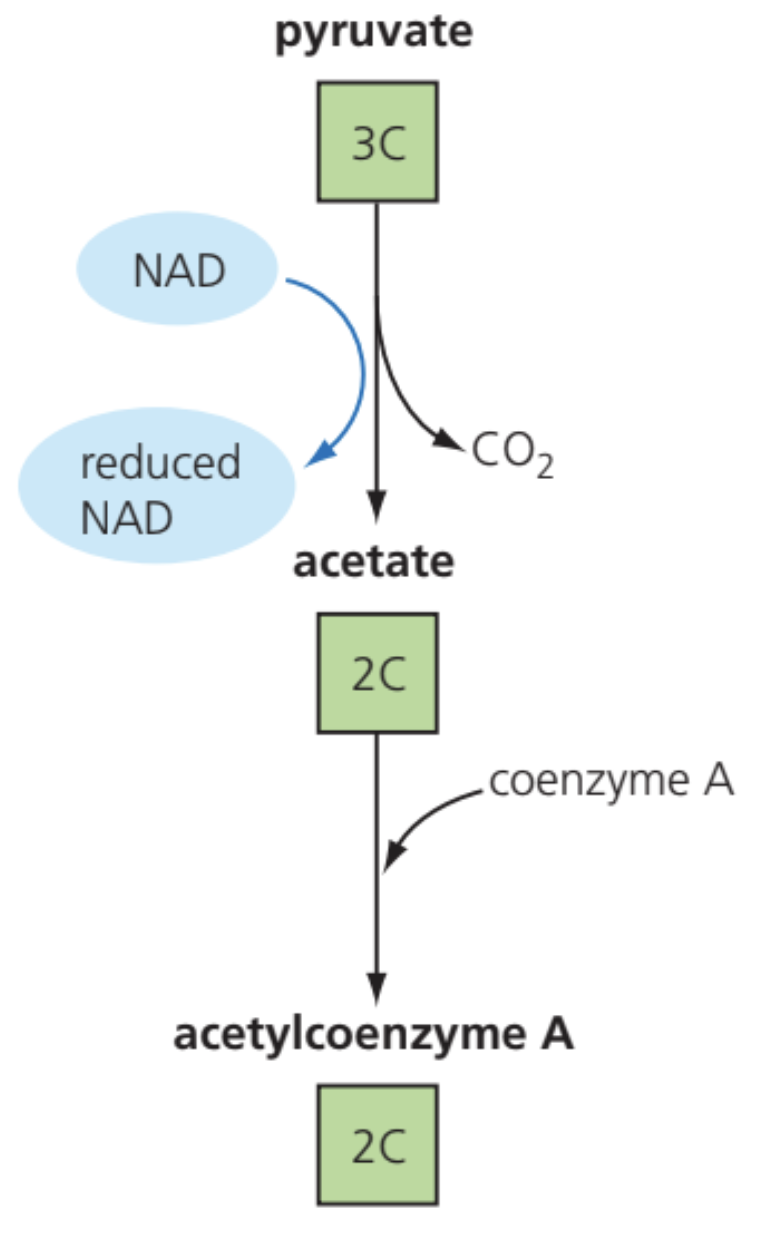
- Decarboxylation: The 3-carbon pyruvate molecule is oxidised to form acetate, losing one carbon atom as carbon dioxide and releasing two hydrogen atoms.
- Formation of acetyl CoA: The 2-carbon acetate molecule combines with coenzyme A (CoA) to produce acetylcoenzyme A, which can then enter the Krebs cycle.
Important
The hydrogen atoms released during oxidation are captured by the carrier molecule NAD, converting it to reduced NAD. This reduced coenzyme will later be used in oxidative phosphorylation to generate ATP - this represents the main energy capture from this step.
Overall equation:
The Krebs cycle
Named after British biochemist Hans Krebs, the Krebs cycle (also known as the citric acid cycle) involves a series of oxidation-reduction reactions that completely break down the acetyl portion of acetyl CoA.
The cycle begins when the 2-carbon acetylcoenzyme A combines with a 4-carbon molecule to form a 6-carbon compound. Through subsequent reactions, this 6-carbon molecule is gradually broken down, losing carbon atoms as carbon dioxide and hydrogen atoms to carrier molecules.
Note
The Krebs cycle is a cyclical pathway, meaning the 4-carbon acceptor molecule is regenerated at the end of each complete cycle, allowing the process to continue indefinitely as long as acetyl CoA is available.
Key events in the cycle:
- The 6-carbon molecule loses carbon dioxide and hydrogen to become a 4-carbon molecule
- One molecule of ATP is produced directly through substrate-level phosphorylation
- The 4-carbon molecule can combine with new acetylcoenzyme A molecules to continue the cycle
The cycle effectively regenerates the 4-carbon acceptor molecule, allowing the process to continue as long as acetyl CoA is available.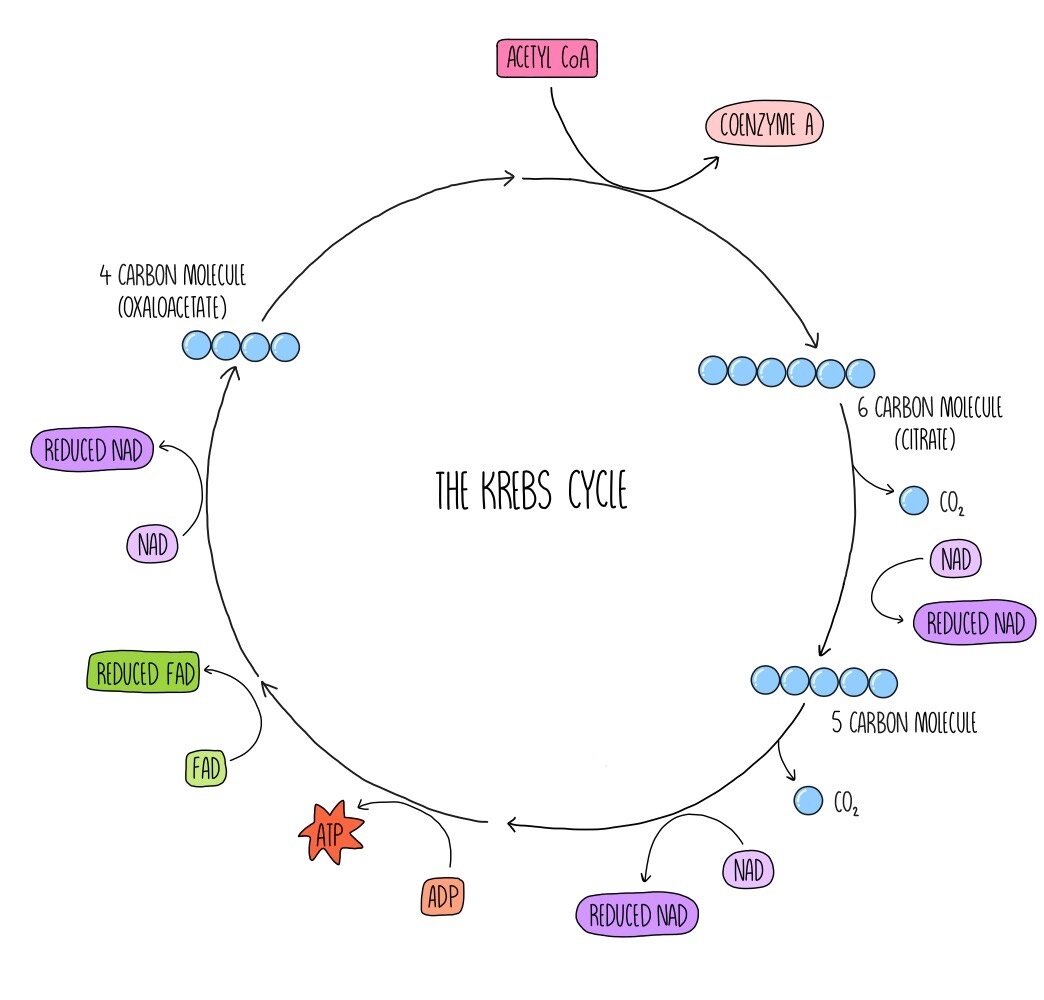
Products of the link reaction and Krebs cycle
For each pyruvate molecule processed through both the link reaction and Krebs cycle, the following products are generated:
Summary
Products per pyruvate molecule:
- Reduced coenzymes: NAD and FAD molecules that have accepted hydrogen atoms
- One ATP molecule: produced directly during the cycle
- Three carbon dioxide molecules: released as waste products
Since glycolysis produces two pyruvate molecules from each glucose molecule, these quantities are doubled when considering the complete breakdown of one glucose molecule.
Coenzymes in respiration
Coenzymes are essential helper molecules required by many enzymes to function properly. In respiration, the most important coenzymes are:
- NAD (nicotinamide adenine dinucleotide): The primary hydrogen carrier in respiration, working with dehydrogenase enzymes to remove hydrogen atoms from substrates and transfer them to the electron transfer chain.
- FAD (flavin adenine dinucleotide): Another important hydrogen carrier, particularly active during the Krebs cycle.
Important
The reduced forms of these coenzymes (reduced NAD and reduced FAD) carry the potential energy that will be converted to ATP during oxidative phosphorylation. This represents the main energy yield from the Krebs cycle, as only a small amount of ATP is produced directly.
Significance of the Krebs cycle
The Krebs cycle performs several vital functions in cellular metabolism:
- Energy production: The cycle produces hydrogen atoms carried by reduced coenzymes, which provide the energy for ATP synthesis through oxidative phosphorylation. This represents the major energy yield from glucose breakdown.
- Waste removal: The cycle completely breaks down pyruvate into carbon dioxide, which can be expelled from the organism as a waste product.
- Metabolic hub: The cycle produces intermediate compounds that serve as starting materials for manufacturing other important biological molecules, including fatty acids, amino acids, and chlorophyll.
- Cycle maintenance: The process regenerates the 4-carbon acceptor molecule, preventing accumulation of acetylcoenzyme A and ensuring the cycle can continue operating.
Note
Links to ATP synthesis occur during oxidative phosphorylation, where the reduced coenzymes generated here transfer their electrons through the electron transport chain. This connection makes the Krebs cycle essential for efficient cellular energy production.
Remember!
Summary
Key Points to Remember:
- Both the link reaction and Krebs cycle occur in the mitochondrial matrix
- The link reaction converts 3-carbon pyruvate to 2-carbon acetyl CoA
- Each pyruvate produces 3 CO₂, 1 ATP, and several reduced coenzymes
- Reduced NAD and FAD carry most of the energy, which is later converted to ATP
- The Krebs cycle serves as a metabolic hub for producing other biological molecules