Oxidative Phosphorylation (AQA A-Level Biology): Revision Notes
📚Revision Notes
Oxidative Phosphorylation
Oxidative phosphorylation is the final stage of aerobic respiration where energy from electrons in hydrogen atoms is used to produce ATP. This process follows glycolysis and the Krebs cycle, using the hydrogen atoms that were removed during these earlier stages to generate the majority of ATP molecules in respiration.
Note
Oxidative phosphorylation is responsible for producing approximately 32-34 ATP molecules per glucose molecule, making it the most productive stage of aerobic respiration compared to glycolysis (2 ATP) and the Krebs cycle (2 ATP).
Where oxidative phosphorylation occurs
Oxidative phosphorylation takes place in mitochondria, which are specialised organelles found in eukaryotic cells. Each mitochondrion has two membranes: a smooth outer membrane and an inner membrane that folds extensively to form structures called cristae.
The inner membrane contains the enzymes and proteins needed for oxidative phosphorylation and ATP synthesis. The space inside the inner membrane is called the matrix, whilst the space between the inner and outer membranes is the inter-membranal space.
Note
Mitochondrial Structure and Function
The extensive folding of the inner membrane into cristae dramatically increases the surface area available for the electron transport chain and ATP synthase complexes. This structural adaptation is crucial for maximising ATP production efficiency.
Metabolically active cells, such as muscle and liver cells, contain many more mitochondria because they require large amounts of energy. These mitochondria also have more densely packed cristae, providing a greater surface area for the membrane-bound enzymes involved in oxidative phosphorylation.
The electron transfer chain and ATP synthesis
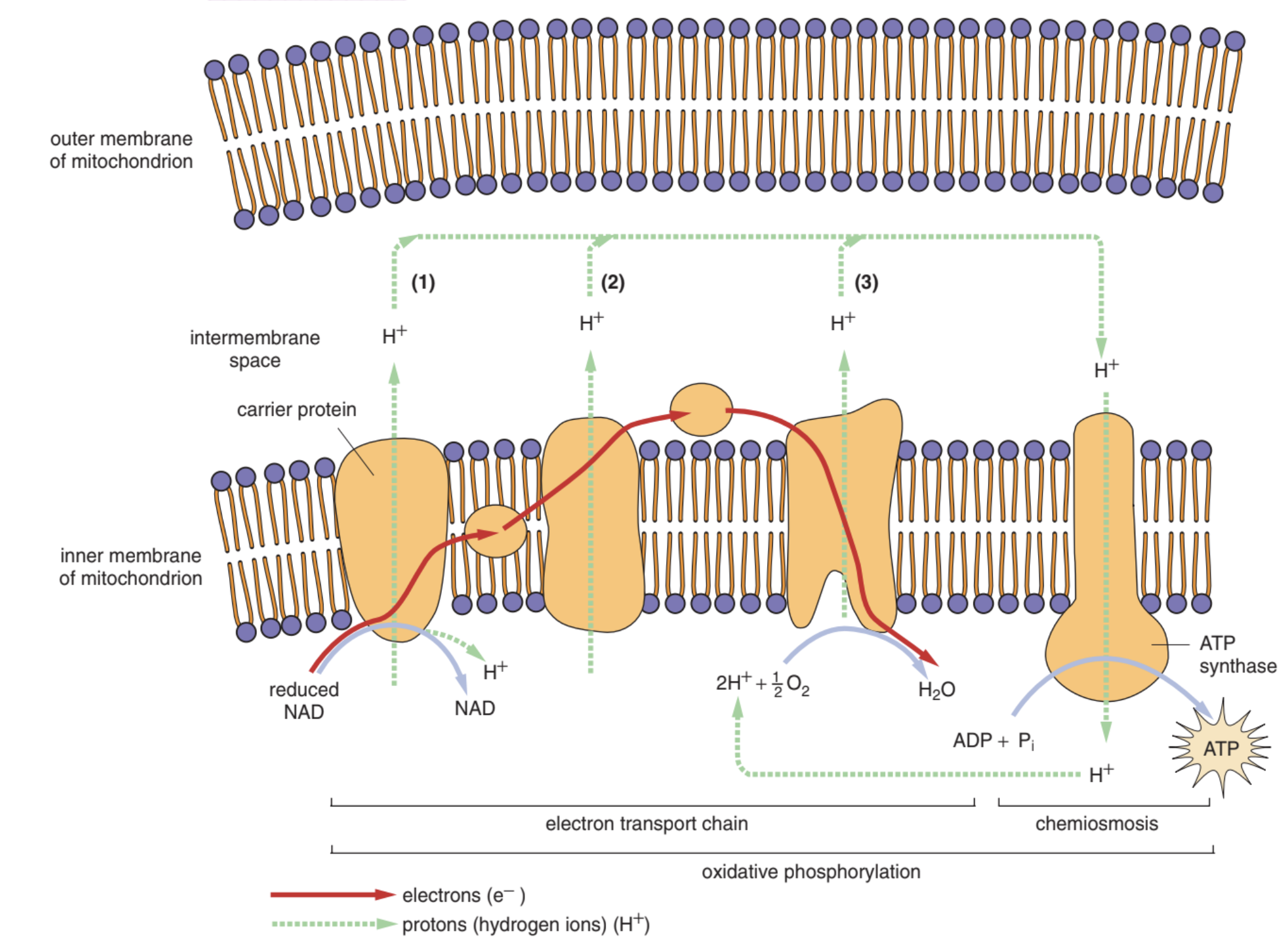
The production of ATP through oxidative phosphorylation involves moving electrons along a series of electron carrier molecules that form the electron transfer chain. This process works through several key steps:
Electron donation
Hydrogen atoms produced during glycolylsis and the Krebs cycle combine with the coenzymes NAD and FAD to form reduced NAD and reduced FAD. These molecules donate the electrons from their hydrogen atoms to the first carrier molecule in the electron transfer chain.
Electron movement
Electrons pass along a chain of electron transfer carrier molecules through a series of oxidation-reduction reactions. As electrons flow along this chain, they release energy that drives the active transport of protons (H⁺) across the inner mitochondrial membrane from the matrix into the inter-membranal space.
Proton accumulation
The movement of protons creates a concentration gradient with a high concentration of protons in the inter-membranal space and a lower concentration in the matrix. This gradient stores potential energy.
ATP synthesis
Protons flow back into the mitochondrial matrix through ATP synthase channels embedded in the inner membrane. The flow of protons causes a change in shape of the ATP synthase protein, which provides the energy needed to synthesise ATP from ADP and inorganic phosphate.
Final electron acceptor
At the end of the chain, electrons combine with protons and oxygen to form water:
Oxygen acts as the final electron acceptor in the electron transfer chain, which is why oxygen is essential for aerobic respiration.
Important
The Chemiosmotic Theory
This process follows the chemiosmotic theory of oxidative phosphorylation, which explains how the energy from electron transfer is used to create a proton gradient that drives ATP synthesis. Without oxygen as the final electron acceptor, the entire electron transport chain would cease to function, halting ATP production.
Releasing energy in stages
Energy release occurs gradually along the electron transfer chain rather than in one large burst. Each electron carrier molecule is at a slightly lower energy level than the previous one, creating an energy gradient.
Example
Why Staged Energy Release is More Efficient
Imagine energy release like water flowing down a series of small waterfalls versus one large waterfall:
- Small waterfalls (staged release): Energy can be captured at multiple points, with less lost as heat
- Large waterfall (single release): Most energy would be lost as heat and waste, overwhelming the system
This staged energy release is more efficient than releasing all the energy at once because:
- Less energy is lost as heat
- More energy can be captured and used to make ATP
- The process is more controlled and manageable for the cell
Important
If all the energy were released in a single step, most would be lost as heat and would be too much for the cell to handle effectively. The staged approach allows cells to capture approximately 40% of the available energy as ATP.
Alternative respiratory substrates
Whilst glucose is the primary respiratory substrate, cells can also use other molecules for respiration when carbohydrates are not available.
Respiration of lipids
Lipids can serve as respiratory substrates and actually release more energy per gramme than carbohydrates. Before respiration, lipids are hydrolysed into glycerol and fatty acids.
The glycerol is phosphorylated and converted to triose phosphate, which then enters the glycolysis pathway. The fatty acids are broken down into 2-carbon fragments that are converted to acetyl coenzyme A, which enters the Krebs cycle directly.
Example
Lipid Energy Yield
Step 1: Lipid hydrolysis Triglyceride → Glycerol + 3 Fatty acids
Step 2: Metabolic pathways
- Glycerol → Triose phosphate → Glycolysis pathway
- Fatty acids → 2-carbon fragments → Acetyl CoA → Krebs cycle
Result: Lipids produce many more hydrogen atoms than glucose, leading to greater ATP yield during oxidative phosphorylation.
Lipid oxidation produces many hydrogen atoms, which are used to generate ATP during oxidative phosphorylation. This is why lipids can release more than double the energy of the same mass of carbohydrate.
Respiration of proteins
Proteins can also be used as respiratory substrates when necessary. They are first hydrolysed into their constituent amino acids, which have their amino groups removed through deamination.
Depending on the number of carbon atoms they contain, the remaining carbon compounds enter the respiratory pathway at different points:
- 3-carbon compounds are converted to pyruvate
- 4-carbon and 5-carbon compounds are converted to intermediates that enter the Krebs cycle directly
Note
Metabolic Flexibility
The ability to use alternative substrates provides metabolic flexibility, allowing organisms to continue producing ATP even when their preferred fuel source is unavailable. This adaptation is particularly important during periods of fasting or intense exercise.
Summary
Key Points to Remember:
- Oxidative phosphorylation occurs in mitochondria and produces most of the ATP in aerobic respiration
- The electron transfer chain uses energy from electrons to pump protons across the inner mitochondrial membrane
- Oxygen is the final electron acceptor and combines with electrons and protons to form water
- Energy is released in stages along the electron transfer chain for maximum efficiency
- Alternative substrates like lipids and proteins can also be used for respiration when carbohydrates are unavailable