Gas Exchange in Fish (AQA A-Level Biology): Revision Notes
📚Revision Notes
Gas Exchange in Fish
Fish face unique challenges for gas exchange due to their aquatic environment. Unlike terrestrial organisms, fish have a waterproof outer covering that prevents gas exchange through their body surface. Additionally, their relatively large size creates a small surface area to volume ratio, making their external surface inadequate for meeting their respiratory needs. To overcome these limitations, fish have developed highly specialised internal gas exchange structures called gills.
Note
The aquatic environment presents two main obstacles for fish respiration: their waterproof covering blocks gas exchange through the skin, and their body size creates an unfavourable surface area to volume ratio for external gas exchange.
Structure of the gills
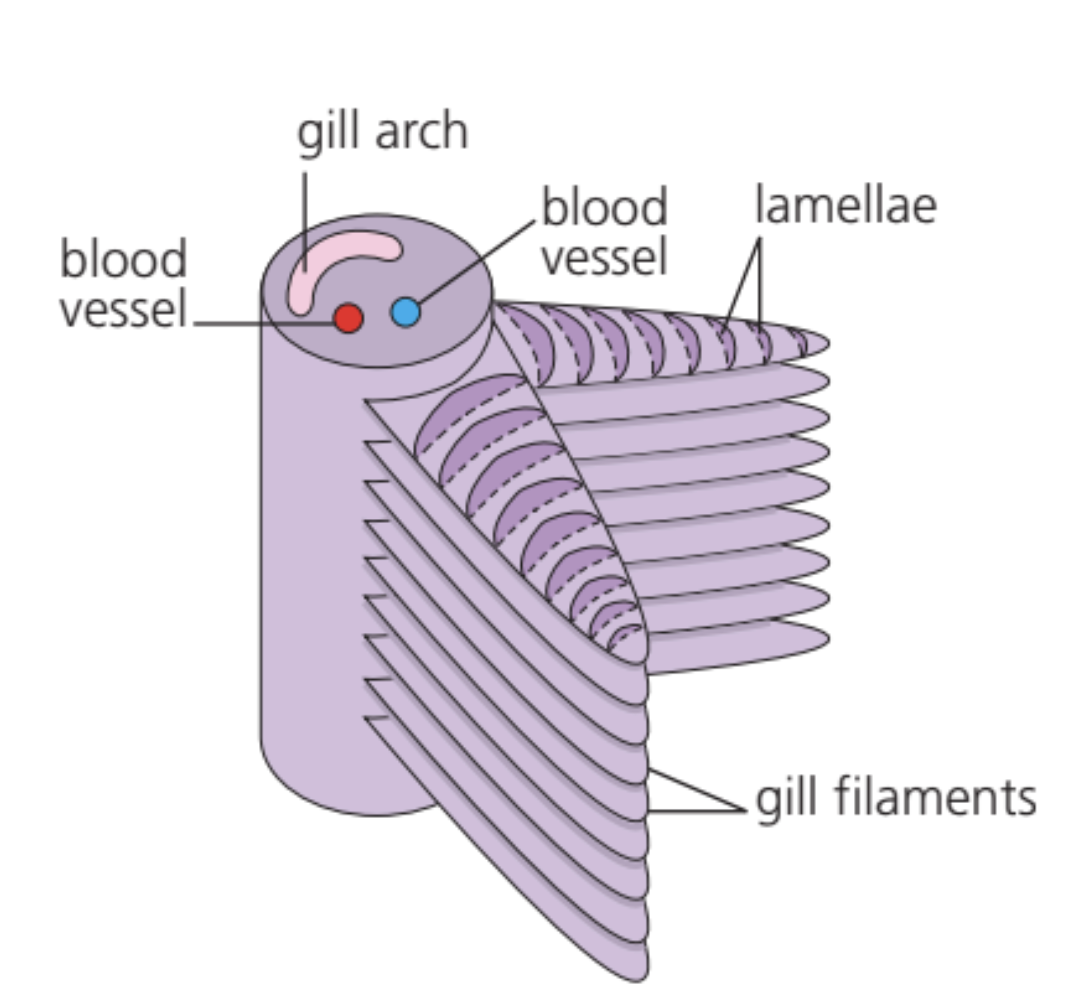
Fish gills are positioned inside the body cavity, located behind the head. The gill system consists of several key components that work together to maximise gas exchange efficiency.
Gill filaments form the primary structure of each gill. These filaments are arranged in a stack formation, similar to pages in a book. Each filament is covered with numerous tiny projections called gill lamellae, which dramatically increase the total surface area available for gas exchange.
Water enters through the fish's mouth and is forced over the gills before exiting through openings on each side of the body. The arrangement of gill filaments and lamellae creates a sophisticated system where water flows over the lamellae whilst blood flows through capillaries within them.
Note
The book-like arrangement of gill filaments with their numerous lamellae projections creates an enormous surface area within a compact space, similar to how the pages of a book provide much more surface area than a single flat sheet.
Countercurrent flow mechanism
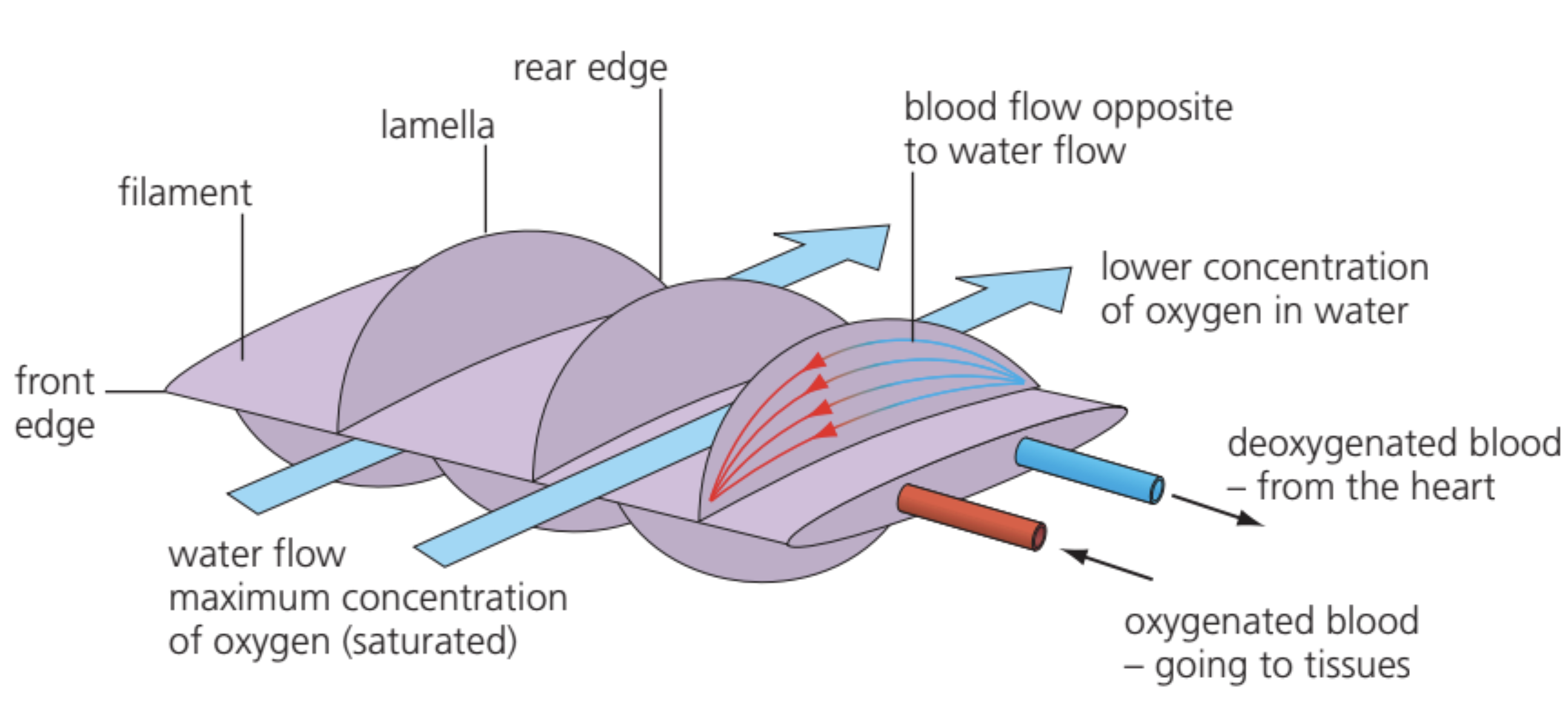
The most remarkable feature of fish gill structure is the countercurrent flow system. This describes the arrangement where water and blood flow in opposite directions across the gill lamellae.
As water passes over the gill lamellae from one direction, blood flows through the capillaries within the lamellae in the opposite direction. This opposing flow pattern is essential for maintaining maximum gas exchange efficiency throughout the entire length of each gill lamella.
Important
The countercurrent flow system is what makes fish gills so incredibly efficient - this opposing flow arrangement is the key innovation that allows fish to extract much more oxygen from water than would otherwise be possible.
The countercurrent exchange principle
The countercurrent system works by maintaining steep diffusion gradients across the full width of the gill lamellae. This arrangement ensures two critical interactions occur:
When blood with high oxygen content meets water at its maximum oxygen concentration, diffusion of oxygen from water to blood continues to occur. Simultaneously, when blood with lower oxygen content encounters water that has already lost some oxygen, diffusion still takes place because the water still contains more oxygen than the blood.
This system maintains a consistent diffusion gradient across the entire gill lamella, allowing fish to extract approximately 80% of the available oxygen from the water passing over their gills.
Example
Worked Example: How Countercurrent Flow Maintains Diffusion
Step 1: Water with 100% oxygen enters and meets blood with 80% oxygen
- Diffusion occurs: 100% → 80% (water to blood)
Step 2: Water (now 90% oxygen) meets blood with 60% oxygen
- Diffusion continues: 90% → 60% (water to blood)
Step 3: Water (now 70% oxygen) meets blood with 20% oxygen
- Diffusion still occurs: 70% → 20% (water to blood)
Result: Diffusion gradient is maintained along the entire length of the gill!
Comparison with parallel flow
To understand why countercurrent flow is so effective, it helps to compare it with parallel flow, where water and blood would move in the same direction.
In a parallel flow system, blood and water would quickly reach equilibrium - the point where their oxygen concentrations become equal. Once this happens, no further diffusion can occur, regardless of how much of the gill lamella remains.
The graphs show this clearly: parallel flow only maintains a diffusion gradient across part of the gill lamella length, resulting in only 50% oxygen extraction from the water. The remaining 50% of available oxygen is lost when the water exits the gills.
In contrast, countercurrent flow maintains the diffusion gradient across the complete gill lamella, nearly doubling the efficiency of oxygen extraction.
Important
Common Misconception to Avoid: Never assume that parallel flow would be just as effective as countercurrent flow. The key difference is that parallel flow reaches equilibrium quickly, stopping further gas exchange, while countercurrent flow prevents this equilibrium from occurring.
Maintaining diffusion gradients
The effectiveness of the countercurrent system relies on continuously bringing oxygen to the exchange surface through water flow (ventilation) and removing it through blood circulation (mass transport). This prevents oxygen from building up at the exchange surface, which would reduce the diffusion gradient and slow gas exchange.
This principle applies to both oxygen uptake and carbon dioxide removal, ensuring efficient exchange of both respiratory gases.
Note
The continuous flow of both water and blood is essential - if either stops moving, the system would reach equilibrium and gas exchange would cease. This is why fish must keep water flowing over their gills and maintain blood circulation simultaneously.
Remember!
Summary
Key Points to Remember:
- Fish gills contain gill filaments with gill lamellae that provide a large surface area for gas exchange
- Countercurrent flow means water and blood move in opposite directions across gill lamellae
- Countercurrent flow maintains diffusion gradients across the entire gill lamella length
- This system extracts about 80% of available oxygen compared to only 50% with parallel flow
- The opposing flow directions ensure blood with different oxygen levels always meets water with appropriate oxygen concentrations for continued diffusion