Gas Exchange in Plants (AQA A-Level Biology): Revision Notes
📚Revision Notes
Gas Exchange in Plants
Overview of plant gas exchange
Plants require gas exchange for two essential processes: respiration and photosynthesis. Unlike animals, plants carry out both processes simultaneously, which creates a unique gas exchange system.
Note
During respiration, plant cells consume oxygen and produce carbon dioxide, just like animal cells. However, during photosynthesis, plant cells take in carbon dioxide and release oxygen. This dual requirement means that the gases produced by one process can sometimes be used by the other, reducing the overall need for gas exchange with the external environment.
Important
The balance between these processes determines the net gas exchange:
- During daylight hours when photosynthesis occurs, most carbon dioxide comes from external air, while some oxygen from photosynthesis is used for respiration
- In darkness when photosynthesis stops, oxygen diffuses into the plant for respiration, and carbon dioxide from respiration diffuses out
Leaf structure and gas exchange adaptations
Plant leaves show several important adaptations that make gas exchange efficient and rapid. These adaptations ensure that no living cell is far from a source of oxygen and carbon dioxide.
The key structural features include:
- Short diffusion pathways - The leaf structure creates minimal distance between external air and internal cells, allowing rapid diffusion of gases.
- Large surface area - The internal structure provides an extensive surface area for gas exchange through interconnected air spaces.
- Gas phase diffusion - Gases move through air-filled spaces rather than through water, making diffusion significantly faster.
- Air spaces in mesophyll - Numerous interconnecting air spaces throughout the mesophyll tissue allow gases to move freely and come into direct contact with mesophyll cells.
Note
These structural adaptations work together to create an extremely efficient gas exchange system. The combination of short distances, large surface areas, and air-filled pathways ensures that gas exchange can occur rapidly enough to meet the plant's metabolic demands.
Stomata structure and function
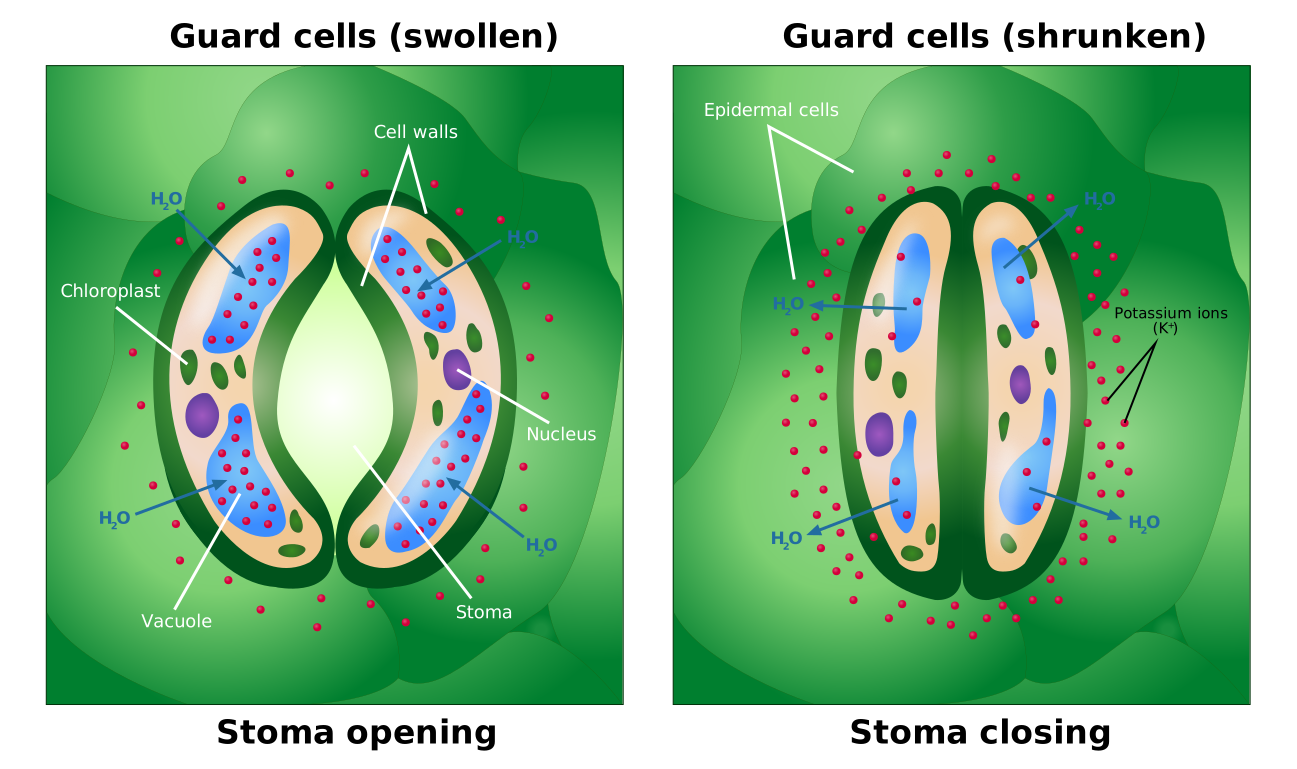
Stomata (singular: stoma) are microscopic pores found mainly on the undersides of leaves. Each stoma consists of a pore surrounded by two specialised guard cells.
Guard cell mechanism
Important
The guard cells control gas exchange by opening and closing the stomatal pore. When conditions favour photosynthesis, guard cells take up water, become turgid, and open the stoma. When water conservation is needed, guard cells lose water, become flaccid, and close the stoma.
This mechanism allows plants to balance two conflicting requirements:
- Gas exchange - needed for photosynthesis and respiration
- Water conservation - preventing excessive water loss through evaporation
Stomatal distribution
Stomata occur predominantly on the lower leaf surface (lower epidermis), which reduces water loss by:
- Avoiding direct exposure to sunlight
- Taking advantage of typically higher humidity near the ground
- Reducing air movement compared to the upper surface
Leaf tissue organisation
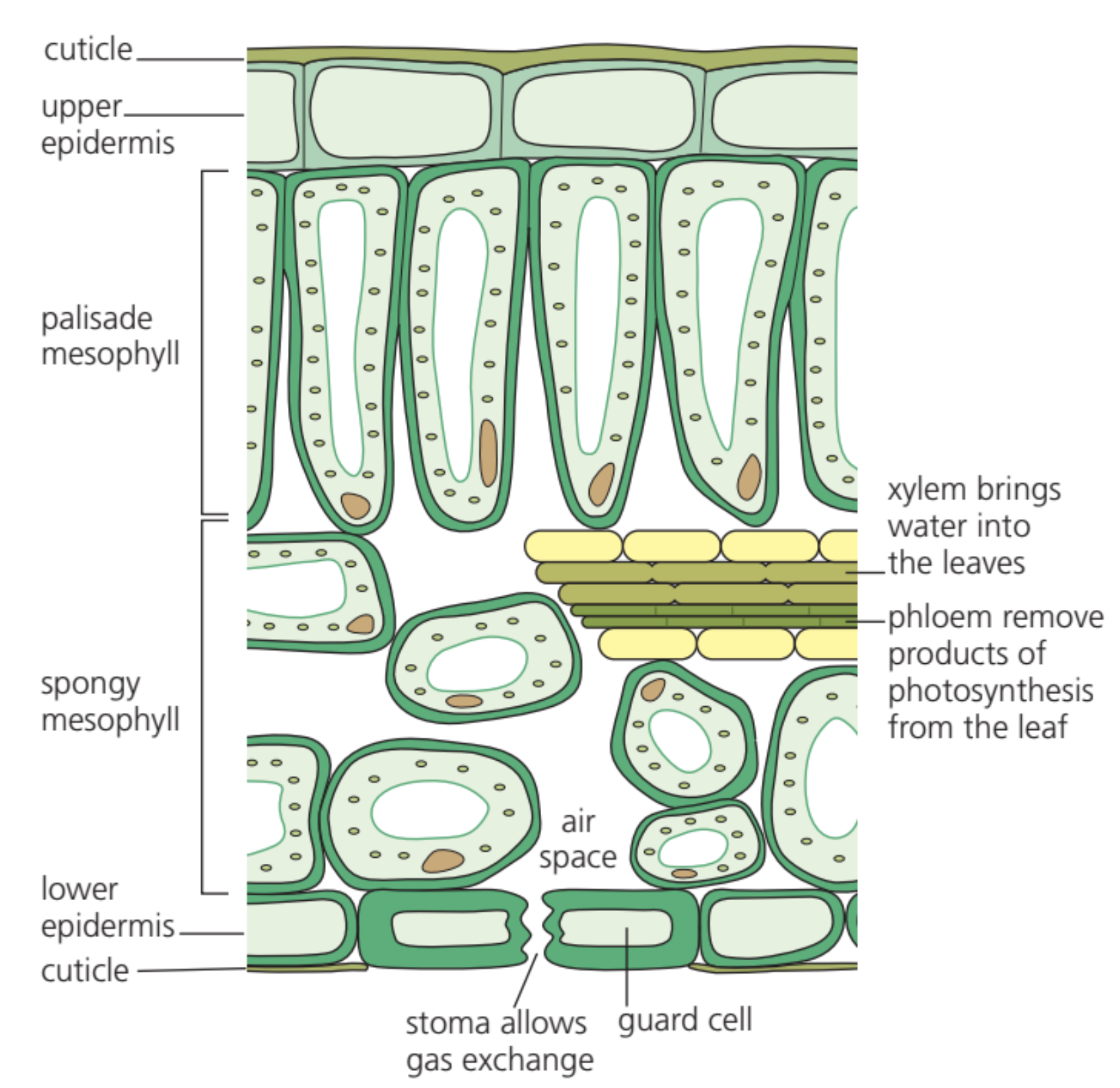
The upper epidermis provides protection and allows light to penetrate to photosynthetic tissues below. It typically lacks stomata to minimise water loss from the upper surface.
Mesophyll tissue forms the main body of the leaf and contains two distinct regions:
- Palisade mesophyll - tightly packed cells rich in chloroplasts for photosynthesis
- Spongy mesophyll - loosely arranged cells with large air spaces for gas circulation
The lower epidermis contains most stomata and provides the main route for gas exchange between internal tissues and the external atmosphere.
Gas exchange processes
During photosynthesis
Example
Gas Exchange During Photosynthesis:
Step 1: Carbon dioxide enters through stomata and diffuses through air spaces to mesophyll cells
Step 2: Chloroplasts in mesophyll cells use CO₂ for photosynthesis
Step 3: Oxygen produced by photosynthesis diffuses out through the same pathway
Step 4: Concentration gradients are maintained by the continuous use of carbon dioxide and production of oxygen in chloroplasts
During respiration
Example
Gas Exchange During Respiration:
Step 1: Oxygen enters through stomata for cellular respiration
Step 2: Mitochondria in all living plant cells use O₂ for respiration
Step 3: Carbon dioxide produced by respiration diffuses out through stomata
Step 4: This process occurs continuously in all living plant cells, not just those with chloroplasts
Efficiency of plant gas exchange
The plant gas exchange system achieves high efficiency through several key features:
- No specialised transport system - Unlike animals, plants don't need a circulatory system to transport gases. Simple diffusion through air spaces is sufficient.
- Minimal diffusion distance - The thin leaf structure ensures rapid diffusion between external air and internal cells.
- Large internal surface area - The extensive air space network maximises the area available for gas exchange.
- Controlled access - Stomatal regulation allows plants to optimise gas exchange while conserving water.
Note
This efficiency is particularly remarkable when compared to animal respiratory systems. Plants achieve effective gas exchange without the complex circulatory and ventilation systems that animals require, demonstrating the elegance of their structural adaptations.
Summary
Key Points to Remember:
- Plants exchange gases for both respiration and photosynthesis, creating unique requirements compared to animals
- Stomata are controllable pores that balance gas exchange needs with water conservation
- Leaf structure maximises efficiency through short diffusion pathways and large internal surface areas
- Guard cells regulate stomatal opening and closing to control gas exchange rates
- Most gas exchange occurs through the lower leaf surface where stomata are concentrated