Lung Disease & Risk Factors (AQA A-Level Biology): Revision Notes
📚Revision Notes
Lung Disease & Risk Factors
Understanding lung disease risk factors
Several specific factors significantly increase an individual's likelihood of developing lung diseases, particularly chronic obstructive pulmonary disease (COPD). This term encompasses conditions including emphysema and chronic bronchitis, which progressively damage the respiratory system and impair gas exchange.
Note
COPD (Chronic Obstructive Pulmonary Disease) is an umbrella term that includes both emphysema and chronic bronchitis. These conditions cause progressive damage to the lungs, making it increasingly difficult to breathe and reducing the efficiency of gas exchange in the respiratory system.
Primary risk factors
- Smoking represents the most significant risk factor, with research showing that 90% of COPD patients are current or former heavy smokers. The chemicals in tobacco smoke directly damage the delicate structures of the lungs, leading to inflammation and progressive tissue destruction.
Important
Smoking is by far the most preventable and significant risk factor for lung disease. The overwhelming majority of COPD cases are directly linked to tobacco use, making smoking cessation the most effective prevention strategy.
- Air pollution poses another major threat to lung health. Harmful particles and gases, including sulphur dioxide, accumulate in the respiratory system and increase COPD risk. This effect becomes particularly pronounced in areas with heavy industrial activity, where pollutant concentrations reach dangerous levels.
- Genetic factors also influence susceptibility to lung disease. Some individuals possess genetic variations that make them more vulnerable to developing respiratory conditions, which explains why certain lifelong smokers never develop lung disease while others experience early onset of symptoms.
- Respiratory infections contribute to lung disease development, especially when they occur repeatedly. People who frequently experience chest infections show higher rates of COPD, as repeated inflammation damages lung tissue over time.
- Occupational exposure to harmful substances represents another significant risk. Workers handling dangerous chemicals, gases, and dust particles face increased lung disease risk due to prolonged inhalation of these damaging materials.
Smoking and mortality: statistical analysis
Study overview
A comprehensive long-term study initiated in the UK during 1951 has provided valuable data about smoking patterns and their relationship to mortality rates. This survey, along with similar international studies, has revealed important statistical patterns linking cigarette consumption to life expectancy.
Data interpretation
The research data demonstrates clear patterns in mortality rates across different smoking groups. All study participants began at 100% survival at age 35, but the groups diverged significantly over time based on their smoking habits.
Example
Statistical Progression of Mortality by Smoking Group:
- Non-smokers: Highest survival rates throughout the study, with many living well beyond 80 years
- Light smokers (1-14 cigarettes daily): Moderately reduced life expectancy, high survival until later ages
- Moderate smokers (15-24 cigarettes daily): More pronounced mortality increases after age 60
- Heavy smokers (25+ cigarettes daily): Steepest mortality curve, complete group mortality by age 82
x-axis: age/years
y-axis: percentage alive
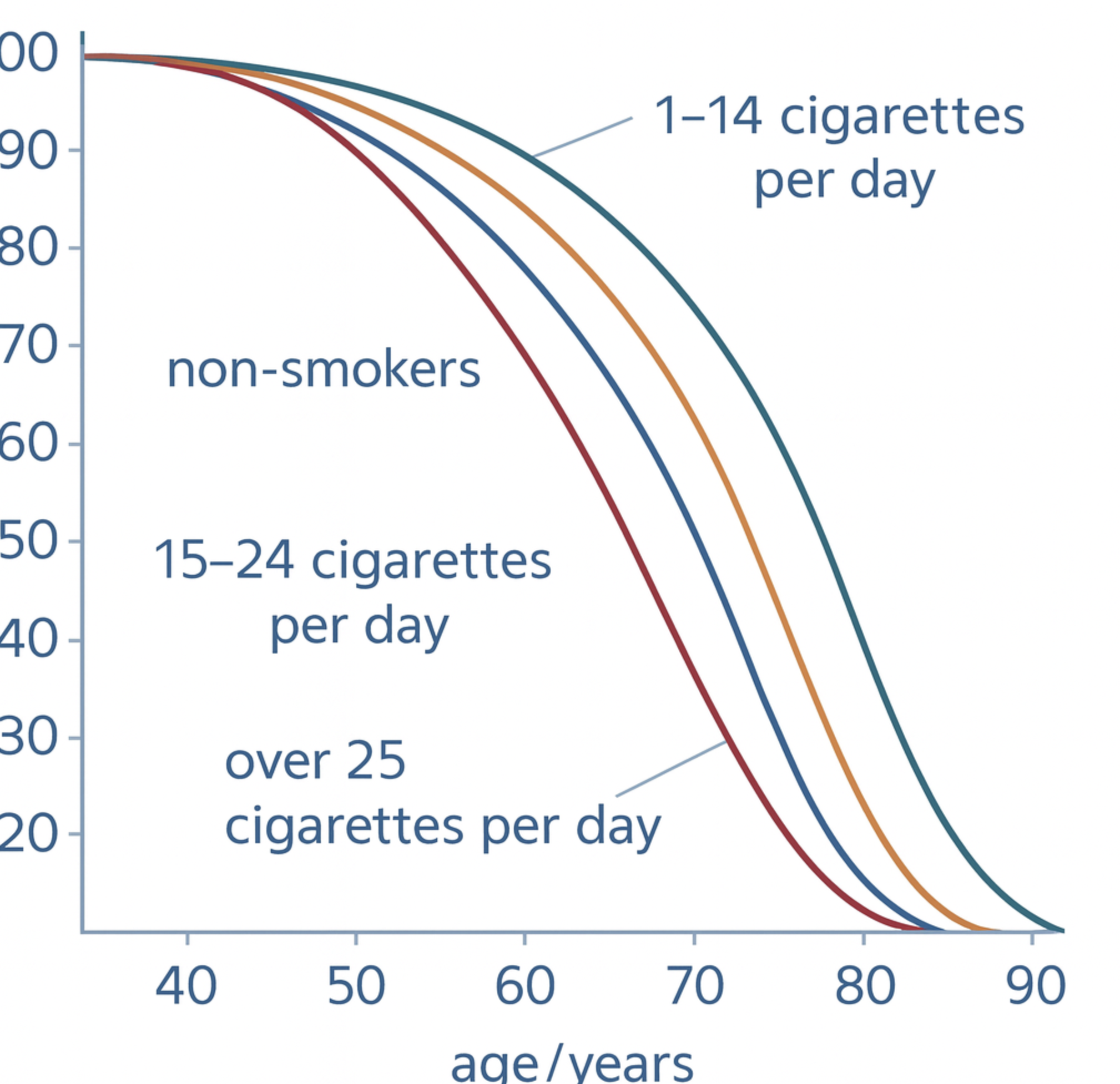
Non-smokers consistently showed the highest survival rates throughout the study period. Their mortality curve declined gradually, with many individuals living well beyond 80 years of age.
Light smokers (1-14 cigarettes daily) experienced moderately reduced life expectancy compared to non-smokers, but their survival rates remained relatively high until later ages.
Moderate smokers (15-24 cigarettes daily) showed more pronounced mortality increases, with survival rates declining more rapidly after age 60.
Heavy smokers (over 25 cigarettes daily) demonstrated the steepest mortality curve, with the group crossing the x-axis (indicating complete mortality) by approximately 82 years. Notably, no individuals in this group survived beyond this age.
Statistical significance
The data reveals a clear dose-response relationship - as daily cigarette consumption increases, life expectancy decreases proportionally. Each smoking category shows progressively earlier and more rapid mortality compared to lighter smoking groups, with the differences becoming more pronounced at advanced ages.
Correlation versus causation
Understanding the relationship
While the statistical data shows a strong correlation between smoking intensity and premature death, this evidence alone does not definitively prove causation. The relationship suggests smoking may cause earlier mortality, but correlation can exist without direct causal links.
Important
Critical Scientific Distinction: Correlation does not imply causation. Just because two variables appear to be related statistically does not automatically mean that one causes the other. Rigorous scientific investigation is required to establish true causal relationships.
Establishing causation scientifically
To prove smoking actually causes premature death, researchers must follow a rigorous three-stage scientific process:
- Hypothesis formation - Develop a testable explanation for the observed correlation based on existing scientific knowledge
- Experimental design and testing - Create controlled experiments that can test the proposed hypothesis while controlling for other variables
- Theory establishment - Formulate comprehensive theories that explain the causal mechanisms and can predict future outcomes
This systematic approach has been successfully applied to establish the proven causal relationship between smoking and lung cancer, providing a model for investigating other health-related correlations.
Summary
Key Points to Remember:
- Five major risk factors increase lung disease probability: smoking, air pollution, genetic predisposition, respiratory infections, and occupational exposure
- Statistical data shows a clear dose-response relationship between cigarette consumption and reduced life expectancy
- Heavy smokers (25+ cigarettes daily) show the shortest life expectancy, with complete group mortality by age 82
- Correlation between variables does not automatically prove causation - scientific investigation requires hypothesis testing and experimental validation
- The three-stage scientific method (hypothesise, experiment, theorise) provides the framework for establishing true causal relationships in health research