Loading, Transport & Unloading of Oxygen (AQA A-Level Biology): Revision Notes
📚Revision Notes
Loading, Transport & Unloading of Oxygen
The Bohr effect and carbon dioxide concentration
Haemoglobin shows reduced affinity for oxygen when carbon dioxide concentration increases. This phenomenon is called the Bohr effect, and it explains how haemoglobin behaves differently in various parts of the body.
When carbon dioxide concentrations are higher, haemoglobin more readily releases its oxygen molecules. This relationship creates an efficient system where oxygen delivery matches tissue demand.
At the gas-exchange surface in the lungs, carbon dioxide concentration remains low because it diffuses across the exchange surface and gets expelled from the organism. The reduced carbon dioxide concentration increases haemoglobin's affinity for oxygen, coupled with the high oxygen concentration in the lungs. This combination ensures oxygen readily loads onto haemoglobin molecules. The effect shifts the oxygen dissociation curve to the left.
Note
The leftward shift of the oxygen dissociation curve indicates increased oxygen affinity - haemoglobin holds onto oxygen more tightly and loads it more readily.
In rapidly respiring tissues like muscles, carbon dioxide concentration becomes high due to cellular respiration. This elevated carbon dioxide level reduces haemoglobin's affinity for oxygen. Combined with lower oxygen concentrations in the muscle cells, this means oxygen readily unloads from haemoglobin into the tissues. The increased carbon dioxide concentration shifts the oxygen dissociation curve to the right.
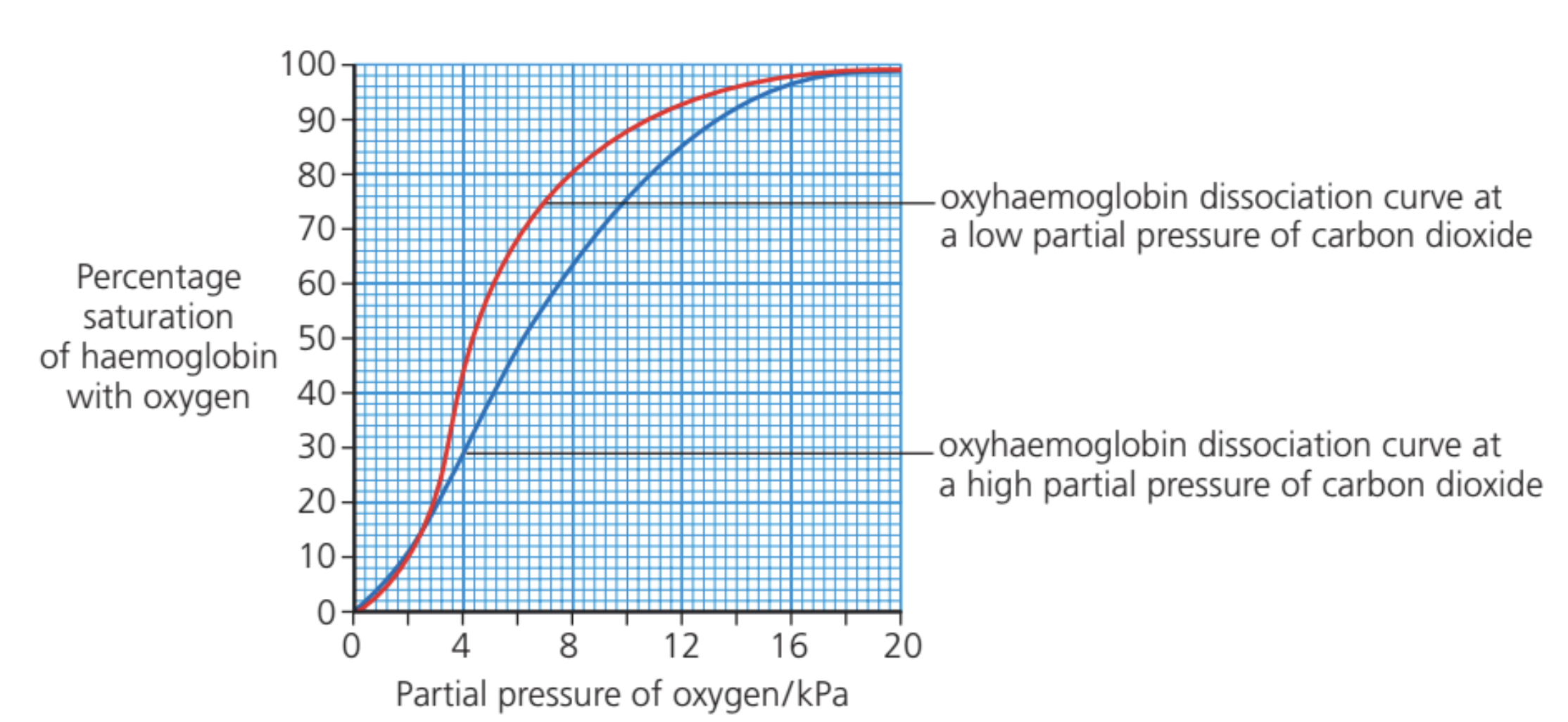
pH effects on haemoglobin structure
The relationship between carbon dioxide and oxygen release occurs because dissolved carbon dioxide forms an acid, which lowers the pH of the blood. This lower pH causes haemoglobin to change shape into a form with reduced affinity for oxygen.
Important
The key mechanism behind the Bohr effect is structural: when pH decreases (becomes more acidic), haemoglobin undergoes conformational changes that physically alter its oxygen-binding sites, making it less likely to hold onto oxygen molecules.
When pH decreases (becomes more acidic), haemoglobin undergoes structural changes that make it less likely to hold onto oxygen molecules. Conversely, when pH increases (becomes less acidic), haemoglobin adopts a shape that increases its oxygen affinity.
The complete loading and unloading mechanism
The oxygen transport system works as an integrated cycle that responds to tissue activity levels. This sophisticated mechanism ensures that oxygen delivery matches metabolic demand across different tissues and activity levels.
At the gas-exchange surface, carbon dioxide gets constantly removed from the blood. This removal slightly raises the pH, which changes haemoglobin's shape to one that loads oxygen more readily. The modified shape also increases haemoglobin's affinity for oxygen, preventing release during transport through the bloodstream.
In tissues, respiring cells produce carbon dioxide as a waste product. Carbon dioxide dissolves in the blood, forming acid that lowers the pH within the tissues. This lower pH changes haemoglobin's shape to one with reduced oxygen affinity, causing haemoglobin to release oxygen into the respiring tissues.
Example
The Self-Regulating Oxygen Delivery Cycle
The process follows this sequence:
- Higher respiration rate → tissues become more metabolically active
- More carbon dioxide production → waste product accumulates locally
- Lower pH → carbonic acid formation acidifies the environment
- Greater haemoglobin shape change → structural modification reduces oxygen affinity
- More readily oxygen unloads → oxygen releases into active tissues
- More oxygen becomes available for respiration → supports continued cellular activity
This creates a flexible system ensuring adequate oxygen supply for respiring tissues.
More active tissues produce more carbon dioxide, which leads to greater pH reduction and increased oxygen unloading.
Oxygen saturation in humans
In humans, haemoglobin normally reaches about 97% saturation with oxygen as it passes through the lungs. This high saturation occurs because not every haemoglobin molecule becomes fully loaded with its maximum four oxygen molecules under normal atmospheric conditions.
When haemoglobin reaches tissues with low respiratory activity, typically only one oxygen molecule gets released from each haemoglobin molecule. The blood returning to the lungs therefore contains haemoglobin that remains approximately 75% saturated with oxygen.
Note
This means that even after delivering oxygen to resting tissues, haemoglobin retains most of its oxygen content, providing a substantial reserve for increased metabolic demands.
However, in very active tissues such as exercising muscle, three oxygen molecules usually unload from each haemoglobin molecule. This increased unloading occurs because active tissues produce more carbon dioxide, creating the conditions that promote oxygen release.
Species adaptations
Different species have evolved distinct types of haemoglobin with unique oxygen dissociation curves adapted to their specific environments and conditions.
Species living in environments with lower partial pressure of oxygen have evolved haemoglobin with higher oxygen affinity compared to species living where oxygen partial pressure is higher.
Note
Lugworm Adaptations
Lugworms provide an excellent example of environmental adaptation. These animals spend most of their time in U-shaped burrows covered by seawater, circulating oxygenated water through their burrows to transport oxygen to their tissues.
When tides recede, lugworms cannot circulate fresh oxygenated water through their burrows. The water in the burrow progressively loses oxygen as the lugworm consumes it. To survive until the tide returns, lugworms must extract maximum oxygen from the increasingly oxygen-poor water in their burrows.
Lugworm haemoglobin has an oxygen dissociation curve shifted far to the left compared to human haemoglobin. This adaptation means lugworm haemoglobin becomes fully loaded with oxygen even when very little oxygen is available in their environment.
Note
Llama High-Altitude Adaptations
Llamas represent another adaptation example. These animals live at high altitudes where atmospheric pressure is lower, making the partial pressure of oxygen lower as well. Loading haemoglobin with oxygen becomes more difficult under these conditions.
Llamas have evolved haemoglobin with higher oxygen affinity than human haemoglobin - their oxygen dissociation curve is shifted to the left compared to humans. This adaptation allows them to load their haemoglobin effectively even in the low-oxygen environment of high altitudes.
Summary
Key Points to Remember:
- The Bohr effect describes how increased carbon dioxide concentration reduces haemoglobin's oxygen affinity, promoting oxygen unloading in active tissues
- pH changes caused by carbon dioxide alter haemoglobin's shape, with lower pH creating a form with reduced oxygen affinity
- The loading and unloading system creates a self-regulating cycle where more active tissues automatically receive more oxygen
- Human haemoglobin normally achieves 97% saturation in lungs but releases different amounts of oxygen depending on tissue activity levels
- Species have evolved different haemoglobin types adapted to their environmental oxygen availability, such as lugworms for low-oxygen burrows and llamas for high-altitude living