Reactions of Metal-Aqua Ions (AQA A-Level Chemistry): Revision Notes
📚Revision Notes
8.2.9 Reactions of Metal-Aqua Ions
Practical: Reactions of Metal-Aqua Ions with Bases
Aim:
In this practical, you will investigate the reactions of metal-aqua ions (specifically copper(II), iron(II), iron(III), and aluminium ions) with three different bases: sodium hydroxide (), ammonia (), and sodium carbonate (). You will observe any precipitates formed and the changes that occur when these bases are added in excess.
Equipment List
- Test Tubes: Multiple clean, dry test tubes for each metal-aqua ion reaction (at least four per ion solution).
- Test Tube Rack: To safely hold test tubes during the experiment.
- Dropper Pipettes: For accurately adding 10 drops of each reagent to the test tubes.
- Labeling Markers: To label test tubes for different metal-aqua ions and reagents used.
- Metal-Aqua Ion Solutions:
- Copper(II) sulphate solution (for ions)
- Iron(II) sulphate solution (for ions)
- Iron(III) chloride solution (for ions)
- Aluminium sulphate solution (for ions)
- Sodium Hydroxide Solution (1.0 mol dm⁻³): For initial reaction and excess testing.
- Ammonia Solution (1.0 mol dm⁻³): To test reactions and add in excess.
- Sodium Carbonate Solution (1.0 mol dm⁻³): As the third base reagent for reactions.
- Gloves and Goggles: For safety when handling potentially harmful chemicals.
- Waste Disposal Beaker: To safely dispose of used solutions after observing results.
Method:
- Add Metal-Aqua Ions:
- Begin by placing 10 drops of the metal-aqua ion solution (⁺) into a clean, dry test tube.
- Add Sodium Hydroxide ():
- Add 10 drops of 1.0 mol dm⁻³ sodium hydroxide solution to the test tube.
- Shake gently and record any observations of precipitates or solution colour.
- Then add another 10 drops of sodium hydroxide to ensure the solution is in excess, shake again, and note any further changes.
- Repeat with Ammonia ():
- Repeat the above procedure, but this time using 1.0 mol dm⁻³ ammonia solution.
- Add 10 drops initially, shake, and record observations. Then add 10 more drops of ammonia to put it in excess, and note any additional changes.
- Repeat with Sodium Carbonate ():
- Finally, repeat the process with 1.0 mol dm⁻³ sodium carbonate solution.
- Add 10 drops, observe, then add 10 more drops and note the changes in the test tube.
- Leave for a Few Minutes:
- Allow each test tube to sit for a few minutes before disposing of the contents, as some reactions may develop over time.
Results:
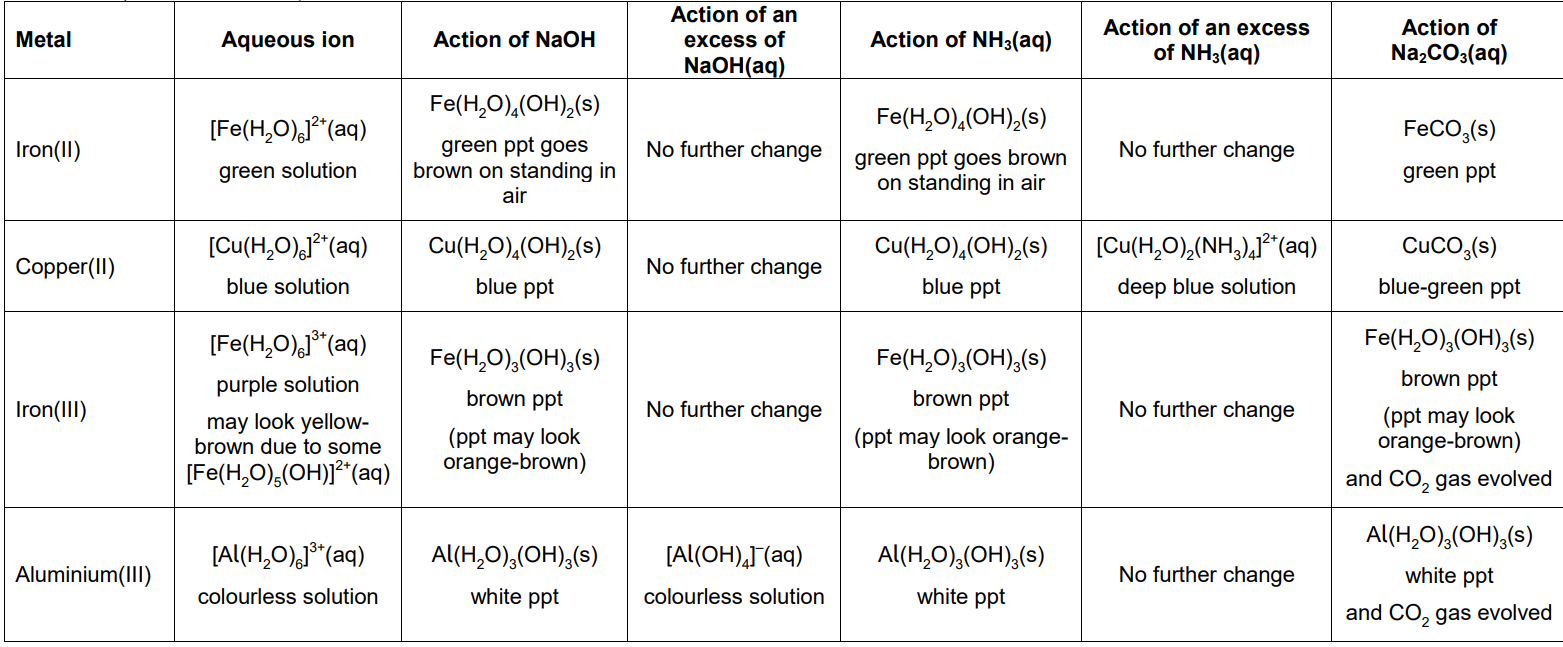
| Ion | Colour of Aqueous Ion | Reaction with | Reaction with | Reaction with |
|---|---|---|---|---|
| Pale green | Dark green precipitate, insoluble in excess, turns orange-brown over time | Dark green precipitate, insoluble in excess, turns orange-brown | Green precipitate | |
| Pale blue | Light blue precipitate, insoluble in excess | Light blue precipitate, soluble in excess forming a dark blue solution | Blue precipitate | |
| Colourless | White precipitate, redissolves in excess to give a colourless solution | White precipitate, insoluble in excess | White precipitate, some effervescence | |
| Pale orange | Red-brown precipitate, insoluble in excess | Red-brown precipitate, insoluble in excess | Red-brown precipitate with some effervescence |
Key Observations:
- Both and form a green precipitate that eventually turns orange-brown at the surface due to oxidation.
- A light blue precipitate is formed with OH⁻ and NH₃, but ammonia in excess dissolves it into a dark blue solution.
- A white precipitate forms, but with OH⁻ in excess, it dissolves to form a colourless solution.
- , Produces a red-brown precipitate in all reactions, but with , effervescence is observed due to release.
Important
Important Tips:
- Vocabulary: Be careful to distinguish between terms like solution (transparent) and precipitate (solid). Use the correct descriptive language in your observations.
- Time-dependent Changes: Some reactions, such as the oxidation of to , occur slowly over time. It's advisable to let the test tubes sit for a few minutes before finalising your observations.