Modification of Alkanes by Cracking (AQA A-Level Chemistry): Revision Notes
📚Revision Notes
3.2.2 Modification of Alkanes by Cracking
What is Cracking?
Note
Cracking is a process used to break the carbon-carbon () bonds in long-chain alkanes, converting them into shorter-chain alkanes and alkenes. This process is crucial because there is a higher demand for shorter hydrocarbons, which are more useful in industries such as fuel production and plastics.
Types of Cracking
There are two main types of cracking processes: thermal cracking and catalytic cracking.
Thermal Cracking
- Conditions: High pressure and very high temperature (around 700-1200 K).
- Products: A high percentage of alkenes (e.g., ethene, which is used to produce polymers).
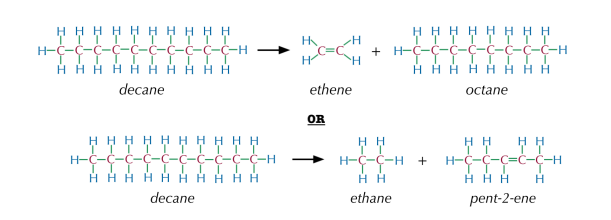
- Mechanism: Involves breaking the bonds in a random manner, resulting in a variety of smaller hydrocarbons. Example:
The cracking of decane () might produce ethene () and octane ():
Catalytic Cracking
- Conditions: Lower pressure, high temperature (around 720 K), and the presence of a zeolite catalyst.
- Products: Motor fuels (e.g., gasoline) and aromatic hydrocarbons.
- Mechanism: The catalyst speeds up the breaking of bonds, focusing on producing branched alkanes and aromatic compounds, which are important in motor fuel production.
2. Economic Reasons for Cracking
Cracking is economically important because it helps meet the demand for more useful hydrocarbons. Here's why cracking is essential:
High Demand for Short-Chain Hydrocarbons
- Short-chain alkanes are better fuels because they are more volatile and burn more easily. For example, propane and butane are widely used in heating and cooking.
- Short-chain alkenes are more reactive than alkanes and are used as feedstock for producing polymers like plastics.
Imbalance in Supply
- Fractional distillation of crude oil naturally produces a surplus of long-chain hydrocarbons and fewer short-chain hydrocarbons than are needed. Long-chain hydrocarbons are less useful and harder to ignite, making them less desirable for fuel. By converting the excess of long-chain hydrocarbons into more useful short-chain alkanes and alkenes, cracking maximises the utility of crude oil and aligns supply with industrial demand.
Note
Summary
Cracking is a vital process in the petroleum industry, ensuring that the right balance of hydrocarbon products is available for various uses, from fuels to the production of plastics.